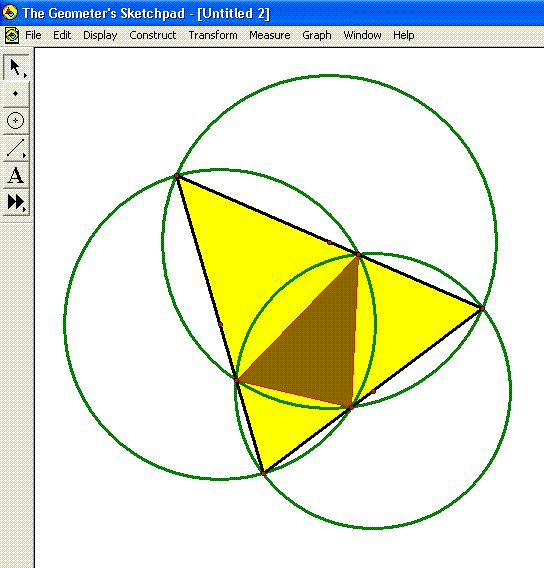
As you can see, these circles intersect on the sides of the triangles. I did not expect that, nor have I proven it. I have moved the triangle around to check to see if this remained true, and it did pass this test. If I can figure out a proof for this, I’ll post it; if one exists already, please post a comment letting me know where to find it.
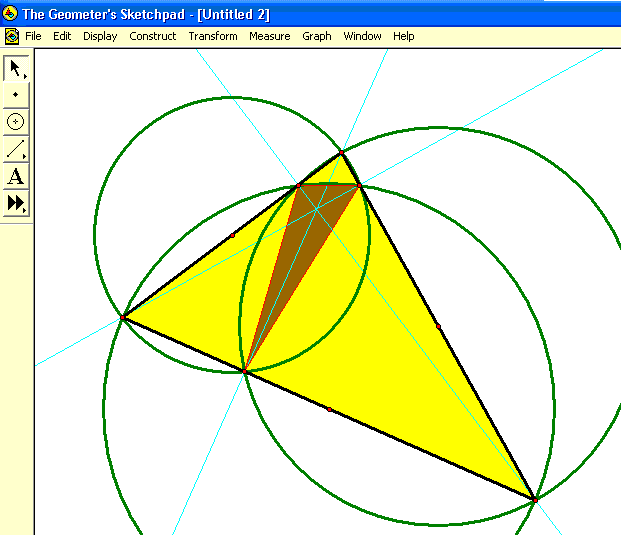
Later edit: I found out that these points of intersection are the altitude feet. Here’s a diagram showing the lines containing the altitudes, meeting at the orthocenter. These blue lines also contain the angle bisectors of the brown triangle defined by the altitude feet.
 RobertLovesPi.net
it looks like the triangle in the middle is completely opposite from the original. The first had two equal sides and one short. The internal shows two short and one long and not equal anymore. The second example, you can see the difference in length of each segment of the triangle. Inside looks it has two identical segments and one shorter segments. The question is, what does the outer triangle that is making this triangle look like. I wonder what that would look like? All we have to do is look at the next small triangle and see what they make. Is it the same or something completely different?
LikeLike