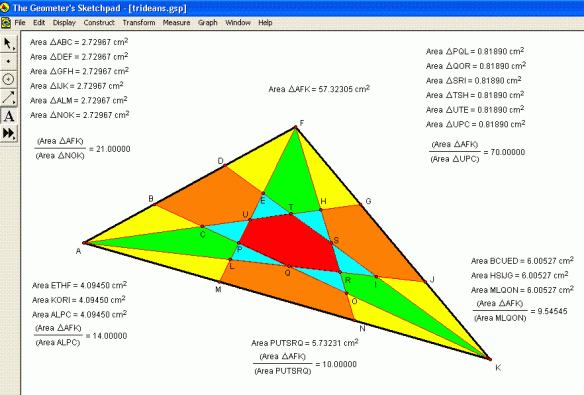
Much work has been done on the medians of triangles: segments that connect vertices with the midpoints of opposite sides. This morning, I decided to explore what happens if the trideans are examined, rather than the medians.
The reason you don’t know the word “tridean” is simple: I just made it up. It’s related to a median, though. To find trideans, you must first trisect, rather than bisect, each side of a triangle. This gives you two equally-spaced points on each side. To form a tridean, simply connect one of those points to the opposite vertex. Every triangle has six trideans, and they split the triangle into a set of non-overlapping polygons, as you can see in the diagram.
When I examined the area of these polygons, I started finding unexpected things right away. As you can see, polygons of the same color in this diagram have the same area, even though they are non-congruent. Moreover, these areas are interesting fractions of the area of the entire triangle. The six yellow triangles, for example, each have 1/21st of the area of the entire triangle. Each blue triangle is 1/70th the area of the large triangle. Each green quadrilateral is 1/14th the area of the large triangle. 21, 70, and 14 have one factor in common: the number seven. Seven? I officially have NO idea why sevens are popping up all over the place in this investigation, but there they are.
The red hexagon in the middle has 1/10th the area of the entire triangle, and this number surprised me as well.
The three orange pentagons took a little more work. As you can see, dividing the area of the large triangle by the area of one of these orange pentagons yields 9.5454, with the “54” repeating. This decimal is 105/11. (Eleven?) At least 105 has three as a factor (as does 21, from earlier); three is the number I expected to pop out all over the place, but it shows up little in this investigation. However, what are the other factors of 105? There’s five — and, yet again, seven.
These sevens are everywhere in this thing, and I have no idea why.
Now, of course, I have proven none of this. This is merely a demonstration and explanation of something I think is a new discovery. I did change the shape of the triangle many ways, as a test, and each of these area ratios remained constant.
If anyone can shed some light on any of this — especially all these sevens — please comment.
 RobertLovesPi.net
This. Is. Awesome. I can’t really help you out with the math. I’m somewhat good at math, but I’m way behind your level, dude. Still, I get chills down my spine when I see your posts!
LikeLiked by 1 person
Thank you. If I knew ENOUGH math, though, I wouldn’t be perplexed by all these sevens, in something I set up based on the number three!
LikeLike
i think the 7 comes from the flat planer length of each internal line as sqrt(7) when the outer triangle is a standard equilateral with side length 3:
https://www.desmos.com/calculator/8xnifjri1n
LikeLike
i ran out of paper and time, but the math seems to be working out on a hex-grid so far:

LikeLike
It took some noodling to figure out what that original diagram was trying to convey – it wrapped around five times. And it’s still messy. Here’s a cleaner version:
The root 7 comes from the trideans hitting the 2,1 and 1,2 coordinates on an isometric grid and its distance formula: 2*2 +1*1 + 2*1 = 7. Relative to the nearest side length, the tridean length will always contain the root 7.
The sequence 60,24,21,15,20 describes the distances between points on the tridean, which holds for any triangle. Since there are no other common factors for those ratios, and they are derived from scaling an equilateral triangle of side length 1 by 420.. those numbers seem entwined with trideans.
Finally, an interactive graph that demonstrates how those ratios hold: desmos.com/calculator/gutvvenas5
LikeLiked by 1 person
i wish i could make money from playing with hexagons, but not much time for fun stuff between cleaning shifts 😅 anyway, made some progress on working out the minimum internal ratios for the equilateral form as n*sqrt(7)*sqrt(1), where the length modifiers for non-equilaterals replace the 1 with the skew on the related axis, this also adds some new precise length and area ratios to investigate::https://imgur.com/a/4eHgREB.jpgfor the equilateral these ratios need to be scaled by a factor of three in order to find an integer point on a hexgrid. for non-equilaterals that rises to six iirc, but here i demonstrate that the smallest scale required to generate integer coordinates for the all tridean intersections from the simplest (0,0), (1,0), (0,1) input triangle is 420:https://imgur.com/a/7PPBsfp.jpgif i get an hour to myself tonight i’ll prove it 🙂
LikeLiked by 1 person
i think you’d find useful a 2-dimensional analogue of the stern-brocot tree. Its first leaves are separated by the medians, but your trideans appear in the second layer, along with some secant lines.
LikeLiked by 1 person