
This was made by the augmentation of a great dodecahedron, using snub dodecahedra on each face. I used software available at http://www.software3d.com/stella.php.
This was made by the augmentation of a great dodecahedron, using snub dodecahedra on each face. I used software available at http://www.software3d.com/stella.php.

In this construction, I took the polyhedral cluster found in the last two posts, and augmented every pentagonal face with yet another great dodecahedron. I used software you can find at http://www.software3d.com/stella.php.

To make this, I used the polyhedron found in the last post, using software I bought at http://www.software3d.com/stella.php, to alter the coloring scheme to make each face a different color unless it is parallel to another, in which case it has the same color as all parallel faces.
Which coloring-scheme do you like best?

Begin with one great dodecahedron, and then augment each face with another, and you get this. I used software you may find at http://www.software3d.com/stella.php to make it.

A cuboctahedron sits at the center of this rotating cluster, but you can’t see it, because each of its fourteen faces (six squares and eight equilateral triangles) has another cuboctahedron, of equal size, attached to it.
Software credit: visit http://www.software3d.com/stella.php to try (or buy) the polyhedral-manipulation software I used to make this virtual model.

There exists a belief that everything — the entire universe — was created exactly twenty minutes ago. What’s more, it is completely impossible to prove that this belief is incorrect.
For the sake of argument, I’ll assume, temporarily, that this belief is true. You might then object that you’ve been sitting at your computer for over an hour, and remember events that happened yesterday, and have memories of your childhood, years ago. Are these objections a problem? Absolutely not! All I have to do, in order to nullify these objections, is explain that, when the universe was created twenty minutes ago, each of us was carefully created with a lifetime of false memories of an existence we believe we remember, but which is actually completely unreal — except for the last twenty minutes, of course.
Of course, this belief — while irrefutable — is also completely ridiculous. Could it be true? Yes, but there’s no reason to accept it as valid. Why? That’s simple: lack of evidence. It makes no sense to accept any proposition when no real evidence exists to support it.
Now, please compare Twenty-Minuteism, an extremely rare belief system, to Young-Earth Creationism, a set of beliefs firmly held by millions of people. These two points of view are basically the same, differing only in the amount of time involved. Young-Earth Creationists hold the view that everything was created fewer than ten thousand years ago, and most have a particular fondness for a period of time of approximately six thousand years, based on certain passages from the Bible.
The objections to Young-Earth Creationism are numerous, but its adherents have an answer for all of them. Take, for example, the existence of ancient fossils. It’s easy to claim that the earth was created with intact fossils underground, and then explain why this was done, in one of several ways. One such method is to claim that the creator of the universe placed these fossils underground, deliberately, as a test of our faith. Another explanation invokes an evil, supernatural being, and then blames this entity for placing these fossils underground, in order to deceive us, and lead us astray. My favorite version, though, is one I actually heard, many years ago, from a card-carrying, professional Creationist. He focused, in his work, on the fossils of large dinosaurs, and even had a dinosaur-silhouette on his slick, professional-looking business card, which he was proud to show me. As he explained it, dinosaurs were alive until the Great Flood described in the Book of Genesis drowned them all — and all that water mixed with soil to make vast amounts of mud. Since dinosaurs were large, heavy animals, he explained, their dead bodies sank further down into this mud, which later became rock — and that explains why dinosaur fossils are found further down than, say, fossilized mice, birds, or people. For someone so incredibly dense (in one sense of the word), this man had very little understanding of density — for it is density (not mass, nor volume, nor weight) which governs whether objects float or sink, in any fluid, as well as how far down they sink (if they sink at all), and he said nothing whatsoever about dinosaur density. I will give this man credit for two things: he was certainly memorable, as well as entertaining.
Another objection to Young-Earth Creationism is based on radioactive dating of rocks, but here’s how Creationists deal with that: they sometimes claim that radioactive-dating doesn’t actually work as scientists explain it, and sometimes even claim that scientists conspire to hide this “truth” from the public — and, of course, these Creationists also throw in just enough scientific-sounding jargon to fool a lot of gullible people. There is another way to “explain away” the radioactive-dating objection to Young-Earth Creationism, of course: just claim that radioisotope-ratios in rocks were created that way, by either a good or evil supernatural being, as a test of faith, or an act of deception — take your pick. This is, of course, the same chicanery usually used when dismissing fossils as evidence that their claims are wrong.
Astronomy provides yet another mountain of evidence to refute Young-Earth Creationism. A prime example of this is the nearest large galaxy, M31, known also as the Andromeda Galaxy — the most distant object which can be seen without a telescope. Scientists have used a variety of methods to calculate the distance to M31, and the current best-estimate of this distance is ~2.5 million light years. Since a light year is defined as the distance light travels in one year, this means we see Andromeda as it existed 2.5 million years ago. How can this be reconciled with the belief that the universe was created less than 10,000 years ago? Why, that’s simple — all you have to do is claim that the light we now see when we look at Andromeda didn’t actually originate there, but was created, at the same time as the rest of the universe, in such a way as to make it appear that this light has been in transit between galaxies. Question this assertion, and you’ll be introduced, once more, to the supernatural beings who are said to be testing us, or trying to deceive us.
The fact is that (except for the heavy-dinosaurs-sinking-further-down silliness described above) no one can disprove any of this nonsense. There is no evidence that supernatural beings have, in fact, not placed fossils underground, nor carefully arranged tricky isotope-ratios in rocks, nor created light in space, nearby, to make it appear that other galaxies existed millions, or even billions, of years ago. However, there is also a complete lack of evidence to support any of these extraordinary claims — just as there is no evidence for, or against, the equally-absurd, but less popular, beliefs of the Twenty-Minuteists. These two belief systems are not only equally absurd, but also equally valid, for zero, like all numbers, is equal to itself.
I have no intention of abandoning my skeptical, scientific approach to understanding as much as I can about reality, as it actually exists. However, if I do lose my mind, some time in the future, and abandon scientific skepticism, I still won’t join forces with the Young-Earth Creationists. After all, if one is going to embrace, and adopt, a irrational way of thinking, why choose one with which millions of people already agree? I much prefer to be different from other people, especially people in large groups, and have always been this way. It’s a core part of my personality.
I have no desire to be “normal,” and, where I live (in the Southern part of the United States), Young-Earth Creationism is (sadly) quite normal, in the sense that a great many people agree with it, despite the total lack of empirical evidence to support it. If I were to become a Twenty-Minuteist, by contrast, I would, at least, get to continue being different from nearly everyone else, rather than being just another normal person, lost in the crowd. To me, that’s at least worth something — something that Young-Earth Creationism simply cannot offer.

This is a good way to explain the viewpoint known as agnostic atheism. A lot of people don’t realize this, but most atheists are also agnostic, simply because we don’t claim to have absolute certainty that no deities exist. We are atheists because we possess no beliefs in any gods, and we are also agnostics because we are willing to admit that we could, possibly, be wrong.
What’s more, many agnostic atheists find the other type of atheist (gnostic atheists, who are few in number, and who do claim certainty that no deities exist) quite irritating. It simply is not rational to claim that one knows, without doubt, that there are no gods, for one simple reason: lack of supporting evidence. There is no evidence that no gods exist. There is also no evidence for the non-existence of, say, leprechauns.
Something else many people don’t know: theists (that is, religious believers) also come in the same two types. Agnostic theists believe in at least one deity, but don’t claim absolute certainty in that belief. Gnostic theists, by contrast, are believers who do not doubt, nor question, their religious beliefs. They claim to know they are right — and, in that one way, they are just like gnostic atheists. Gnostics, of whatever type, aren’t willing to admit there is the slightest chance that they might be wrong. It’s much easier to have reasonable, productive conversations with agnostics than with gnostics — regardless of whether they are they are theists or atheists. Also, when it comes to debate, there’s simply no point in debating anything with a gnostic. One might as well argue with a rock, for a rock is exactly as likely as a gnostic to have a change of opinion.
(Note: unlike most images on this blog, this picture is not one I created myself. Only the words below the image, in this post, are mine.)

I made this, using Stella 4d, by augmenting each decagonal face of the cluster in the previous post with a truncated dodecahedron. You can give this program a try yourself, for free, at http://www.software3d.com/stella.php.
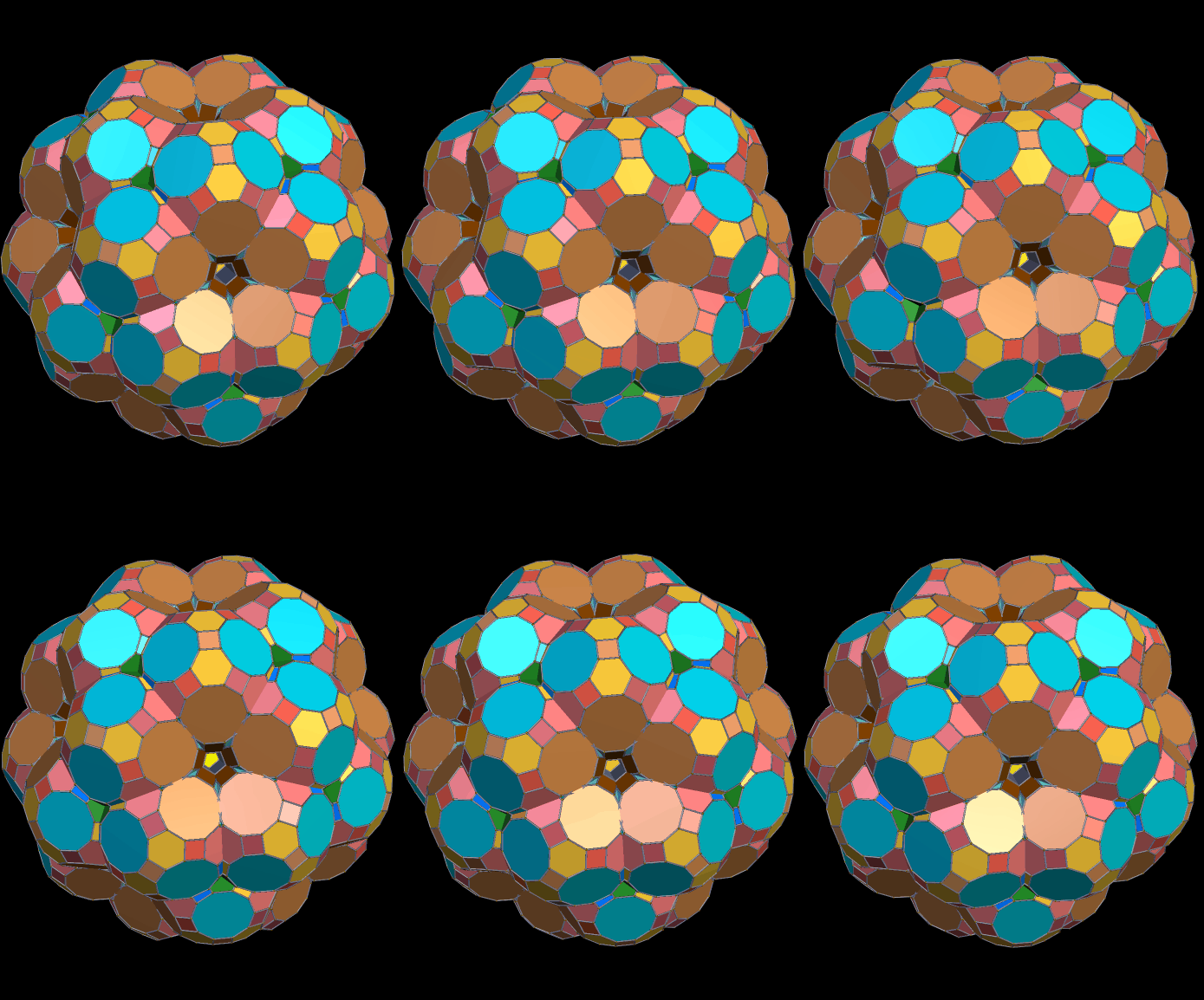
I made this, using Stella 4d, by augmenting the thirty square faces of a great rhombicosidodecahedron with additional great rhombicosidodecahedra. The result has one of these polyhedra located in each position which corresponds to a vertex of an icosidodecahedron.
You can give this program a try yourself, for free, at http://www.software3d.com/stella.php.

I made this, using Stella 4d, by augmenting each face of an octahedron with a rhombicosidodecahedron. You can give this program a try yourself, for free, at http://www.software3d.com/stella.php.
 RobertLovesPi.net