Unknown's avatar

About RobertLovesPi

I go by RobertLovesPi on-line, and am interested in many things, a large portion of which are geometrical. Welcome to my own little slice of the Internet. The viewpoints and opinions expressed on this website are my own. They should not be confused with those of my employer, nor any other organization, nor institution, of any kind.

A Concave Polyhedron Made of Kites and Stars

I made this using Stella 4d, which you can try for free at http://www.software3d.com/Stella.php. It contains, as faces, sixty kites and twelve five-pointed stars.

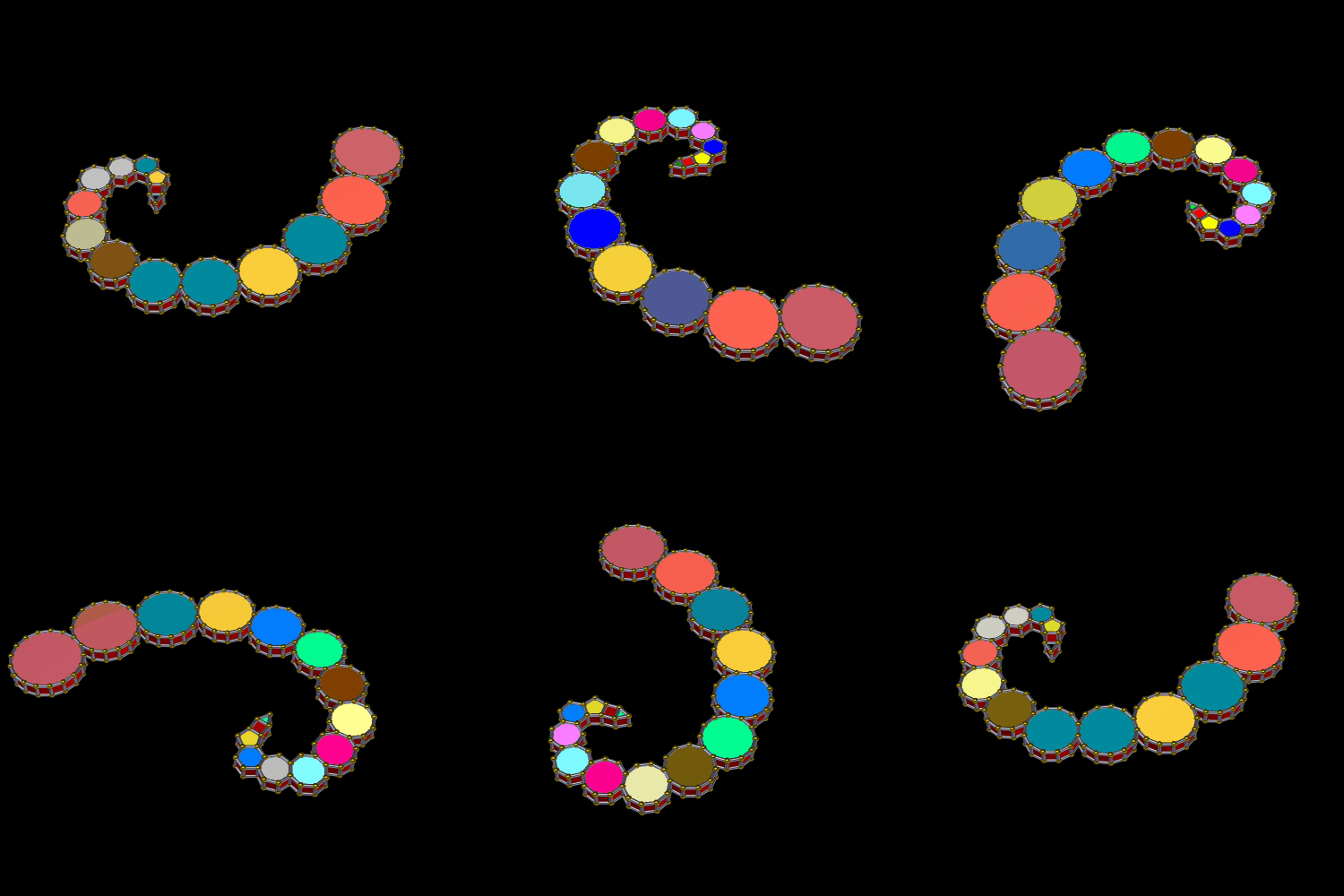
A Spiral of Fifteen Regular Prisms Which Could Continue Indefinitely

I made this using Stella 4d, which you can try for free at http://www.software3d.com/Stella.php.

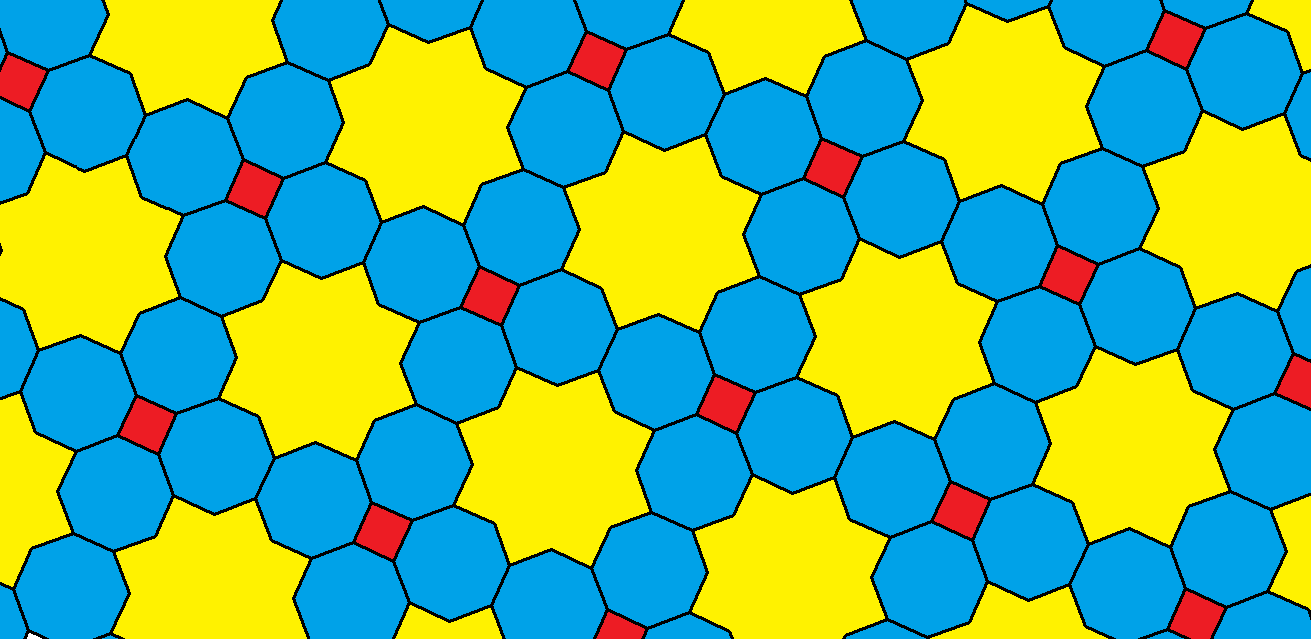
A Tessellation Featuring Regular Enneagons, Squares, and Other Polygons

Image

A Tessellation of Regular Octagons, Squares, and Eight-Pointed Stars

Image

Eight Overlapping {8/3} Star Octagons

These octagrams were rotated about the center point. Every other one is yellow, and between the yellow ones are blue ones. The green areas are where the blue and yellow octagrams coincide.

A Euclidean Construction of a Regular Convex Pentagon and a Regular Star Pentagon, Both Inscribed Inside a Given Circle

  1. Start with a (green) circle centered on A with radius AB. Point B is on this circle.
  2. Construct a line which intersects line AB at point A, in such a way that these two lines are perpendicular.
  3. This green circle intersects the newest line at two points. Designate one of these intersections as point C.
  4. Bisect segment AC, and mark point D as this segment’s midpoint.
  5. Construct a circle (the blue one) which is centered on D and includes point B.
  6. The blue circle intersects line AC at two points. Only one of these points is inside the green circle. Label this point F.
  7. Construct segment BF. This segment’s length is the edge length of the pentagon under construction.
  8. Construct a circle (the red one) which is centered on B and includes point F.
  9. The red and green circles have two points of intersection. One of them is closer to point F than the other; label this closer intersection as point I. The other point of intersection is closer to point C; label it J.
  10. J, B, and I are vertices of a regular pentagon. Construct a circle (orange) which is centered on point I and passes through point B. The orange and green circles intersect at two points, one of which is labeled B. Label the other one K. Point K is a vertex of the pentagon under construction.
  11. Construct a (purple) circle centered on K and passing through I. This purple circle intersects the green circle at two points, one of which is already labeled I. Label the other point of intersection as L. Point L is the fifth vertex of the pentagon.
  12. Connect points with segments to form regular pentagon JBIKL.
  13. Connect points with segments to form regular star pentagon BKJIL.

The Rhombic Enneacontahedron, With All Faces Augmented With Pyramids

I made this using Stella 4d: Polyhedron Navigator, which you can try for free at http://www.software3d.com/Stella.php.

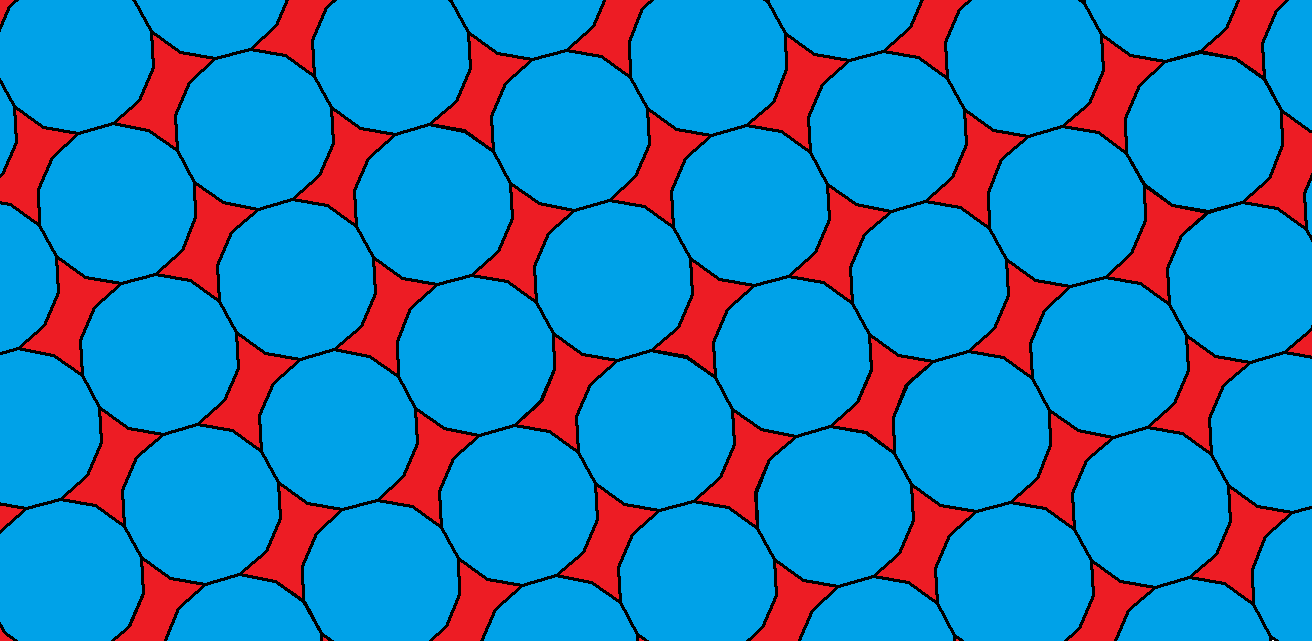
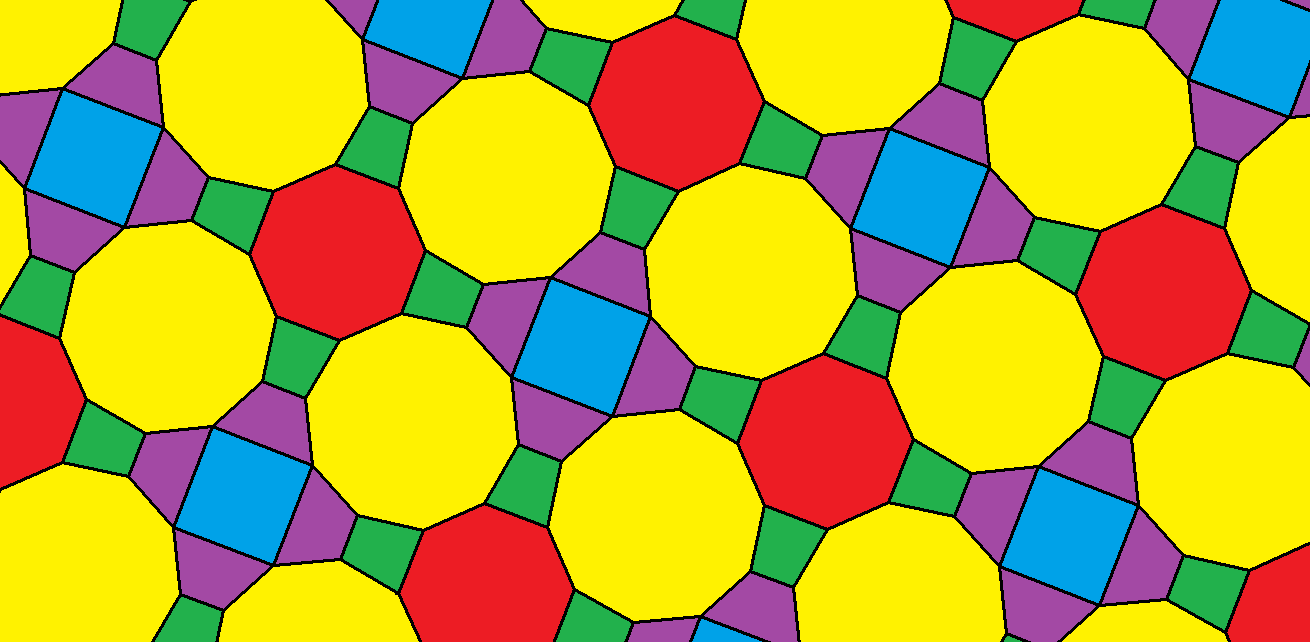
A Tessellation Featuring Regular Decagons, Regular Octagons, Squares, and Two Types of Isosceles Trapezoids

Image

A Tessellation of the Plane Featuring Regular Tetradecagons and Concave, Equilateral Decagons

Image

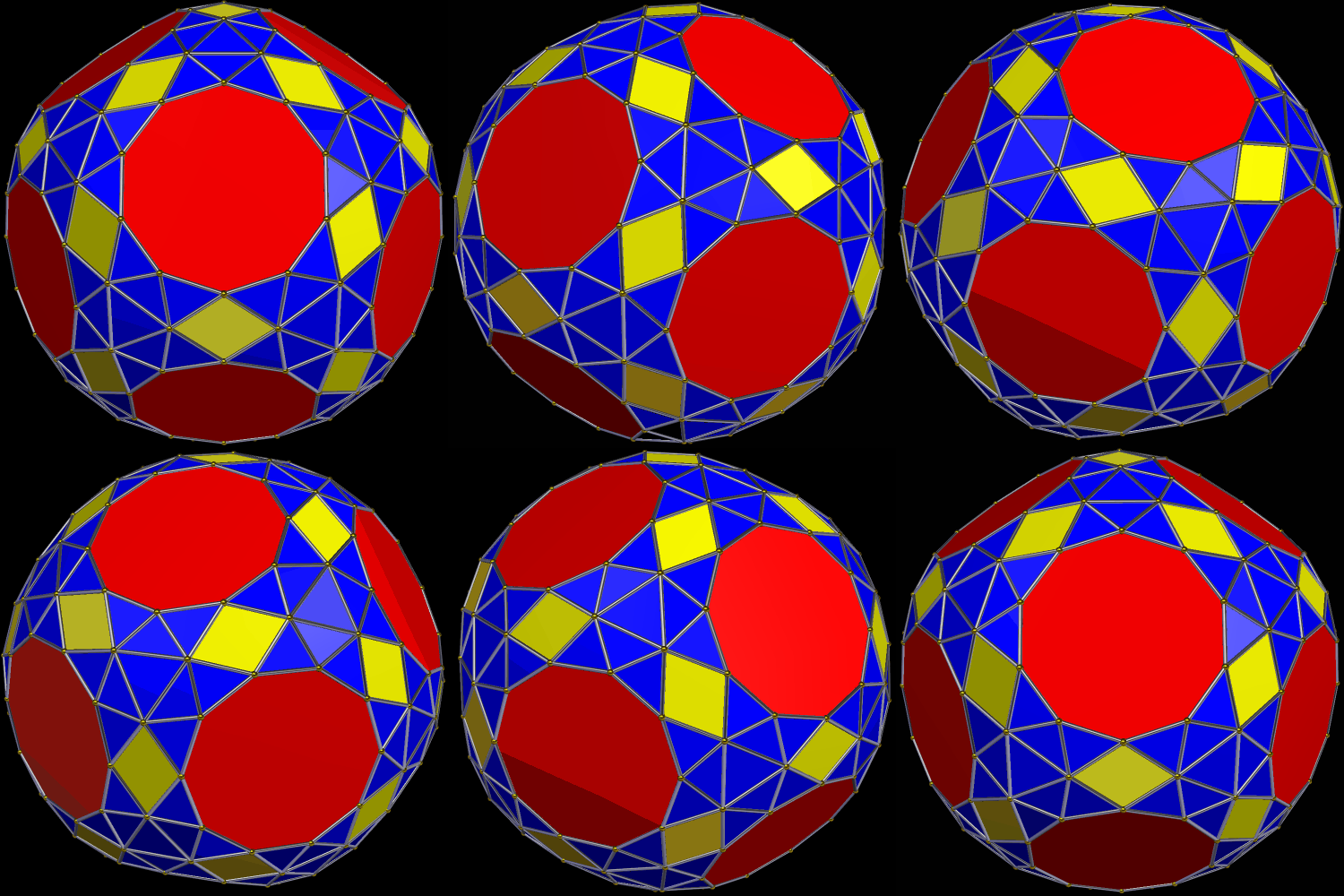
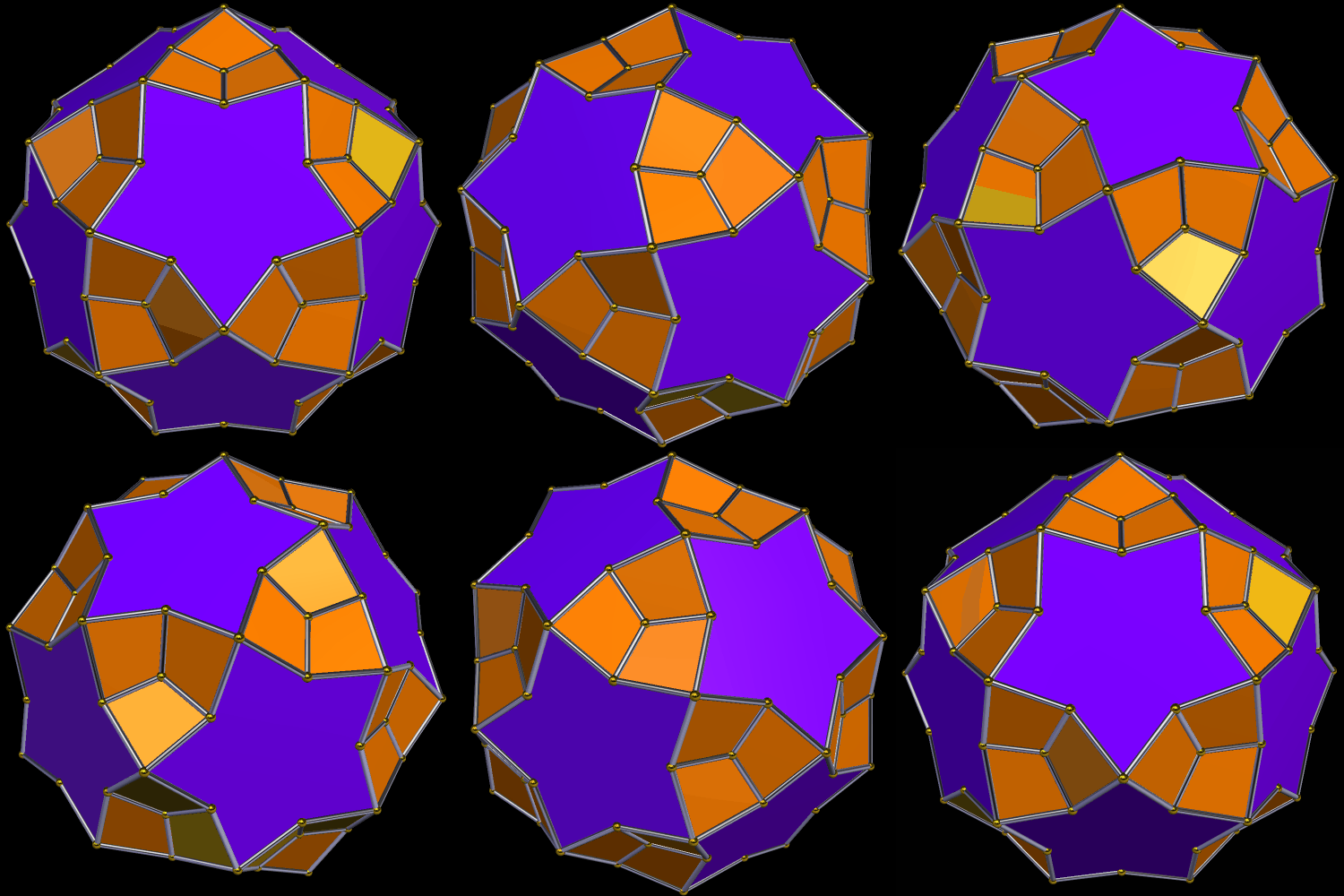
A 242-Faced Polyhedron, Along With Its Dual

This polyhedron’s faces include twelve decagons, thirty rhombi, and 200 triangles. Its dual is shown below.

This dual has 180 faces: 60 hexagons, and 60 each of two types of kites.