My Unusual View of Islam

Image

My Unusual View of Islam

As most readers of my blog know, I am an atheist. All atheists differ, of course, and one of the ways I differ from almost all of my fellow atheists is that I have a very different view of Islam and Muslims.

I haven’t always been this way. 25 years ago, as an undergraduate, I had unconsciously allowed myself to be heavily influenced by media coverage of the Middle East. I’m embarrassed to admit now that, then, I concluded, simply and uncritically, that this entire region is chock-full of crazy people. I openly speculated that there must be some mind-affecting drug in the water there, to cause such madness as I saw on the TV news.

As I now know, TV networks are very selective about what they show. Burning American flags make the news, to the exclusion of coverage of the millions of sane, kind people in the Muslim world, for they are not viewed as newsworthy.

I will always be grateful to my Muslim friends for helping me make this transformation. They key was getting to know them, one at a time — not as Muslims, per se, but simply as people. After getting to know them, and calling them friends, falling into the type of thinking which is dominated by stereotypes quickly became impossible, for the stereotypes did not match the behavior of any of my friends. I was given a choice between believing TV, or the evidence gathered with my own eyes and ears, and that’s always an easy choice.

It is a shame, but it is true: bigotries are only lost one at a time. I am delighted to be free of my former Islamophobia.

I now have dozens of Muslim friends, all over the world. If it bothers them that I am not a believer, they politely keep that to themselves. They’re always willing to answer my questions about Islamic practices and beliefs, but never use such questions as an opportunity to try to convert me.

The contrast with Christianity, in my experience, is vivid. Of course, I do not experience Islam as one might in, say, Iran. I also do not experience Christianity as everyone else in the world, for I live in the American South, the part of the USA with the highest rates of religiosity, and a form of Christianity in ascendance which is often intolerant of others, in the extreme. Here, I have had many (but not all, of course) Christians react to my atheism quite negatively. I have to remind myself, often, that Christianity here is unusual when viewed through a world-wide lens. For example, consider evolution. Around much of the Christian world, believers have, long ago, “grown up” on the subject of evolution. Pope John Paul II himself said that he viewed it as valid. This in not the case here in the South, where Christianity often goes hand-in-hand with Creationism, a pseodoscience to which I have a quite negative reaction, due to my strong and life-long fascination with, and respect for, real science.

There is also my personal history in play here. I have suffered horrible abuse (I’ll spare you the details) at the hands of Christians, often with the abuse having specifically religious elements. By contrast, no Muslim has ever even tried to harm me, in any way.

Most Americans, of course, think “terrorist” when they hear the word Muslim. The cure for this is simple: make friends with Muslims, and discuss this with them. You’ll learn that most Muslims detest organizations such as Al-Qaeda, and are quick to disavow them. The fact is, the Christian world has its share of such people as well; they’re the types of Christian who shoot doctors and bomb women’s health clinics. Extremists can be found everywhere, and the only reason extremists are of a particular type is almost always the same:  a simple accident of birth.

Pick one hundred Christians at random, and its almost certain that you won’t find one fitting this description. Repeat this with one hundred random Muslims, and the odds against you finding a terrorist in your sample are also almost-certain.

Sometimes, people learn that I have a generally favorable view of mainstream Islam, and wonder why I don’t convert. That’s simple: I am unconvinced that any deity or deities exist, due simply to a lack of evidence, and one cannot be a Muslim without honestly believing that a single deity exists. However, I don’t need to be a Muslim to treat Muslims as actual people, and to fight the scourge of Islamophobia wherever I find it.

Unfortunately, there’s a LOT of Islamophobia out there — and it is, sadly, very strong in the loosely-knit community of atheists. I get asked, for example, to participate in “Everyone Draw Muhummad Day” on Facebook, every year. I always refuse. Is this censorship? No, it’s simply my choosing not to offend my friends for no good reason at all.

Throughout the years I have encountered many people who rabidly hate Islam, and they are usually either Christians or atheists. I try to reason with them. It usually doesn’t work, but sometimes it does, so I generally try it anyway. Hate doesn’t help anyone, and the more of it we can rid ourselves of, the better off all of us will be.

[Later edit:  part II of this post may be found right here — https://robertlovespi.wordpress.com/2013/04/07/my-unusual-view-of-islam-part-ii/]

I Prefer “Skeptic”

If there is one thing people who are not religious have proven they know how to do, it’s quibble over labels.

Atheist. Agnostic. Anti-theist. Non-believer. Non-theist. Non-religious. Bright. Pastafarian. Freethinker. And so on. They don’t all mean the exact same thing, of course, but there are common similarities, such as rejection of religious orthodoxy.

Some of those words apply to me, and some do not. The most familiar, to the largest number of people, is “atheist,” and it’s also a term that can turn a lot of people off in a hurry. Some of us who are atheists avoid using the term for that reason.

I have a different reason for my growing dislike of the word “atheist.” It’s really starting to bug me that the word doesn’t go far enough. It is simply too narrow in focus for my tastes.

All “atheist” really means is that one lacks any belief in any deity. It is possible, therefore — and yes, it happens — to be an atheist, and also believe in all sorts of irrational nonsense which has nothing to do with the divine. For example, there are atheists (not many, but some) who actually accept, and “use,” astrology, homeopathy, numerology, and their own (delusional) superhuman abilities. Even more numerous are the atheists who buy into one or more conspiracy theories. Merely putting a red “A” on one’s Facebook profile-pic does not immunize a person from error.

I don’t want to accept anything as valid without sufficient cause, and there is no reason to focus this attitude exclusively towards religion — nor anything else.

What is sufficient cause for accepting a proposition as valid? Well, mathematical proof certainly works, as does the scientific method (with the latter subject to later revision, of course, but only based on evidence).

I chose my preferred label in reaction to astrology, something I have disliked, intensely, since early childhood.

Image

Skepticism is an attitude, and it is all-encompassing. It protects the skeptic from accepting the invalid as valid — when correctly and carefully applied, of course. It includes, but is not limited to, skepticism about religious claims. There is, after all, no good reason to have such a limitation.

On Loving Christmas But Hating Xmas

I may have heard the objection a thousand times, living here in Arkansas:  “They’re trying to ‘X’ out the ‘Christ’ from ‘Christmas!'”

Such people have apparently never heard of one of the most ancient Christian symbols in existence (and still in heavy use):

Image

Chi and rho are the first two letters one uses to spell “Christ” in Greek, the original language of most of the New Testament. It makes much more sense to interpret the “X” in “Xmas” as a reference to Christ, through the “chi” in the “Chi Rho” symbol, rather than some insidious plot to eliminate Christ from this holiday — a holiday with a history that, as many people know, predates Christ by centuries, anyway.

Of course, those people who object to “Xmas” don’t know about the Greek letter chi, or the fact that it looks just like an “X,” as used in English, or that the two letters represent very different sounds. There’s no shame in simple ignorance, curable as it is by education. However, I would wager that most of those who object to “Xmas” also do not want to know these things, either, and in that, there is shame. Not wanting one’s own ignorance to be replaced by knowledge is an excellent definition for stupidity.

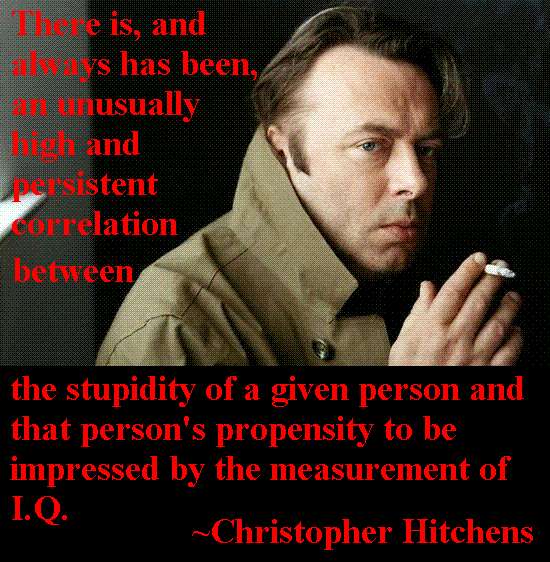
Six Christopher Hitchens Quotes

hitchmeme1
hitchmeme2
hitchmeme3
hitchmeme4
hitchmeme5
hitchmeme6
All found in The Quotable Hitchens (2011).

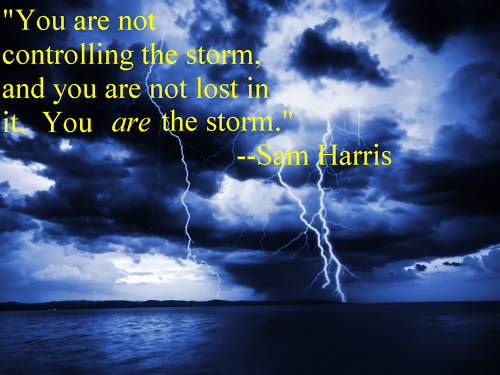
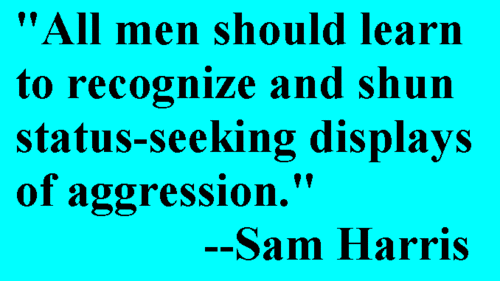
Sam Harris Meme Collection

tumblr_m3mbpq6C3G1r426yxo1_500
tumblr_m51xfbTxIM1r426yxo1_500
tumblr_m51xgx3jOE1r426yxo1_500

Image

tumblr_mbhe5f46Ra1qh6ytbo1_500

My Choices for Ten Ethical Principles

I may not do this better than Christopher Hitchens, but I contend I have done it better than Exodus.

Image

I just sold an indulgence.

The going rate is $2, via PayPal to robertlovespi@yahoo.com.

The buyer wanted an indulgence re: sloth, and was given a virtual “get out of purgatory free” card for anything having to do with sloth.

If you need an indulgence, just let me know. The Vatican’s started this practice back up again — why shouldn’t I get in on the action?

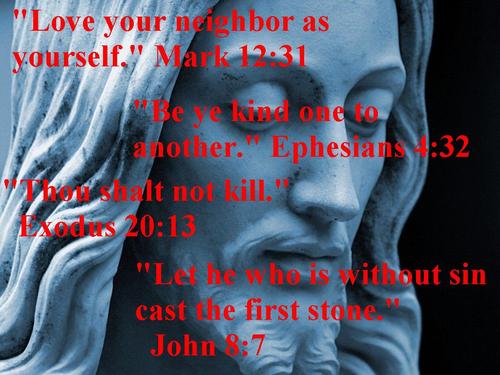
Don’t Forget These Verses

Image

Attention, “Christians” who do hateful things, such as:

*Issuing death threats against Sam Harris, Richard Dawkins, and many others

*Bullying numerous gays, to the point of suicide

*Bombing women’s health clinics, and killing the doctors who work there

YOU MISSED SOME IMPORTANT VERSES IN YOUR FAVORITE BOOK!

A Look Back Backwards, at Thanatophobia

Thanatophobia is an irrational, exaggerated fear of death, not to be confused with the healthy biological imperative that compels most people, most of the time, to avoid dying if they can.  I had thanatophobia for as long as I can remember, up until two years ago, when it started to fade from existence.

Not coincidentally, this is also the period when I put aside those “What if I’m wrong about religion?” questions, stopped calling myself, primarily, an agnostic, and, as an atheist, just stopped worrying about post-death judgment.

We get judged by people enough while we’re alive. Adding eternity to that, on the basis on dubious or nonexistent evidence, is unhealthy.

I also must consider this:  the inevitability of my own death means there is some point in the future beyond which I will never experience panic, rage, pain, or hatred. Beyond that point, there are no responsibilities.

I just blew off an entire weekend. I was exhausted, simply needed to do as little as possible (or I was going to end up in worse shape), and proceeded to sleep for 40 of the next 48 hours. I have a lot of things to do, but I did take the weekend off. I don’t remember much about it because I was sleeping most of that time, but it wasn’t unpleasant. The only unpleasant thing about it was having to re-activate myself for the workweek, and the resumption of responsibility that comes with it.

What happens after we die?

I don’t really know, but I have no evidence that it’s anything like Heaven and Hell as depicted in the Bible, Dante’s Inferno, Robert Heinlein’s Job, and numerous other works.

I once heard James Randi give an excellent answer, in the form of a question:  “What happens to a computer when you turn off the power?”

I now have an answer of my own. The workweek ends. Troubles end. Everything that annoys me, won’t anymore. I’m certainly in no hurry to stop existing, but whether I see a triple-digit age, don’t make it to my next birthday, or somewhere in-between (the most likely of the three), death just isn’t terrifying any more. That should make the process of living the rest of my life more pleasant than if I resumed worrying about what happens to me after that life is over.

Atheists Change

(Originally published June 9, 2012, on a Tumblr-blog — reposted here with some minor editing, for clarity.)

Change is a fundamental part of the human condition. We change until we die, whether or not we have religious beliefs, so, of course, atheists change, just as everyone does.

One can change for the better, or one can change for the worse. I am trying to change for the better.

As you may know, I’m in the middle of a huge political fight, with powerful opponents. I also have a lot of allies in this fight: teachers, union people, our families, sympathetic people all over the place (including some in the local media), angry taxpayers — and this is all going on in Arkansas. A majority of Arkansans are Baptists, with the bulk of the non-Baptists being Christians of other denominations.

Many of my allies are, therefore, people with sincere religious beliefs. How could it be otherwise, here? To offend them, I now see, by being the stereotypical “angry atheist,” would simply be stupid. On the other hand, I am not ashamed of my lack of belief. My “show me the evidence” skepticism is not a secret — and has even been useful in this struggle. “Show me the evidence” is a good response, for example, when claims about a superintendent’s salary are disputed. Arkansas has a strong FOI (Freedom of Information) Act, so I have the means of getting the evidence I need.

We have lawyers to fight in court, we have people taking petitions door-to-door, and it makes sense to do those things one can do well. I spend most of my time on this, therefore, as an Internet activist, since I am accustomed to functioning in cyberspace. This is my preferred environment; it now feels as if I was born here, in fact, although I obviously was not.

It isn’t hard to find past posts of mine about religion which were quite hostile. I don’t intend to delete them, but I am changing my approach — turning into a different type of atheist. Working on a common cause with many religious people naturally has that effect, for I would be useless for this fight if I went around bashing religion constantly. If our opponents “creep” my Tumblr-blogs, they’ll simply find evidence of this transformation. I am not ashamed of it.

Here’s an example of this transformation. I have allies who find prayer helpful, and I used to be the sort of atheist who would instantly ridicule such an idea. This is not true any more, for I have realized now that I was simply incorrect, before, about sincere prayer being a useless activity. Prayer really does help these people keep their spirits up, in this situation, through boosting morale, and I have my own, secular ways to keep my own morale high. There is no need for me to pretend to pray with anyone (which is all I could possibly do, of course). I only need to respect their right to pray, which I believe they do sincerely, alone and in groups. Of course, these allies talk about prayer at times, post about it on Facebook, etc. — and when they do, I have learned, after many years, something important: how to shut up. This is something I needed to learn, anyway. I have developed such respect, to a greater degree than I had it before — out of political necessity, at first, I admit. As this goes on, though, I’m simply changing because I want to. I think these are changes for the better, and, since I like the way this is going, there is no reason for me to try to fight these changes — only to understand them.

This struggle is changing me, and it certainly is not easy to go through this, for any of us. I am certain it is changing all of us, not just me. While I am learning to work cooperatively with religious people, by setting aside differences which have become irrelevant, some of them are probably experiencing a similar phenomenon, from the other direction. It is no secret here that I am an atheist, and, yes, that has rubbed some people the wrong way in the past. Some of those people are now among my closest allies. I never saw this situation coming. Neither did they. My guess is that some of them are as surprised to be working cooperatively with an open and unashamed atheist as I am by the changes I have described.

This is Arkansas. My Tumblr co-blogger is in Utah. Unless we move, we’re not escaping religious people in these two highly-conservative, very religious parts of the United States. This isn’t California, nor is it Europe. These are facts, and facts are ignored at great peril. Where we live, peaceful co-existence of the religious with the non-religious is a goal that makes sense, and we have found a way to do it, in the middle of a storm. Yes, the atheists among us can, to use John Lennon’s phrase, “imagine no religion” all we want … and, at times, I do. In our areas, however, it would be delusional to forget that this is merely a fantasy, at least in our lifetimes. Should I ever want to escape religion in my environment, I have accepted that I will need to move, for I can’t get all these churches around here to move, nor do I have the right to expect them to. I am grateful that the world now has highly-secular areas I can move to, of course. This was not always the case.

I’m walking carefully, along a very thin line, but my eyes are wide open, and I can see clearly.