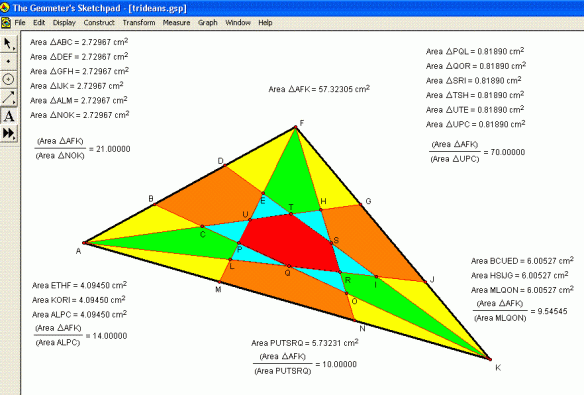
Much work has been done on the medians of triangles: segments that connect vertices with the midpoints of opposite sides. This morning, I decided to explore what happens if the trideans are examined, rather than the medians.
The reason you don’t know the word “tridean” is simple: I just made it up. It’s related to a median, though. To find trideans, you must first trisect, rather than bisect, each side of a triangle. This gives you two equally-spaced points on each side. To form a tridean, simply connect one of those points to the opposite vertex. Every triangle has six trideans, and they split the triangle into a set of non-overlapping polygons, as you can see in the diagram.
When I examined the area of these polygons, I started finding unexpected things right away. As you can see, polygons of the same color in this diagram have the same area, even though they are non-congruent. Moreover, these areas are interesting fractions of the area of the entire triangle. The six yellow triangles, for example, each have 1/21st of the area of the entire triangle. Each blue triangle is 1/70th the area of the large triangle. Each green quadrilateral is 1/14th the area of the large triangle. 21, 70, and 14 have one factor in common: the number seven. Seven? I officially have NO idea why sevens are popping up all over the place in this investigation, but there they are.
The red hexagon in the middle has 1/10th the area of the entire triangle, and this number surprised me as well.
The three orange pentagons took a little more work. As you can see, dividing the area of the large triangle by the area of one of these orange pentagons yields 9.5454, with the “54” repeating. This decimal is 105/11. (Eleven?) At least 105 has three as a factor (as does 21, from earlier); three is the number I expected to pop out all over the place, but it shows up little in this investigation. However, what are the other factors of 105? There’s five — and, yet again, seven.
These sevens are everywhere in this thing, and I have no idea why.
Now, of course, I have proven none of this. This is merely a demonstration and explanation of something I think is a new discovery. I did change the shape of the triangle many ways, as a test, and each of these area ratios remained constant.
If anyone can shed some light on any of this — especially all these sevens — please comment.
 RobertLovesPi.net