The 15-75-90 Triangle

Image

The 15-75-90 Triangle

As the 30-60-90 triangle is based on an equilateral triangle, the 45-45-90 triangle is based on a square, the 18-72-90 and 36-54-90 triangles are based on the regular pentagon (see https://robertlovespi.wordpress.com/2013/03/12/the-18-72-90-and-36-54-90-triangles/), and the 22.5-67.5-90 triangle is based on the regular octagon (see previous post), so the 15-75-90 triangle is based on the regular dodecagon, shown here with three radii (red) and a single diagonal (purple). The 15-75-90 triangle is shown in yellow. An argument from symmetry is sufficient to show that angle EFC is the right triangle in this triangle, and the larger of its two acute angles (angle FCE) is one-half of an interior angle of this dodecagon. The interior angle of a regular decagon measures 150 degrees (the proof of this is trivial), and so angle FCE must measure half that amount, or 75 degrees. This leaves 15 degrees for angle CEF, via the triangle sum theorem.

What about the side lengths of the 15-75-90 triangle, though? First, consider the red diagonals shown, and let them each have a length of 2. Angles DAF and FAE each measure 30 degrees, since 360/12 = 30, and they are central angles between adjacent radii. This makes angle DAE 60 degrees by angle addition, and triangle DAE is known to be isosceles, since the two red sides are radii of the same regular dodecagon, and therefore are congruent. By the isosceles triangle theorem and triangle sum theorem, then, angles ADE and AED each also measure (180-60)/2 = 60 degrees, so triangle ADE is therefore equilateral, with the purple side, DE, also having a length of two. Symmetry is sufficient to see that DE is bisected by radius AC, which leads to the conclusion that EF, the long leg of the 15-75-90 triangle, has a length of 1.

Segment AF is a median, and therefore also an altitude, of equilateral triangle ADE, and splits it into two 30-60-90 triangles, one of which is triangle AEF. Its hypotenuse, AE, is already known to have a length of 2, while its short leg, EF, is already known to have a length of 1. Segment AF is therefore the long leg of this 30-60-90 triangle, with a length of √3.

AF, length √3, and FC, the short leg of the 15-75-90 triangle, together form dodecagon radius AC, already set at length 2. By length subtraction, then, FC, the 15-75-90 triangle’s short leg, has a length of 2 – √3. A test is prudent at this point, by taking the tangent of the 15 degree angle FEC in the yellow triangle. Tan(15 degrees) is equal to 0.26794919…, which is also the decimal approximation for FC/EF, or (2 – √3)/1.

All that remains to know the length ratios for the sides of the 15-75-90 triangle is to determine the length of EC, its hypotenuse, via the Pythagorean Theorem. The square of length EC must equal the square of 1 plus the square of (2 – √3), so EC, squared, equals 1 + 4 – 4√3 + 3, or 8 – 4√3. The hypotenuse (EC) must therefore be the square root of 8 – 4√3, which is √(8-4√3)) = 2√(2-√3)).

The short leg:long leg:hypotenuse ratio in a 15-75-90 triangle is, therefore, (2-√3):1:2√(2-√3)).

The 22.5-67.5-90 Triangle

Image

22p5-67p5-90-triangle corrrected

In the diagram above, a regular octagon is shown nested inside square LMNP. The central angles of this octagon, such as angle HAF, each measure 360/8 = 45 degrees. Segments HA and FA are radii, and G is the midpoint of HF, making GF a half-side and GA an apothem. Since this apothem bisects angle HAF, angle GAF is 22.5 degrees, making the yellow triangle a 22.5-67.5-90 triangle.

Let FH = 2, as well as FK (and the other six sides of the regular octagon, as well), and GF would then equal 1, since G is the midpoint of FH. Triangle KNF is a 45-45-90 triangle with hypotenuse length 2, giving it a leg length of 2/√2, or simply √2. This makes segment XN (with X the midpoint of EK) have a length of 1 + √2, and the light blue segment, AG, has this same length of 1 + √2, by horizontal translation to the left.

The hypotenuse of the yellow 22.5-67.5-90 triangle can then be found using the Pythagorean theorem, since it is is known that the short leg (GF) has a length of 1, while the long leg (AG) has a length of 1+√2. Let this hypotenuse (AF, shown in red) be x, and then x2 = 12 + (1 + √2)2 = 1 + 1 + 2√2 + 2 = 4 + 2√2, so x, and therefore the hypotenuse, has a length of √(4+2√2).

The 22.5-67.5-90 triangle, therefore, has a short leg:long leg:hypotenuse ratio of 1:1+√2:√(4+2√2).

Starry Icosidodecahedron

Image

Starry Icosidodecahedron

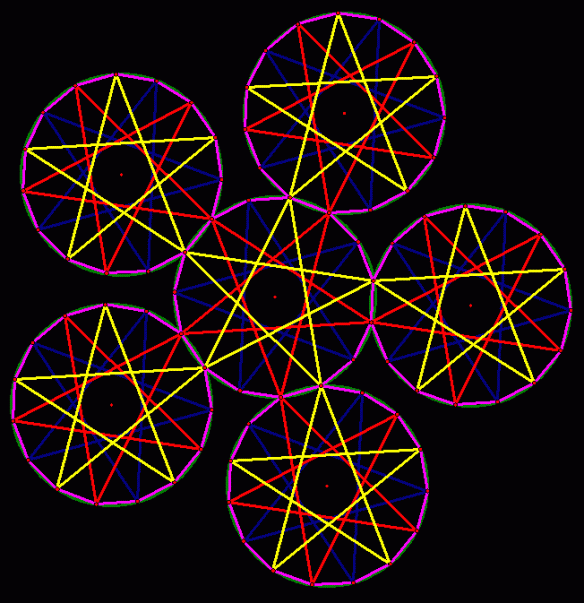
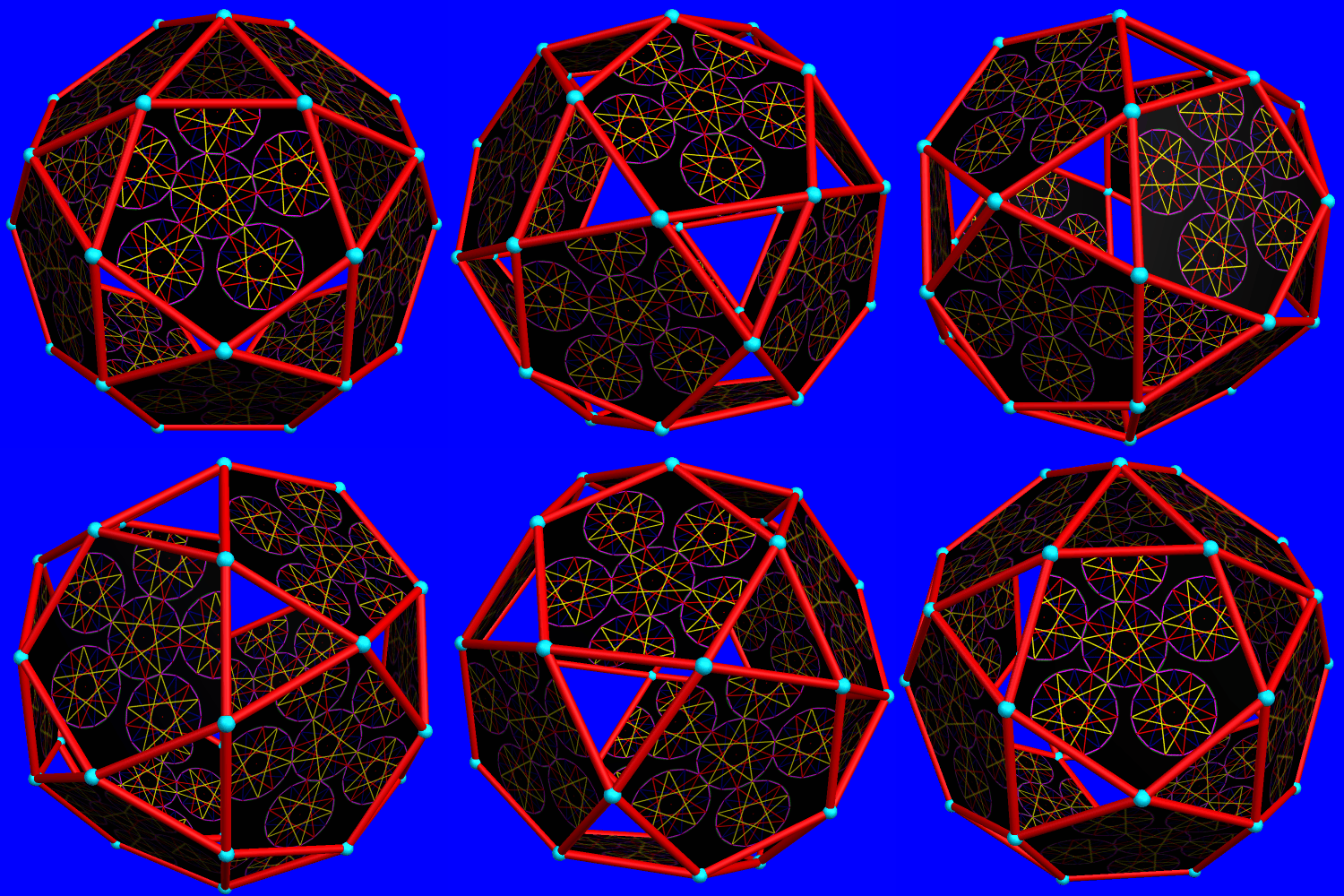
This was created using Geometer’s Sketchpad, MS-Paint, and Stella 4d.

If you’d like to try Stella 4d for yourself, please visit www.software3d.com/stella.php.

Eighteen Stars

Image

Thirty Stars

A Proof

Image

A Proof

I ran into a problem at a meeting of teachers, yesterday, which exposed an embarrassing hole in my geometrical knowledge — and so I quickly became obsessed with filling it. In the diagram, the large triangle is right, and the leg lengths were given; the problem was to find the length of the hypotenuse (also the diameter of the circle centered at B). The median seen here was not shown, however, and no right angle was identified. Were the triangle not a right triangle, this would be an impossible problem, so I knew it had to be a right triangle . . . but that didn’t satisfy me. I had to have a proof, so I wrote one.

Here it is: in the diagram shown, segment AC is a diameter of a circle with center B, while D is any point on the triangle distinct from A and C. Segments BA, BD, and BC are all radii of the same circle, and therefore have the same length, making triangles ABD and CBD isosceles with bases, respectively, of AD and CD.

Let the measure of angle ABD be some number x. Since it forms a linear pair with angle CBD, angle CBD’s measure must be 180 – x.

Angles BAD and BDA are the base angles of isosceles triangle ABD, which has a vertex angle measure already chosen as x. Since these base angles must be congruent, it follows from the triangle sum theorem that each of these angles must measure (180 – x)/2.

Angles BCD and BDC are the base angles of isosceles triangle CBD, which has a vertex angle measure already determines to be 180 – x. Since these base angles must be congruent, it follows from the triangle sum theorem that each of these angles must measure (180 – (180 – x))/2.

By the angle sum theorem, the measure of angle ADC must equal the sum of the measures of angles BDC and BDA, already shown, respectively, to be (180 – (180 – x))/2 and (180 – x)/2.

Angle ADC’s measure therefore equals (180 – (180 – x))/2 + (180 – x)/2, which simplifies to (180 – 180 + x)/2 + (180 – x)/2, which further simplifies to x/2 + (180 – x)/2. Adding these two fractions yields the sum (x + 180 – x)/2, and then the “x”s cancel, leaving only 180/2, or 90 degrees, for the measure of angle ADC. Therefore. triangle ADC, the large triangle in the diagram, must be a right triangle — QED.

I’m rather embarrassed that I didn’t already know this property of inscribed triangles with one side being the diameter of the triangle’s circumscribed circle — but at least I figured the proof out myself, and that, in turn, made the faculty meeting easily the least boring one I have ever attended.