I’m 90% sure this hasn’t been found before. It has three-fold pyramidal symmetry.

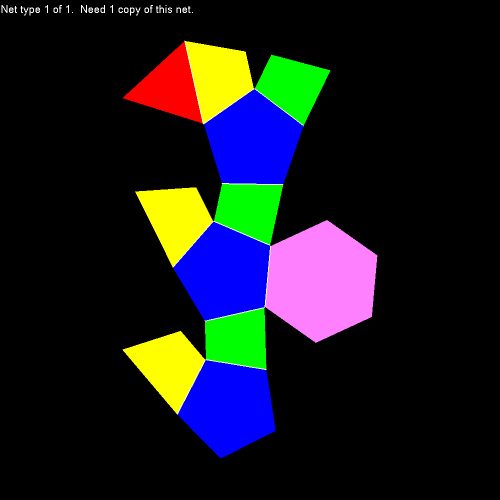
Here is its net.
I used Stella 4d to make this. You can try this program for free at this website.
I’m 90% sure this hasn’t been found before. It has three-fold pyramidal symmetry.
Here is its net.
I used Stella 4d to make this. You can try this program for free at this website.

I made this using Stella 4d, which you can try for free right here. It’s a continuation of the post immediately before this one.
Starting with the rhombic triacontahedron, I tetstelled it three times, and found this unusual polyhedron. It has eighteen faces: six parallelograms, and twelve trapezoids.

Here’s what happened when I used Stella 4d‘s “try to make faces regular” function on the polyhedron above.

This solid has six rhombic faces, and twelve faces which are kites. Here is its dual:

Next, I returned to the red-and-yellow solid above, and tetstelled it numerous times, producing a compound of a cube and a distorted rhombic dodecahedron.

A few more tetstells produced this interesting three-part compound.

If you’d like to try Stella yourself, the website to visit is http://www.software3d.com/Stella.php. There’s a free trial download there.
WordPress charges me $480 every two years to host this blog (because it’s so big), and keep it ad-free. I’m now accepting donations to offset this cost. To access the donation site, just look on the right side of the menu bar at the top of any page here, where it says “Tip Jar,” click on those words, and then look for the blue link.
This is completely voluntary. There’s no “premium” content to unlock. Those who choose not to donate can still access everything here. Those who do donate receive my gratitude, along with the warm, fuzzy feeling one gets from doing a good deed.
Donations are not tax-deductible.
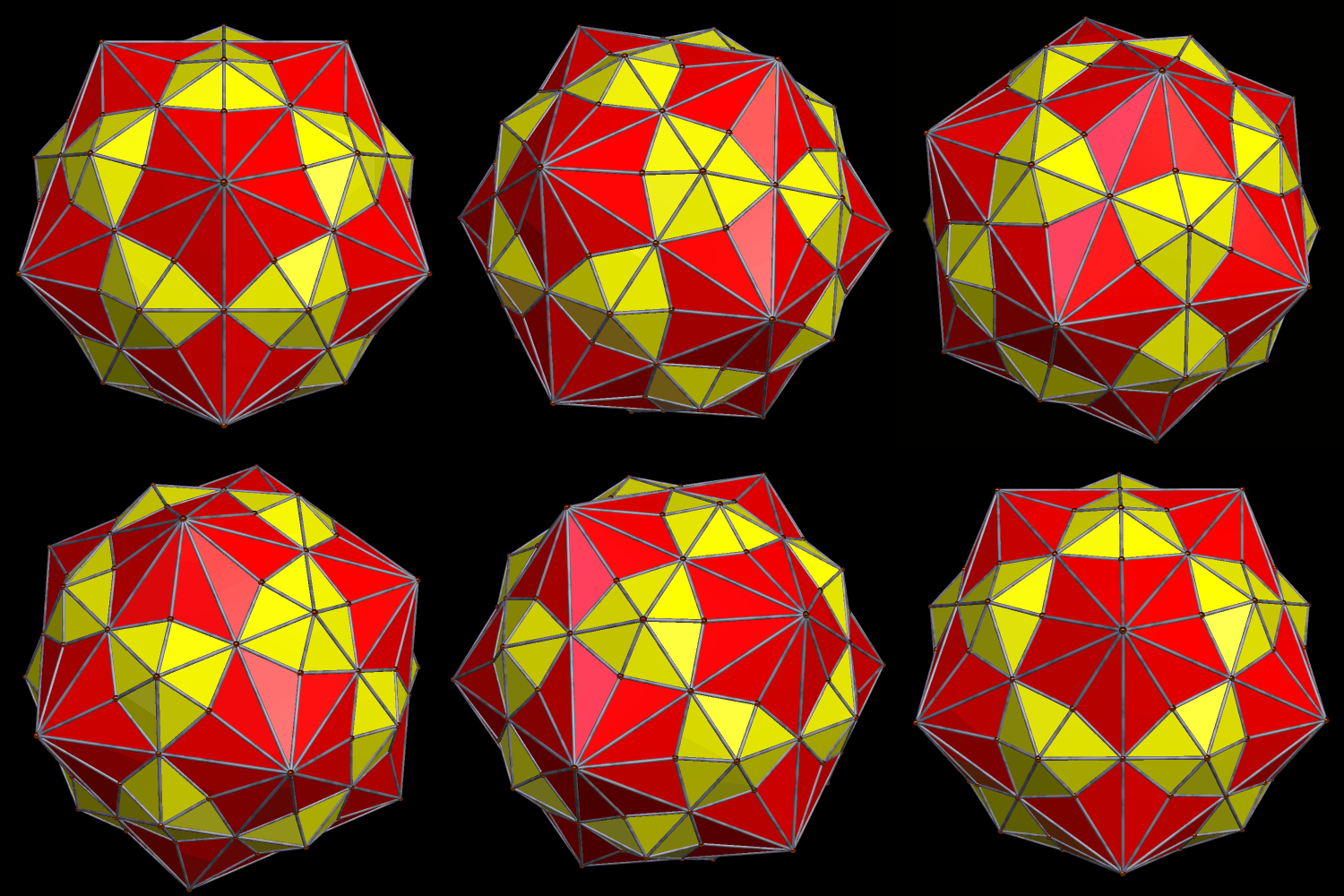
This is the familiar compound of the icosahedron and dodecahedron, except with both of those solids augmented on each face with short pyramids. I made it using Stella 4d, which you can try at this website.
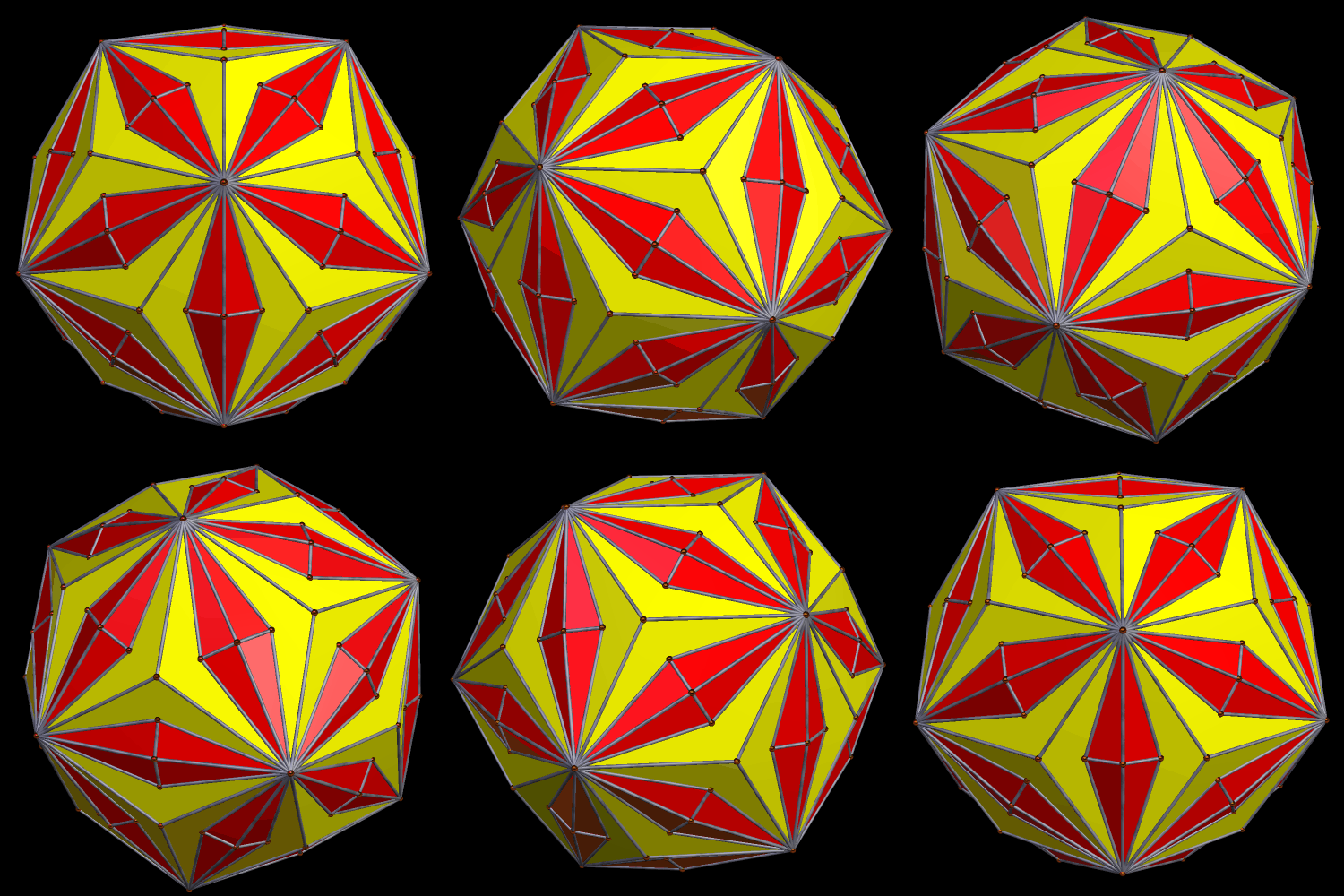
The yellow component of this compound is a rhombic triacontahedron, while the red component is a slightly-stretched version of the strombic hexecontahedron (the dual of the rhombicosidodecahedron). The compound is derived from the truncated dodecahedron, and I made it using Stella 4d, which you can try for free right here.
The dual of the snub cube is the pentagonal icositetrahedron. Both solids are chiral, so it is possible to make compounds out of each solid and its mirror-image. The polyhedron shown below is a compound of an enantiomorphic pair of pentagonal icositetrahedra.
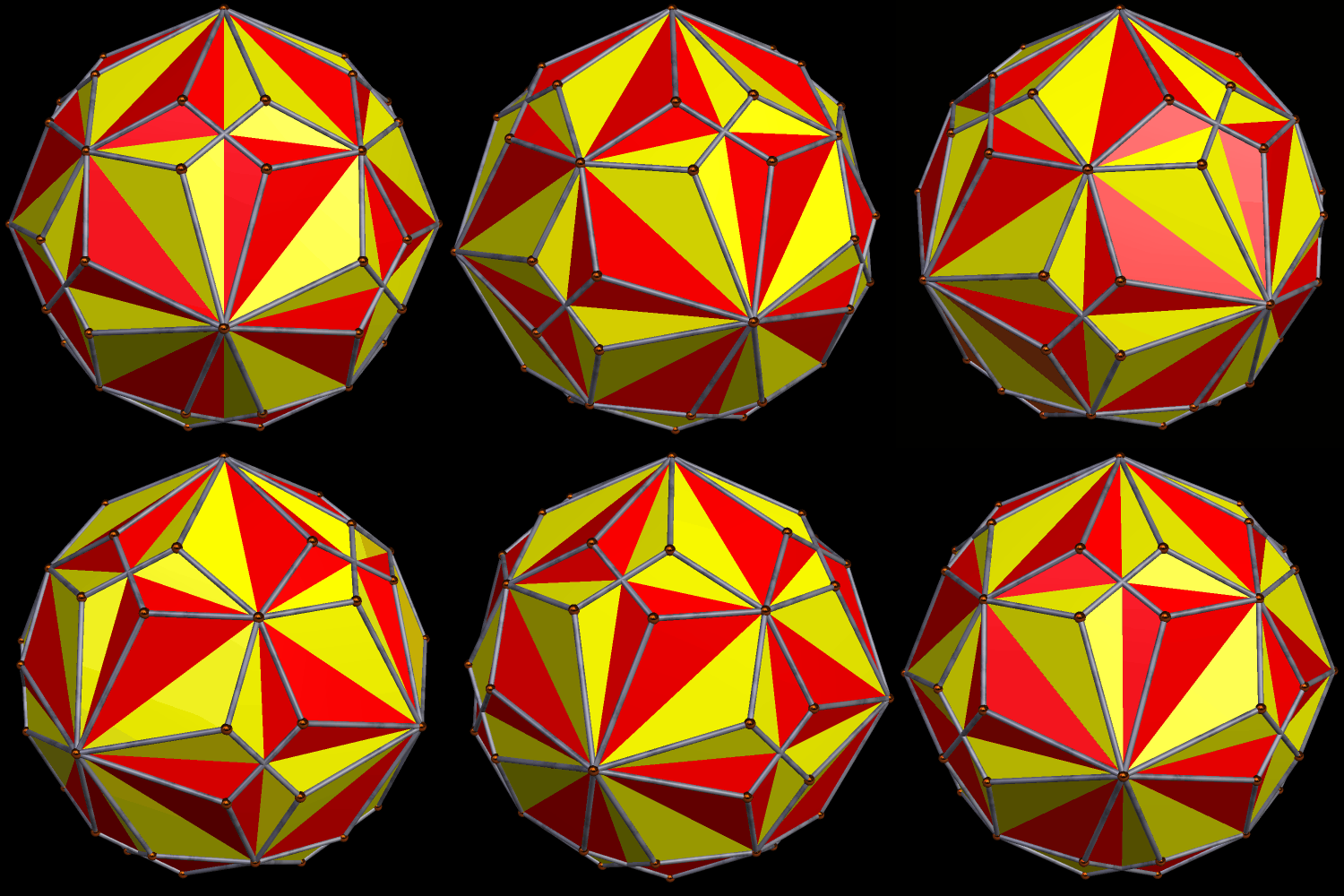
The next solid shown was formed in the same way, except I started with the snub dodecahedron. This is the compound of an enantiomorphic pair of pentagonal hexecontahedra.
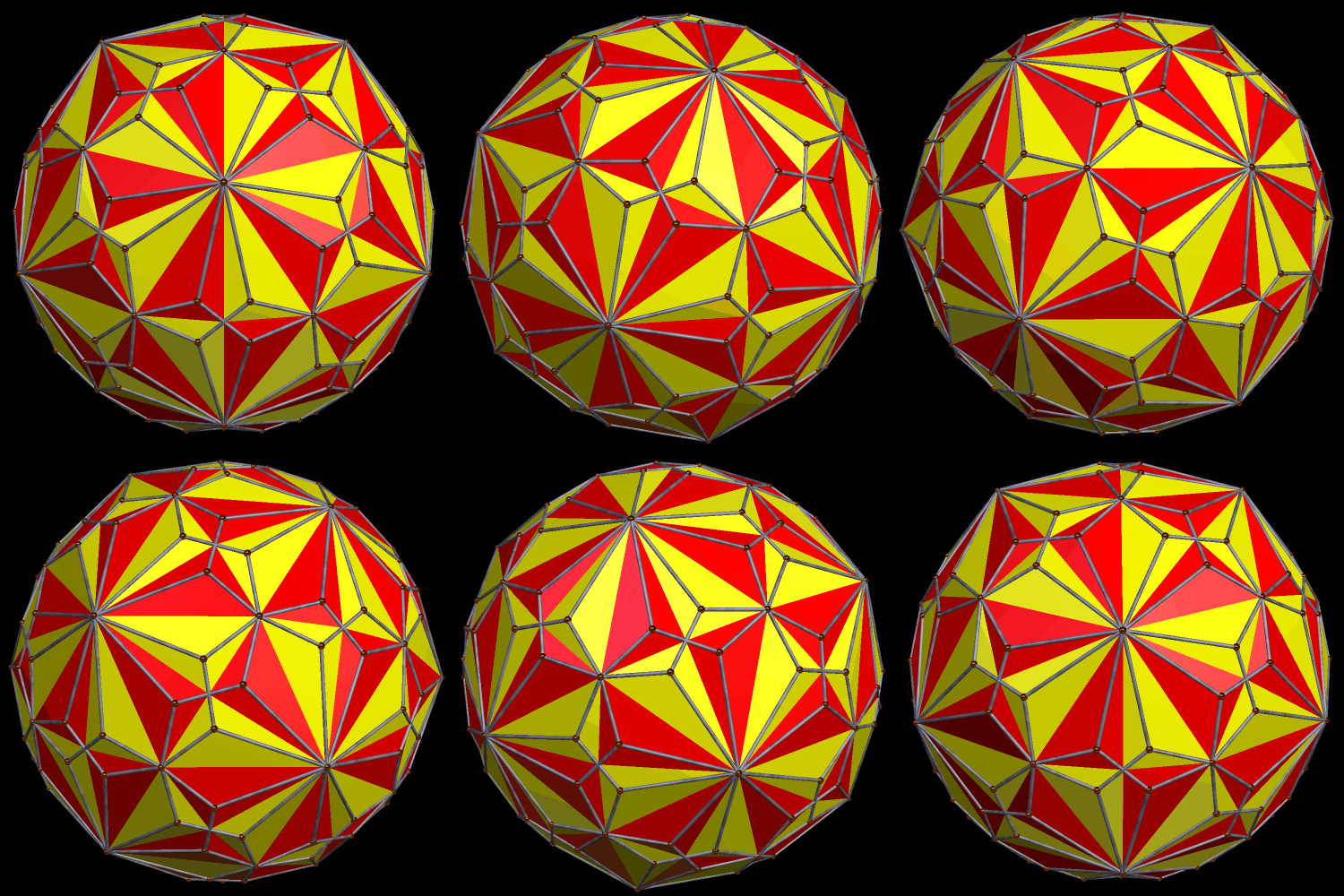
I did these polyhedron-transformations, as well as making these rotating .gifs, using Stella 4d: Polyhedron Navigator. You can try this program for free at http://www.software3d.com/Stella.php.
 RobertLovesPi.net