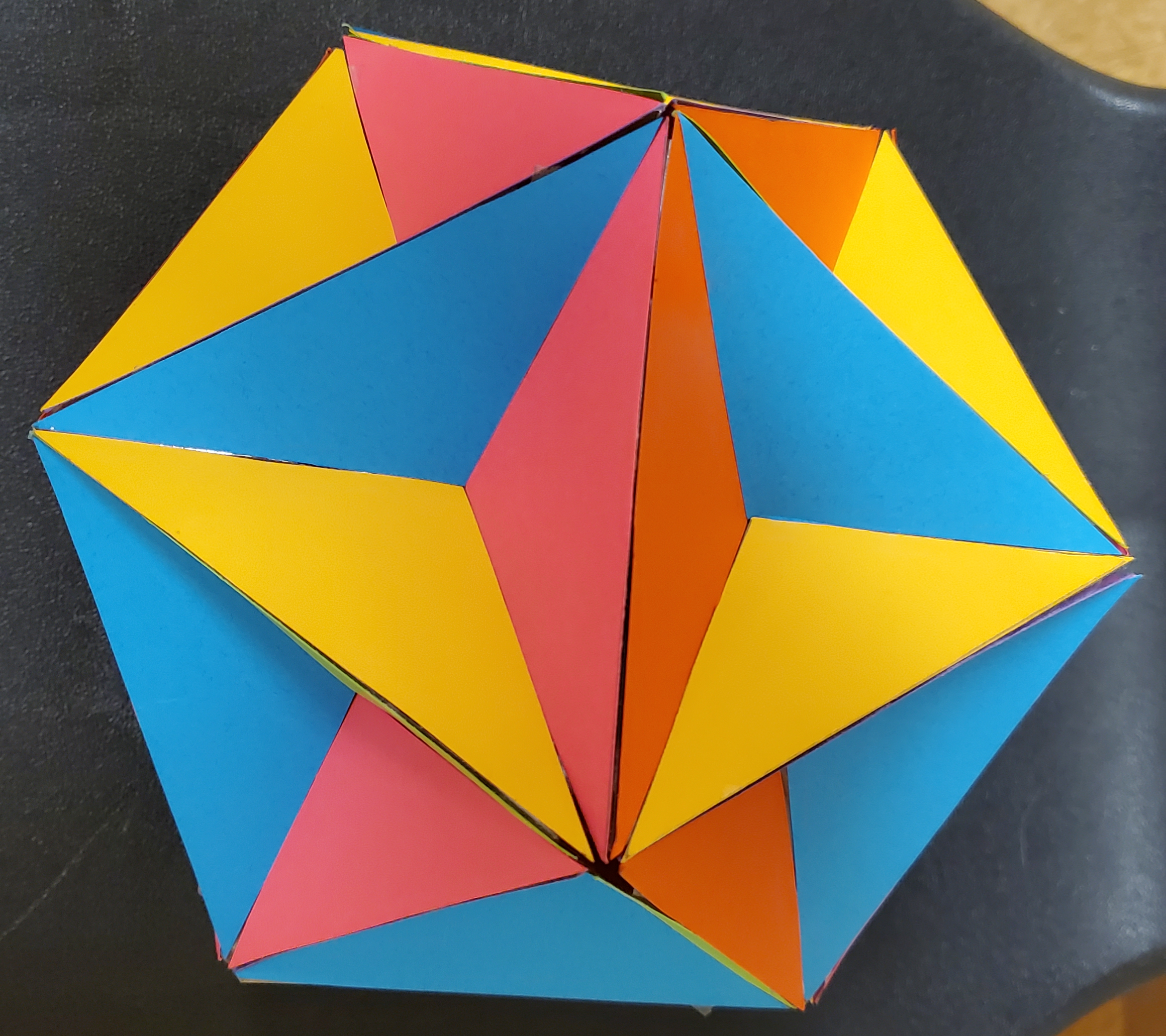
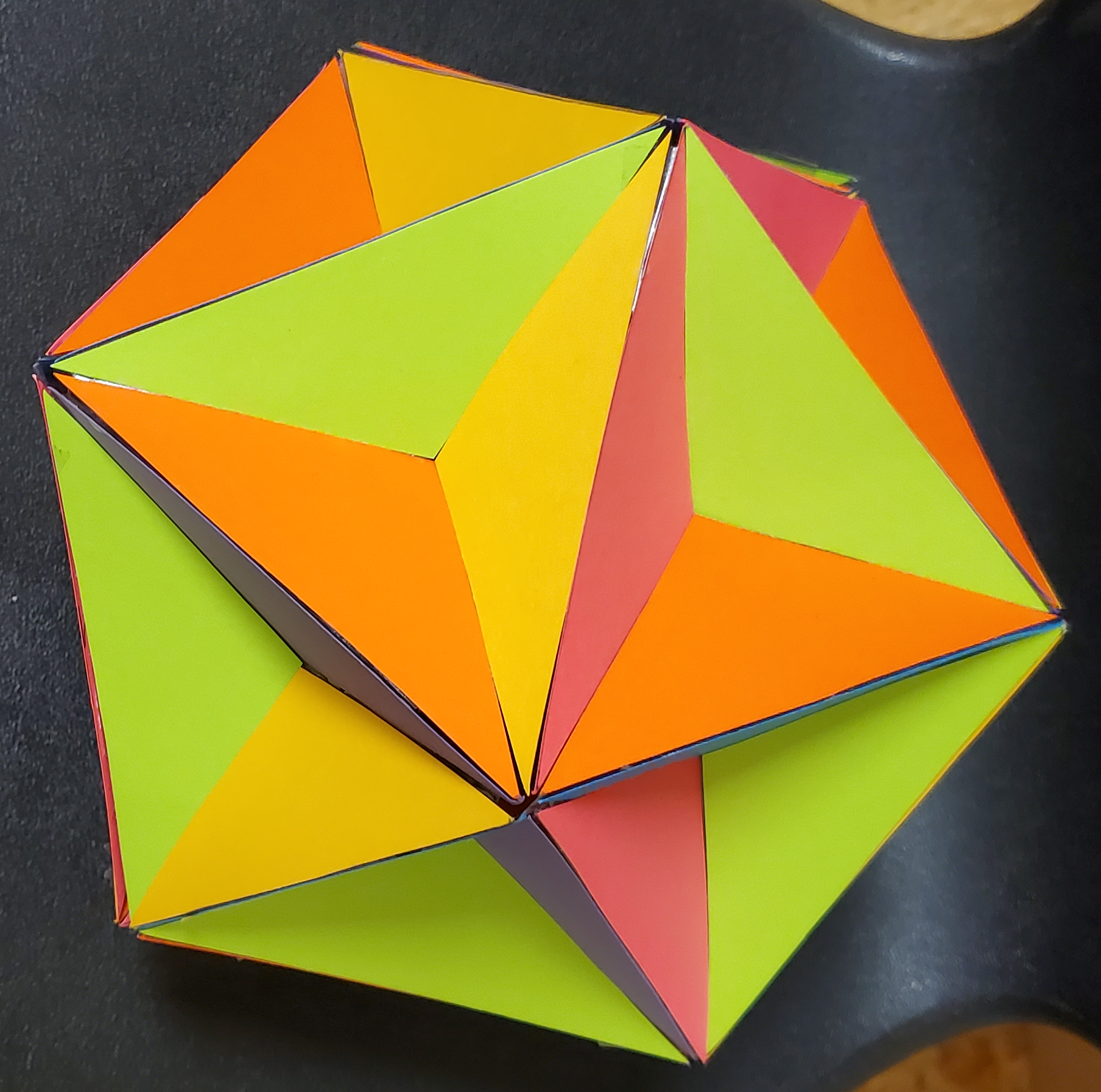
I’m sure I’ll get back to virtual polyhedra soon enough, but, in the meantime, enjoy this icosidodecahedron made using the traditional Euclidean tools, plus scissors, card stock, and tape. No computers were used to make this polyhedron.
The obtuse triangles here are golden gnomons, which are isosceles triangles with vertex angles of 108 degrees, as well as base-to-leg ratios which are golden. These triangles are facelets; the actual, much larger faces are the regular pentagons of which the golden gnomons are parts. In this model, all facelets which are part of the same (or parallel) faces are all one color, with six colors of paper used, in all, for this non-convex, twelve-faced, regular polyhedron, which is one of the Kepler-Poinsot solids.
Much of each face is hidden from view in this polyhedron’s interior — or rather, this is the case for the mathematical construct called the great dodecahedron. This physical model, on the other hand, is hollow on the inside. One is made only of ideas, while the other is made of atoms.
No computer programs were involved in the construction of this model. It was made using compass, straight edge, scissors, card stock, pencils, and tape.
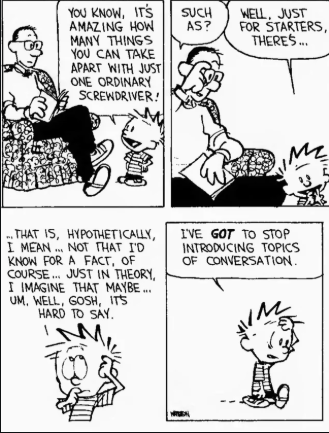
This is one example of an unusual feature sometimes seen in Bill Watterson’s Calvin and Hobbes — a single panel from this cartoon can be presented alone, without being the punch-line at the very end, and actually be funnier, by itself, than the original full comic strip it came from. Here’s the full original comic from which the above image was taken. And yes, Calvin, it is amazing.
Here’s another example of a C&H first-panel-only cartoon being funnier than the strip from which it came. (Side note: also, it’s Saturday right now.) =D
Keep an eye on social media’s image-cycle as they bring this single panel up again every time Saturday happens. (I do my part with this.) The full comic strip is actually harder to find than the striking single panel.
Here’s one more — one of my favorites.
This single panel above is, to me, one of the funniest things ever created on the subjects of death and mathematics. Here’s the full strip it came from. Note that, in this strip, the stand-alone panel is the second one, rather than being the opening panel, as this pattern is usually seen in C&H.
This pattern didn’t dominate Calvin and Hobbes; it was simply an occasionally-reoccuring form which helped make the strip unusual, for most comic strips relied on a punchline at the end of the strip. Here’s an example of a different writing-pattern in the same strip which relies primarily on the entire sequence of events in the strip, and the way the panels interact as the strip progresses.
The single-panel-alone technique was used effectivelly by Watterson, but it did not dominate the strip, as was the case in a few other comic strips, most notably Gary Larson’s The Far Side.
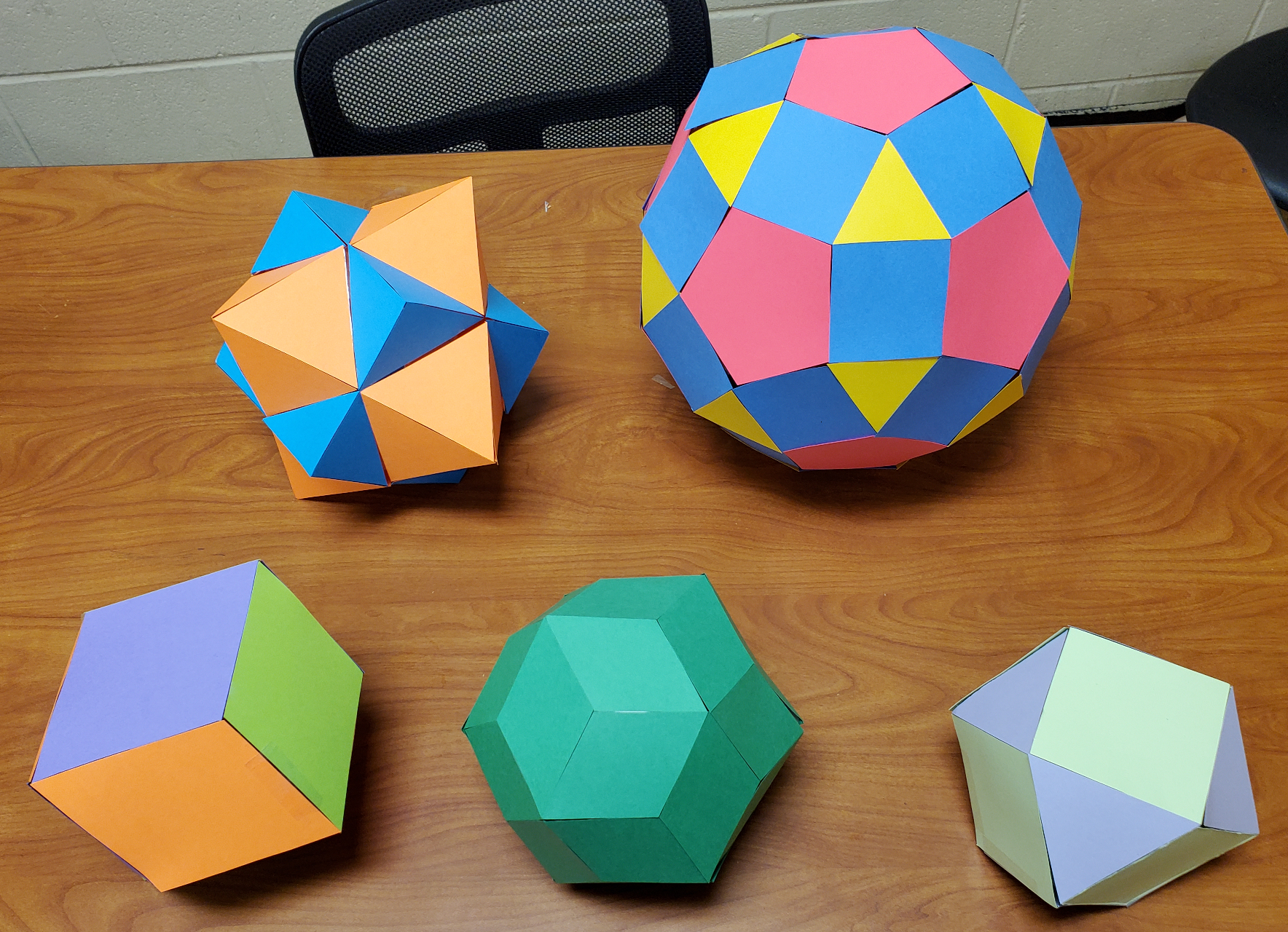
Clockwise from bottom right, these polyhedra are the cuboctahedron, the rhombic triacontahedron, the rhombic dodecahedron, the compound of the cube and the octahedron, and the rhombicosidodecahedron. They were made using card stock, compass, straightedge, scissors, and tape. Since I started blogging polyhedra, I’ve made most of my models using software, and quite a few using Zome. Making paper models was something I used to do . . . until a couple of days ago, when, on a lark, I made the cuboctahedron you see here. Bitten by the bug, I then made the other four models yesterday and today. There’s something satisfying about returning to the basics now and then.






 RobertLovesPi.net