Unknown's avatar

About RobertLovesPi

I go by RobertLovesPi on-line, and am interested in many things, a large portion of which are geometrical. Welcome to my own little slice of the Internet. The viewpoints and opinions expressed on this website are my own. They should not be confused with those of my employer, nor any other organization, nor institution, of any kind.

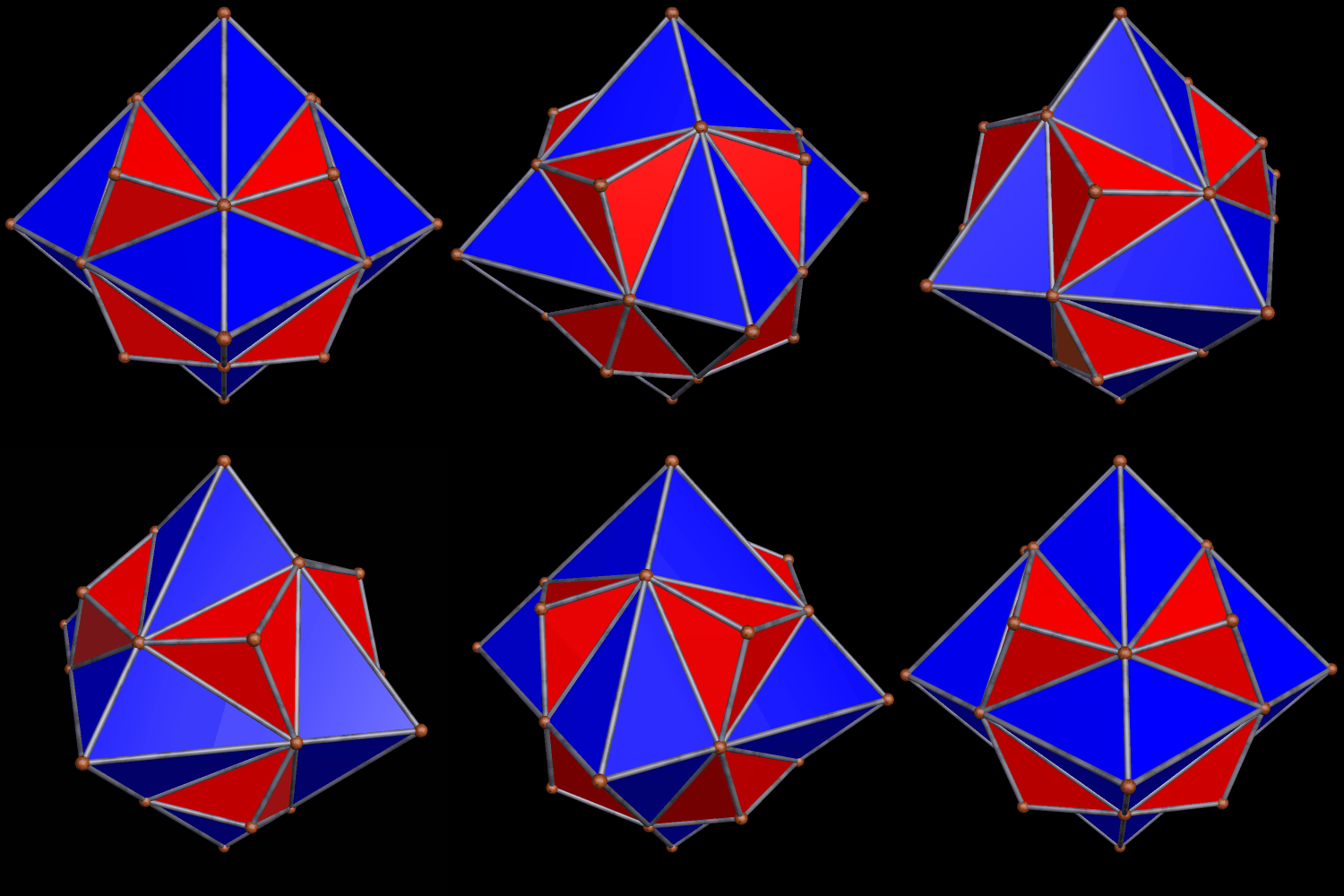
A Compound of the Octahedron, and a Pyritohedral Dodecahedron

Compound of octa and pyritohedral dodeca

This compound is the first I have seen which combines a Platonic solid (the blue octahedron) with a pyritohedral modification of a Platonic solid. Here’s what a pyritohedral dodecahedron looks like, by itself:

pyritohedral dodecahedron

Stella 4d: Polyhedron Navigator was used to make these — software you can try right here: http://www.software3d.com/Stella.php.

A (Possible) New Near-Miss to the Johnson Solids

near-miss candidate

In the polyhedron above, the octagons, hexagons, and triangles are regular. The only irregularities are found in the near-squares, which are actually isosceles trapezoids with three edges of equal length: the ones shared with the octagons and hexagons. The trapezoid-edges adjacent to the triangles, however, are ~15.89% longer than its other three edges. As a result, two of the interior angles of the trapezoids measure ~85.44º (the ones nearest the triangles), while the other two (adjacent to the shorter of the two trapezoid bases) measure ~94.56º. In a rotating model, it can be difficult to see the irregularities in these trapezoids. Were someone to build an actual physical model, however, the fact that they are not squares would be far more obvious.

In case someone would like to build such a model, here is a net you can use.

near-miss candidate

As you can see on this Wikipedia page, near-misses are not precisely defined — nor can they be, without such a definition (including something such as “no edge may be more than 10% longer than any other) being unjustifiably arbitrary. Instead, new near-miss candidates are discussed among members of the small community of polyhedral enthusiasts with an interest in near-misses, and are either admitted to the set of recognized near-misses, or not, based on consensus of opinion. This isn’t an entirely satisfactory system, but it’s the best we have, and may even be the best system possible.

The shortest definition for “near-miss Johnson solid” is simply “a polyhedron which is almost a Johnson solid.” Recently, a new (and even more informal) term has been created: the “near near-miss,” for polyhedra which are almost near-misses, but with deviations from regularity which are too large, by consensus of opinion, to be called near-misses. This polyhedron may well end up labeled a “near near-miss,” rather than a genuine near-miss.

Several questions remain at this point, and once I have found the answers, I will update this post to include them.

  • Is this close enough to being a Johnson solid to be called a near-miss, or merely a “near near-miss?”
  • Has this polyhedron already been found before? It looks quite familiar to me, and so it is entirely possible I have seen it before, and have simply forgotten when and where I saw it. On the other hand, this “I’ve seen it before” feeling may be caused by this polyhedron’s similarity to the great rhombcuboctahedron (also known as the truncated cuboctahedron, and a few other names), one of the Archimedean solids.
  • Does this polyhedron already have a name?
  • If unnamed at this time, what name would be suitable for it?

All the images in this post were created using Stella 4d, and I also used this software to obtain the numerical data given above. A free trial download of this program is available, and you can find it at http://www.software3d.com/Stella.php. Also, since it was mentioned above, I’ll close this post with a rotating image of the great rhombcuboctahedron. Perhaps a suitable name for the near-miss candidate above would be the “expanded great rhombcuboctahedron,” although it is entirely possible that a better name will be found.

Trunc Cubocta

Update #1: I now remember where I’ve seen this before: right here on my own blog! You can find that post here. I could delete this, as a duplicate post, but am choosing not to. One reason: the paths I took to create these two identical polyhedra were entirely different. Another reason is that this post includes information not included the first time around.

Update #2: This was already discussed among my circle of polyhedral enthusiasts. As I now recall, the irregularity in the quadrilaterals was agreed to be too large to call this a true “near-miss,” so, clearly, it’s a “near near-miss” instead.

Five More Clusters of Rhombicosidodecahedra

Making the four different clusters of rhombicosidodecahedra seen in the post right before this one was fun, so I decided to make more of them.

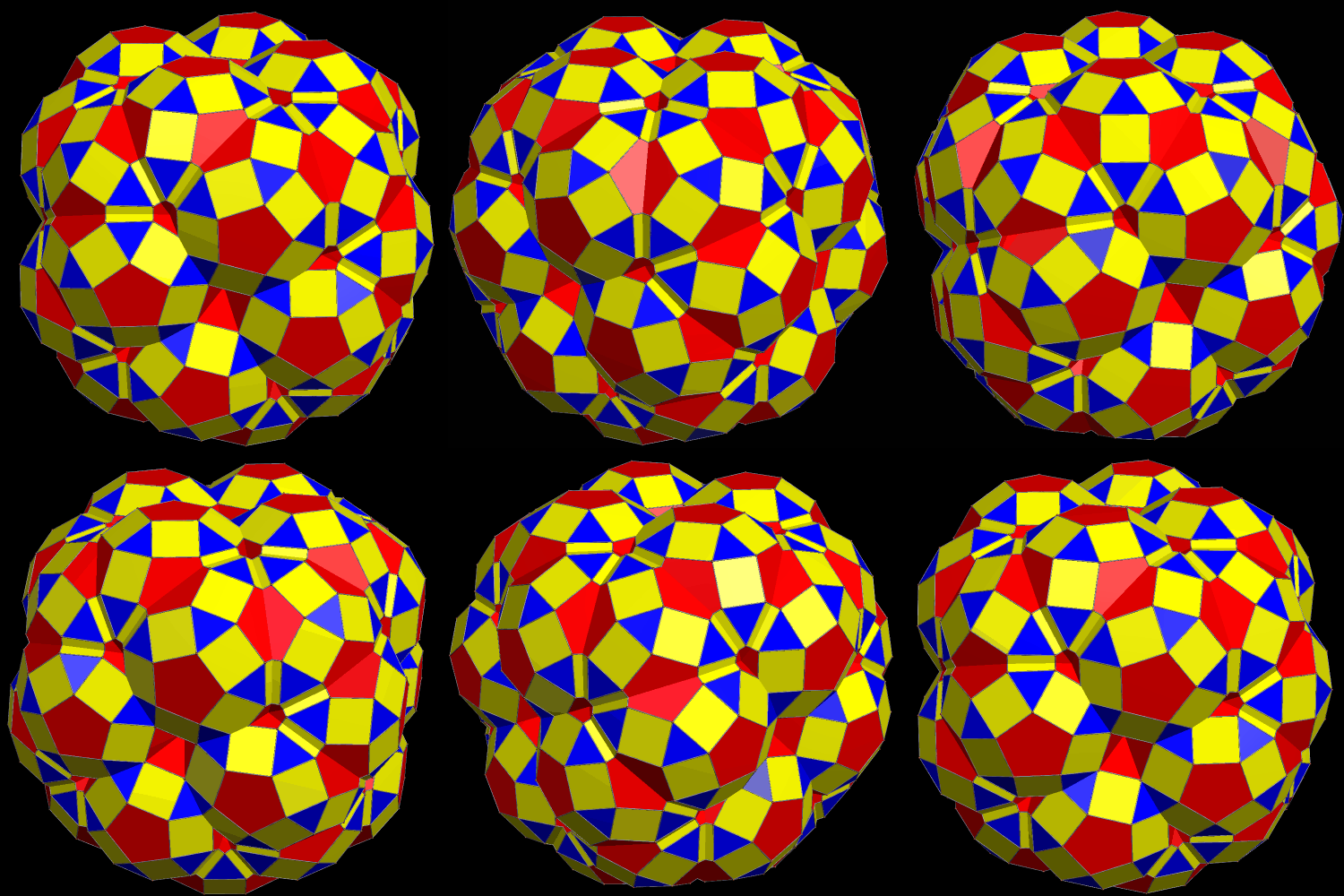
Tetrahedra 20 A augmented with 80 RIDs

There are two different forms of the compound of twenty tetrahedra. To make the polyhedral cluster above, I chose one of them, and then augmented each of its 20(4) = 80 triangular faces with a rhombicosidodecahedron.

For the next of these clusters, I decided to move away from using compounds for the central, hidden figure. Instead, I chose a snub cube, and augmented each of its 32 triangular faces with a rhombicosidodecahedron. Since the snub cube is chiral, this cluster is chiral as well.

Augmented Snub Cube the 32 triangles are augmented by RIDs

Any chiral polyhedron can be combined with its mirror-image to produce a new compound, and that’s what I did to make this next cluster, which is composed of 64 rhombicosidodecahedra: I simply added the cluster above to its own reflection.

Compound of enantiomorphic pair of snub cubes with RIDs augmenting the 64 triangles

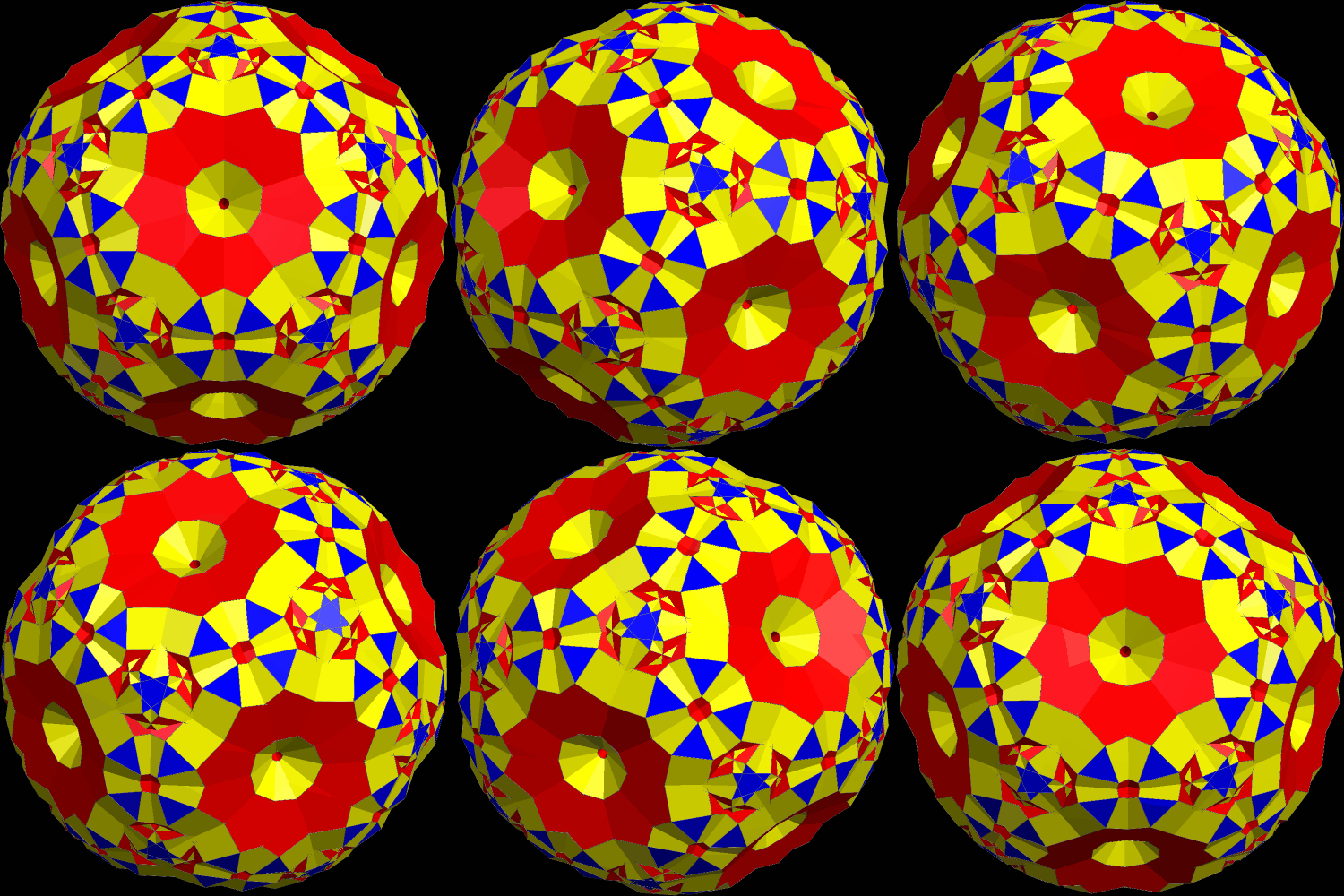
Next, I turned to the snub dodecahedron, also chiral, and with 80 triangular faces. Augmentation of all 80 produced this chiral cluster of 80 rhombicosidodecahedra:

Augmented Snub Dodeca with 80 RIDs on triangular faces it is chiral

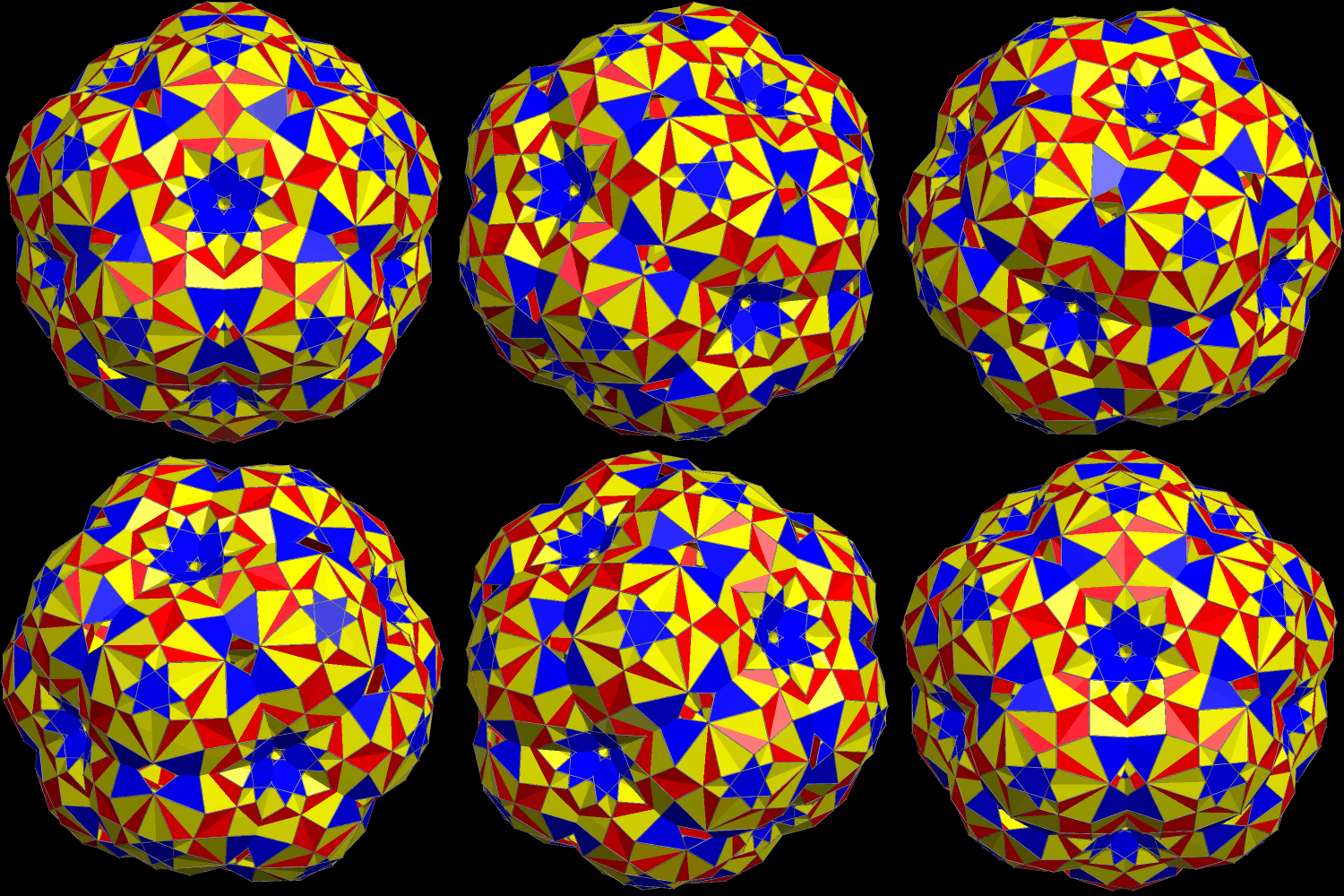
Finally, I added this last cluster to its own mirror-image, producing this symmetrical cluster of 160 rhombicosidodecahedra.

160 RIDs augmenting the triangular faces of snub dod enan pair compound

Each of these was created using a program called Stella 4d: Polyhedron Navigator, software you can try for free right here.

Four Different Clusters of Multiple Rhombicosidodecahedra

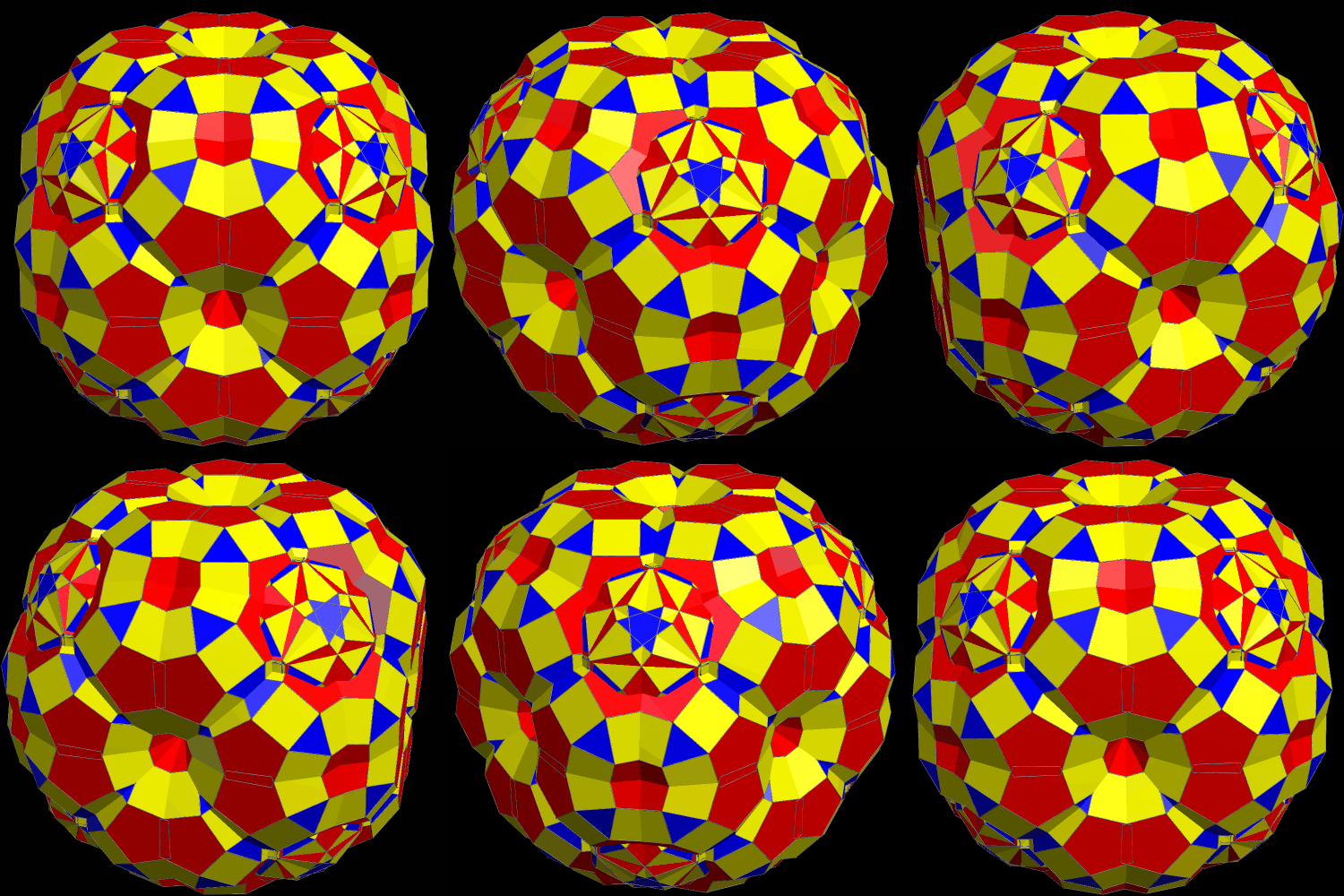
Octa 5 augmented with 40 RIDs

To make the cluster above, I began with the compound of five octahedra, which has 5(8) = 40 faces, all of them equilateral triangles. Next, I augmented each of those triangular faces with a single rhombicosidodecahedron — forty in all.

Next, I started anew with the compound of five dodecahedra, which has 5(12) = 60 pentagonal faces, all of them regular. Each of these sixty pentagons was then augmented by a single rhombicosidodecahedron.

Dodecahedra 5 augmented by 60 RIDs

For the next cluster, I started with the most well-known compound of ten tetrahedra. There are actually two such compounds; I used the one which is the compound of the chiral five-tetrahedron compound, combined with its mirror image. Since 10(4) = 40, this cluster, like the first one in this post, contains forty rhombicosidodecahedra. Unlike the other models shown here, this one has “holes,” which you can see as it rotates, but the reason for this is a mystery to me. The same is true for the first cluster shown in this post.

Tetrahedra 10 augemnted with 40 RIDs

There also exist two compounds of eight tetrahedra each, and I used one of them for this next cluster, using the same procedure, so this cluster is composed of 8(4) = 32 rhombicosidodecahedra.

Tetrahedra 8 augmented with 32 RIDs

All four of these clusters were created with Stella 4d, a program you may try for free here.

The Compound of the Truncated Octahedron and the Rhombic Dodecahedron

RD trunct oct compound

I created this compound using Stella 4d, software you may try at this website.

Orcus and Vanth

There’s a binary dwarf-planet-candidate / large satellite pair, way out in the outer solar system, called Orcus and Vanth. Much like the “double dwarf planet” Pluto/Charon, and the other satellites in that system, Orcus and Vanth orbit the sun in a 3:2 resonance with Neptune, and this orbit crosses that of Neptune, as well. The Orcus/Vanth binary system is sometimes referred to as the “anti-Pluto,” because, unlike most “plutinos” (as such distant objects, in orbital resonance with Neptune, are called), Orcus and Vanth have a strange — and, so far, unexplained — relationship with the Pluto/Charon system. When Pluto and Charon are closest to the sun (perihelion), Orcus and Vanth are at their furthest from the sun (aphelion), and vice-versa. So far as I have been able to determine, this is not true for any other known plutinos. For more on the real Orcus and Vanth, please check this Wikipedia page.

Those are the scientific facts, as we know them . . . and now, it’s time for some silliness. On Facebook, recently, I mentioned that “Orcus” and “Vanth” really would make good names for comic book characters, but that I couldn’t decide what they should look like, nor what powers they should have. A discussion with some of my friends followed, and, together, we decided that Orcus should be a tough fighter-type, while “Vanth” sounded like a name for some sort of spell-caster. It didn’t take long before I decided I should visit one of the numerous create-your-own-comic-book-character websites, and go ahead and make quasi-anthropomorphized images of Orcus and Vanth — the characters, not the outer solar-system objects.

I used a website called Hero Machine for this diversionwhich you can find here. First, I created an image for a character named Orcus.

orcus

Unfortunately, I didn’t discover (until it was too late) that this website allows the user to change the background . . . and I didn’t want to re-make Orcus, so I went ahead and created an image of his companion, Vanth, instead.

vanth

I don’t have the time, nor the artistic talent, to write and illustrate actual comic book stories featuring this pair of characters . . . but perhaps someone will read this, and decide they want to take on such a project. That’s fine with me . . . but I want credit (in writing, each issue) for creating them, and, if the endeavor makes any money, I want at least 20% of the profits, and that’s if I have nothing more to do with creating Orcus and Vanth stories, beyond what is posted here. If I do have additional involvement, of course, we’ll need to carefully negotiate the terms of a contractual agreement. I consider 20% fair for simply creating images of this pair of characters, but actually co-creating stories would be something else altogether.

By the way, although Orcus certainly looks scarier, Vanth is actually the more formidable of the pair. She just pretends to play the “side-kick” role, in order to preserve the element of surprise, for situations when, during their adventures, Orcus finds himself in over his head, and Vanth then needs to really cut loose with the full extent of her abilities.

A Hybrid Polyhedron: The “Offspring” of Jessen’s Icosahedron and the Great Dodecahedron

I stumbled upon this interesting hybrid of two well-known polyhedra, while simply playing around with Stella 4d, the software I use to make these rotating polyhedral images (you can try a free trial download of it here).

Jessens icosa meets the great dodeca

The faces of the above polyhedron are twelve modified regular pentagons, each with a triangular piece removed which contained one of the pentagon’s edges. Therefore, it would also be correct to refer to these modified pentagons as non-convex hexagons. These modified pentagons interpenetrate, so all that can be seen are triangular “facelets” — the parts of the faces which are not hidden inside the polyhedron. Each of these facelets is a golden gnomon (an obtuse, isosceles triangle with a base:leg ratio which is the golden ratio), and these golden gnomons come in two sizes. The larger ones were “inherited” from Jessen’s icosahedron, and there are twelve of them. The smaller golden gnomons, on the other hand, were “inherited” from the great dodecahedron, and are twenty-four in number, in eight sets of three. Like Jessen’s icosahedron itself, but unlike the great dodecahedron, this hybrid has pyritohedral symmetry.

For more information about Jessen’s icosahedron, please visit this site at Wolfram Mathworld. Also, here is an image of Jessen’s icosahedron, one of the two “parents” of the hybrid above.

Jessens Icosa

While Jessen’s icosahedron is a relatively new discovery (Børge Jessen revealed it to the world in 1967), the hybrid’s other “parent,” the great dodecahedron, has been known for much longer; Louis Poinsot discovered it in 1809, according to this source. Here’s an image of the great dodecahedron.

Great Dodeca

As you can see, the smaller golden gnomons found in the hybrid above were “inherited” from the great dodecahedron, while the larger ones came from the six indented face-pairs found in Jessen’s icosahedron.

A well-known property of Jessen’s icosahedron is that it is “shaky,” unlike most polyhedra, which are rigid. A physical model of Jessen’s icosahedron, made from paper and tape, can, in fact, be collapsed to form an octahedron. While I suspect that a physical, paper-and-tape model of this newly-discovered hybrid polyhedron would share these properties (“shakiness,” and at least some degree of collapsibility), I have not (yet) tested this conjecture.

On the Verge

Mysterious

I made this with Stella 4d, which you can download here.

The Great Rhombicosidodecahedron, Built from Rhombic Triacontahedra, and Its Dual

The great rhombicosidodecahedron is also known as the truncated icosidodecahedron (and, confusingly, several other names). Regardless of what it’s called, these pictures demonstrate that this Archimedean solid can be constructed using rhombic triacontahedra as building-blocks.

First, here’s one in the same color I used for the decagonal ring of rhombic triacontahedra in the last post:

GRID of Rhombic Triaconta

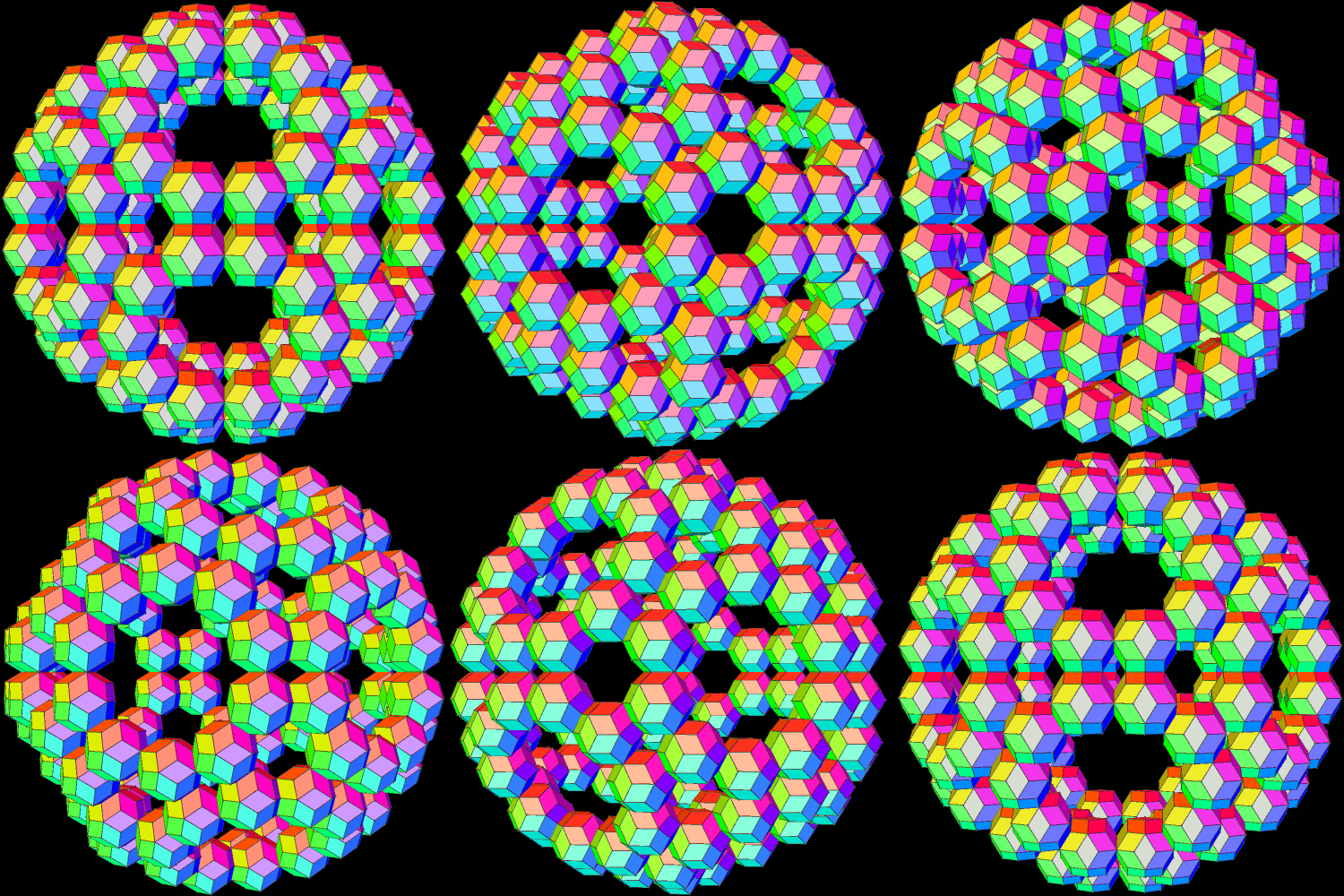
The next one is identical, except I used “rainbow color mode” for it.

GRID of Rhombic Triaconta RB

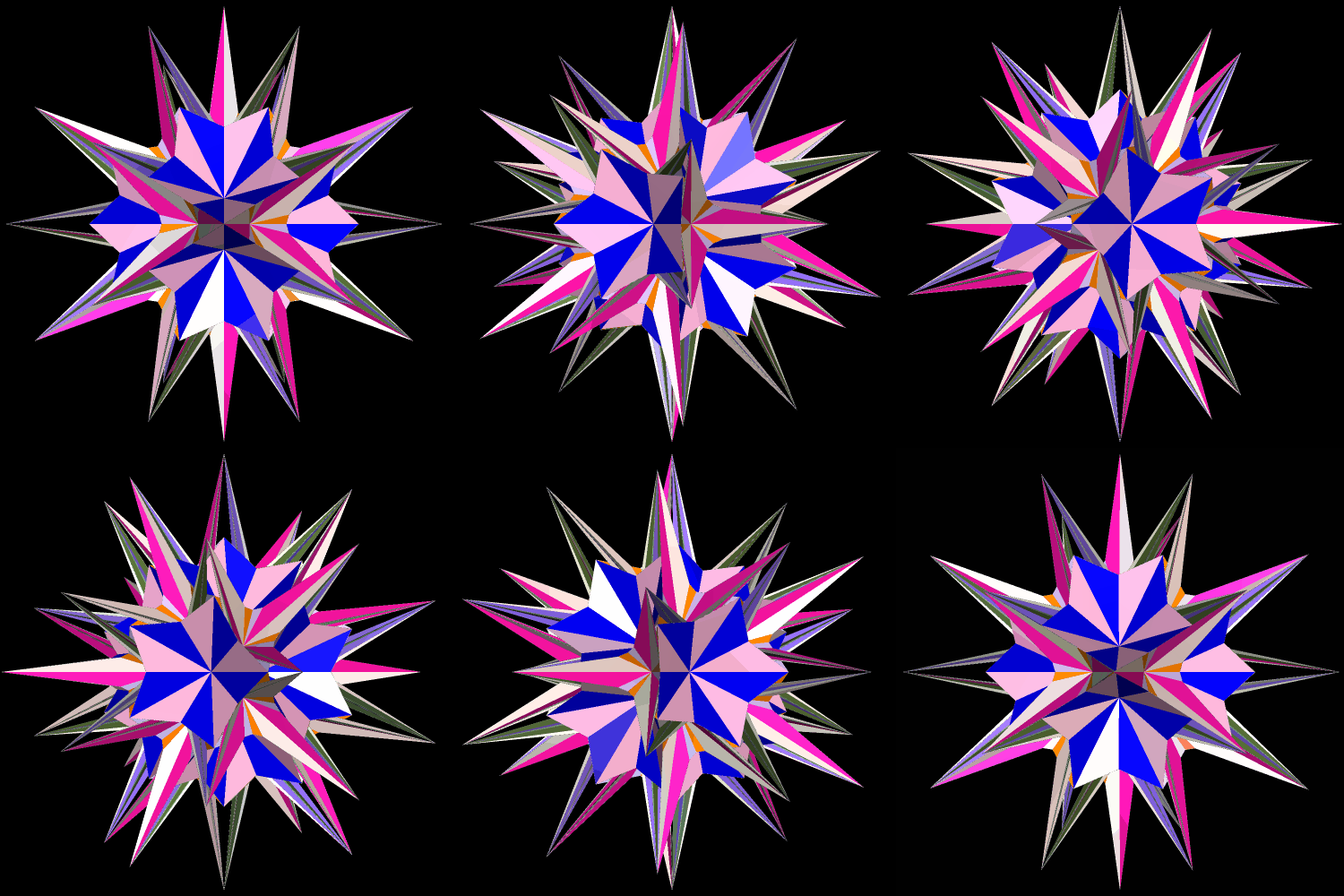
Also, just in case you’re curious, here’s the dual of this polyhedron-made-of-polyhedra — this time, colored by face-type.

dual of GRID of Rhombic Triaconta

These virtual models were all built using Stella 4d, software you may buy, or try for free, right here.

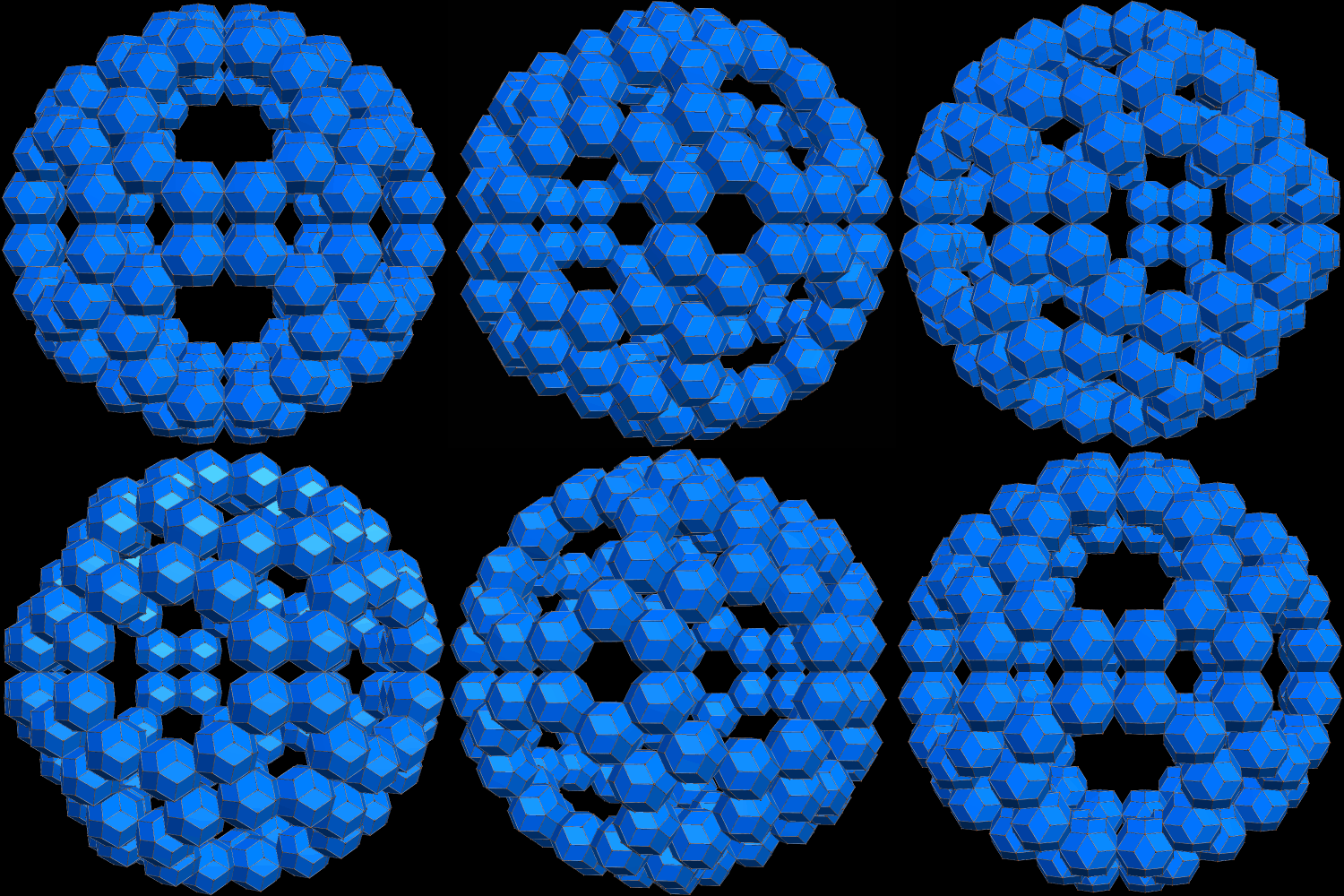
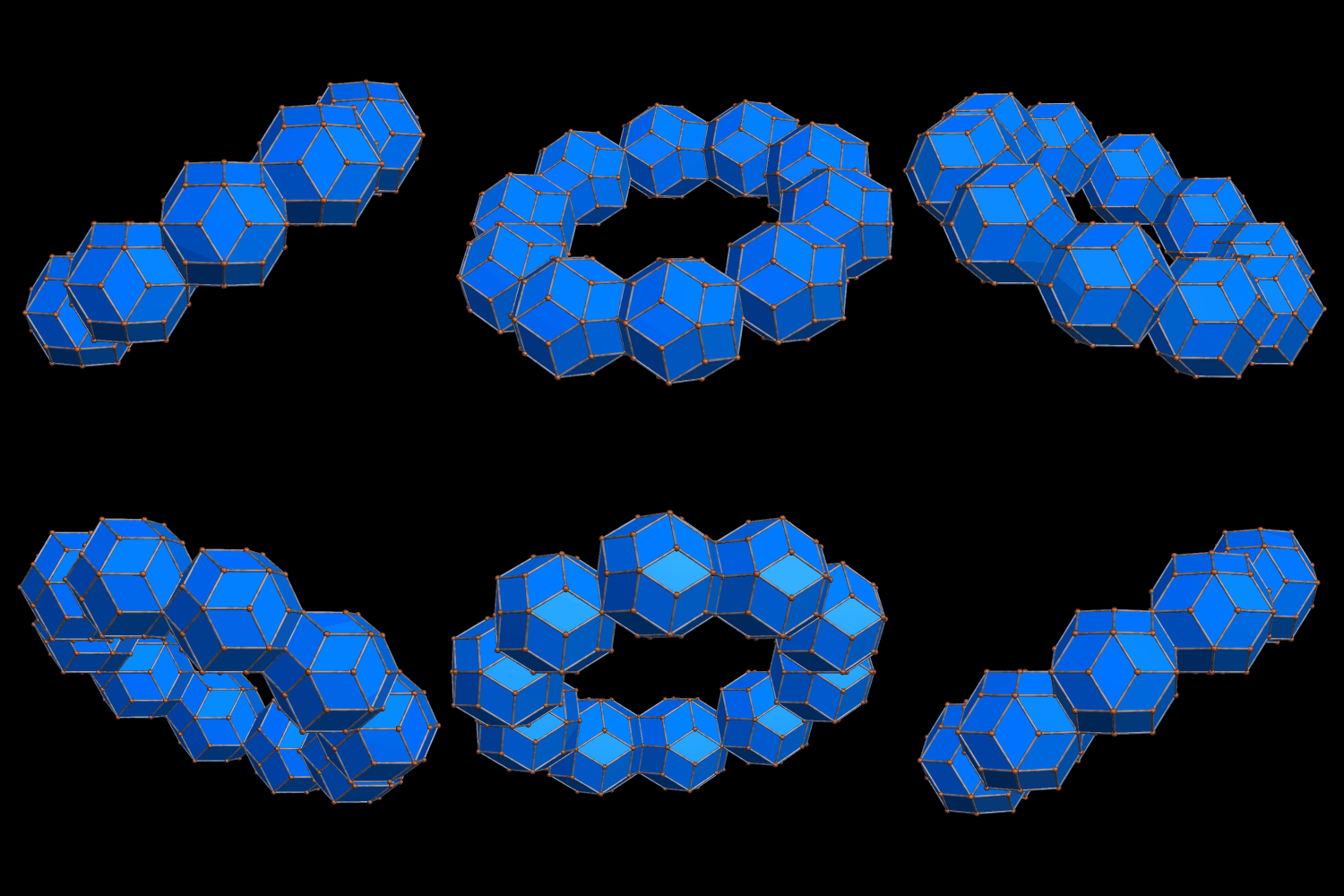
Decagonal Ring of Rhombic Triacontahedra

ring of ten Rhombic Triaconta

Ten rhombic triacontahedra fit perfectly into a decagonal ring. It’s not a “near-miss” — the fit is exact.

I made this with Stella 4d, software you can try for free, or purchase, at http://www.software3d.com/Stella.php.