Unknown's avatar

About RobertLovesPi

I go by RobertLovesPi on-line, and am interested in many things, a large portion of which are geometrical. Welcome to my own little slice of the Internet. The viewpoints and opinions expressed on this website are my own. They should not be confused with those of my employer, nor any other organization, nor institution, of any kind.

The 12th Stellation of the Dodecahedron/Icosahedron Compound

I used Stella 4d to make this. You can try this program for yourself, for free, at this website.

Alone at the Typewriter, With an Unusual Use of Mozart

Image source: here.

At 53, I’m old enough to have needed a typewriter to write papers, as an undergraduate, back when I was still living with my mother in Little Rock, Arkansas (USA), and attending the University of Arkansas at Little Rock, or UALR. Majoring in history, I wrote many. When I did this, I had a certain ritual about the activity, one that fell from use once I made the much-appreciated transition to using computers, instead.

First, I had to have the typewriter in the center of the living room, oriented at a 45 degree diagonal to the walls. Next, I had to be wearing a bedsheet, wrapped around one shoulder, toga-style. No other clothes were permitted. Finally, I had to have my vinyl version of Mozart’s Requiem playing, over and over, from the time I started the paper until it was completed. This would generally happen early in the morning, on the day the paper was due, procrastination being one of my defining characteristics at that age.

I’m glad I don’t have to write papers anymore, and that the typewriter era is over.

Two Polyhedra Derived From the Icosahedron

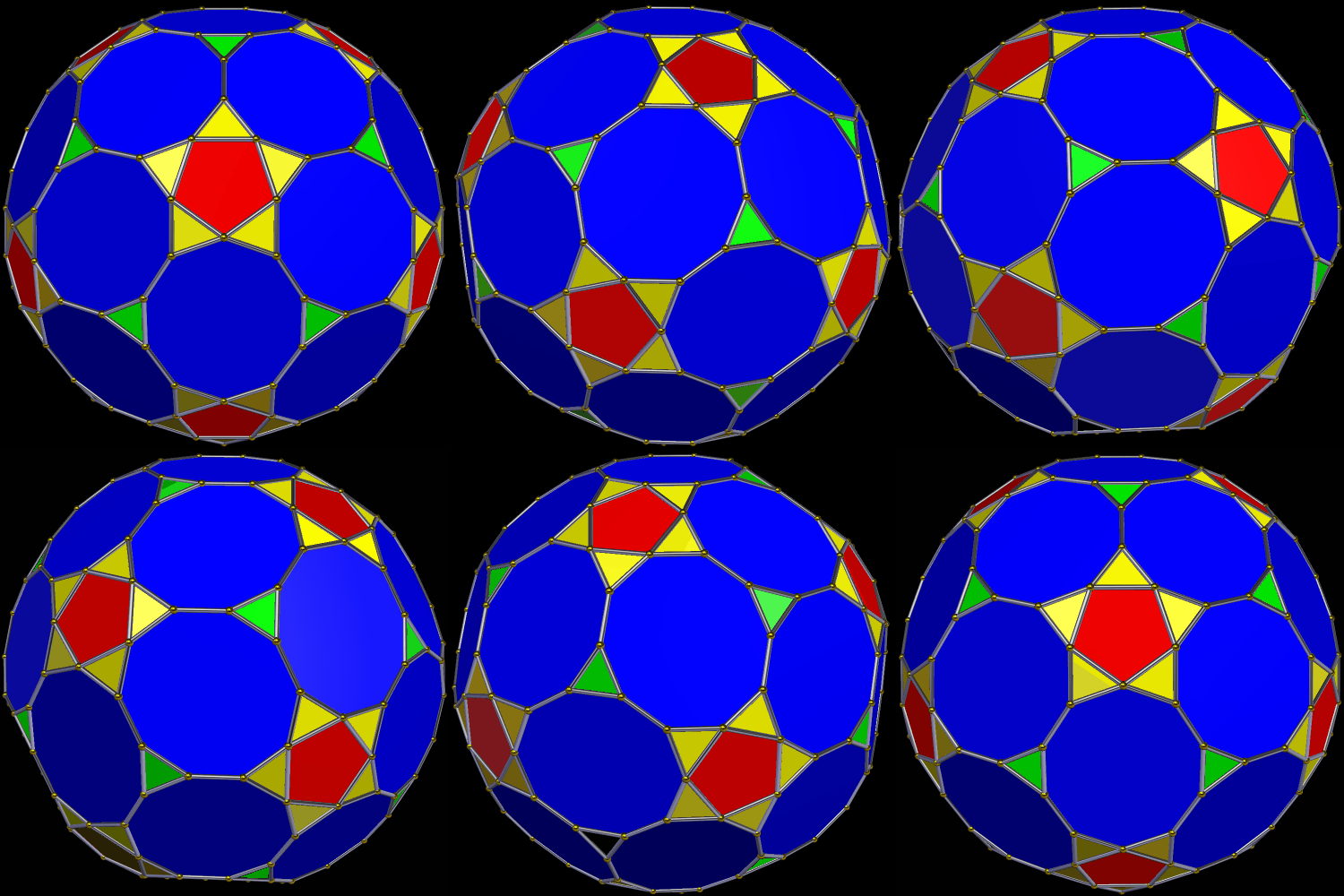
The polyhedron above is a zonish icosahedron, with zones added to that Platonic solid based on its faces and vertices. Its faces are twenty equilateral triangles, thirty equilateral decagons, and sixty rhombi. After making it, I used faceting to truncate the vertices where sets of five rhombi met, creating the polyhedron below. It has twelve regular pentagons as faces, with the sixty rhombi of the polyhedron above turned into sixty isosceles triangles, along with the thirty decagons and twenty triangles from the first of these two polyhedra. This second one could be called either a faceted zonish icosahedron, or a truncated zonish icosahedron.

Both of these polyhedra were created using Stella 4d: Polyhedron Navigator, software you can try for free at http://www.software3d.com/Stella.php.

A Regular Icosagon, Split Into 180 Rhombi

Image

A Tessellation Featuring Regular Octadecagons, Regular Hexagons, and Equilateral Triangles, as Well as Right Trapezoids

Image

A Tessellation Featuring Regular Tetrakaiicosagons, Squares, Convex Pentagons, and Isosceles Triangles

Image

A Tessellation Featuring Regular Tetrakaiicosagons, Regular Dodecagons, Convex Pentagons, Rectangles, and Isosceles Triangles

Image

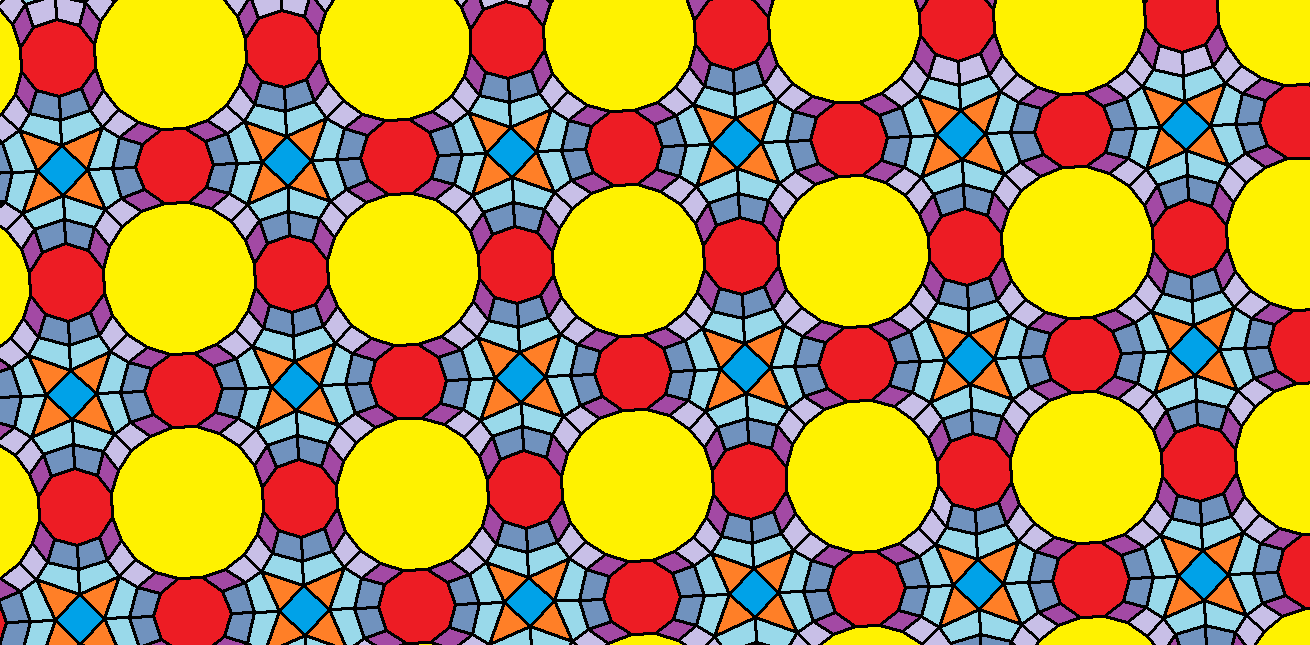
A Tessellation Featuring Regular Icosagons, Decagons, and Squares, Along With Rhombi, Other Quadrilaterals, and Isosceles Triangles

Image

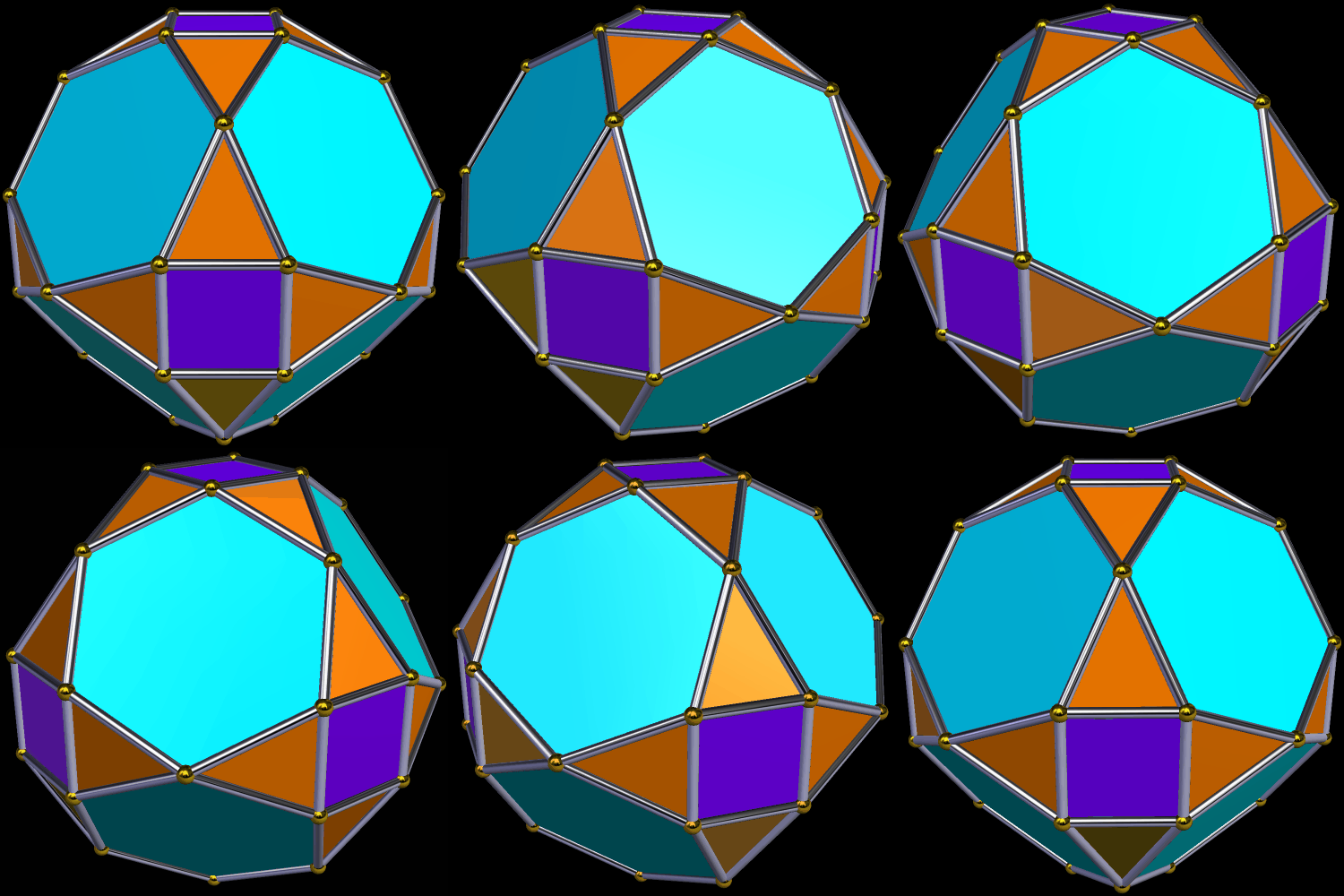
A Symmetrohedron Featuring Eight Regular Hexagons, Six Squares, and 24 Isosceles Triangles

The isosceles triangles in this polyhedron have legs which are each 22.475% longer than their bases. I made this by creating the dual of the convex hull of the base/dual compound of the truncated octahedron, using a program called Stella 4d, which you can try for free right here.

The Compound of the Truncated Cube and the Rhombic Dodecahedron

This was created using Stella 4d: Polyhedron Navigator. You may try this program for free at this website.