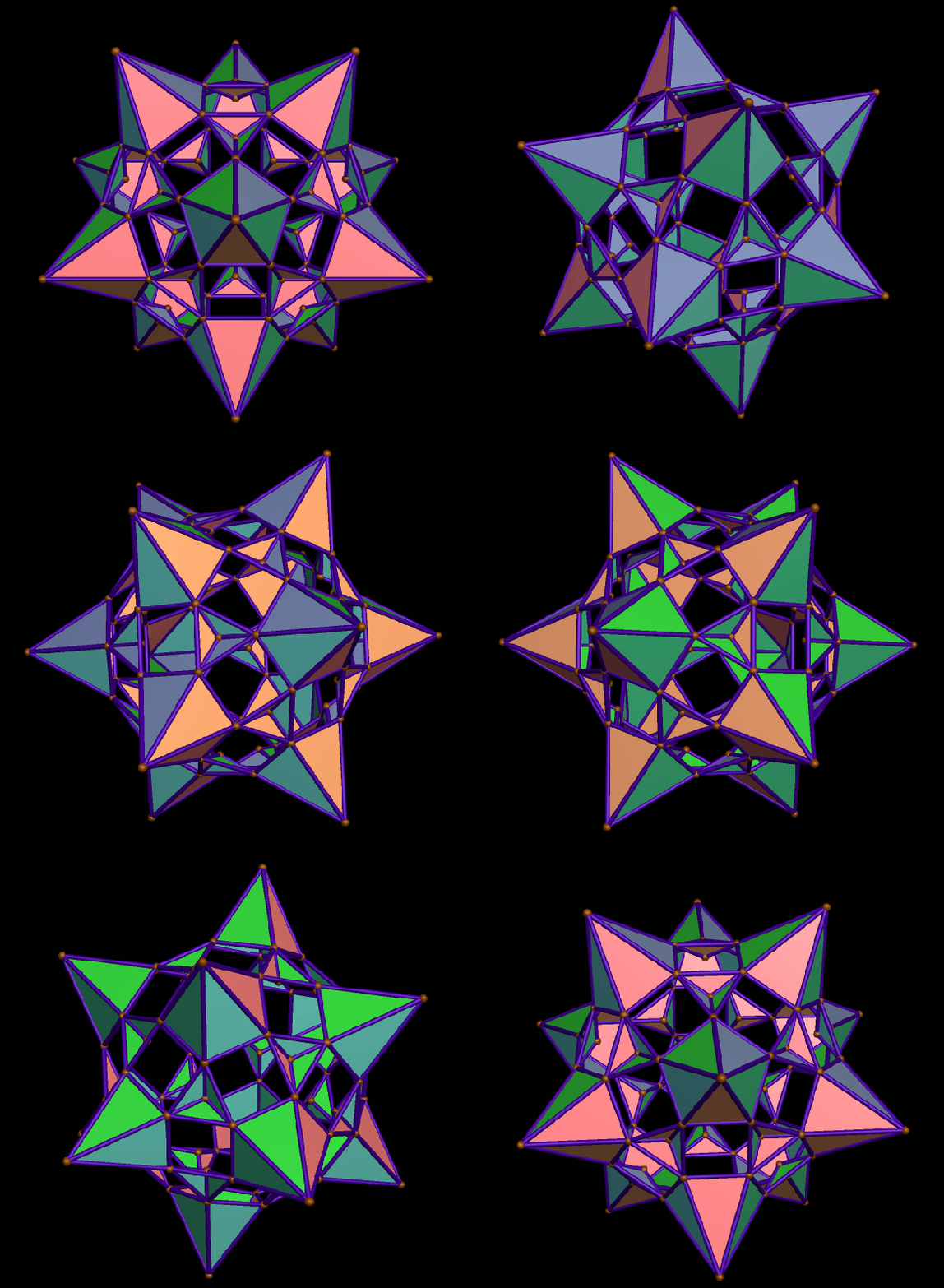
Software credit: I made this image using Stella 4d, available at http://www.software3d.com/Stella.php (free trial download available).
Software credit: I made this image using Stella 4d, available at http://www.software3d.com/Stella.php (free trial download available).
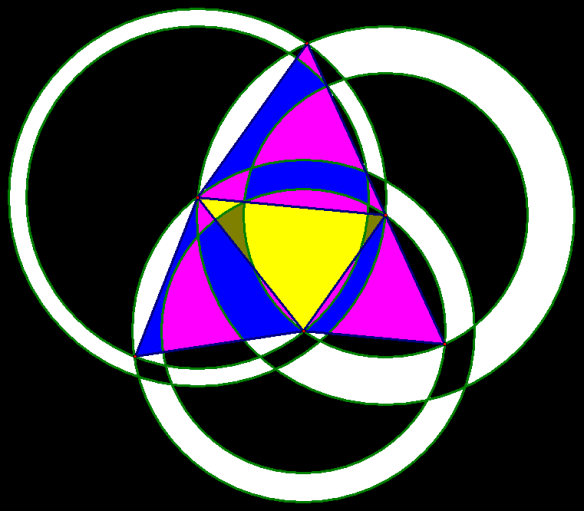

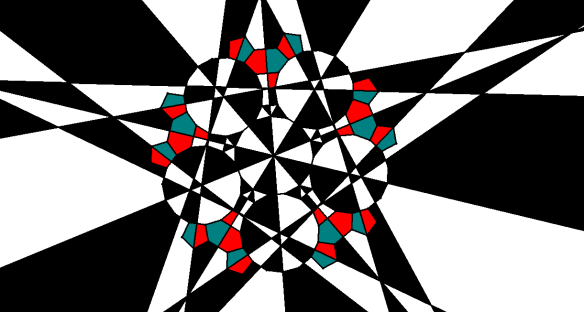
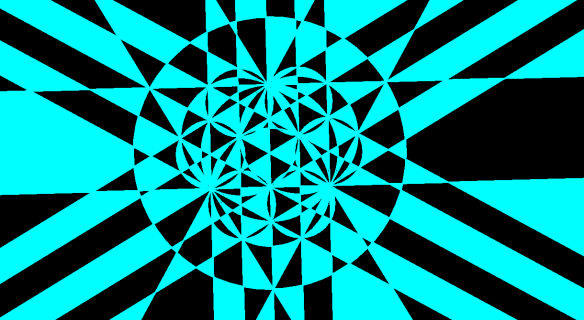
[Note: if you are not familiar with the nine-point circle already, you may wish to see the next post on this blog, where it is explained in detail.]
The largest circle shown here is the circumscribed circle for a large equilateral triangle, and its nine-point circle is shown as well. Also, each altitude of an equilateral triangle splits it into two 30-60-90 triangles. Since there are three such altitudes, there are six 30-60-90 triangles of this size — and all their nine-point circles are shown as well. These three altitudes, taken together, also split the equilateral triangle into six smaller 30-60-90 triangles, and their nine-point circles are also shown here.

I suspect that this could be continued outward indefinitely, as a radial and aperiodic tessellation, using only the four polygons you see, repeatedly, here. However, I have no proof of this.


This is a top-down depiction of the first nine terms of the Fibonacci Sequence: 1, 1, 2, 3, 5, 8, 13, 21, and 34. Since each term is simply the sum of the previous two terms, the next term (and the first one to not be shown here) is 55. The sequence, of course, continues forever . . . but if too much of the sequence is shown in this manner, the top of the tower would become too small to be seen.
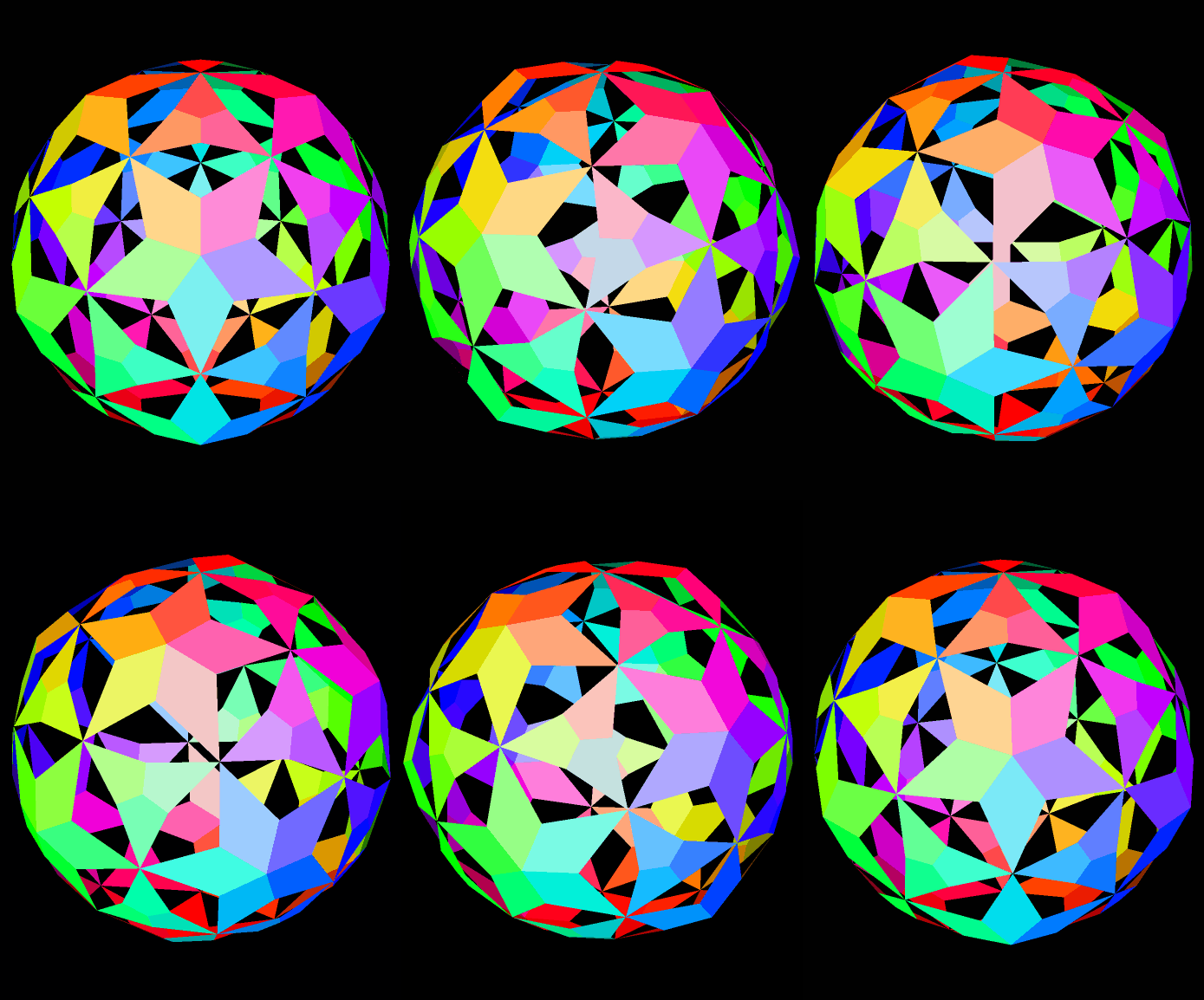
Created with software you can try and/or buy at http://www.software3d.com.Stella.php.

Created with software you can try and/or buy at http://www.software3d.com.Stella.php.
 RobertLovesPi.net