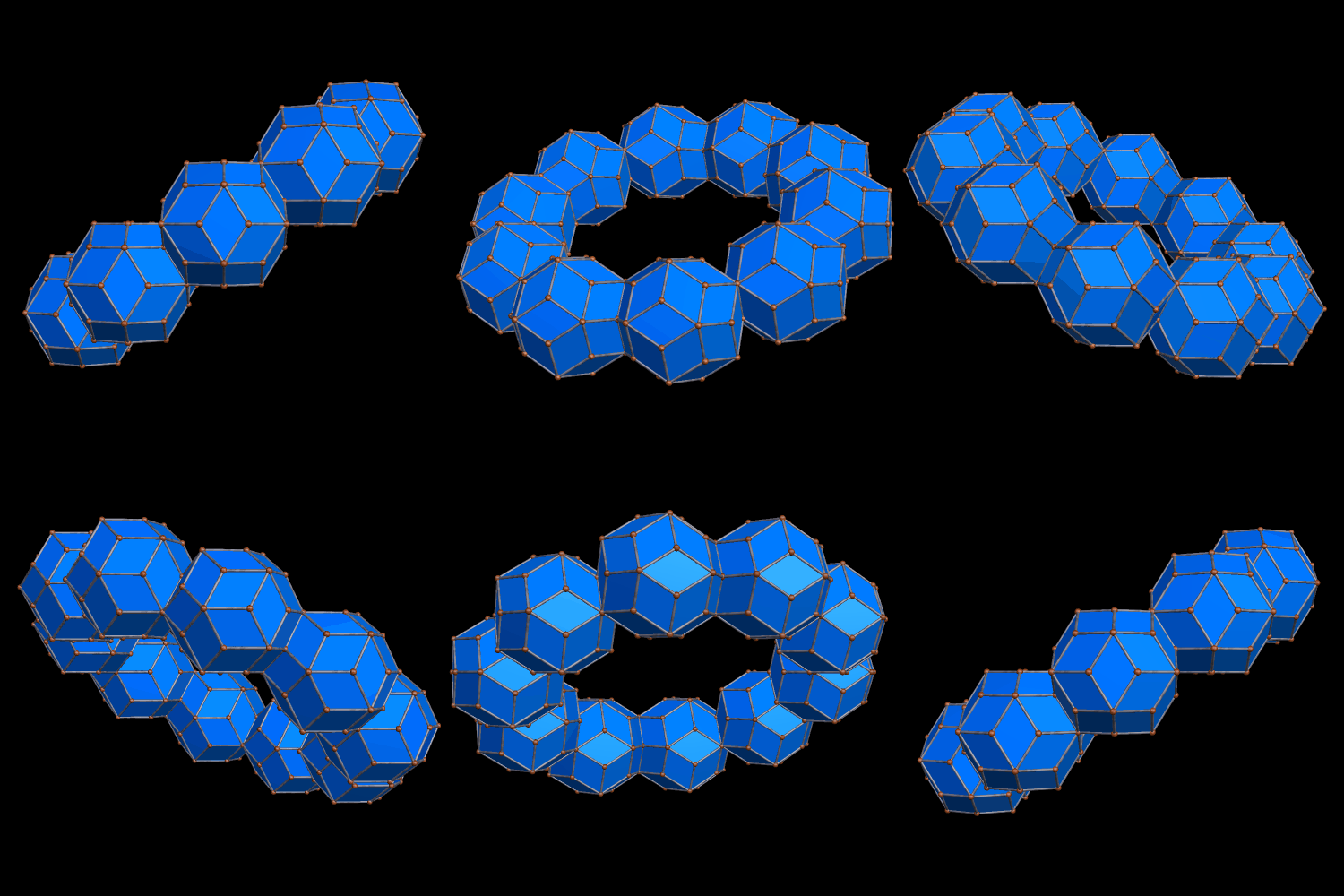
Ten rhombic triacontahedra fit perfectly into a decagonal ring. It’s not a “near-miss” — the fit is exact.
I made this with Stella 4d, software you can try for free, or purchase, at http://www.software3d.com/Stella.php.
Ten rhombic triacontahedra fit perfectly into a decagonal ring. It’s not a “near-miss” — the fit is exact.
I made this with Stella 4d, software you can try for free, or purchase, at http://www.software3d.com/Stella.php.
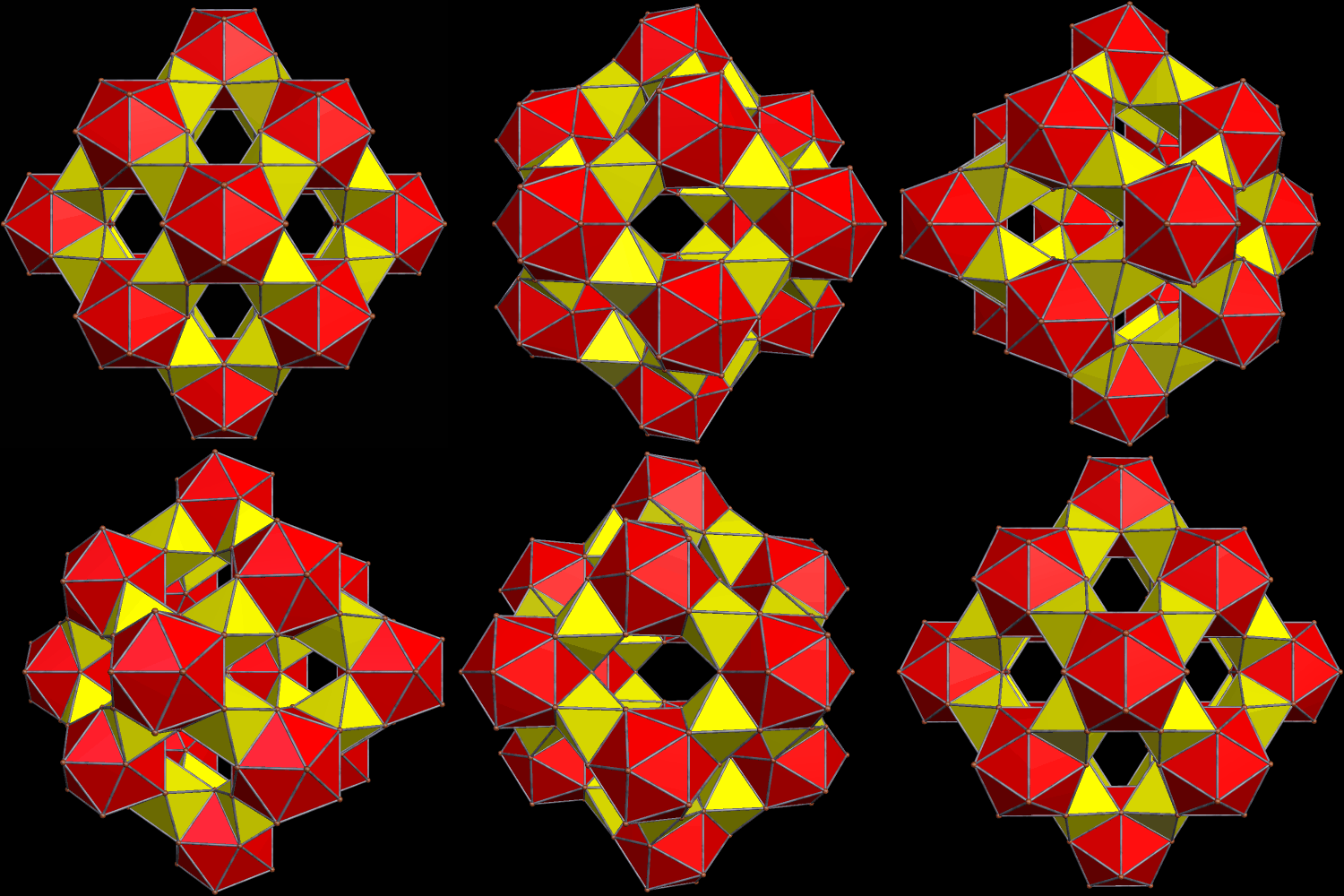
I assembled this using Stella 4d, software available here.

Viewers will be the judges of how successful this attempt to blend these polyhedra actually is. I made it using Stella 4d, software you can try right here.

The twelve purple faces of this faceted dodecahedron show up on Stella 4d‘s control interface as {10/4} star decagons, which would make them each have five pairs of two coincident vertices. I’m informally naming this special decagon-that-looks-like-a-pentagram (or “star pentagon,” if you prefer) the “antipentagram,” for reasons which I hope are clear.
Stella 4d, the program I use to make most of my polyhedral images, may be tried for free at http://www.software3d.com/Stella.php.

I put these two polyhedra together using Stella 4d: Polyhedron Navigator. If you’d like to try this program yourself, for free, this website is the one to visit: http://www.software3d.com/Stella.php.

These are facetings of the snub cube (above) and snub dodecahedron (below). I made both using Stella 4d, software you can try for yourself right here.


I made this using Stella 4d: Polyhedron Navigator, software available here.
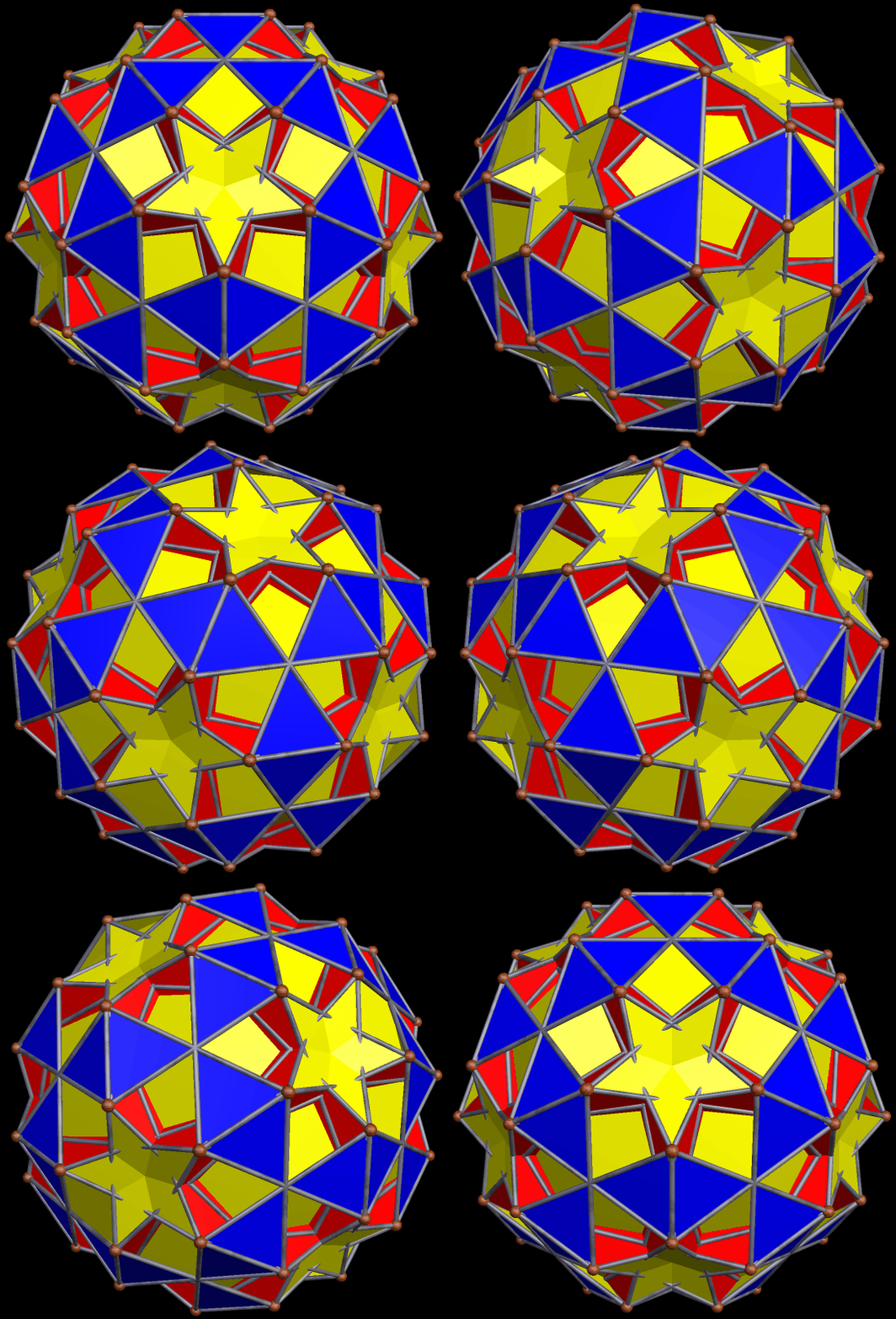
I made these faceted polyhedra, both facetings of the truncated icosahedron, using Stella 4d, software available here.

This survey began in the last post, with selections from the first hundred stellations of this Archimedean solid. In this survey of the second hundred stellations, the first one I find noteworthy enough for inclusion here is the 102nd stellation.

A similar figure is the 111th stellation:

There followed a long “desert” when I did not find any that really “grabbed” me . . . and then I came to the 174th stellation.

The fact that it is monocolored, the way I had Stella 4d set, told me immediately that this stellation (the one above) has only one face-type. There are twenty of these faces; they are each equilateral hexagons which “circumscibe,” in a way, the triangular faces of an icosahedron. For this reason, I suspect this is also one of the stellations of the icosahedron; I’m making a mental note to do exactly that.
I also make a second virtual model of the 174th stellation of the rhombicosidodecahedron, with the faces colored in such a way as to make the interpenetrating equilateral hexagons more obvious.
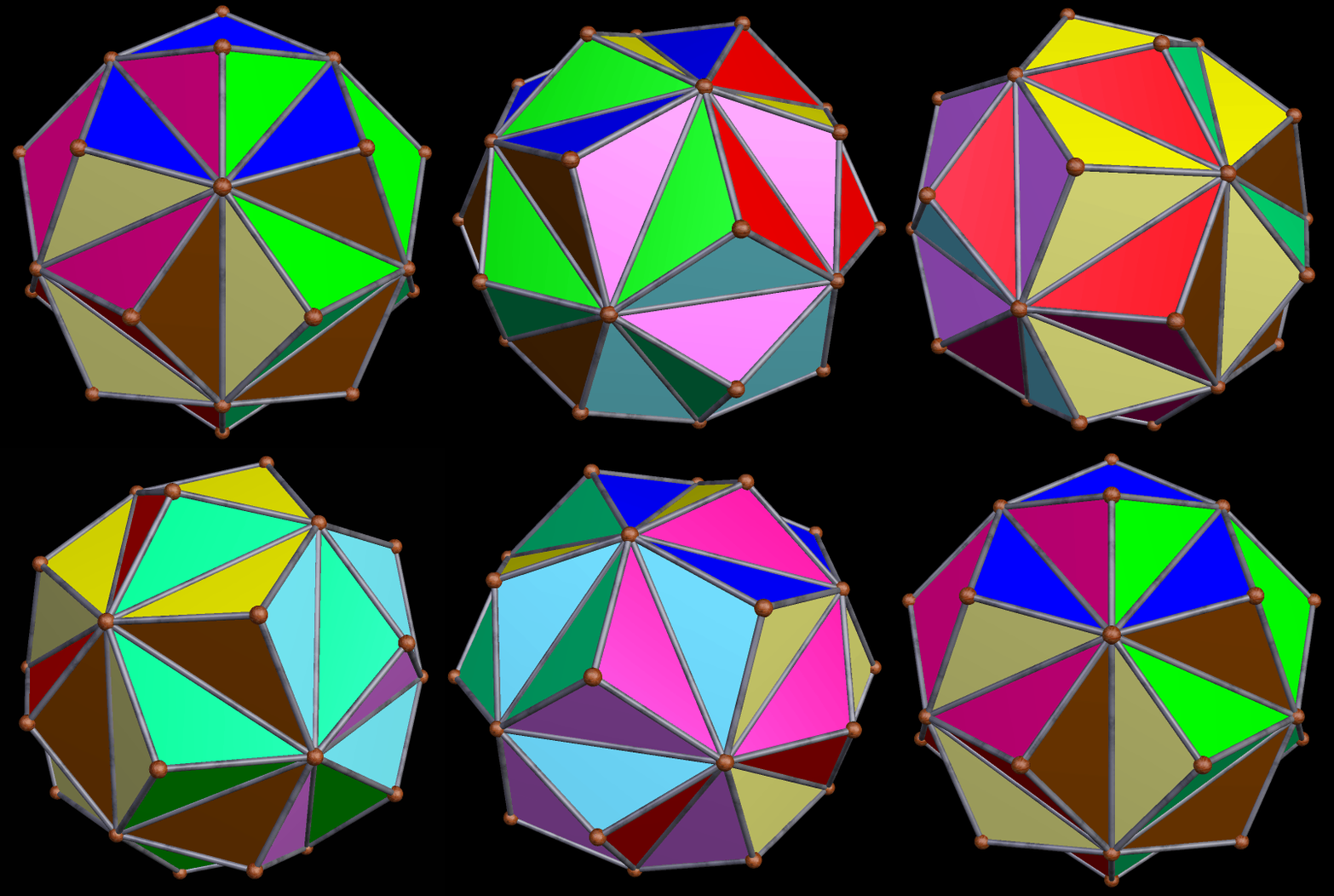
After that interesting stellation, the next one to caught my attention is the 179th stellation.
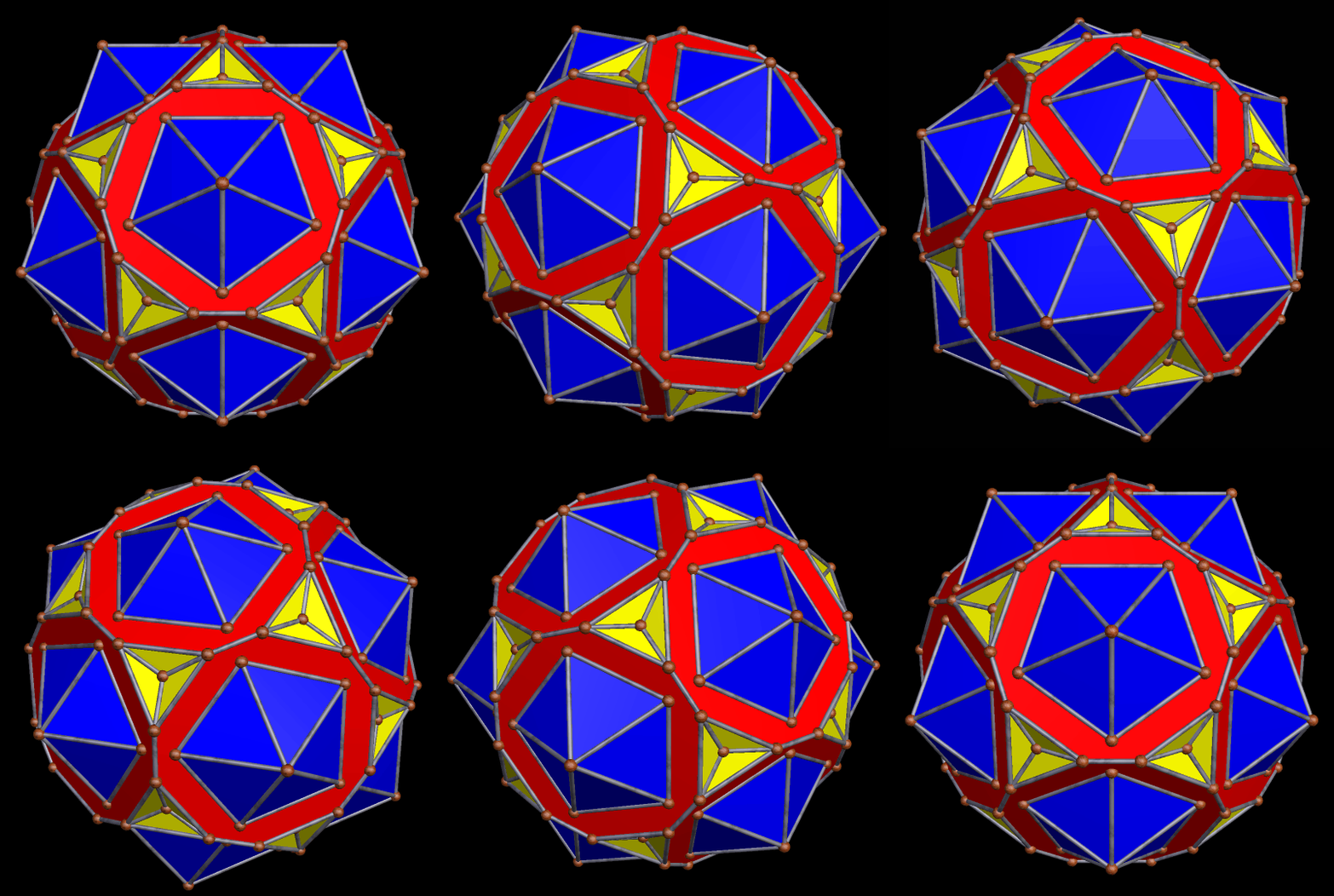
Next of note, the 182nd stellation is similar to the icosahedron/dodecahedron compound, but with the dodecaheron larger than it is in that compound, so that edges, one from each component polyhedron, do not intersect, but are instead skew. Another way to view it is that the dodecahedron is encasing the icoahedron, but with enough room left for portions of the icosahedron to protrude from the faces of the “dodecahedral cage.”

Next is the 183rd stellation.

Here is the 187th stellation, which is quite similar to the last one shown. The pulsating effect, first seen in the last post above, is an accident, and not discovered until after these images were already made, using Stella 4d, which may be tried here. Why didn’t I re-create the .gifs? Simple: I don’t feel like taking the ~10 minutes each to do so.

The 190th stellation may also be viewed as a dodecahedron, augmented with variations of pentagonal pyramids on each face:

Next, the 191st stellation:

And, after that, the 192nd stellation.

The next stellation which grabbed by attention: the 198th.

Finally, I’ll close this set of highlights from this part of the rhombicosidodecahedron’s stellation-series with that solid’s 199th stellation.

Since shortly after I learned of their existence, I have found the rhombicosidodecahedron to be the most attractive of the Archimedean solids. That’s a personal aesthetic statement, of course, not a mathematical one.
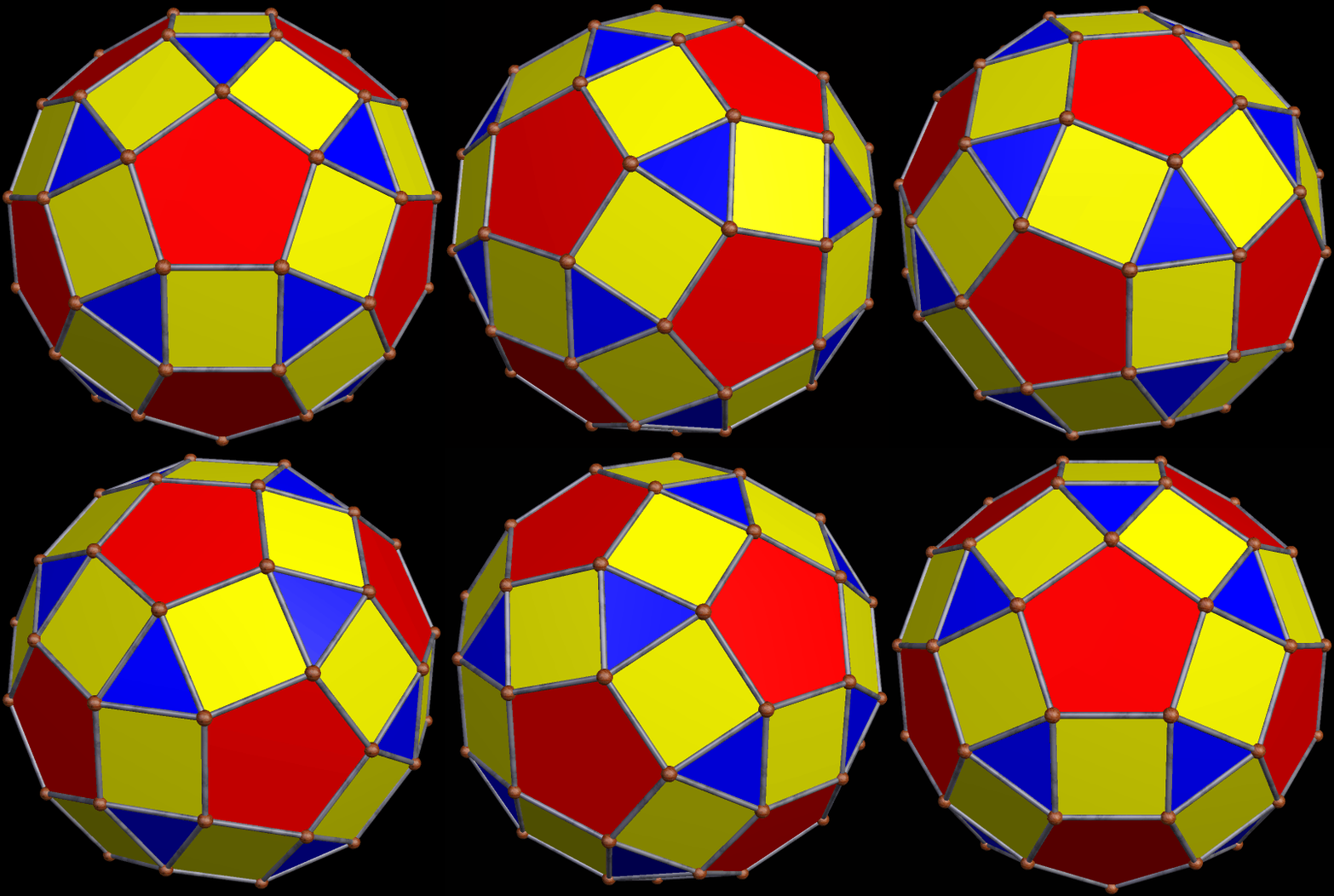
This solid has a long stellation-series. With Stella 4d, the program I used to make these images, it’s easy to simply scroll through them. The stellation of this polyhedron follows these stellation-diagrams; I used Stella 4d to make them as well. You may research, try, or buy this program at this website. The first of these stellation-diagrams is for the planes of the twelve pentagonal faces.
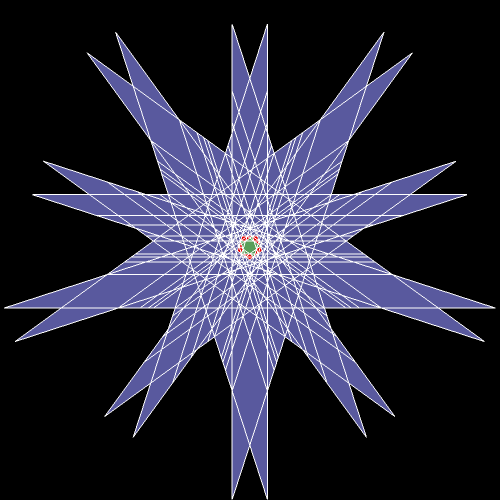
For the planes of the twenty triangular faces, this is the stellation-diagram:
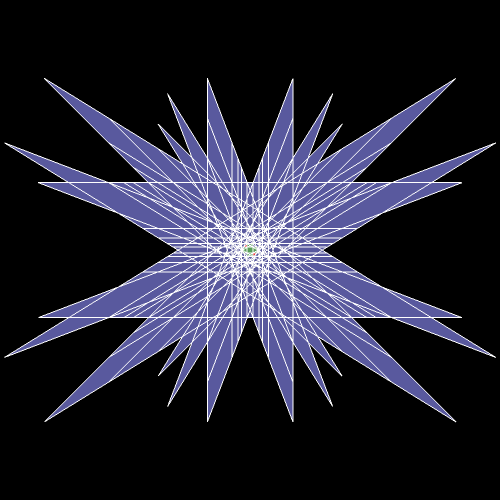
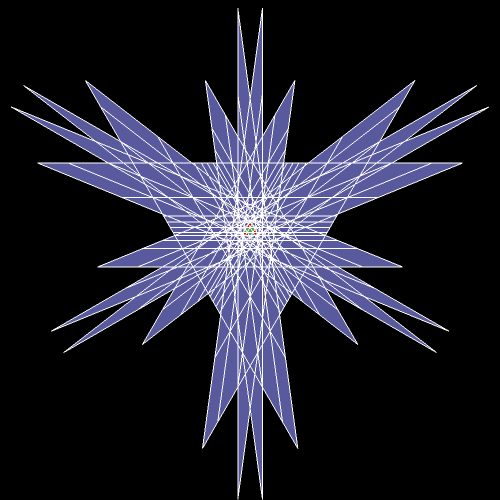 Finally, there are the the planes of the thirty square faces.
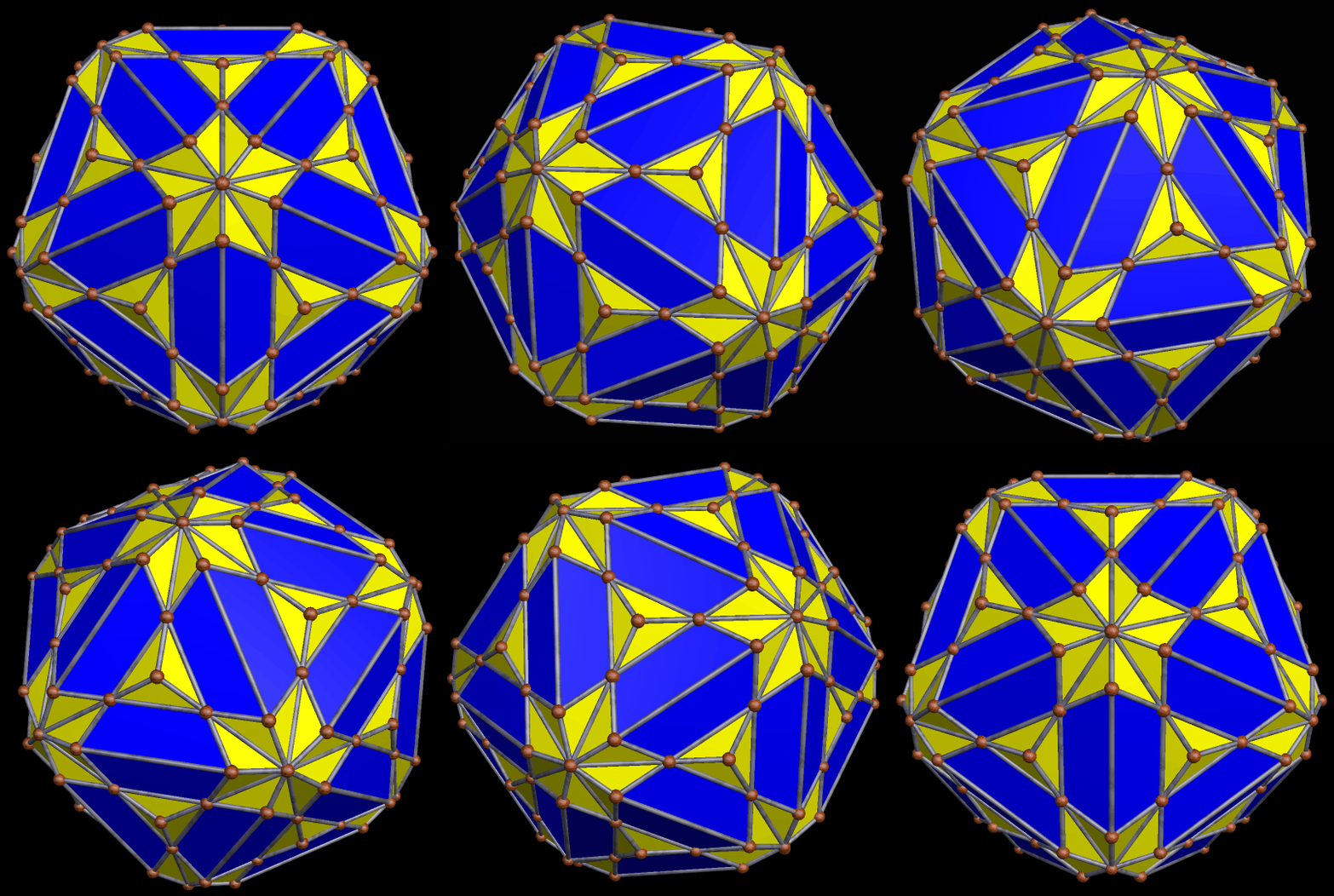
The following survey of the first hundred stellations is not intended to be exhaustive; I’m including all those I find worthy of inclusion on subjective aesthetic grounds. The first stellation shown here is actually the 25th stellation of the rhombicosidodecahedron:
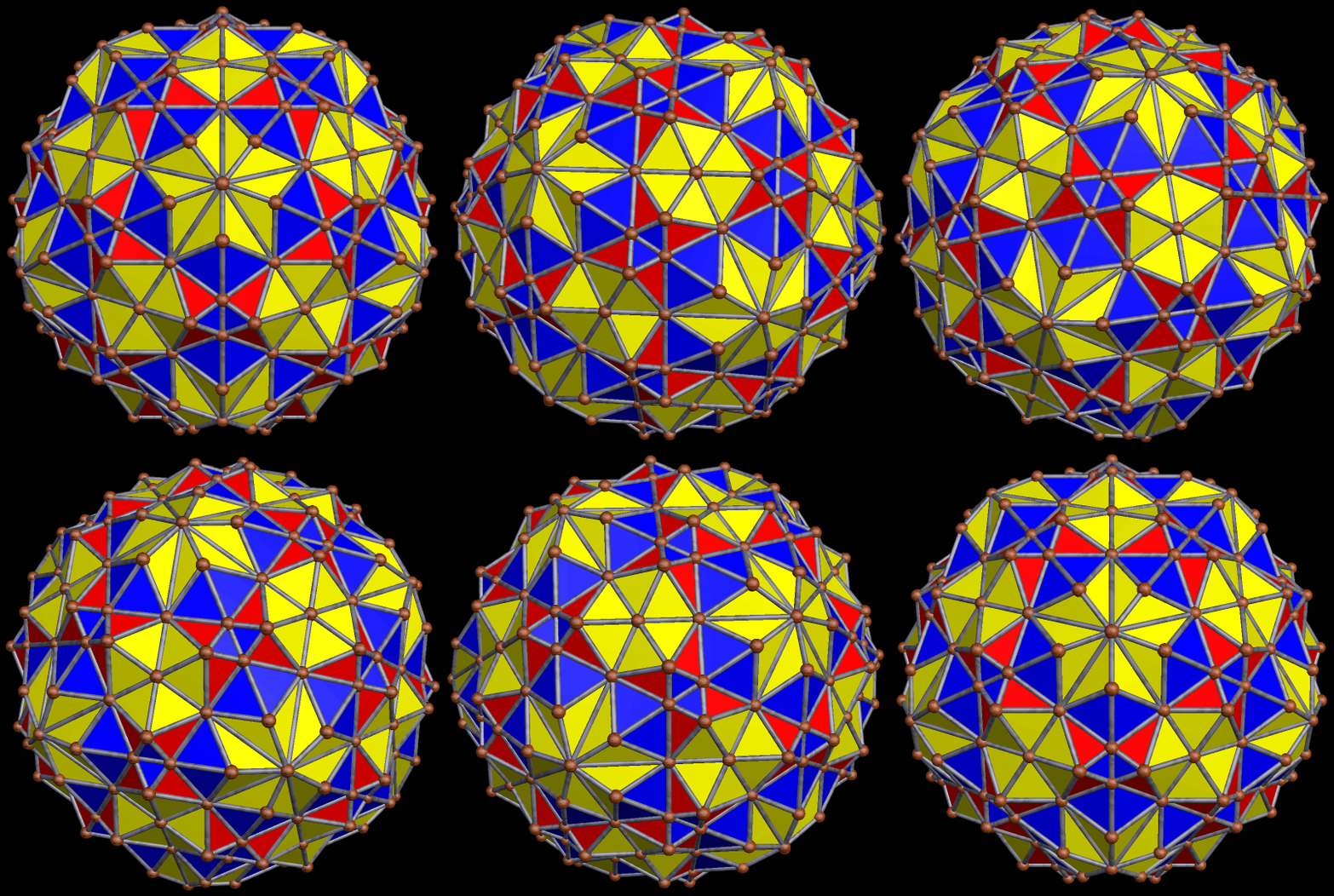
Next, the 30th stellation:
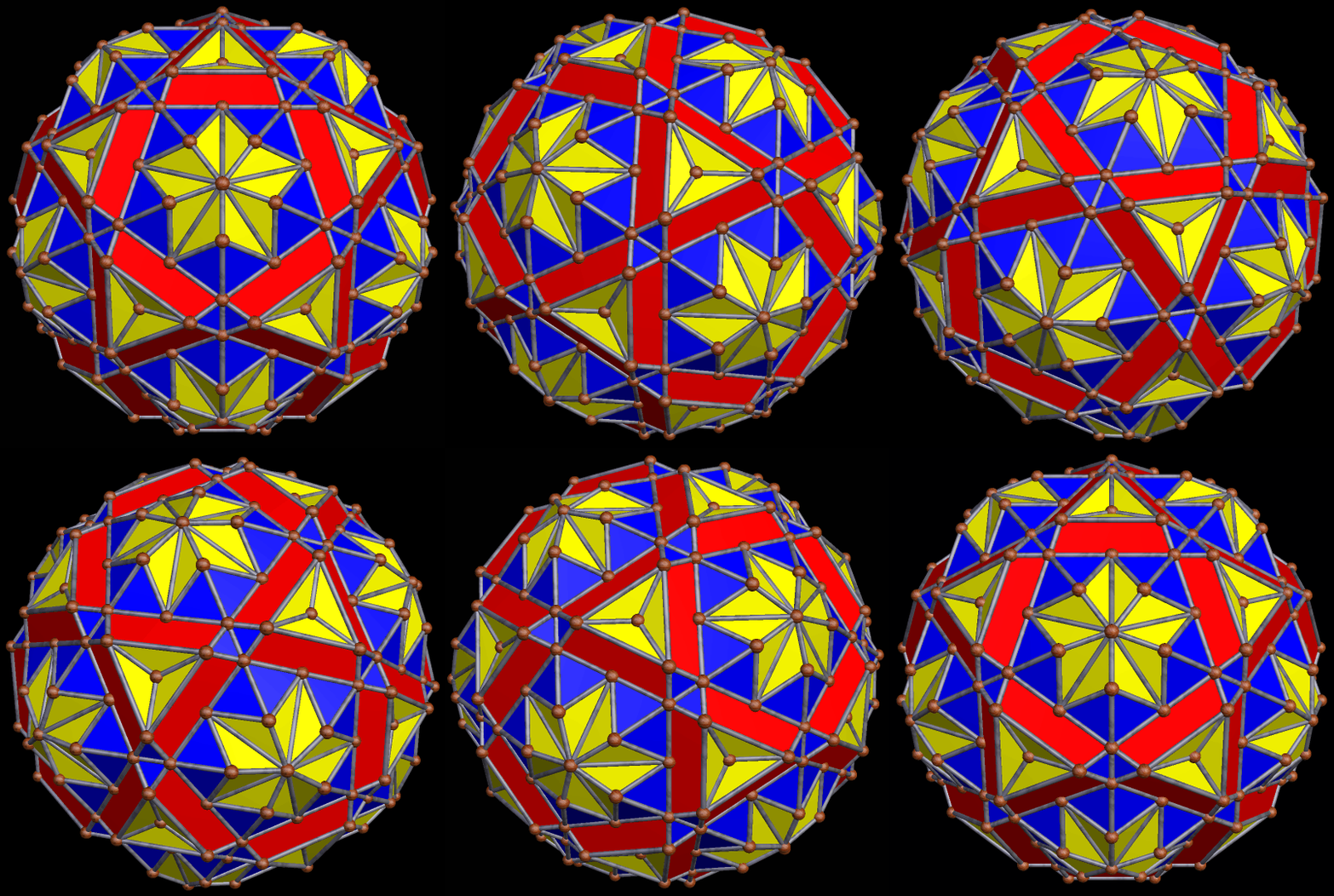
The next one is the 33rd stellation.

And next, the 38th stellation.
Here is the 46th stellation:

And the 48th stellation:
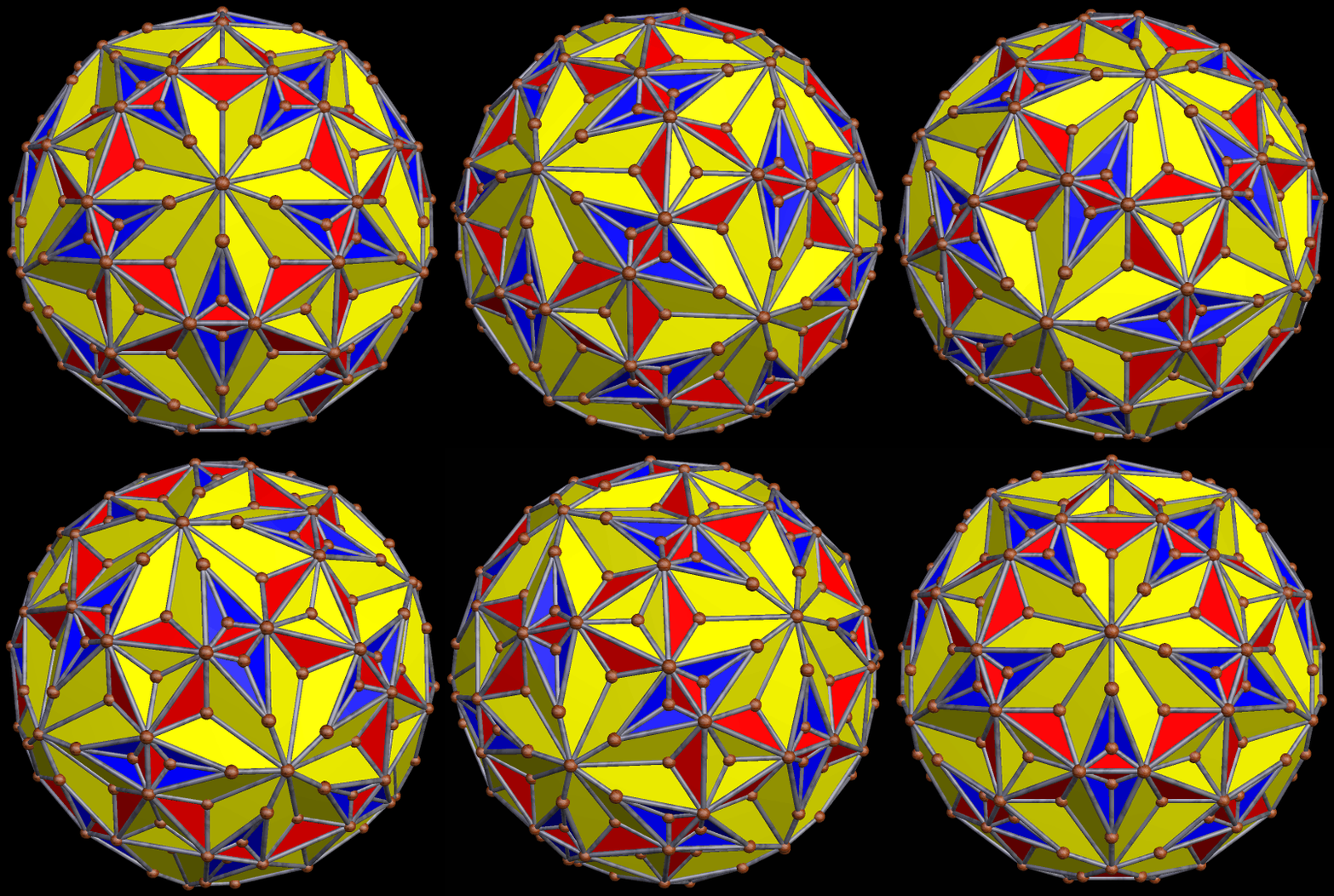
Next, the 58th stellation:
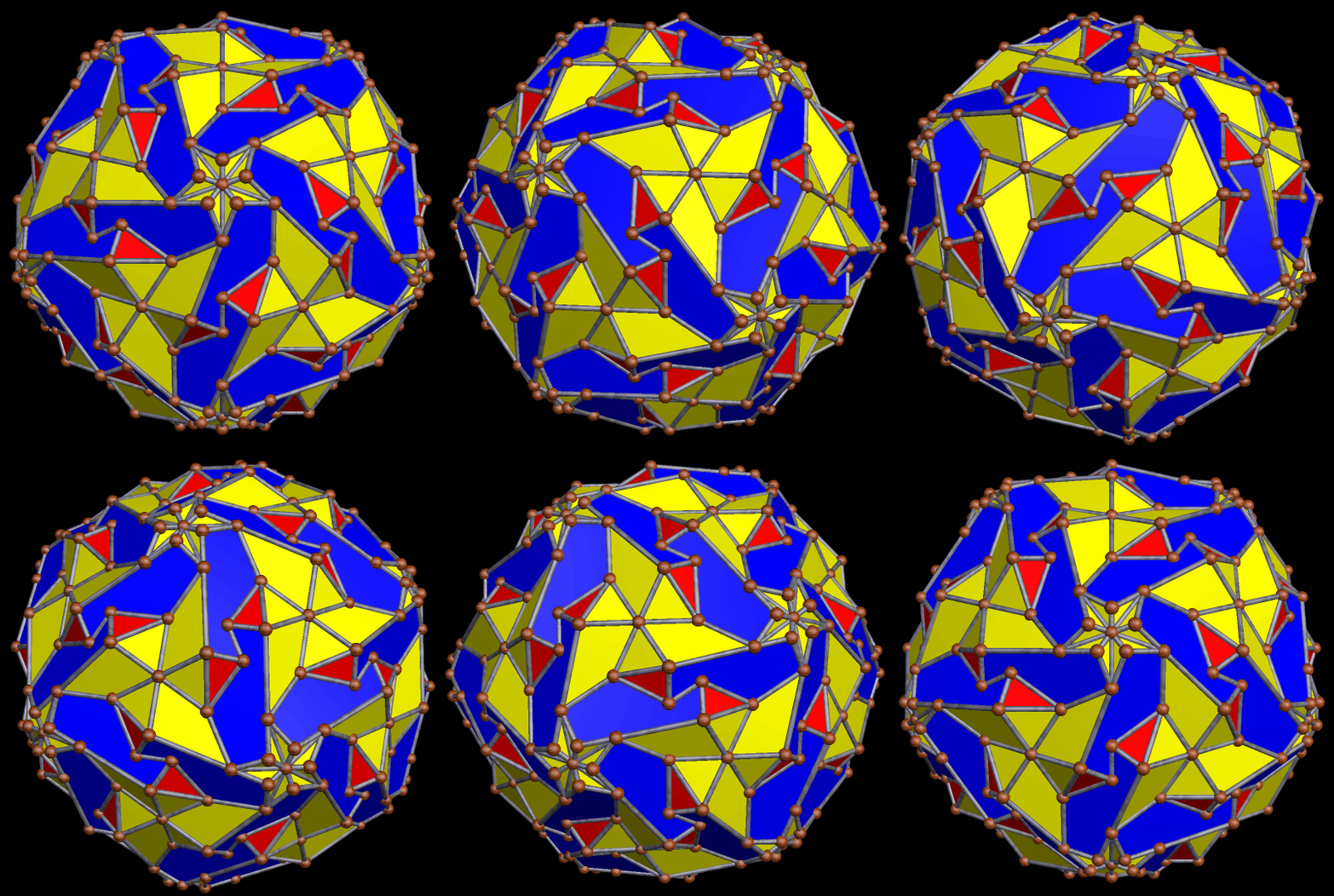
And now, the 62nd stellation.

Next is the 85th stellation; it’s also a compound of an icosahedron (blue), and a yellow polyhedron I have not yet identified, except as the nth stellation of something. This I know: I have seen the yellow polyhedron before. If you happen to know what it is, the identify it in a comment.
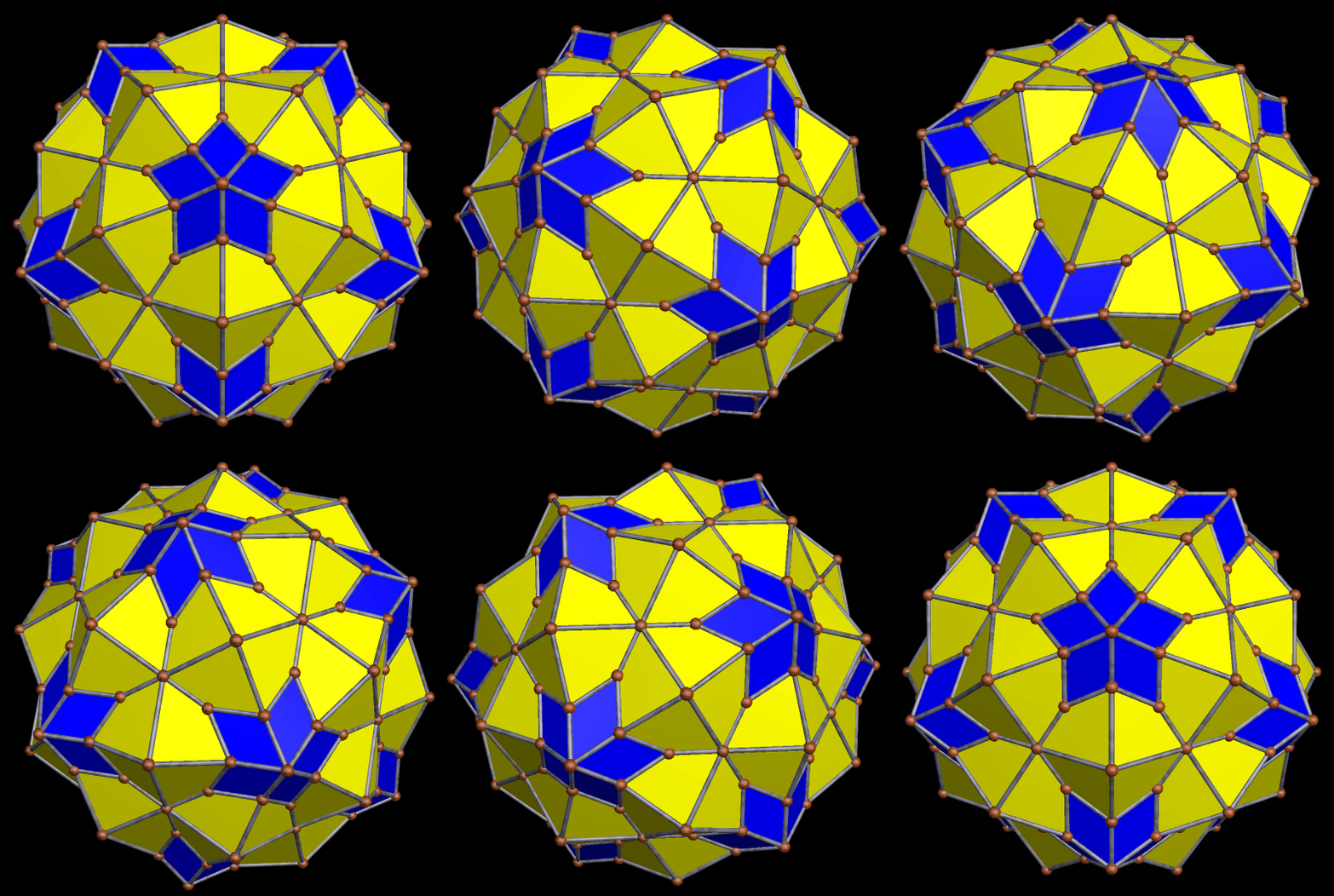
The next stellation shown is the next one in the series, the 86th. It demonstrates a phenomenon I have observed, but cannot explain, and that is the tendency, in sequences of stellations, to have a large number of similar stellations in a row, followed by a sudden, much more extreme change in appearance, from one stellation to the next, as seen here. It’s a phenomenon which I would like to better understand.
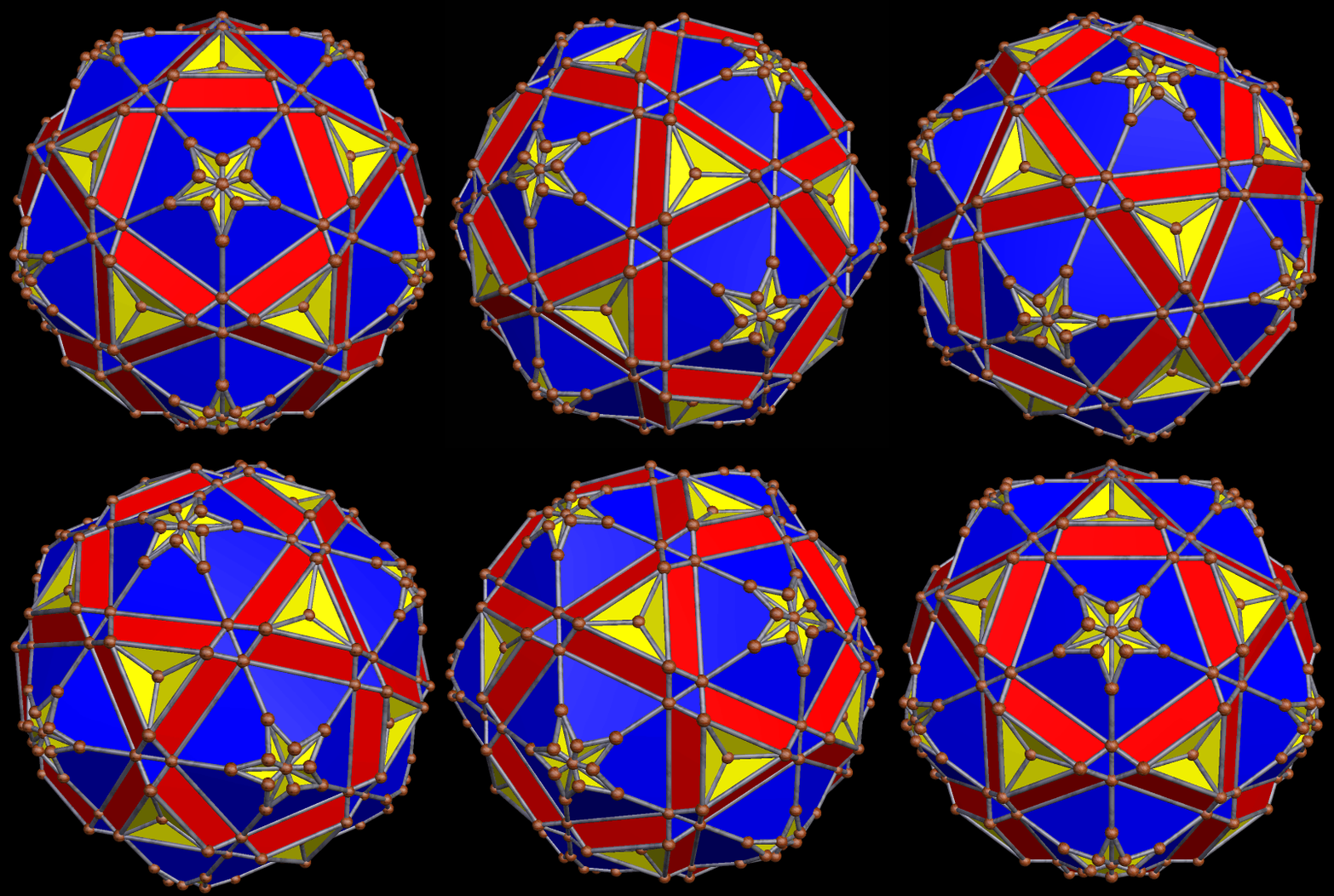
To be continued, with selections from the next hundred stellations….
 RobertLovesPi.net