Truncated Dodecahedron with Mandalas

Image

Truncated Dodecahedron with Mandalas

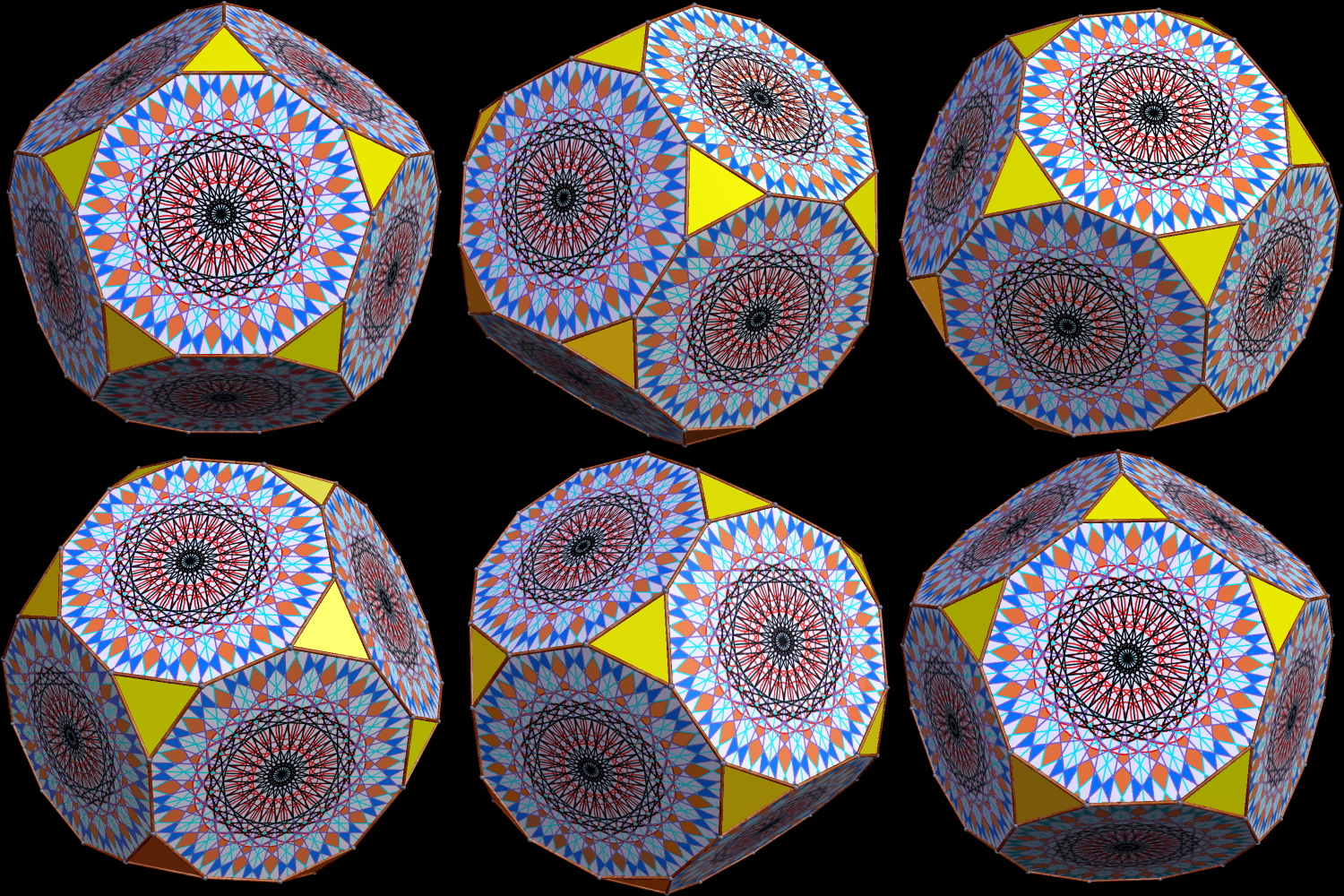
A flat version of the mandala on each decagonal face here may be seen in the previous post. I used Geometer’s Sketchpad and MS-Paint to make it.

To place the mandalas on the decagonal faces of a truncated dodecahedron, I used a program called Stella 4d, which you may try for yourself at http://www.software3d.com/stella.php.

Polyhedron Featuring Decagons and Pentagons

Image

Polyhedron Featuring Decagons and Pentagons

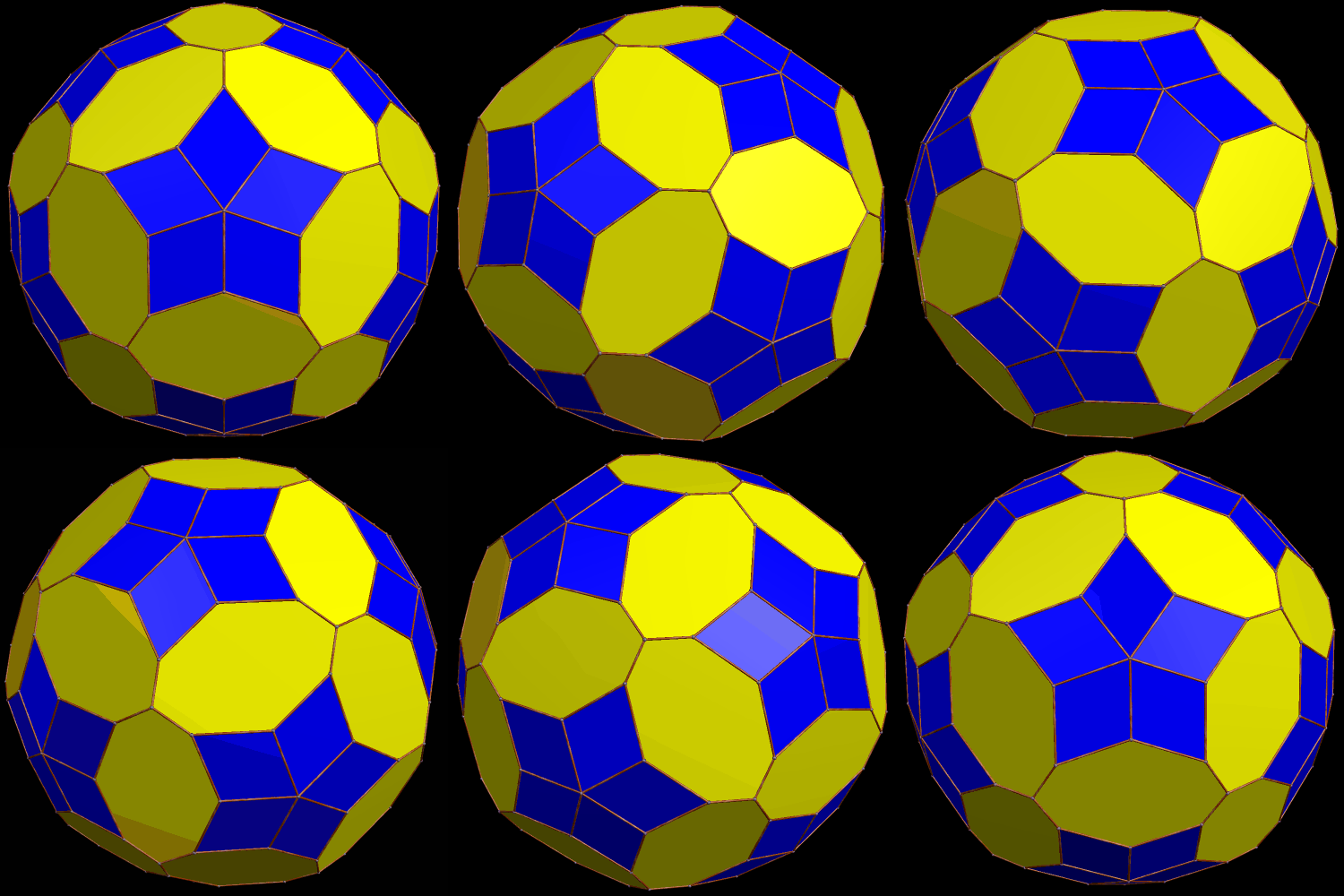
There are twelve regular decagons in this polyhedron, and sixty irregular pentagons. If the pentagons were closer to regularity, this would qualify as a near-miss to the ninety-two Johnson Solids. It is not known how many of these “near-misses” exist — primarily because this group of polyhedra lacks a precise definition.

This polyhedron was discovered with the aid of Stella 4d, software you can try for yourself at http://www.software3d.com/stella.php.

A Ninety-Faced Zonohedron

Image

A Ninety-Faced Zonohedron

Sixty of the faces of this zonohedron are thombi, and the other thirty are zonogonal octagons.

Software available at http://www.software3d.com/stella.php was used to create this rotating image.

A Polyhedron with 152 Faces

Image

A Polyhedron with 152 Faces

The faces are:

  • twelve irregular decagons
  • twenty irregular nonagons
  • sixty irregular pentagons
  • sixty isosceles trapezoids

This polyhedron was created using Stella 4d, which may be tried for free at http://www.software3d.com/stella.php.

Solar Eclipses and Mandalas On a Great Rhombcuboctahedron

Image

Solar Eclipses and Mandalas On a Great Rhombcuboctahedron

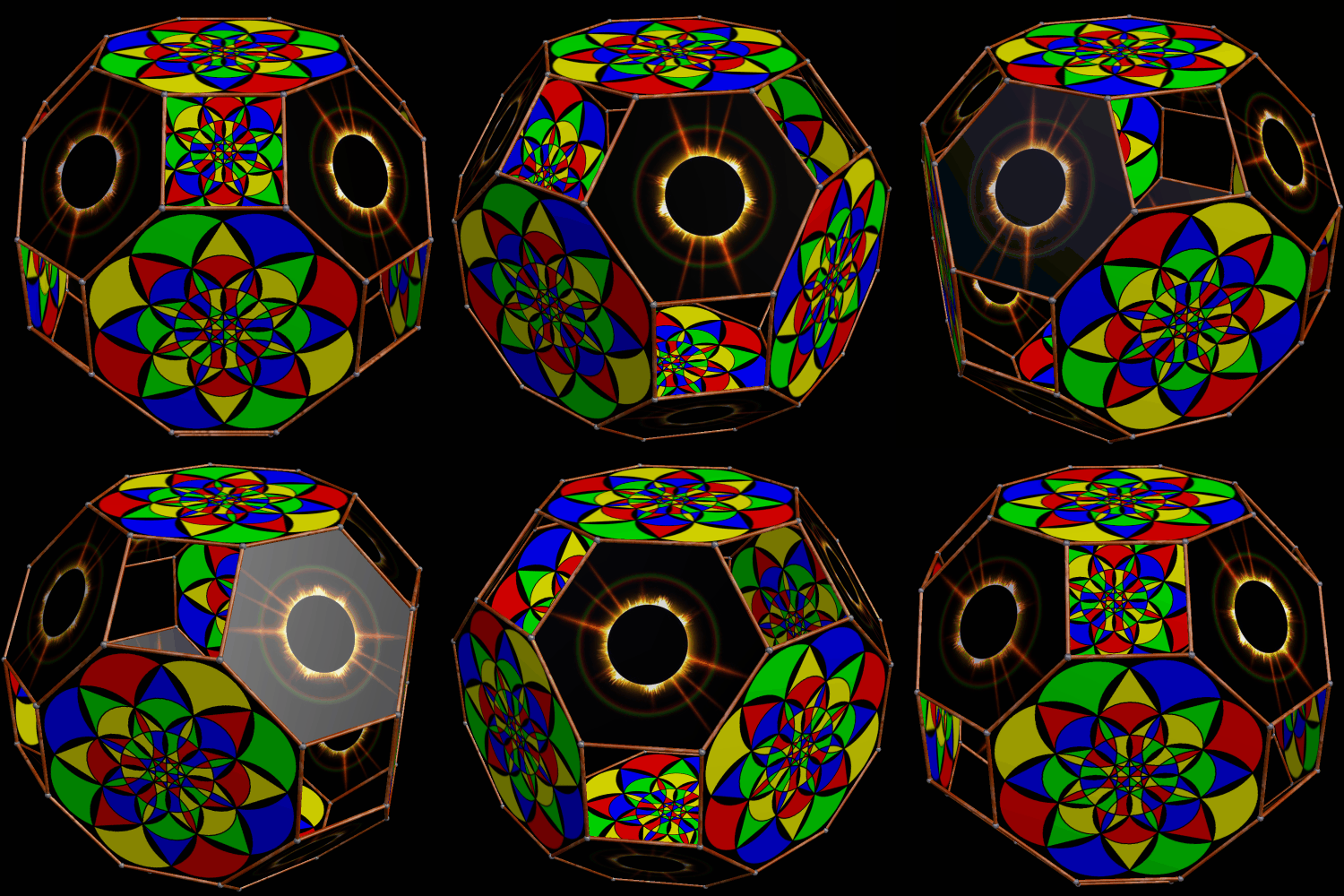
Credit where credit is due:

I found the eclipse picture with a Google-search.

The mandalas are the one in the previous post here (“Seventeen Circles”). I made it using Geometer’s Sketchpad and MS-Paint.

I used software called Stella 4d to assemble this onto the chosen polyhedron, and make the animated .gif file you see here. This software is available at http://www.software3d.com/stella.php, with a free trial download available.

165-Srix

Image

165-Srix

In three-dimensional space, there are five Platonic and thirteen Archimedean polyhedra, plus numerous other shapes, in several categories. The whole collection can appear to be quite a confusing jumble — until, and unless, you start surveying four-dimensional polytopes, known as polychora.

There are six regular polychora, and they are analogous to the five Platonic solids. Each three-dimensional cell is regular, and all are identical, within a single one of these six. When peering beyond these six, however, things can get very confusing, very quickly.

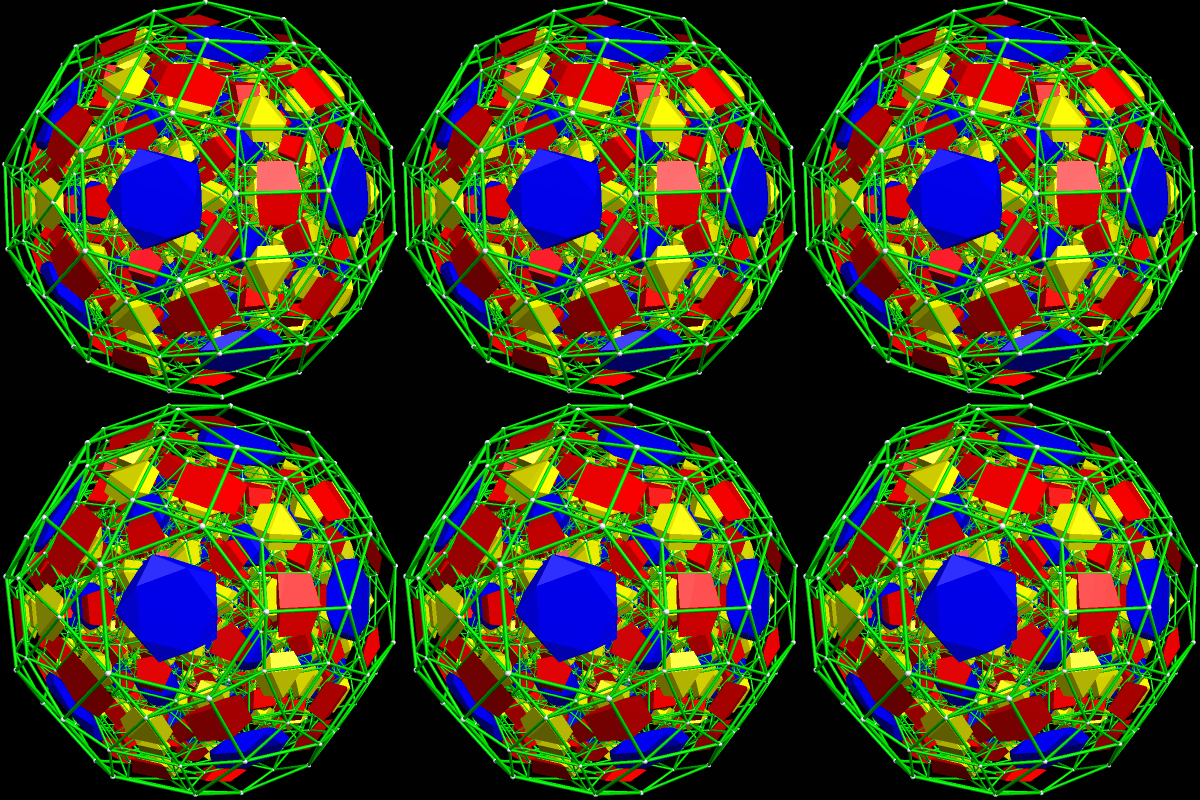
The software I used to generate this image, Stella 4d, has a built-in library of polyhedra and polychora. You can examine it as a free trial download at http://www.software3d.com/stella.php. Today, motivated by curiosity, I went surveying, using this program, into the more complex polychora — beyond the six regular ones — which have different polyhedra as cells, looking for one I could (try to) understand, and which appealed to me aesthetically.

The one I settled on for this post is known as 165-Srix, as well as the small rhombated 600-cell, a/k/a the cantellated 600-cell. It has 600 cells which are cuboctahedra, shown here in yellow, 120 more which are icosidodecahedra, shown here in blue, and 720 cells which are regular pentagonal prisms.

I must admit this: I’m more than a little jealous of those who seem to be able to easily understand these four-dimensional shapes. I am definitely not one of them.
120 Undulating Dodecahedra

Image

120 Undulating Dodecahedra

This is a 120-cell, one of the regular polychora (four-dimensional polytopes), with its edges and vertices rendered invisible, and its dodecahedral cells shrunk somewhat, to put some empty space between them. It’s rotating in hyperspace, and what you are seeing at any given moment is a particular three-dimensional “shadow,” or projection, of the entire figure.

It’s easy to make this sort of thing with software called Stella 4d, written by an Australian friend of mine. Here’s a link to a site where you can try it, as a free trial download, before deciding whether or not to purchase the fully-functioning version: http://www.software3d.com/stella.php.

600 Undulating Tetrahedra

Image

600 Undulating Tetrahedra

This is a 600-cell, one of the regular polychora (four-dimensional polytopes), with its edges and vertices rendered invisible, and its cells shrunk so that they do not touch. It’s rotating in hyperspace, and what you are seeing at any given moment is a particular three-dimensional “shadow,” or projection, of the entire figure.

It’s easy to make this sort of thing with software called Stella 4d, written by an Australian friend of mine. Here’s a link to a site where you can try it, as a free trial download, before deciding whether or not to purchase the fully-functioning version: http://www.software3d.com/Stella.php.

“All Is Number”

Image

“All is number” was a motto of the ancient Pythagorean Society. I thought it would also make a good title for this geometrical design.

When Must the Four Perpendicular Bisectors of the Sides of a Quadrilateral Be Concurrent?

Image

When Must the Four Perpendicular Bisectors of the Sides of a Quadrilateral Be Concurrent?

The perpendicular bisectors of the three sides of any triangle must be concurrent, as is well-known. However, this is not true of quadrilaterals. For quadrilaterals, the four perpendicular bisectors may be concurrent, or not. So when must they be?

The answer: when a pair of opposite angles in the quadrilateral are right angles.

Why is this the case? Well, it’s a consequence of what happens in triangles to this point of concurrence, called the circumcenter. In right triangles — and only in right triangles — the circumcenter falls on a side of the triangle, and that side is always the hypotenuse, with the circumcenter located at its midpoint. If a quadrilateral has two right angles as a pair of opposite angles, as ABCD does in the diagram above, then it can be split into two right triangles with a common hypotenuse, as shown — and that hypotenuse’s midpoint will then be the point of concurrence of all four perpendicular bisectors of the sides of the quadrilateral.

[Later edit:  my friend Andrew make the following comment, when I posted a link to this post on Facebook. I appreciate it when my friends make such corrections.]

“Actually, the Perpendicular Bisectors are concurrent for any Cyclical Quadrilateral. (Opposite angles sum to 180 degrees). Even Non-convex Cyclical Quadrilaterals have this property (Note a Non-convex Cyclical Quadrilateral must be self-intersecting). All Cyclical Quadrilaterals can be circumscribed by a circle.”

For proof, consider the cyclical or non-cyclical quadrilateral (or higher polygon, as well), together with its circumscribed circle. All sides of this polygon are chords of this circle, and perpendicular bisectors of chords pass through the circle’s center — the point of concurrency.