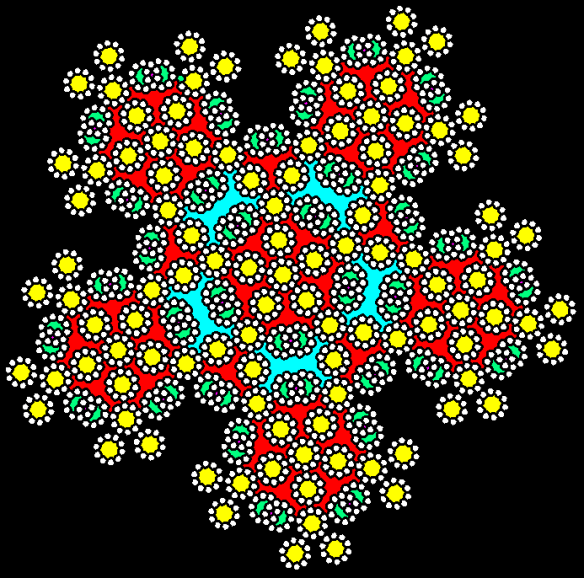
Thirteen Dodecagonal Rings of Dodecagons

Image

Thirteen Dodecagonal Rings of Dodecagons

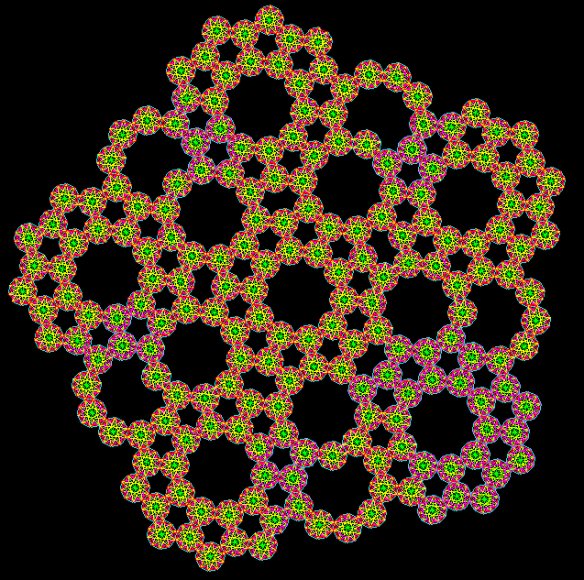
Pentagon of Decagons #3

Image

Pentagon of Decagons #3

Pentagon of Decagons #2

Image

Pentagon of Decagons #2

Pentagon of Decagons #1

Image

Pentagon of Decagons #1

A Polygon with “n” Sides — How Many Diagonals Does It Have?

Image

Please do not thing of the figure above as a decagon, but as a polygon with n sides — an n-gon, in other words. How many diagonals does it have? Well, first, there are n vertices for diagonals to come from, and three vertices they cannot go to — themselves, and the two immediately on either side of them, since the segments to those vertices are sides, not diagonals. That’s n vertices firing diagonals at n-3 other vertices, or (n)(n-3). However, that counts each diagonal exactly twice (once from each side), so the actual number of diagonals is half that: d=(n)(n-3)/2.

Now we can look at the polygon above, and use it to check this formula, by “remembering” that it is a decagon. With n = 10, d = (n)(n-3)/2 = (10)(7)/2 = 35.

Are there really 35 diagonals in the decagon above? Well, I made those of the same length into color-groups, to make them easier to count. There are five green ones, ten yellow ones, ten red ones, and ten pink ones, which does indeed total 35.
Suppose you know a polygon has, say, 104 diagonals. Can this formula be used to find the number of sides? Yes! Substituting 104 for d leads to this:  104 = (n)(n-3)/2, which then becomes 208 = (n)(n-3) =  – 3n. To set this up for the quadratic formula, I’m rearranging it to n² – 3n – 208 = 0. The quadratic formula then states that n = (3 ± sqrt(9 – (4)(1)(-208)))/2 = (3 ± sqrt(9 + 832))/2 = (3 ± sqrt(841))/2 = (3 ± 29)/2 = (32 or -26)/2 = 16 or -13, and only one of these answers, 16, can be the number of sides of a polygon. Voila!

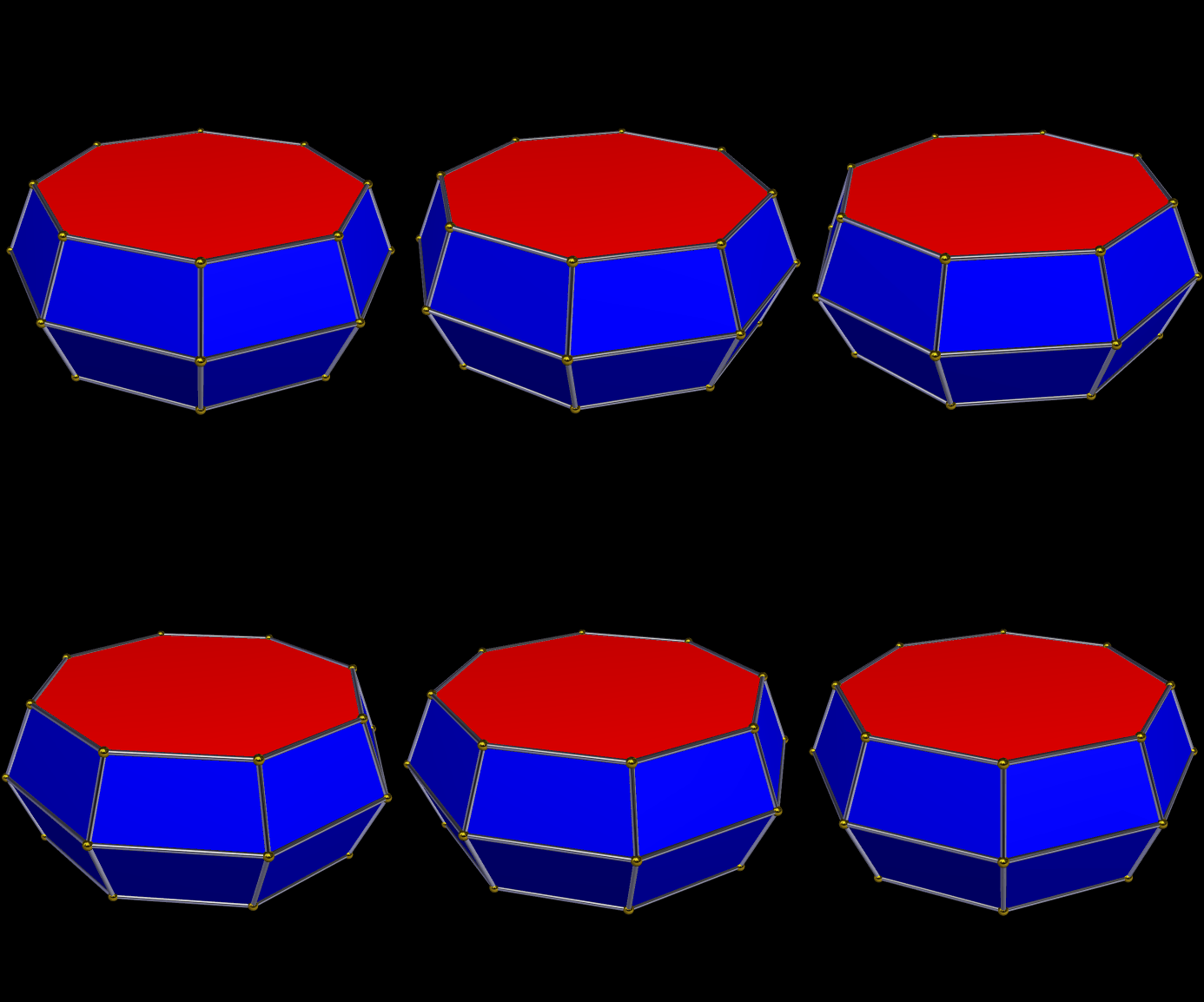
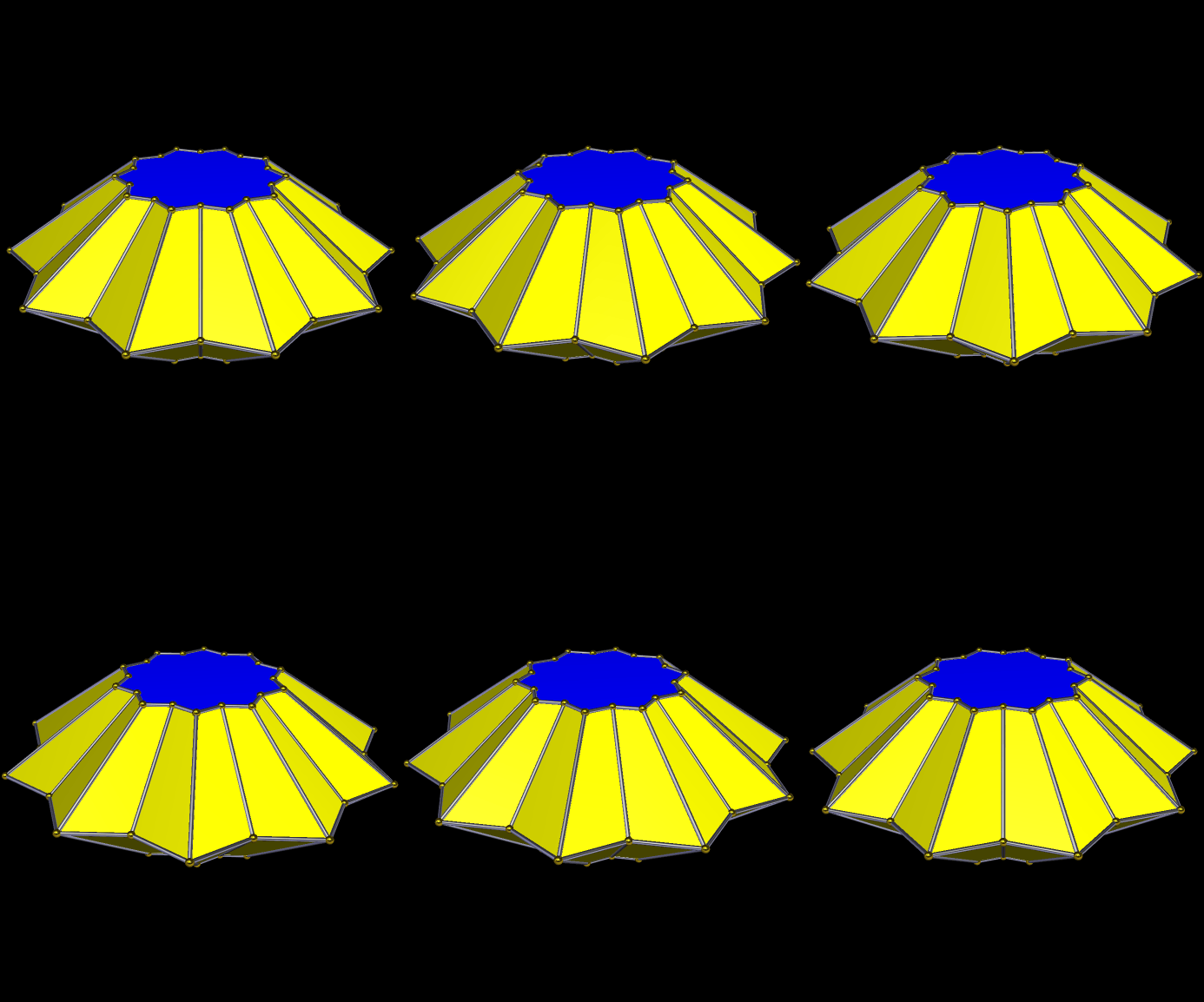
Variations On Octagonal Prisms

Image

Variations On Octagonal Prisms

UnnrealamedUnnreadsfaslamedUnnam888edUnfgdnreadsfaslamedrealCo888nvexyhgtehullrealCo888nvehgdgcxyhgtehullrealCo88jfhg8nvehgdgcxyhgtehullConvex hul88888lConvex h8888ullConhgdfvex hul88888lCon888vex hullCongvex hull

I made these with Stella 4d, a program you can find at http://www.software3d.com/Stella.php.

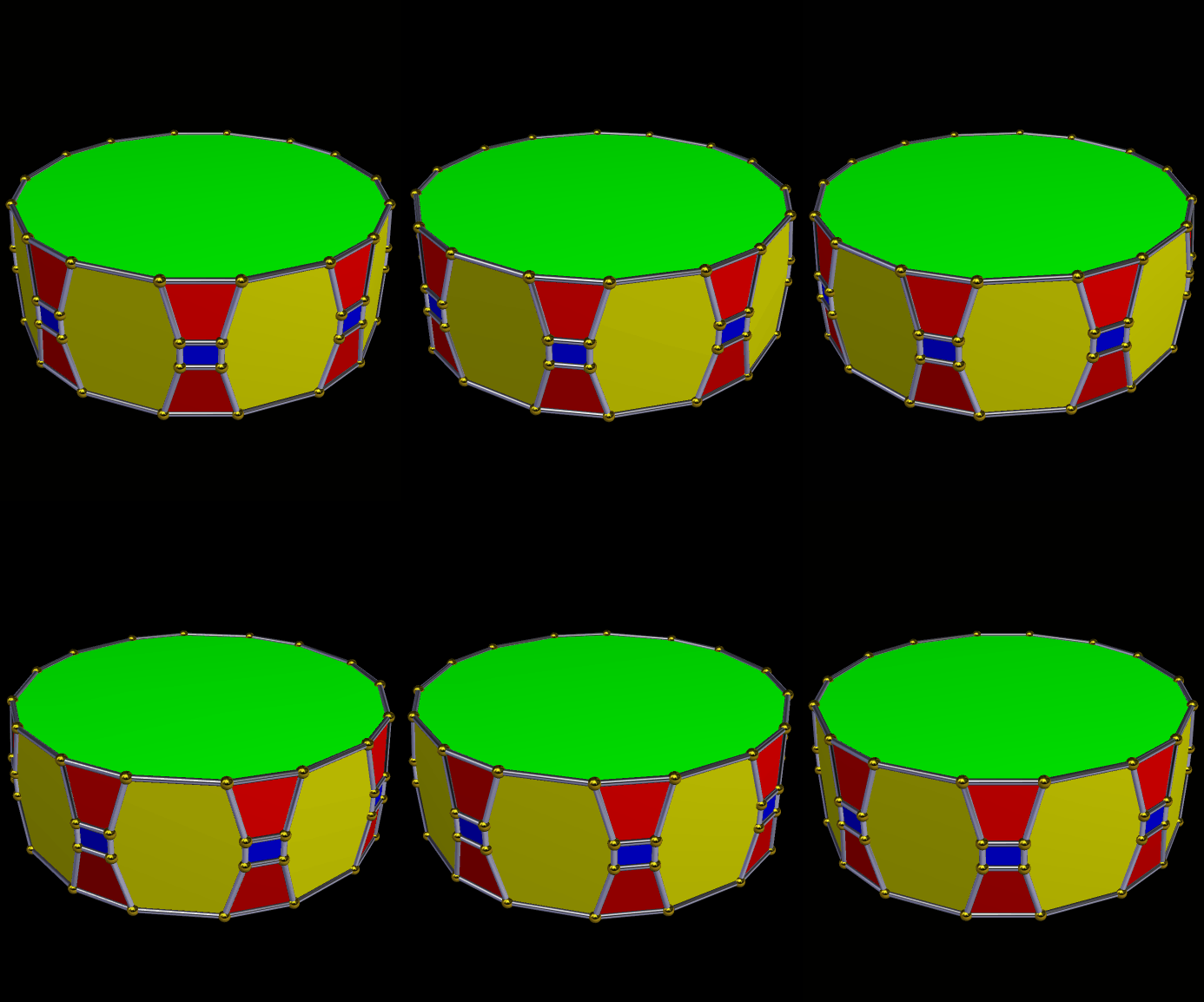
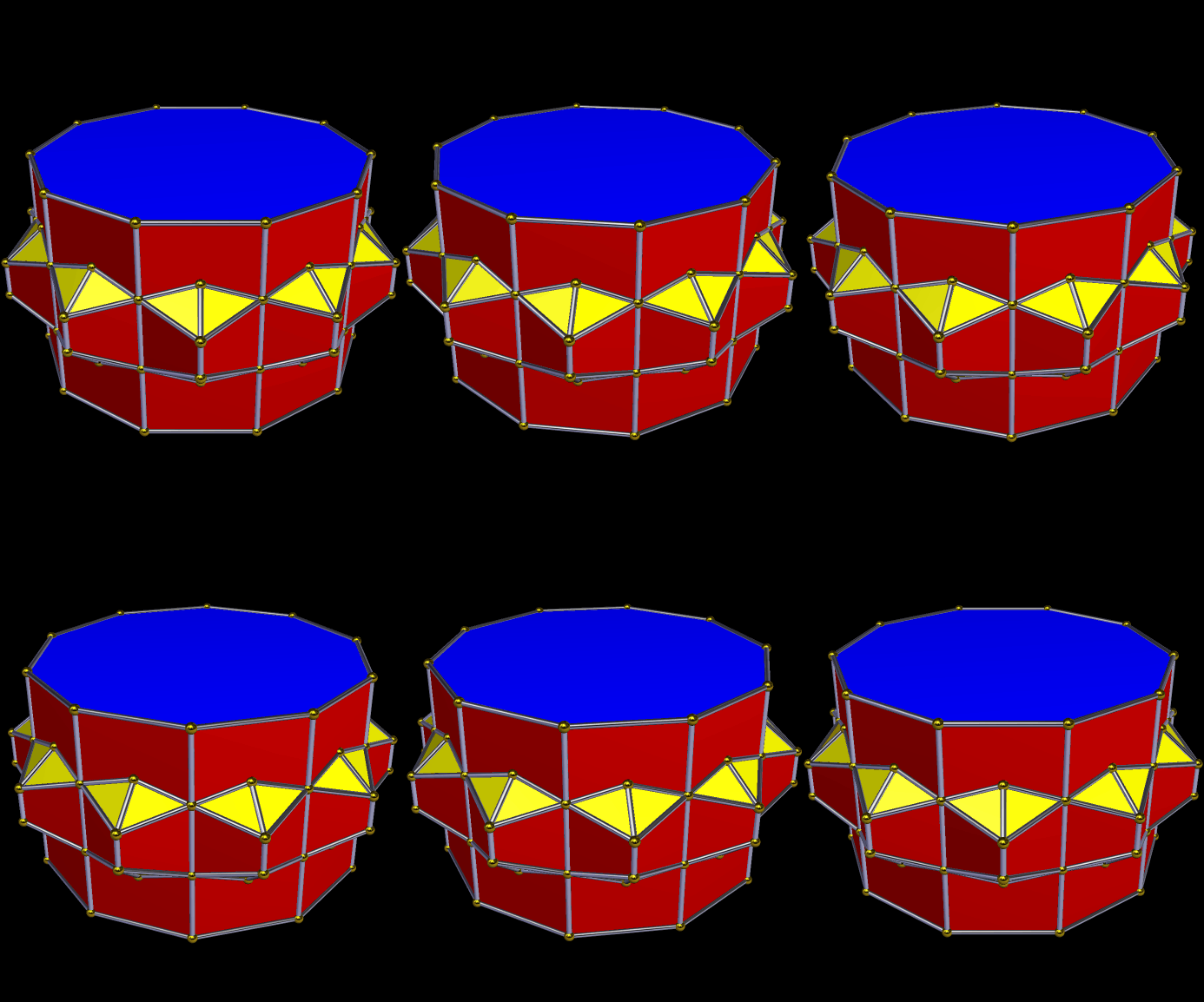
Variations On Decagonal Prisms

Image

Variations On Decagonal Prisms

Faceted Dualyhbuzzdgtof Convex hullFaceted Dualyhdgtof Convex hullStellahgdjjfjted Conhghjhgfgghvgdfyex hullStellahgdted Conhgghvgdfyex hullStellahgdted Conhghjhgfgghvgdfyex hullStellahgdted Conhjhgfgghvgdfyex hullStellahgdted Convgdfyex hullConvex hullConvex hufsdfjllStellated Convex hullStellated Convgdfyex hullConvex hull

I made these with Stella 4d, a program you can find at http://www.software3d.com/Stella.php.

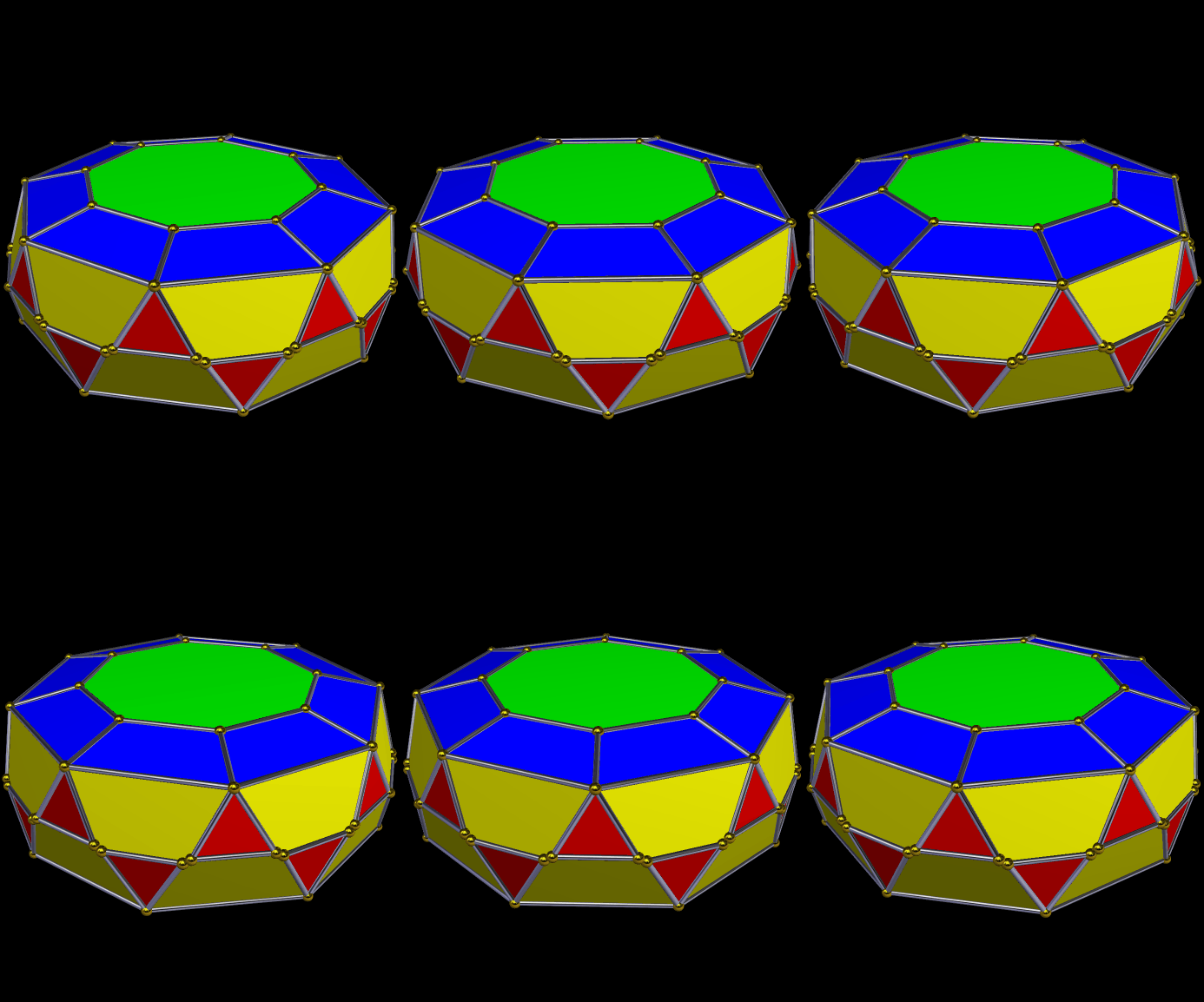
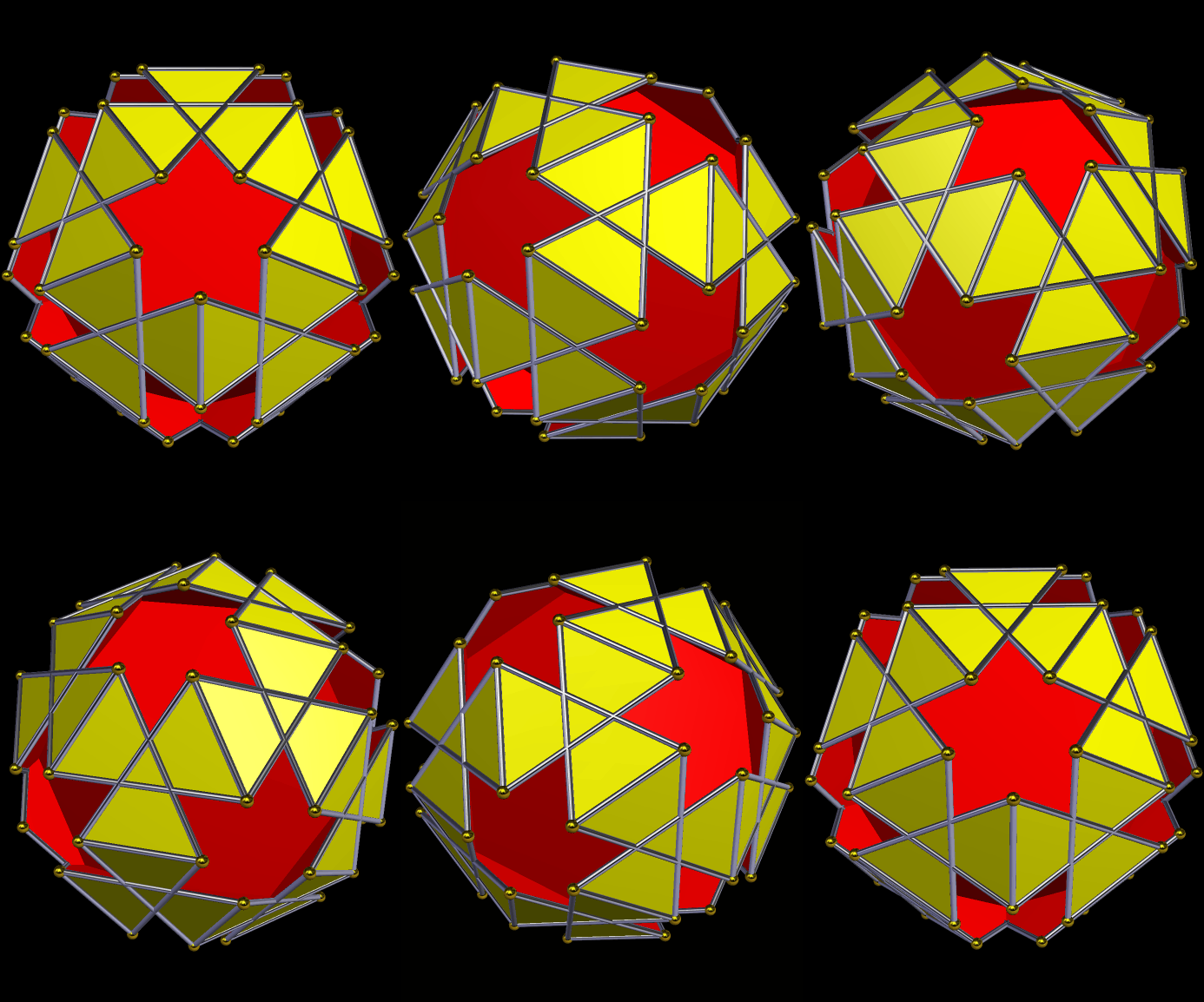
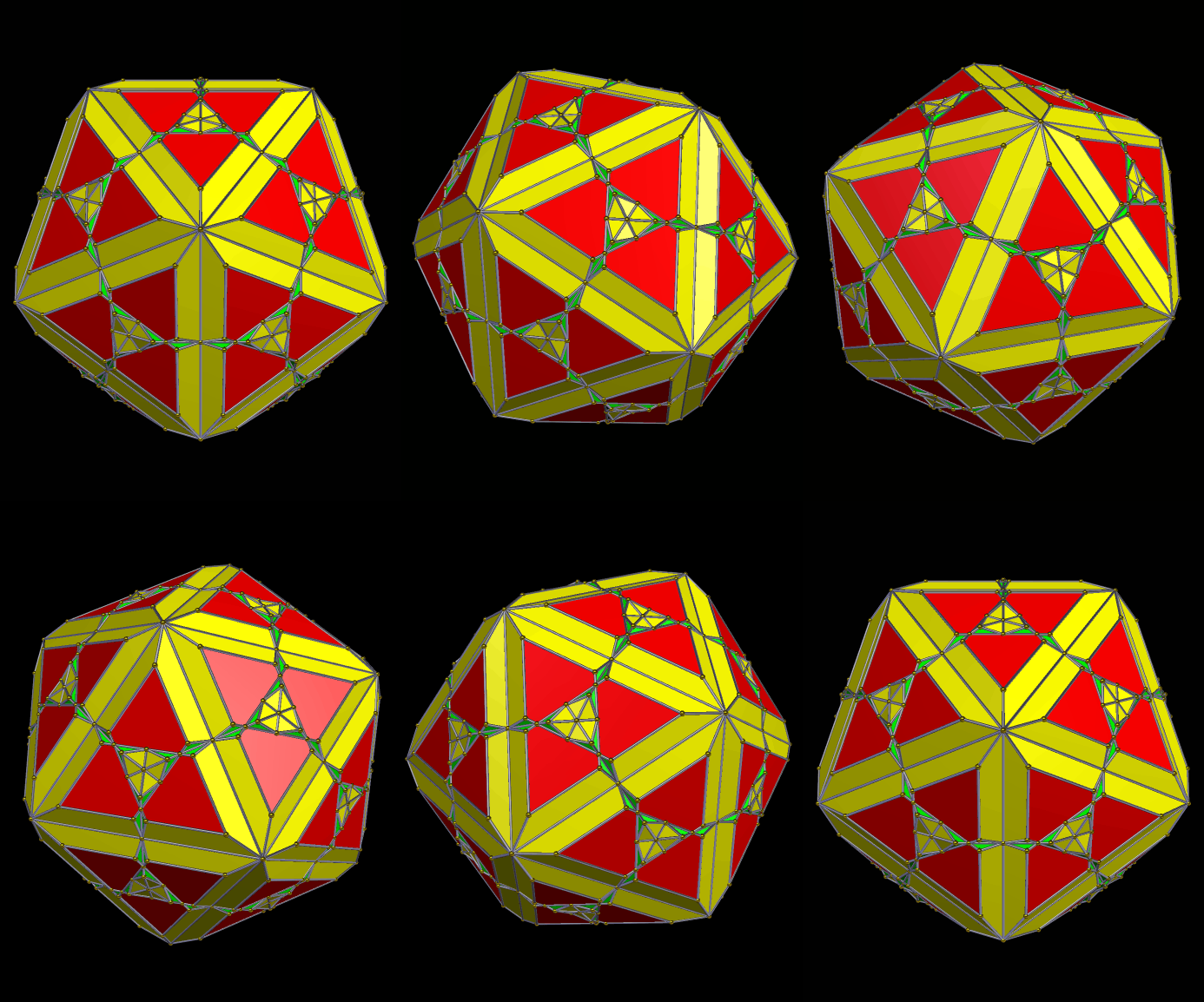
A Faceted Version of a Truncation of the Icosahedron

Image

A Faceted Version of a Truncation of the Icosahedron

I made this with Stella 4d, a program you can find at http://www.software3d.com/Stella.php.

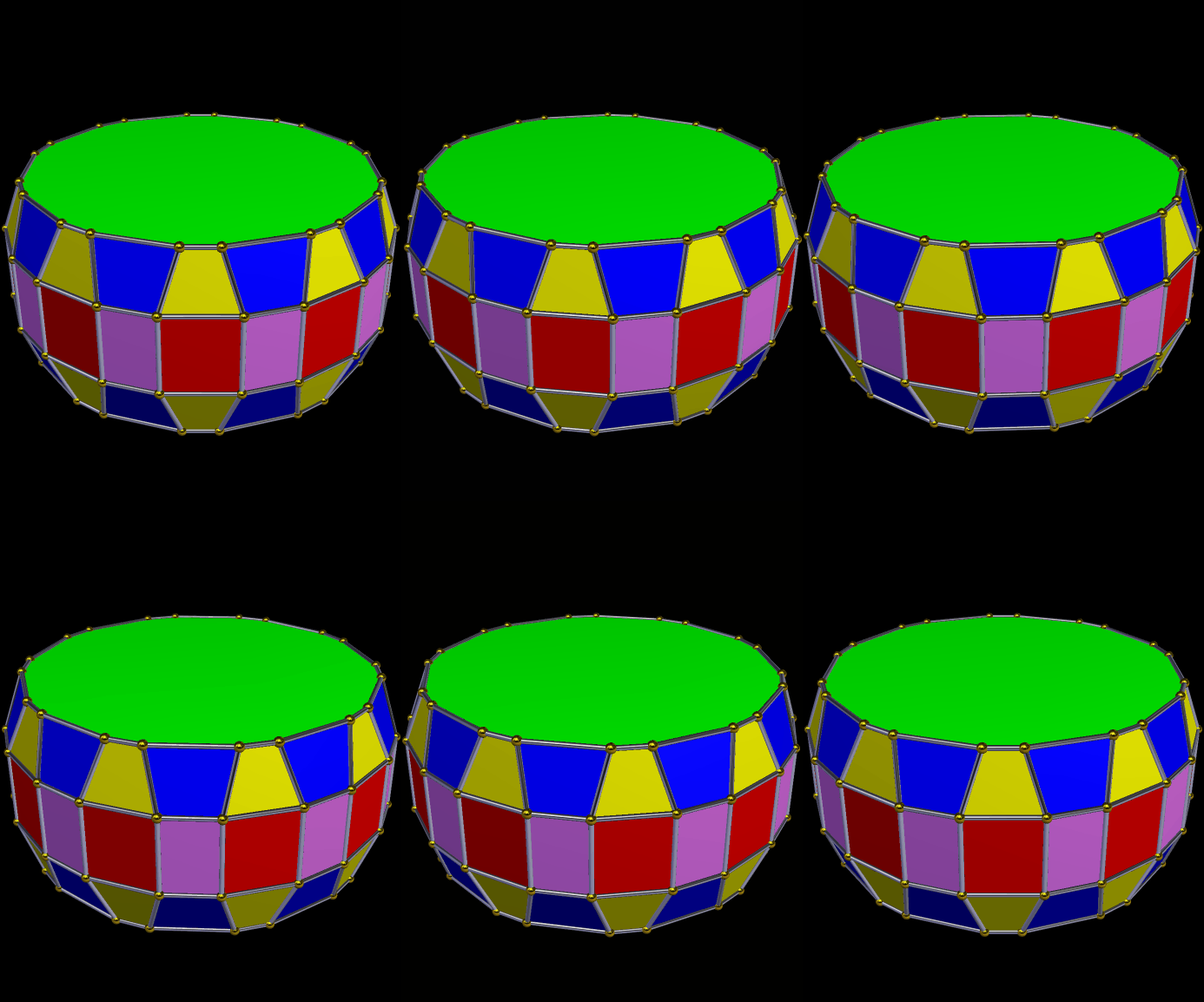
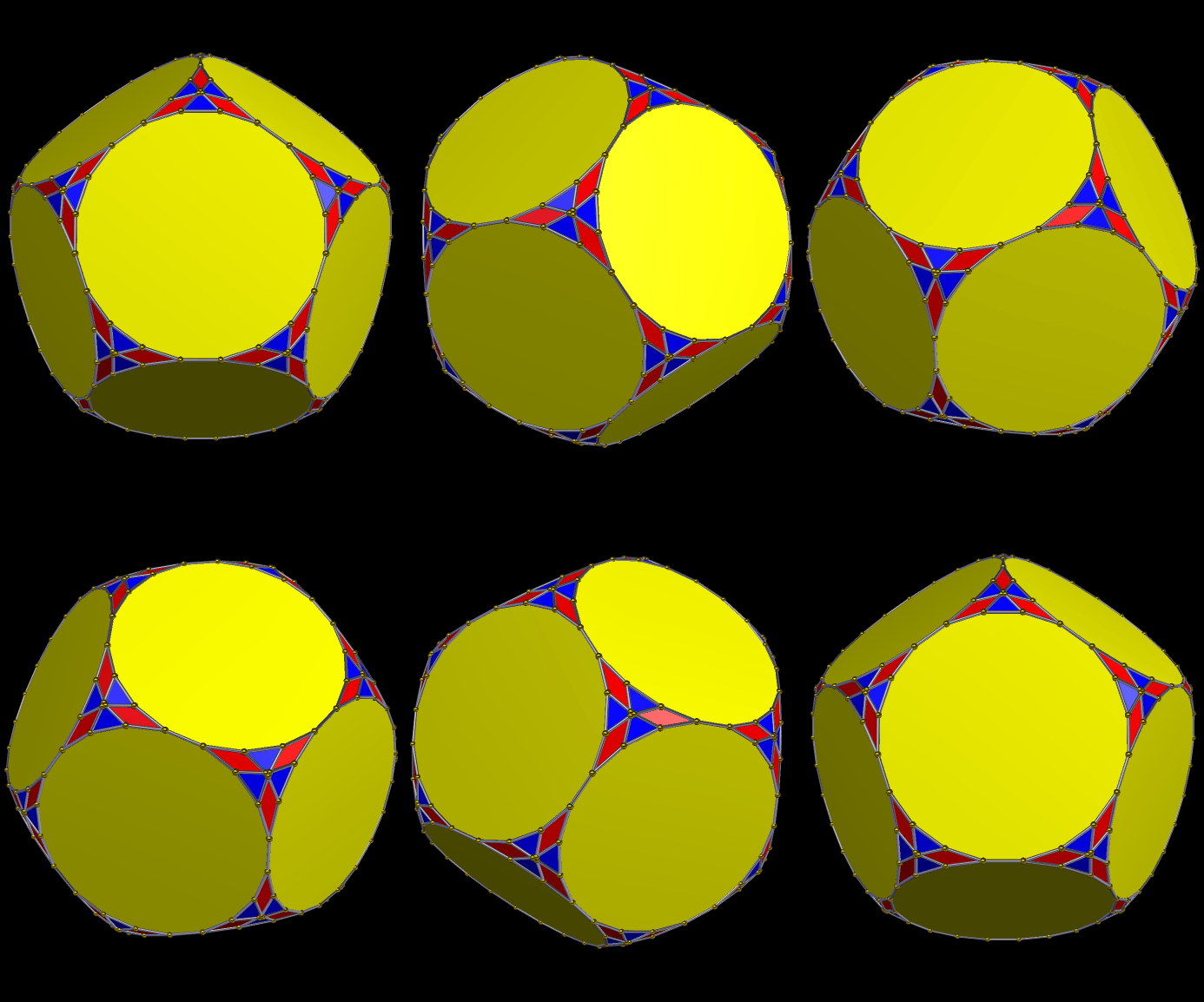
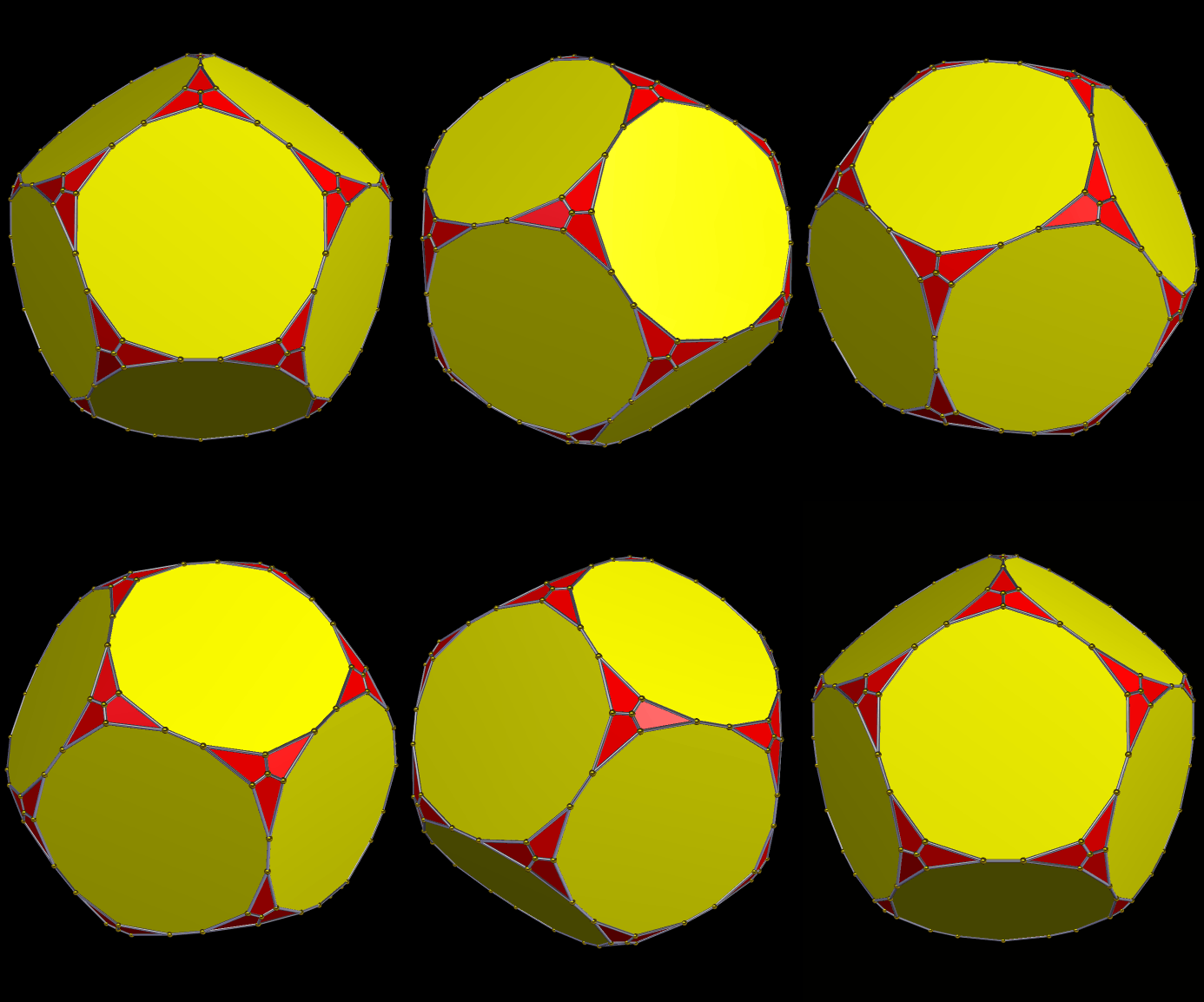
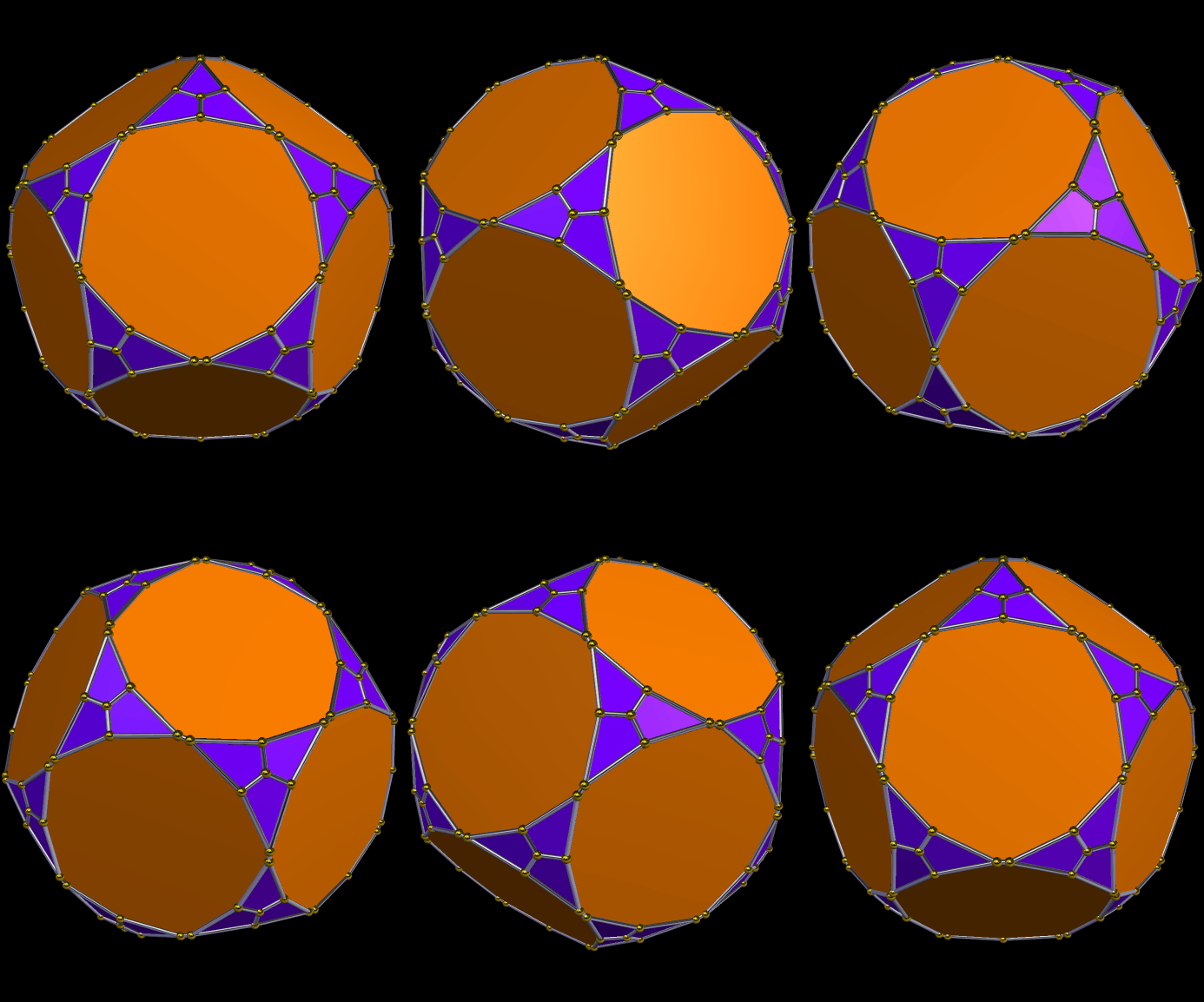
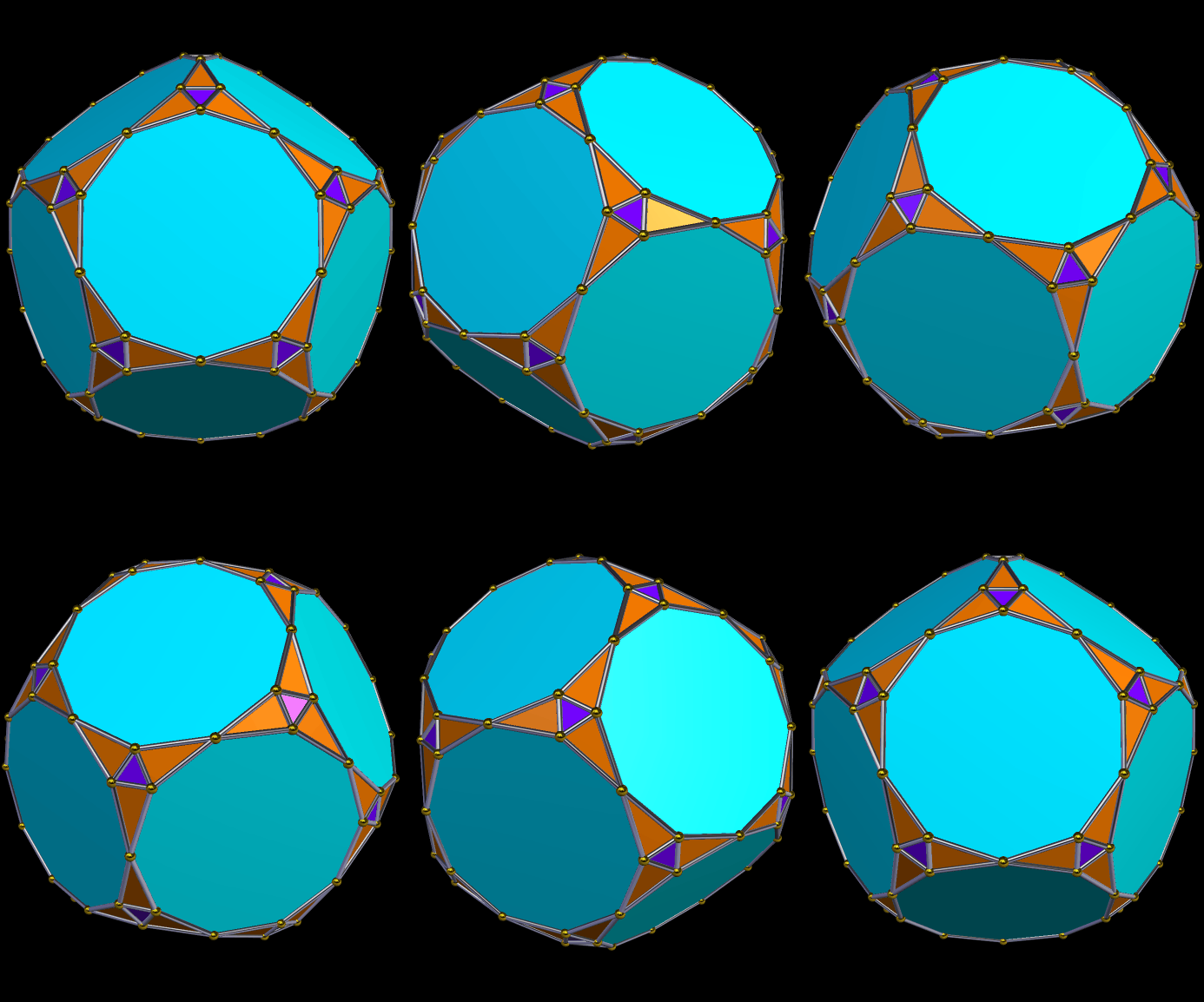
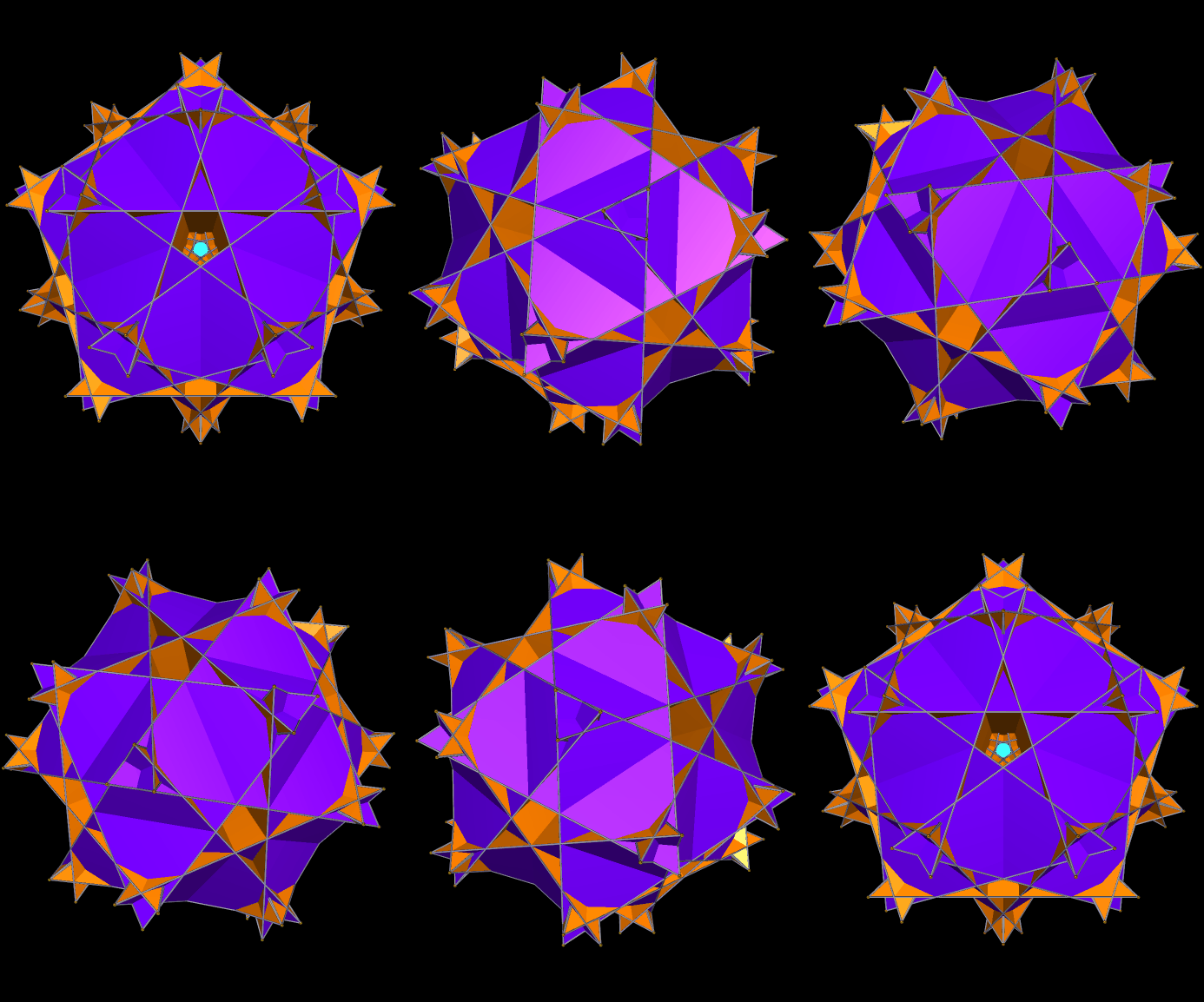
Seven Variants of the Truncated Dodecahedron

Image

Several Variants of the Truncated Dodecahedron

The smaller pics may be enlarged with a click.

UnbvxcgnamedDual of Convedgex hullConvex hullUnnamed DualDual of Conhdgsavex hullanother compoundStefgasdllated Dual of Convex hull

I used Stella 4d to assemble these polyhedra. You may try this program for free at http://www.software3d.com/Stella.php.

Given Equations for Two Circles, How Does One Find the Coordinates of Their Point(s) of Intersection, If Any?

Image

Given Equations for Two Circles, How Does One Find the Coordinates of Their Point(s) of Intersection, If Any?

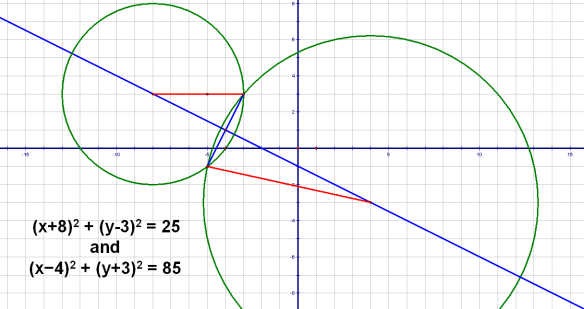
Before attempting to create a method for solving this problem with any given circles, I’m going to attempt solving it for this arbitrary pair of circles. The small circle has radius 5, is centered at (-8,3), and has the equation (x+8)² + (y-3)² = 25. The larger circle has a radius of √85, is centered at (4,-3), and has the equation (x-4)² + (y+3)² = 85.

The first thing I will do is add 60 to each side of the equation of the smaller circle, changing that equation to (x+8)² + (y-3)² + 60 = 85. There are now two equations with 85 on one side, so I will set their other sides equal to each other:  (x+8)² + (y-3)² + 60 = (x-4)² + (y+3)². Next, I square each term in parentheses, turning this equation into x² + 16x +64 + y² -6y +9 + 60 = x² – 8x +16 + y² + 6y +9. After x², y², and 9 are each cancelled from each side, the equation looks like this:  16x +64 – 6y +60 = -8x + 16 + 6y. This simplifies further to -12y + 124= -24x +16, then -12y = -24x -108, then, after dividing both sides -12, that yields the simplified equation for the straight line y = 2x + 9. Any solutions which exist, therefore, must be found on the line y = 2x + 9.

(x+8)² + (y-3)² = 25 is the equation of the smaller circle, and substituting 2x + 9 for y in this equation turns it into (x+8)² + (2x + 9 – 3)² = 25, which is equivalent to (x+8)² + (2x + 6)² = 25. By squaring the terms in parentheses found in this last equation, this turns into x² + 16x +64 + 4x² + 24x + 36 = 25, which simplifies further to 5x² +40x + 75 = 0, and then x² +8x + 15 = 0.

Applying the quadratic formula (because I don’t enjoy factoring trimonials) to this last equation, x = {-8 ± sqrt[64 – (4)(1)15)]}/2, which means that x has two values in this case:  x = (-8 + 2)/2 = -6/2 = -3, and x = (-8 – 2)/2 = -10/2 = -5. When x = -3, then y = 2(-3) +9 = -6 + 9 = 3, so one solution is the ordered pair (-3,3). By constrast, when x = -5, then y = 2(-5) +9 = -10 + 9 = -1, so the other solution is the ordered pair (-5,-1).

For other circle-pairs, the method is the same, but appropriate substitutions will need to be made in the numbers with which I started, likely leading, of course, to different answers. For some pairs of circles, the quadratic formula will not yield two real ordered pairs as solutions. If all values of x and y are nonreal, this simply means that the two circles do not touch at all. If, on the other hand, only ordered pair can be found as a solution, this means the circles are tangent to each other — touching only at a single point.