The Five Fictional Characters Who Have Most Strongly Influenced My Life

These five fictional characters have strongly influenced me, and I will always be grateful to the brilliant people who created them. I am presenting them in chronological order — using the time when this influence started, rather than their date of creation.

#1: Snoopy

Snoopy2

When I was very young — before my memory-record begins, actually — I was given Peanuts books. They were simply left in my possession, as far as I know; no explanation was necessary. The antics of Snoopy, in particular, were extremely entertaining to the little-kid version of me. Since I could see Snoopy dancing around, playing baseball, typing, irritating Lucy, etc., I wanted to understand what was actually going on with all this activity — and this provided the necessary motivation for me to teach myself how to read. There wasn’t any other way for me to tell what was going on in these comic strips!

The fact that I learned to read in this manner led to some very funny moments, due to the fact that the number of words whose meaning I understood, generally from context, exceeded the number of words I knew how to pronounce — and, no doubt, still does. Once, in elementary school, I was laughed at by an entire class, after saying something about the “Eeffel Tower” (yes, that’s how I pronounced it). I also remember pronouncing the “b” in “doubt,” much to the amusement of my parents. Even in graduate school, I made a history professor groan in agony when I made a reference to the Weimar Republic — and pronounced the “W” as it is pronounced in English, rather than German.

#2: Mr. Spock

Spock

A scientist aboard a starship, exploring the galaxy, who uses logic to try to understand two things:  the nature of the universe (much of which he understood), and the behavior of illogical humans (something which confuses me to this day, just as it often confounded him). The first person I remember seeing on television had pointed ears, and there were several of them in that episode, “Amok Time.” In other episodes, of course, few Vulcans other than Mr. Spock appeared, and I always found him, to use one of his favorite words, “fascinating.” He influenced me in several ways, and still does, to this day. I am grateful to the creators of this character for inspiring my passion for science, ability to use logic, appreciation of diversity, and strong desire to maintain control of my emotions.

#3: Matt Murdock / Daredevil

daredevil

I may not have red hair, but I share many other characteristics with Daredevil — and I mean the character from comic books, not that disappointing B-movie (which deserves no further mention). Other than amplified senses — which I experience (unpleasantly) when I get migraines — Daredevil has no superpowers, yet he faces, and does battle with, super-powered villains, and usually wins. He is also a study in contradictions: a lapsed Catholic, who spends a lot of time dressed in a devil costume; a lawyer, with a second “career” as a costumed vigilante; and a blind man, who nonetheless perceives the world around him more clearly than anyone else. Matt Murdock has inspired me to respect the concept of justice, has influenced me to study what laws I need to understand, and, most importantly, has shown me, by example, how to face down those who would do harm to those I care about — and do it, as Daredevil does, without fear. I have also developed my “never give up” attitude, toward my adversaries (bullies, mostly), with inspiration from this character.

Matt Murdock and I have also had very rocky histories when it comes to romantic relationships. I have (finally) found happiness in this aspect of life, and am writing this next to my beloved, sleeping wife. Unfortunately, the writers of Daredevil, while they will let Matt Murdock enjoy temporary happiness in relationships with women, will never allow him to keep it.

#4: Data
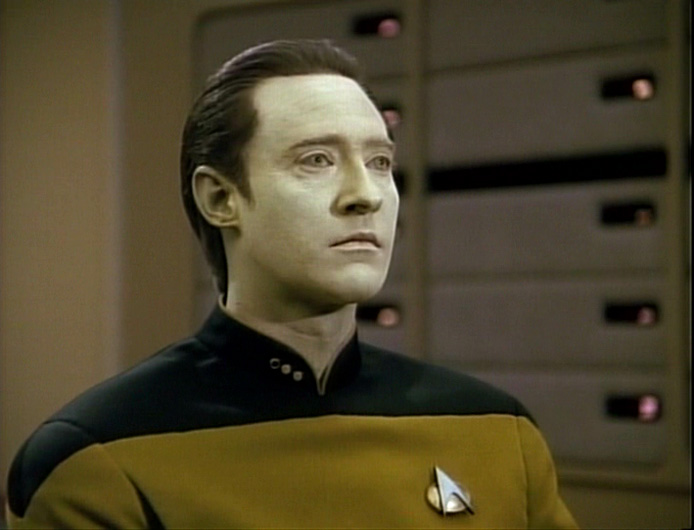
Data2366

Data is amazing to me:  a sentient android, and an artificial person. He actually had to go on trial to assert his rights to personhood, and, with the aid of Captain Picard, won the case. He has a lightning-speed calculator, built right in to his positronic brain, which far exceeds the abilities of my own, not-too-shabby mental calculator. I have long had the ambition to gain the ability to reprogram my own brain’s “software,” and have written, on this blog, about how I finally gained that ability, after working on developing it for roughly thirty years. Data, of course, had this ability from the moment he was activated, but, unlike me, he does not have to sleep for it to work.

Despite his claim to experience no emotions, Data often expressed a feeling of being perpetually alone, for there was no one else like him anywhere — until he met his brother, another android, who turned out to be malicious. That feeling of being unlike everyone else is quite familiar to me.

Both Data, and Mr. Spock, display many characteristics of Asperger’s Syndrome, and my study of these two characters helped me figure out that I am, myself, an “Aspie” — our nickname for ourselves.

#5: Calvin

Calvin_by_Watterson

When I am playing (and, yes, I play a lot, especially with mathematics), and someone asks me why I, an adult, am playing, I have a standard reply: “Because I’m six.” This is a reference to Calvin, who was six years old during the entire ten-year run of Calvin and Hobbes, the best comic strip ever created. I read it from the first day it appeared in newspapers, and have the boxed set of the complete collection of these comic strips only a meter away, as I write this. Calvin is a six-year old prodigy, as one can tell from his expansive vocabulary, but is prone to making social errors, due to a lack of understanding of social conventions — and both of these things mirror my own life. (I grew up, literally, in science laboratories, unsupervised for hours at a time, designing and conducting my own experiments, and that sort of thing simply doesn’t happen without having profound effects on a child’s development — but, then again, why would I want to be normal?) Calvin, like myself, found elementary school boring in the extreme, and so he slipped, frequently, into his own inner life of fantasy. The fact that, being socially isolated (no siblings, and no friends, other than his stuffed tiger), he is usually alone, never stopped Calvin from having fun. Just like Calvin, I can have unlimited fun, in solitude — because I choose to be this way. Some adults lose the child within them, but, thanks to Calvin’s inspiration, that will never happen to me. I’m actually 46 years old now — so I’m pretty sure that, if I was ever going to lose the ability to have fun, it would have happened already.

To those brilliant people who invented these five characters: thank you.

Recovering from Theophobia: My Personal, Secular Jihad

640px-Lutte_de_Jacob_avec_l'Ange

The image above is a 19th-Century painting by Eugène Delacroix, depicting the story of Jacob, wrestling with a being often described as an angel, as described in the Book of Genesis. An interesting part of the story is that there were no witnesses to this struggle in the darkness (“So Jacob was left alone, and a man wrestled with him till daybreak,” Gen. 32:24, NIV), which tells me that the conflict could have occurred entirely inside Jacob’s mind. It does not matter if there was, or was not, an actual person, named Jacob, who had such an experience. No supernatural beliefs are necessary to find this story interesting, and there is no good reason to avoid thinking about it.

Thought is, of course, a mental activity which can bring clarity to confusing things in life, just as a sunrise can enable one to see things which have previously been hidden by night. There are times when thinking requires solitude, and the process of figuring out difficult problems usually doesn’t succeed without some sort of internal struggle. If you have ever wrestled with a single, difficult mathematical problem for several days running, as I have, then you understand this already — but the need for clear, rational thinking is certainly not limited to the field of mathematics. Rational thought is important in all parts of life.

Whether we like it or not, life contains a series of both external and internal struggles. Many people dislike conflict, and go to great lengths to avoid it. I am not one of those people, but this is not by choice. It is, rather, a result of the fact that I was born into an intense struggle-in-progress:  the efforts of my now-deceased father, a religious fanatic, to control the lives of everyone around him, and use them for his own selfish purposes — and the efforts of some of these other people, myself included, to escape his efforts to control every facet of our lives. From an early age, out of necessity, I had to develop complex techniques of mental and verbal combat, both defensive and offensive, simply to survive childhood with some semblance of sanity intact — although the resulting PTSD, from growing up in the war zone I called “home,” is something with which I will always have to cope. My earliest memory, after all, is surviving shaken baby syndrome at age 2½, and that sort of experience simply cannot be escaped without consequences.

My mental-combat techniques still exist, available for use at any time of my choosing, and can have devastating impact on others — I seldom lose an argument — but using these verbal and mental weapons at full power is, I now realize, quite dangerous, more so to myself than to anyone else. Now, decades later, I still have to be careful not to be overly eager to jump headlong, as if by instinct, into any conflict which presents itself, especially if I see those I care about being bullied, or otherwise abused. I have neither the time, nor the mental energy, to fight every single injustice I see, but it took many years for me to understand the wisdom of the well-known saying that it is important to choose one’s battles carefully.

The word “jihad,” which I deliberately used in the title of this post, is complex, and has multiple definitions. It is also an emotionally-charged word, and out-of-control emotions are, perhaps, the greatest enemy of rational thought. So, first, please understand this: when I use this word, I am not referring to any sort of “holy war,” which is the first thing that comes to mind, for many people, when they hear what I sometimes call the “j-word.” I am also not making any sort of comment for, nor against, Islam, but am simply borrowing a word from another language, Arabic, because it applies so well to much of my own life. Another definition you will find here is “a personal struggle in devotion to Islam especially involving spiritual discipline” — in other words, an internal struggle to do the right thing. While I am not religious in any conventional sense, I definitely understand the important idea of an internal, mental — or “spiritual,” if you prefer — struggle. My personal internal struggle involves a never-ending effort to maintain self-control, especially over destructive emotions, such as hatred, and fury. Fury isn’t simply anger, after all — it goes far beyond that. It is an absolutely horrific state of mind where one is so overcome by anger that the rational self becomes utterly consumed by white-hot, blinding rage.

For years, without realizing it, I was a theophobe — hardly surprising, considering the religious elements of the more unpleasant parts of my childhood. Theophobia is not a familiar word to most people, but it can exist in both religious and non-religious people, and can be defined as an irrational fear and hatred of God, religion, religious people, and religious institutions, such as churches and mosques. There have been entire years — especially since the Catholic Church’s pedophilia scandal blew wide-open in the media, worldwide — when I could not bring myself to go near a church of any denomination, let alone enter one, for fear that being near such a place would trigger a panic attack, or, even worse, a PTSD “freakout” episode. It isn’t hard to spot theophobes, of course; they are easily identified, especially among the much larger, rapidly-growing group of people who call themselves atheists. You probably know at least a few atheists yourself, and might have noticed that some of them seem to be at peace with life, and can easily interact peacefully with religious people — while others are a perfect fit for the “angry atheist” stereotype, attacking religion as if it were the source of all evil in the world. It isn’t, but that didn’t stop me from thinking that it was, for many years.  Recovering from theophobia is not easy, and is definitely a struggle, but is also very much worth the effort.

Unusually, several of the people I am now grateful to, specifically for helping me recover from theophobia, are practicing Muslims. This doesn’t fit the stereotype of Islam portrayed in the Western media, of course. If you get all of your information about Islam from stories in the news, you might think all Muslims hijack airplanes, commit suicide bombings, oppress women, and decapitate “infidels” every time they get they chance. Fortunately, I started using another approach, while still in college:  conversation. Simply by talking to Muslims I am now proud to call my friends, I have learned several things, among them that most Muslims are kind and decent people, and also that most Muslims intensely dislike the extremists within Islam — about as much as the average Christian dislikes, say, the Westboro Baptist Church. Adding practicing Christians to the list of people I can successfully engage in productive conversation took a lot longer, but the reason for this has absolutely nothing to do with Christianity, and everything to do with my own personal history. My father was, after all (among many other things), an ordained Christian minister. Later, he moved through several other religions, attempting to drag my family along with him, and these religions included his own warped version of amalgamated Native American religious traditions, the Soka Gakkai sect of Buddhism, and several others. A notable absence on this list — one of the few religions with which my father never developed an obsession — is Islam. This fact made Islam, and those who practice it, a logical place for me to start the process of making peace with certain inescapable facts: (1) the world contains billions of religious people, most of whom are not dangerous fanatics, and (2) religion is not going away any time soon, no matter how much the furious theophobes of the world rage against it.

This personal recovery-process is not over; I still have much internal, mental work left to do, especially when it comes to establishing peace with Christianity, the world’s largest religion. The important thing, at this point, is that I am doing it. I’m quite happy to have left the “angry atheist” phase of my life in the past, where it belongs, and have no intention of returning there.

Fort Smith? Pine Bluff? What’s the Difference?

Fort Smith is Pine Bluff

Unless you also live in the American state of Arkansas, you may not have even heard of Fort Smith and Pine Bluff. For those who grew up in this state, though, they’re considered (by our peculiar standards) to be major cities. Fort Smith is on the far West side of the state, on the Oklahoma border, while Pine Bluff is in the Southeastern part of the state, also known as the Mississippi Delta.

I didn’t learn Arkansas geography in school. Instead, when I was a child, my family traveled, mostly within the state — a lot. By the time I was ten years old, I’d been in all 75 counties of Arkansas, and knew quite a bit about where things are here . . . except for these two cities, Fort Smith and Pine Bluff.

If you’re from Arkansas, you know these two cities are nothing alike. What I noticed in childhood, above all else, was the fact that the two cities smelled so different from each other. The reason is simple:  Pine Bluff has a lot of paper mills, and the smell near paper mills is not entirely unlike being locked in a small closet with several dozen rotten eggs. Fort Smith, by contrast, is relatively odorless.

What perplexed my parents, though, is the fact that I would consistently confuse these two cities. I’d refer to the “horrible smell of Fort Smith,” or, if I knew we were going to Pine Bluff, I might ask if we’d be crossing the border into Oklahoma. My parents always corrected these mistakes, but I kept making them, repeatedly, which is not like me at all. When young, I never had more than a 50% chance of correctly identifying either of these cities. Once I figured out what I was doing, though — at around age twelve — this repeated error made perfect sense.

When I try to understand something, I examine it, and consider it, mathematically. Often, I’m not even conscious I’m doing that — it’s simply how I think. Both Fort Smith and Pine Bluff are two-word city names. To make matters even worse, the first word of each city-name has four letters, and the second word in each has five. Once I realized these parallels, though, it all made sense:  no wonder I couldn’t tell these places apart, with names which, examined through the lens of childhood mathematics, looked exactly alike.

To my knowledge, no one else has ever had a long-term problem confusing these two Arkansas cities. However, when those who know me well hear this story, they are never surprised that I would do such a thing.

“Strong Grape Juice”

Image


My earliest memory of a church service involves a trip to visit relatives, and I started discovering how different from others I was at a very young age. This is one of the episodes which played a major role in that discovery.

I was only four or five years old, and had already developed an intense hatred of being bored. Ignoring the sermon seemed like an even more boring prospect that actually paying attention to it, so I consciously chose the latter, which I’ve observed is often not the choice young children make.

This church’s denomination is one of those that teaches that drinking alcohol is sinful. They are also Biblical literalists. This, of course, poses a problem, for there is a lot of drinking of wine to be found in the Bible. This preacher didn’t avoid the contradiction, though. His task, that Sunday morning, was to deal with it head-on, and he did so with the following claim: when Jesus, his disciples, and numerous other people from the Bible are described as drinking wine, that wine actually contained no alcohol. It was not wine as we know it today. It was, rather, merely “strong grape juice.” Those were his exact words.

Even at that young age, I had already started working on building, in my own mind, the best crap-detector I could possibly create. (Improving it is still something I work on today.) I didn’t yet realize that real wine would be far safer, before refrigeration existed, than grape juice, simply because alcohol, at the concentrations found in wine, kills lots of disease-causing bacteria. However, that morning, I had learned enough to instantly recognize this “strong grape juice” claim as absolute crap.

Dismissing the preacher as not worthy of further attention, I stood up in our pew, and turned around to face the back of the church. We were sitting near the front, so this let me see most of the congregation. I didn’t need to speak to them — I just wanted to look at them. I remember being stunned by what I saw. Nearly everyone appeared quite attentive to the sermon. Some mouths were half-open, and numerous heads were nodding in agreement with the preacher’s droning nonsense. I figured it out: they were actually accepting what this man was saying as the truth, and were doing so without question! They believed him! At first, I felt dizzy, and then, later, I felt sick. The more I thought about the experience, the worse I felt, and I could think about nothing else for a long time after that church service finally ended.

I’d been exposed to religion many times before, but it always seemed to me that adults didn’t really believe what they were saying, any more than when they told children my age about the Tooth Fairy or Santa Claus. At that moment, though, I realized I had been mistaken. This was no act. These people, in that church that day, actually believed what they were told. Why? I didn’t know. I still don’t. If that man told them that two plus two equals six, would they believe that? I suspected they would.

I was surrounded by a herd of sheep. That moment of clarity, when I realized this fact, scared me. It made me wonder, and not for the last nor first time, if I had been secretly planted on earth by aliens, as a baby, and without a guidebook.

This is only one of many experiences that convinced me of the importance of skepticism. The fact that it is so clear, in my memory, leads me to think it was one of the more important of those experiences. It cemented, in my mind, a scary truth: the world is infested with large numbers of incredibly gullible, deluded people. They weren’t like me. I didn’t understand them. They were everywhere. I wasn’t anything like them, and didn’t want to be, either. I was, however, stuck here with them.

I was stranded on the wrong planet, with no prospect for escape, any time soon. That was over forty years ago, and I’m still here.

Issues of Control

Image

Issues of Control

There’s a common phrase which has been said to me many times — often enough, in fact, that I sometimes now find it amusing when I hear it. You’ve probably heard it, also, or perhaps have said it to other people, yourself: “You have control issues.”

I sometimes wonder why anyone would feel the need to point this out to me. It’s something that is so blindingly obvious, to myself, and to all who know me well, that it really doesn’t even need to be said. My usual response, the last few years, has been the following: “Control issues? I don’t merely have control issues. I’ve got a lifetime subscription.”

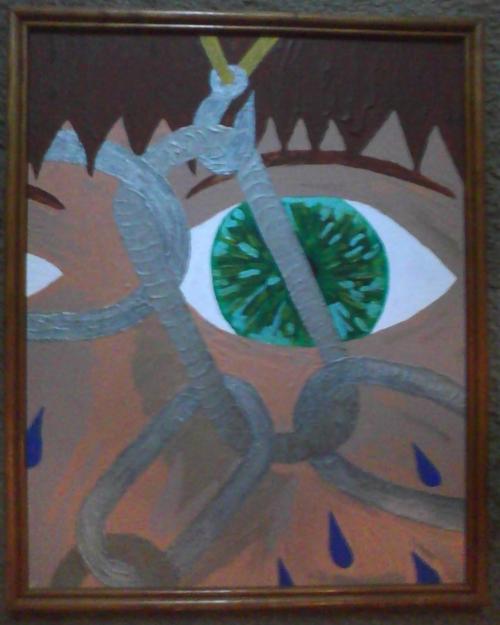
The painting at the top of this post was a self-portrait I painted many years ago, while still struggling with (metaphorical) inner “demons” that bother me much less now, compared to how I was even a few years ago, at a time when my mental health was far more precarious.

Am I, to use an informal term for it, a “control freak?” Well, yes, I am — but not of the common variety. I’ve discerned that there are two very different types of control freak in existence, and have labeled them, simply, as type I and type II control freaks. I’m of the second type, but the first type is far more common.

Type I control freaks, as I define them, put a lot of time and energy into controlling other people, or at least trying to do so. I see such people as insecure, on an unconscious level, and suspect they have a strong drive to force their will on others, simply as a way to help them feel more secure about themselves. Such people are extremely unpleasant for me to be around, and I avoid them whenever I can. When forced to be around them, conflict is common.

Type II control freaks are very different from those of the first type. They — or, rather, we — have no particular urge to control other people. We do, however, still have very strong issues related to control, and, yes, this can cause problems at times.

(As an aside, I should explain my use of the word “freak,” since some people find that word offensive. It’s a word I’ve applied to myself since childhood. I don’t ever use this word as an insult. If I call someone “normal,” though, that’s another matter. “Normal” is a word I do use, when I use it, as an insult — a synonym for such terms as “boring,” “ordinary,” or “typical.” The idea of being normal is, to me, horrifying in the extreme — and to be a “freak” is, of course, the exact opposite.)

So what’s up with these people I call type II control freaks? In short, what’s our problem, and how do we differ from control freaks of the more common variety? Well, in my case (and that of others like me, I suspect), we were subjected, when very young, to extreme amounts of manipulative, controlling behavior by others — to such an extreme degree that we are now hypersensitive to any real (or perceived) efforts to control us. In my case, this overly-controlling person — the overwhelming monster of my childhood — was my father, deceased since mid-2010, and, at least by me, completely unmourned. When I painted the painting above, he was still alive. Now that he is gone, and can, therefore, never harm another person, the chains depicted in this painting have, after many decades, finally been broken, even though I still have to deal with lingering PTSD, and likely always will, because of the trauma he inflicted on me in childhood. (The difference is that, now, I simply have to deal with the fact that I used to be “chained up,” and cope with the resulting memories, whereas, before he died, the chains were still “on,” even though we were estranged for many years.) Hearing the news of his death was, quite possibly, the most liberating moment of my life.

Type II control freaks have no need to control others — we simply have an overwhelming need to keep others from controlling us. We are lovers of freedom and liberty, and need it almost as intensely as all humans need oxygen. At least in my case, I can’t even stand to see the first type of control freak in action, against another, without feeling an overwhelming urge to do almost anything in my power to stop them.

I have no qualms about being, and openly admitting to being, a control freak of the second type. It’s simply a part of who I am. There are certainly less healthy ways to react to childhood trauma, after all — such as when someone turns into the same type of monster that terrorized him or her in the first place, thus perpetuating a multi-generational cycle which is unhealthy in the extreme.

As for the type I control freaks, I am unable to feel any sympathy for them. They victimize others whenever they can. They’re bullies. They need to be opposed, and they need to be stopped. They are, in a word, evil — and that’s not a word I use often, nor one I use lightly.

I’m a permanent part of the resistance to such people, and have no reservations about this. If it were in my power to change this part of who I am — and it isn’t, anyway — I certainly would not choose to do so.

The Best Way to Lose a Spelling Bee

bee

In 4th grade, I finished in second place in my school district’s spelling bee. This makes a much better story than winning, because of the word I could not spell correctly. That word was obeid (crap) obiedi (grrrr) obedei (blast it) obeedient that word that means you do as you are told.

My mother’s reaction was great:  “Of course he couldn’t spell it! He doesn’t know what that word means!”