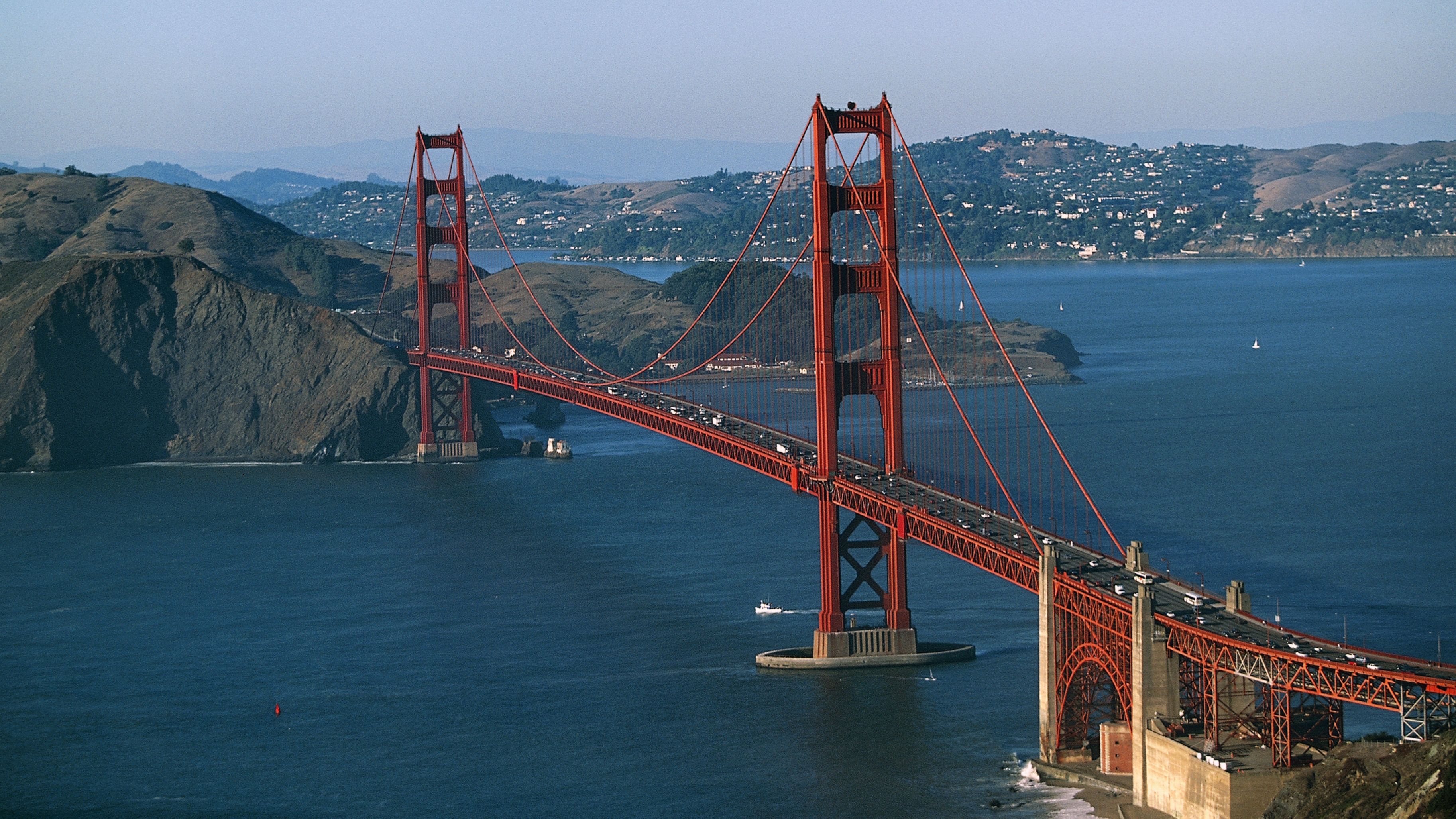
My 1987 Visit to the Golden Gate Bridge

(Photo credit: CNN.)

After my freshman year of college, in 1985-86, I dropped out of college (temporarily, as it turned out), and went hitchhiking around the Western U.S. during the next school year. (Important disclaimer: this is not a recommended mode of travel!) One of the highlights of these journeys was my visit to San Francisco’s Golden Gate Bridge. Having no car, I walked across this famous bridge, starting from the San Francisco side. It is an awesome landmark, with an incredible view. I stopped half-way across, and sat there on the bridge’s walkway for maybe half an hour, watching the waves in San Francisco Bay, as well as looking over the bridge at the Pacific Ocean. After sitting for that time, enjoying the view, I got up, and resumed my walk north, across the bridge to Marin County.

Months later, after returning home to Arkansas, I ran into statistics like these I just looked up, using Google: there were 31 suicides in 1976 from people jumping off the Golden Gate Bridge, 24 in 1980, and so on. I wondered: how exactly did they know? Do they just count bodies that wash up on the shore, or is there a guy with a yellow legal pad and a pencil, in a small office at the base of the bridge, getting paid by the City and County of San Francisco to watch for, and count, jumpers? And, if there is such a guy, what was he doing when I sat in the middle of the bridge in 1987 for half an hour? Was he watching me with binoculars? Was he saying to himself, perhaps out loud, “I wish that jerk up there in the black t-shirt would make up his mind, already! Jump, or get off the bridge! I’m late for my lunch break, AND I have to go to the bathroom!”

At no point have I ever been suicidal, but I still laugh thinking about that hypothetical guy with the yellow legal pad. Dark humor is, in my opinion, the best kind.

Two Black, Stellated Polyhedra, Rotating in the Dark

The polyhedron shown above is the final stellation of the icosahedron, while the one below is the rhombic triacontahedron’s final stellation. I made these using Stella 4d, which you can try for free at http://www.software3d.com/Stella.php.

An Image, from Outside All of the Numerous Event Horizons Inside the Universe, During the Early Black Hole Era

late universe

This image shows exactly what most of the universe will look like — on a 1:1 scale, or many other scales — as soon as the long Black Hole Era has begun, so this is the view, sometime after 1040 years have passed since the Big Bang. This is such a long time that it means essentially the same thing as “1040 years from now,” the mere ~1010 years between the beginning of time, and now, fading into insignificance by comparison, not even close to a visible slice of a city-wide pie chart.

This isn’t just after the last star has stopped burning, but also after the last stellar remnant (such as white dwarfs and neutron stars), other than black holes, is gone, which takes many orders of magnitude more time. What is left, in the dark, by this point? A few photons (mostly radio waves), as well as some electrons and positrons — and lots — lots — of neutrinos and antineutrinos. There are also absurd numbers of black holes; their mass dominates the mass of the universe during this time, but slowly diminishes via Hawking radiation, with this decay happening glacially for large black holes, and rapidly for small ones, culminating in a micro-black-hole’s final explosion. Will there be any baryonic matter at all? The unanswered question of the long-term stability of the proton creates uncertainty here, but there will, at minimum, be at least be some protons and neutrons generated, each time a micro-black-hole explodes itself away.

Things stay like this until the last black hole in the cosmos finally evaporates away, perhaps a googol years from now. That isn’t the end of time, but it does make things less interesting, subtracting black holes, and their Hawking radiation, from the mix. It’s still dark, but now even the last of the flashes from a tiny, evaporating black hole has stopped interrupting the darkness, so then, after that . . . nothing does. The universe continues to expand, forever, but the bigger it becomes, the less likely anything complex, and therefore interesting, could possibly have survived the eons intact.

For more on the late stages of the universe, please visit this Wikipedea article, upon which some of the above draws, and the sources cited there.

32 Octagonal Mandalas, Rotating in the Dark

Icosidodeca

To create the octagonal mandalas, I used Geometer’s Sketchpad and MS-Paint. I then projected them onto the faces of an all-but invisible icosidodecahedron, and created this rotating .gif image of it, using Stella 4d: Polyhedron Navigator, software you can try for free, right here.

A Dozen Octagonal Mandalas, Rotating in the Dark

DodecaTo create the octagonal mandalas, I used Geometer’s Sketchpad and MS-Paint. I then projected them onto the faces of an all-but invisible dodecahedron, and created this rotating .gif image of it, using Stella 4d: Polyhedron Navigator, software you can try for free, right here.

How Richard Feynman Saved Eastern Tennessee from Getting Nuked

feynman

I’m reading the book shown above for the second time, and am noticing many things that escaped my attention the first time through. The most shocking of these items, so far, is finding out that history’s first nuclear explosion almost occurred by accident, in Oak Ridge, Tennessee, during World War II. One person prevented this disaster, and that person was Richard Feynman, my favorite scientist in any field. If you’d like to read Feynman’s account of this, in his own words, it’s in the chapter “Los Alamos from Below,” which starts on page 107.

Feynman, a physicist, was one of many civilians involved in the Manhattan Project, doing most of his work in New Mexico. At one point, though, he obtained permission to visit Oak Ridge, in order to try to solve problems which existed there. These problems were caused by the American military’s obsession with secrecy, which was caused, in turn, by the fact that it was known, correctly, that at least one spy for the Nazis was among the people working on the Manhattan Project. The military’s “solution” to this problem was to try to keep each group of civilians working for them in the dark about what the other groups of civilians were doing. Most of them had no idea that they were working to develop a bomb, let alone an atomic bomb. In Tennessee, they thought they were simply working on developing a way to separate uranium isotopes, but did not know the underlying purpose for this research.

The military men in charge knew (because the physicists in New Mexico figured it out, and told them) a little bit about the concept of critical mass. In short, “critical mass” means that if you get too much uranium-235 in one place, a runaway chain-reaction occurs, and causes a nuclear explosion. The military “brass” had relayed this information to the civilian teams working in Tennessee, by simply telling them to keep the amount of U-235 in one place below a certain, specific amount. However, they lacked enough knowledge of physics to include all the necessary details, and they deliberately withheld the purpose for their directive. Feynman, by contrast, did not share this dangerous ignorance, nor was he a fan of secrecy — and, as is well known, the concept of respecting “authority” was utterly meaningless to him.

While in Tennessee, Feynman saw a large amount of “green water,” which was actually an aqueous solution of uranium nitrate. What he knew, but those in Tennessee did not, is that water slows down neutrons, and slow neutrons are the key to setting off a chain reaction. For this reason, the critical mass for uranium-235 in water is much less than the critical mass of dry U-235, and the “green water” Feynman saw contained enough U-235 to put it dangerously close to this lower threshhold. In response to this, Feynman told anyone who would listen that they were risking blowing up everything around them.

It wasn’t easy for Feynman to get people to believe this warning, but he persisted, until he found someone in authority — a military officer, of course — who, although he didn’t understand the physics involved, was smart enough to realize that Feynman did understand the physics. He was also smart enough to carefully listen to Feynman, and decided to heed his warning. The safety protocols were modified, as were procedures regarding sharing of information. With more openness, not only was a disaster in Tennessee avoided, but progress toward developing an atomic bomb was accelerated. It turns out that people are better at solving problems . . . when they know the purpose of those problems.

Had this not happened, not only would Eastern Tennessee likely have suffered the world’s first nuclear explosion, but overall progress on the Manhattan Project would have remained slow — and the Nazis, therefore, might have developed a controlled nuclear bomb before the Americans, making it more likely that the Axis Powers would have won the war. Richard Feynman, therefore, dramatically affected the course of history — by deliberately putting his disdain for authority to good use. 

save lives