I had a strange mishap recently with a member of my large collection of polyhedral dice. This hollow d12 fell apart, into two panels of six pentagons each.

I held them together at vertices, rotating one of the panels slightly.
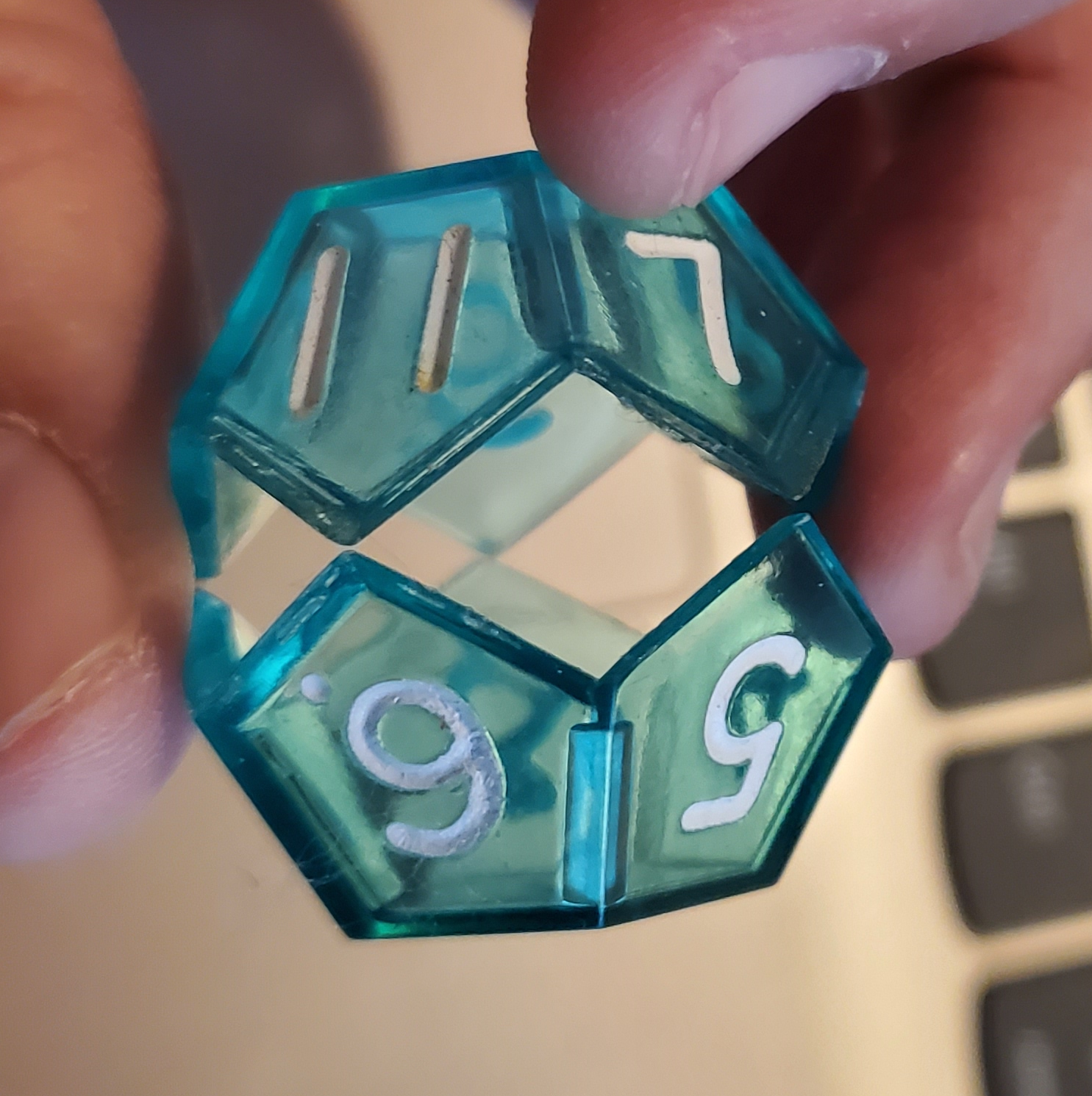
Those gaps aren’t rhombi, because their four vertices are noncoplanar. Instead of rhombi, therefore, I’m filling the gaps with pairs of isosceles triangles. I’m going to request help from experts to find the edge length ratio for these isosceles triangles, but I know it isn’t 1:1, since all 92 of the Johnson solids have been found.
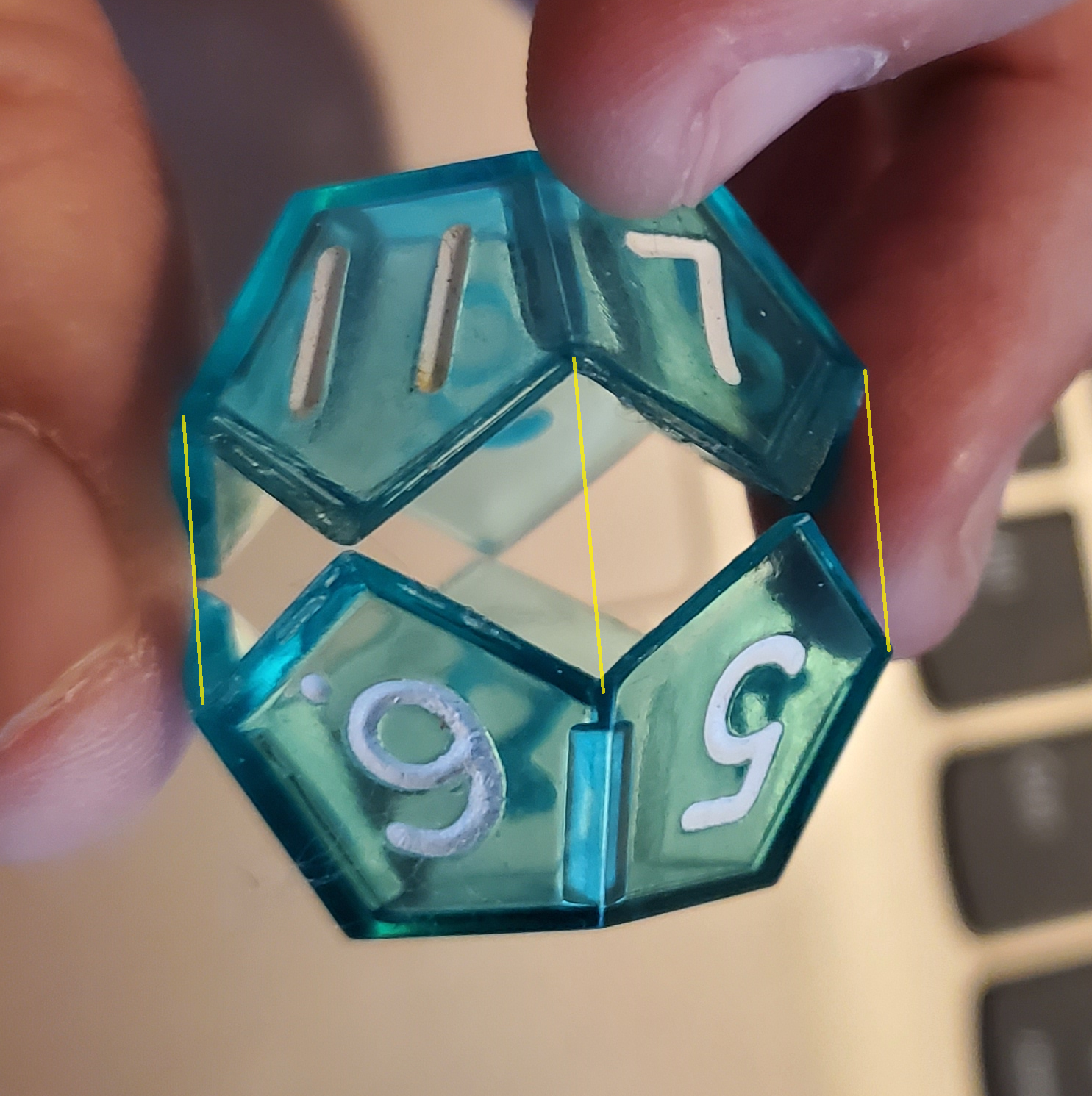
I think this particular near-miss may have been found and posted before in a Facebook group devoted to polyhedra, as a magnetic ball-and-stick model, but I don’t think it was named at that time. The name “ditrated dodecahedron” is derived from “tetrated dodecahedron,” which you can read about right here. The tetrated dodecahedron has four panels of pentagons rotated away from the center, while the ditrated dodecahedron has only two panels. The latter’s faces are twelve regular pentagons, and ten isosceles triangles.
I’m going to post this in that Facebook group where I think this near-miss to the Johnson solids may have been seen before, in an effort to spread the discovery-credit around anywhere it has been earned. I’d also like to have a Stella 4d model of this solid, and for that, again, I need the help of experts. Once I know more about this near-miss, I’ll post part two. [Update: part two is right here.]
 RobertLovesPi.net