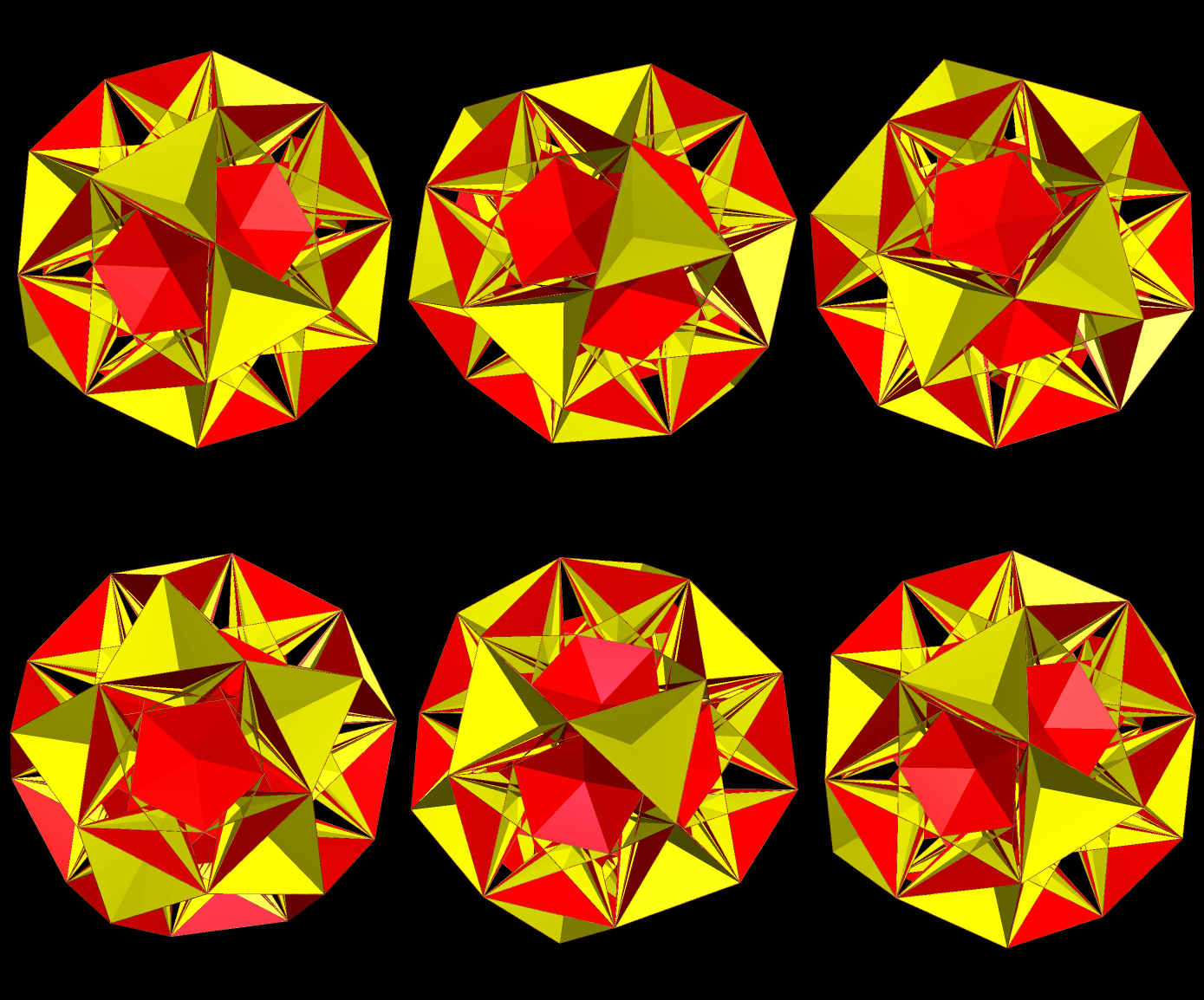
Aftershock

Image

Aftershock

Here’s the inverted-color version, also:
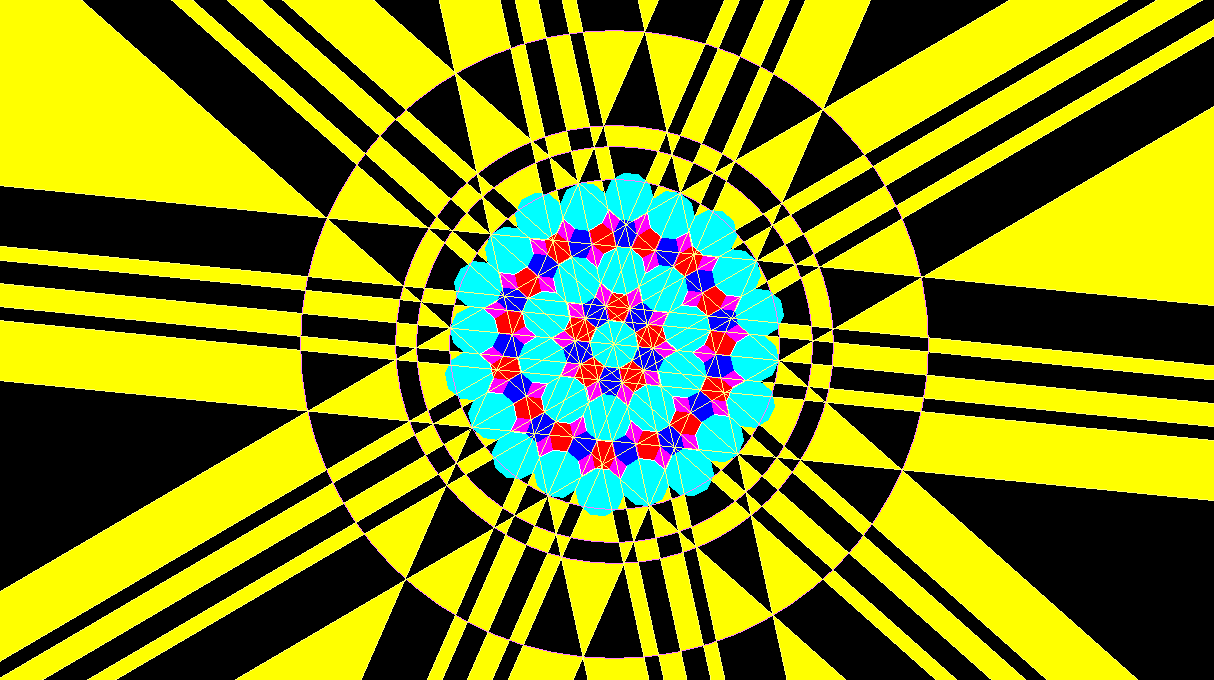
shock2inv

Shock

Image

Shock

The Dual of a Dodecahedron Made of Rhombic Triacontahedra

Image

The Dual of a Dodecahedron Made of Rhombic Triacontahedra

This is the dual of the figure shown in the last post.

Software used: see http://www.software3d.com/Stella.php.

Dodecahedron Made of Rhombic Triacontahedra

Image

Dodecahedron Made of Rhombic Triacontahedra

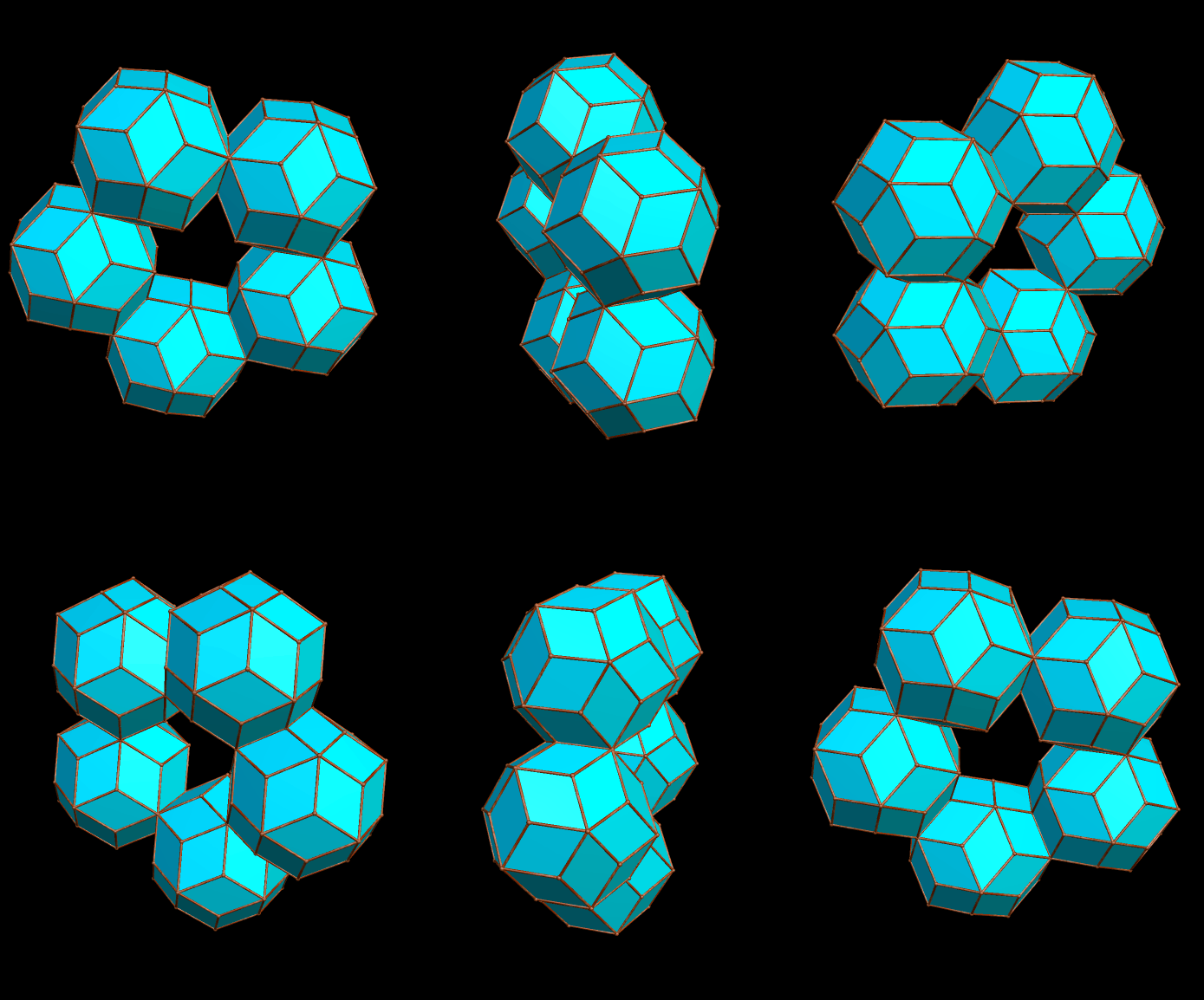
In the last post, I showed that five rhombic triacontahedra can be stuck together to form a pentagonal ring. The next logical step is shown here: using such pentagonal rings to construct an entire dodecahedron made of rhombic triacontahedra.

Software credit: see http://www.software3d.com/stella.php.

Pentagonal Ring of Rhombic Triacontahedra

Image

Pentagonal Ring of Rhombic Triacontahedra

Software credit: http://www.software3d.com/Stella.php.

The Second Stellation of a Mandala-Covered Truncated Octahedron

Image

The Second Stellation of a Mandala-Covered Truncated Octahedron

To see what the truncated octahedron looked like before being stellated twice, and read about how it was created, I refer you to the previous post on this blog.

Stellation of polyhedra is easy with Stella 4d, a program you can try and/or buy at http://www.software3d.com/Stella.php.

Truncated Octahedron Decorated with Mandalas

Image

Truncated Octahedron Decorated with Mandalas

The image on the squares is the same that appears two posts ago here, its color-inversion appears on the hexagons, and these were created with Geometer’s Sketchpad and MS-Paint. Projecting those images onto the larger faces of this polyhedron, and then creating this rotating .gif file, was accomplished with the use of Stella 4d, polyhedron-manipulating software you can try and/or buy at http://www.software3d.com/stella.php.

Truncated Tetrahedron Decorated with Mandalas

Image

Truncated Tetrahedron Decorated with Mandalas

The image on the hexagons is the same that appears in the previous post here, and was created with Geometer’s Sketchpad and MS-Paint. Projecting those images onto the larger faces of this polyhedron, and then creating this rotating .gif file, was accomplished with the use of Stella 4d, polyhedron-manipulating software you can try and/or buy at http://www.software3d.com/stella.php.

The Seventeenth Stellation of the Truncated Cube

Image

The Seventeenth Stellation of the Truncated Cube

Cretaed using Stella 4d, available at http://www.software3d.com/stella.php.

Truncated Cube Decorated with Waves

Image

Truncated Cube Decorated with Waves

On the octagonal faces, the waves shown in blue, red, and purple are sine waves of varying wavelength and amplitude. The other three waves were each formed by combining two of these component waves by simple addition — wave interference, in other words. All three possible combinations of two component waves are included.

I needed three different types of software to create this. First, Geometer’s Sketchpad was used to create the multiple-wave image itself. Next, with MS-Paint, I cropped the image and converted it into a usable format. Finally, Stella 4d was used to place the image on the large faces of this truncated cube, and create this rotating .gif file.

Of these three programs, Stella 4d is easily my favorite, and it also happens to be written by a friend of mine. Trial version / purchase information for this program may be found at http://www.software3d.com/stella.php.