Kryptonite

Image

Kryptonite

Software credit: see http://www.software3d.com/stella.php

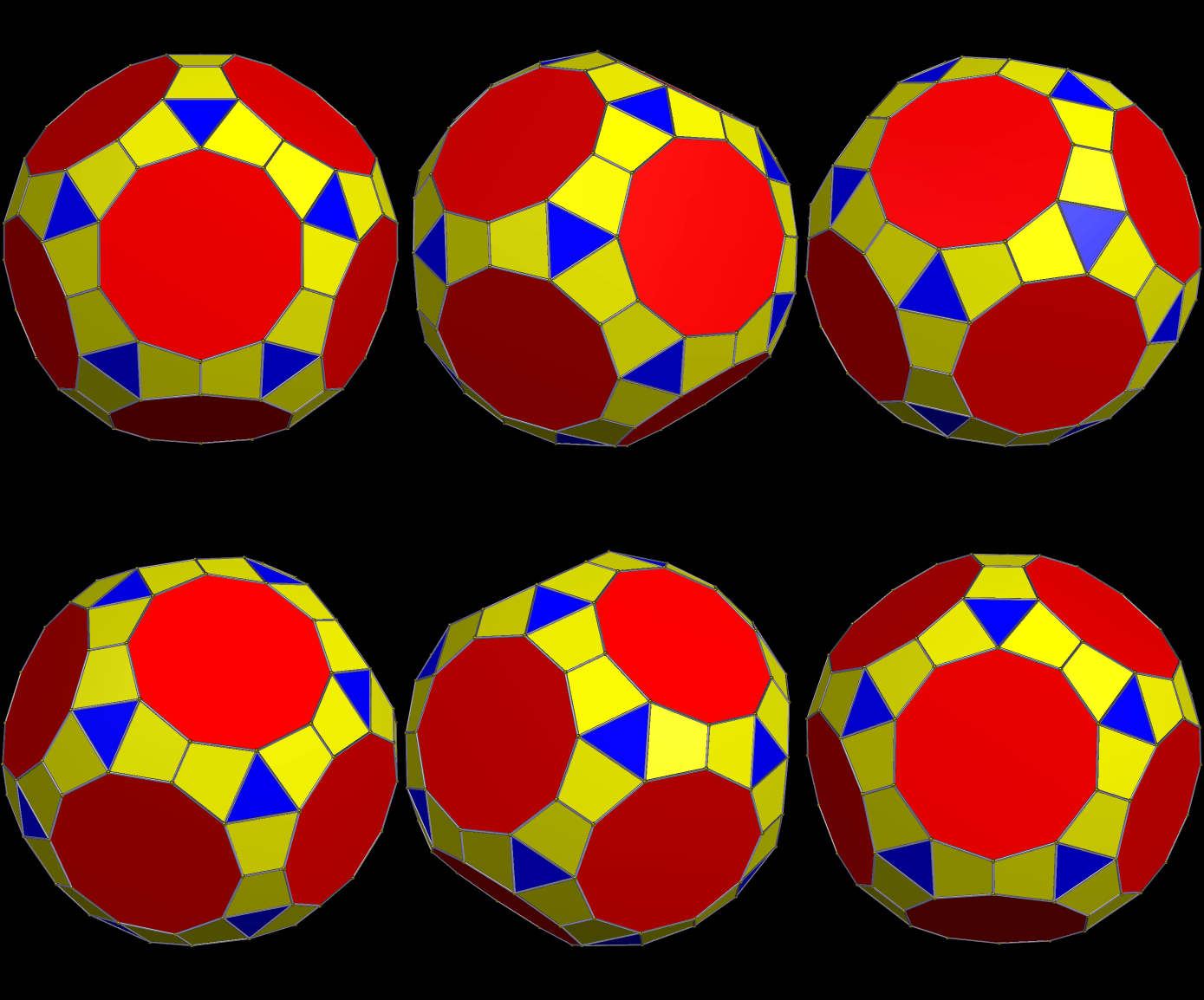
A Polyhedron with 182 Faces

Image

A Polyhedron with 182 Faces

The faces of this polyhedron include:

12 decagons
30 octagons
60 light-colored hexagons
20 dark-colored hexagons
60 isosceles trapezoids

It was made with Stella 4d, software you can try and/or buy at http://www.software3d.com/stella.php.

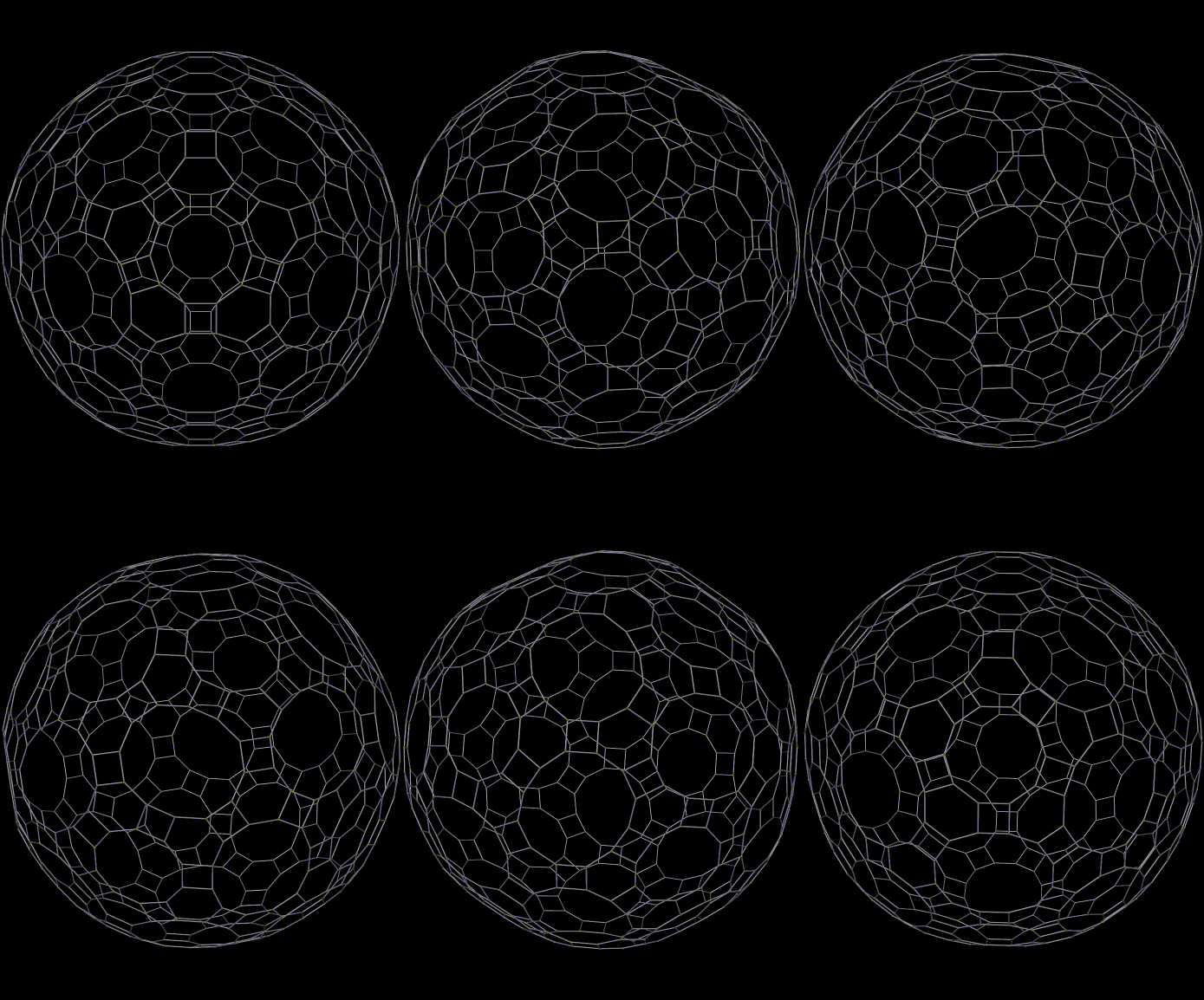
A Wire-Frame Zonohedron Based On the Faces, Edges, and Vertices of an Icosahedron

Image

A Wire-Frame Zonohedron Based On the Faces, Edges, and Vertices of an Icosahedron

This is the shape of the largest zonohedron one can make with red, yellow and blue Zome (see http://www.zometool.com for more on that product for 3-d real-world polyhedron modeling). This image was made using Stella 4d, which you can find at http://www.software3d.com/stella.php.

A Bowtie Symmetrohedron Featuring Twelve Decagons and Twenty Equilateral Triangles

Image

A Bowtie Symmetrahedron Featuring Twelve Decagons and Twenty Equilateral Triangles

Created using software you can try at http://www.software3d.com/stella.php.

Later edit:  I found this same polyhedron on another website, one that has been online longer than my blog, so I now for, for certain, that this was not an original discovery of my own. At http://www.cgl.uwaterloo.ca/~csk/projects/symmetrohedra/, it is named the “alternate bowtie dodecahedron” by Craig Kaplan and George W. Hart.

122-Faced Zonohedron with Equal Edge Lengths

Image

122-Faced, Equal-Edge-Length Zonohedron

The 122 Faces are:

  • 12 regular decagons
  • 20 regular hexagons
  • 60 squares
  • 30 equilateral (but not equiangular) octagons

Created with Stella 4d, avaialable at http://www.software3d.com/stella.php.

Tessellation of Regular Dodecagons and Regular Enneagons, Together with “Bowtie” Hexagons

Image

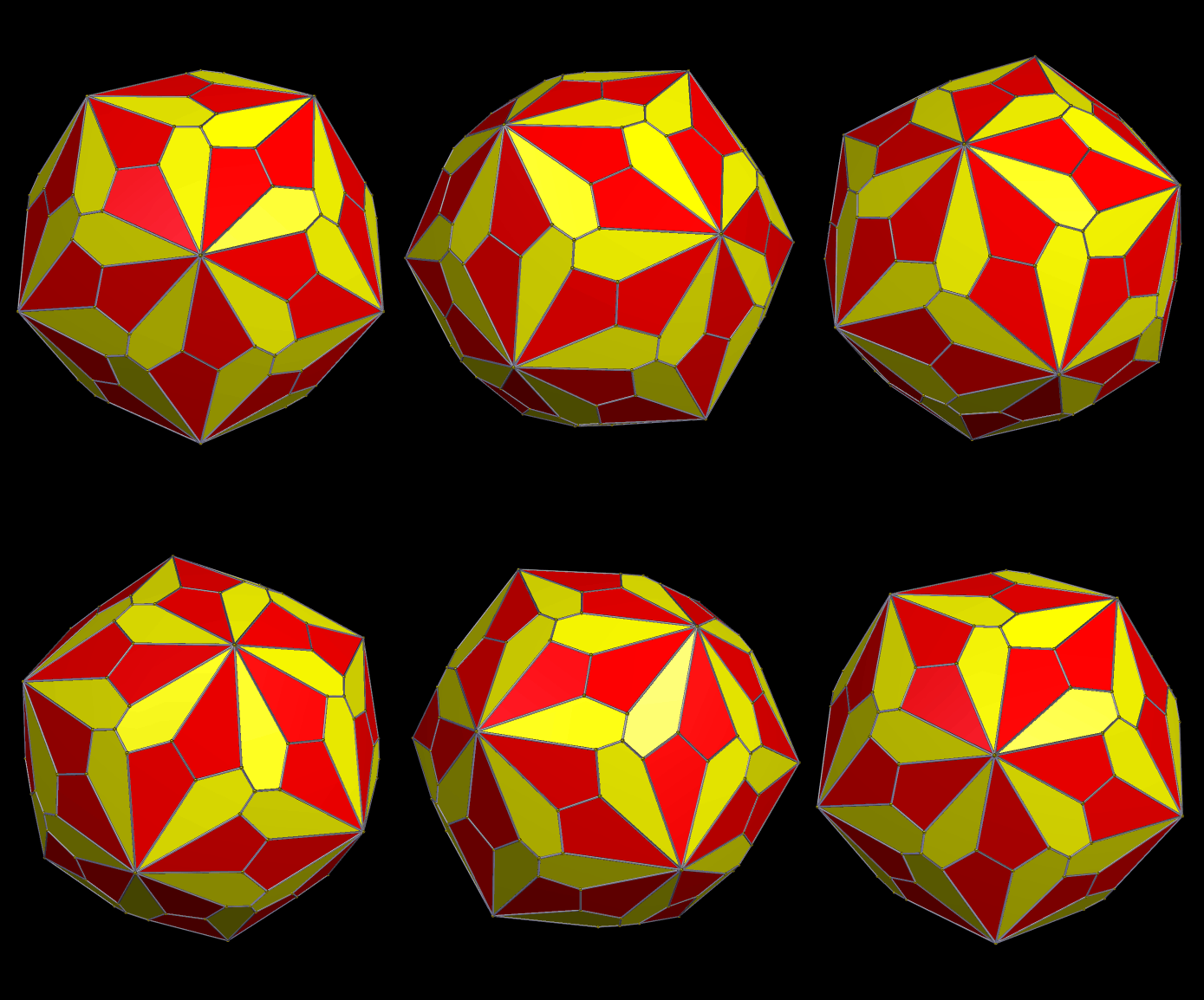
Lightning Bolts and Triskelions

Image

Lightning Bolts and Triskelions

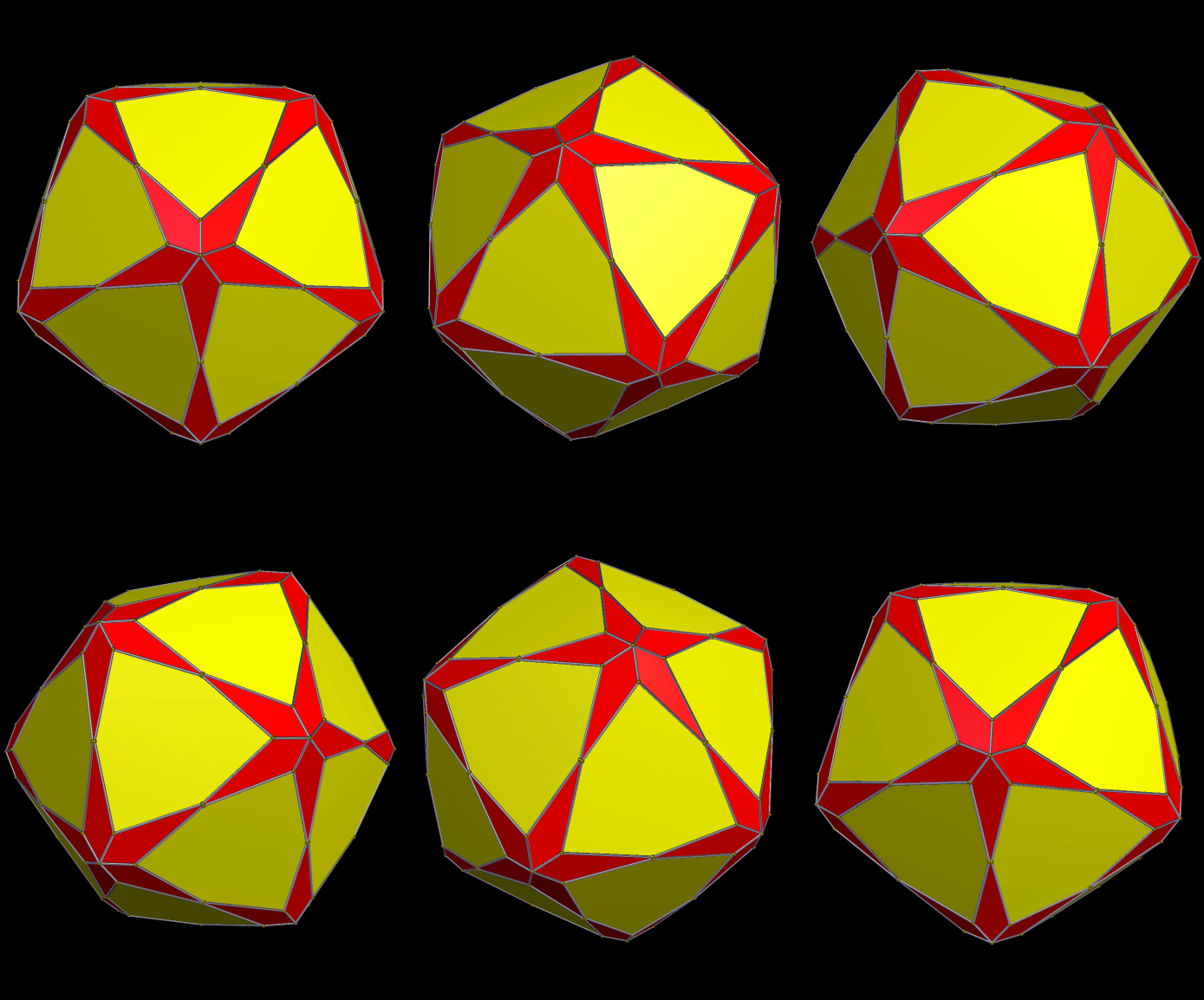
The yellow “triskelions” here are twenty in number, and are made of three irregular pentagons each. The red “lightning bolts” between them are thirty in number, and are made with two irregular quadrilaterals each.

I stumbled across this polyhedron by accident, while playing with different polyhedral transformations possible using Stella 4d: Polyhedron Navigator. You may try this software yourself at http://www.software3d.com/Stella.php as a free trial download, before deciding whether to purchase the fully-functioning version.

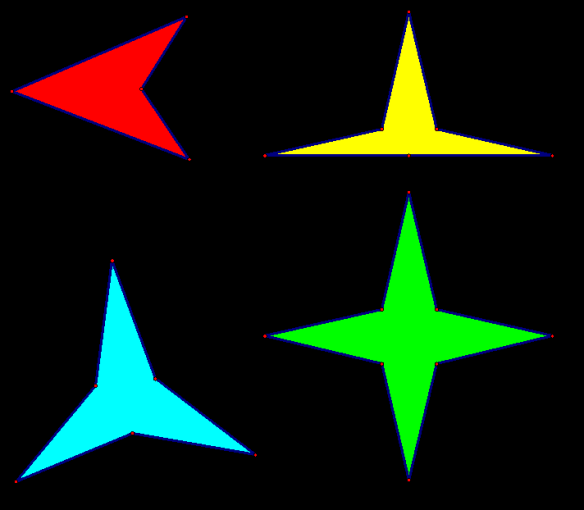
On Classification of Concave Polygons By Number of Concavities

Image

On Classification of Concave Polygons By Number of Concavities

Concave triangles do not exist, so concavity does not appear in the examination of polygons by ascending side length until the quadrilateral. A quadrilateral may only have one concavity, as shown in the red figure. Any polygon with exactly one concavity is called a uniconcave polygon.

Beginning with pentagons, the potential for two concavities appears. A polygon with two concavities, such as the yellow pentagon shown here, is a biconcave polygon.

Triconcave polygons, such as the blue hexagon here, have exactly three concavities. It is not possible for a triconcave polygon to have fewer than six sides.

For a tetraconcave polygon, with four concavities, at least eight sides are needed. The example shown here is the green octagon.

For higher number of concavities, simply double the number of sides to find the minimum number of sides for such a polygon. This pattern begins on the bottom row in the diagram here, but does not apply to the polygons shown in the top row.

A Tessellation Featuring Regular Heptagons

Image

Tessellation Featuring Regular Heptagons

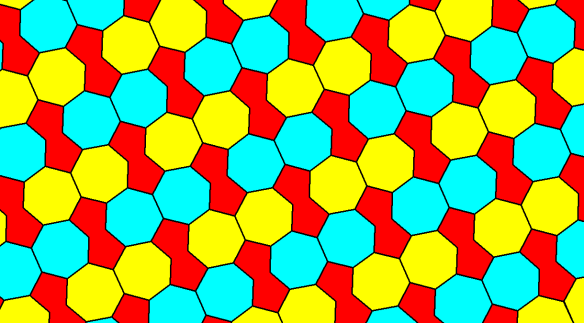
Regular heptagons, of course, can’t tile a plane by themselves. Of all tessellations of the plane which include regular heptagons, I think this is the one which minimizes between-heptagon gap-size (the parts of the plane outside any heptagon). However, I do not have a proof of this. The shape of each of the polygons which fill the “heptagon-only gaps” is a biconcave, equilateral octagon. With these octagons, this is a tessellation, but without them, it wouldn’t fit the definition of that term.

[Later edit:  on Facebook, a friend showed me two others with smaller gap-sizes. In other words, the conjecture above has now been shown to be wrong.]

An Icosahedron Variant Featuring Kite-Stars

Image

An Icosahedron Variant Featuring Kite-Stars

This variant of the icosahedron has five kites meeting at each of its twelve vertices, forming what I call the twelve “kite-stars” of this polyhedron. Also, two kites meet at the midpoint of each of the icosahedron’s thirty edges. The emplacement of the kites changes the triangular faces of the icosahedron into equilateral, but non-equiangular, hexagons.

Software credit: see http://www.software3d.com/stella.php to try or buy Stella 4d, the software I used to create this image.