Space-Filling Truncated Octahedra in a Rhombic Dodecahedral Cluster

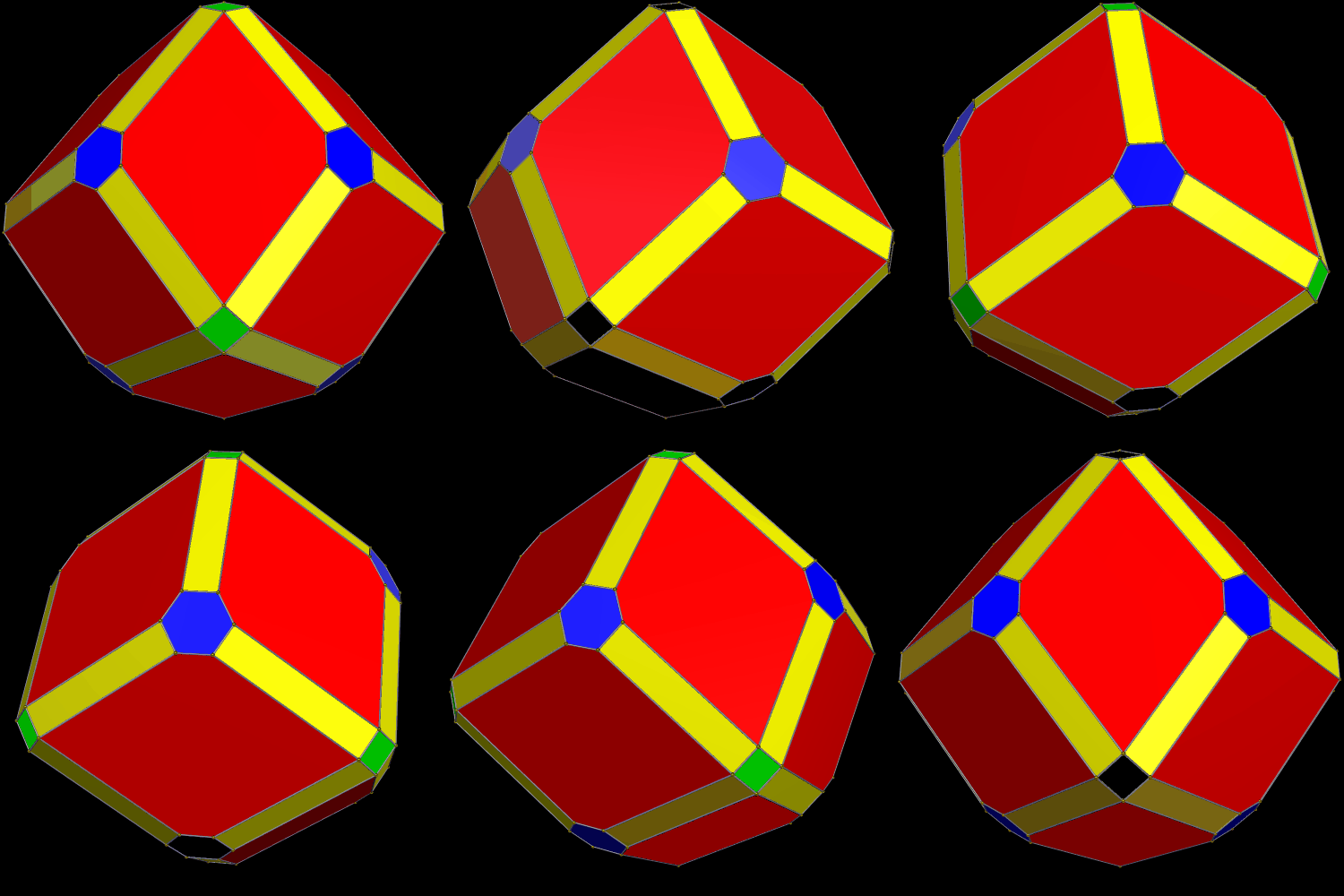
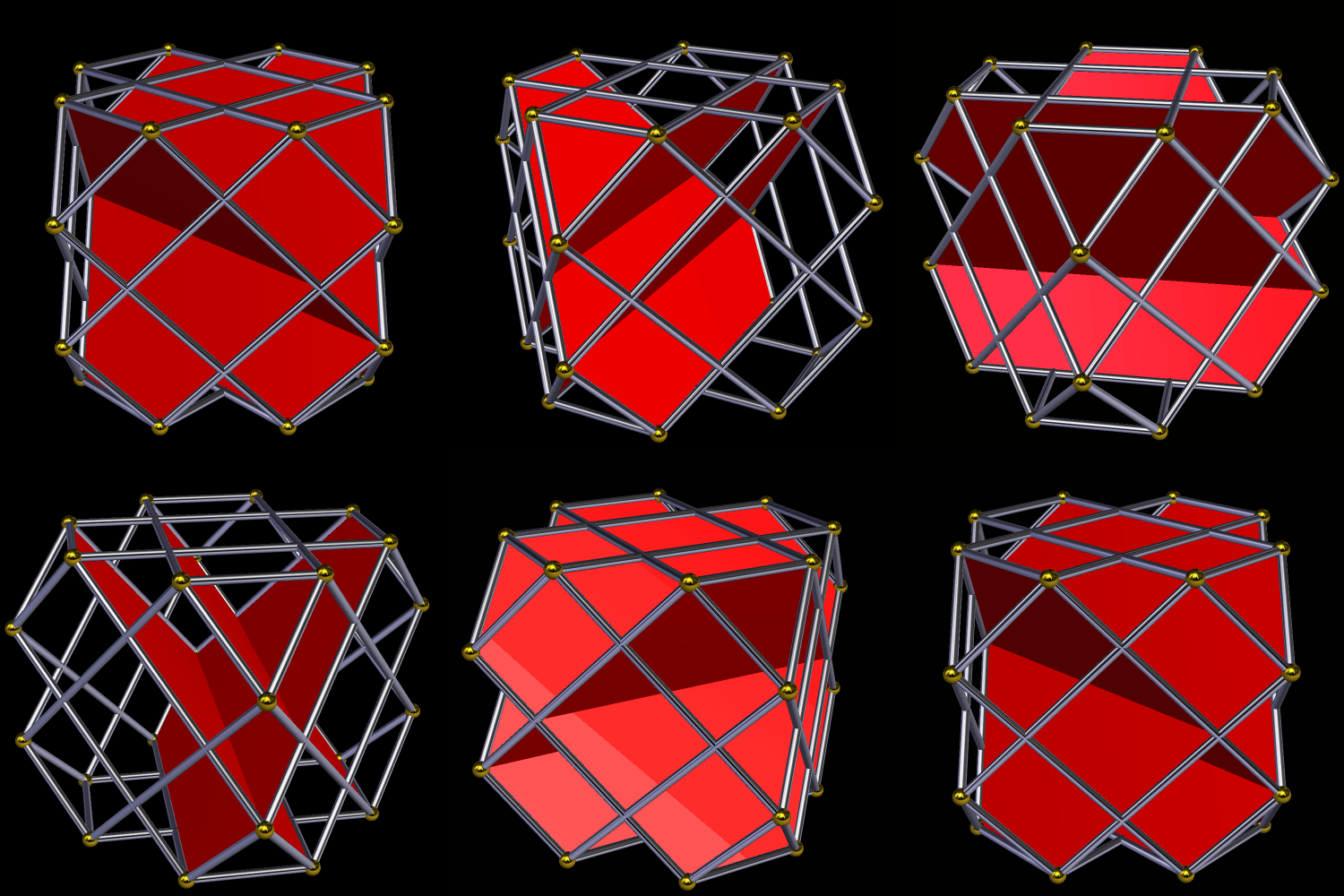
The truncated octahedron is well-known as the only Archimedean solid which can fill space, by itself, without leaving any gaps. The cluster below shows this, and has the overall shape of a rhombic dodecahedron.

Augmented Trunc Octa.gif

It’s easier to see the rhombic dodecahedral shape of this cluster when looking at its convex hull:

Convex hull.gif

Both images here were made using Stella 4d, which you can try for free right here.

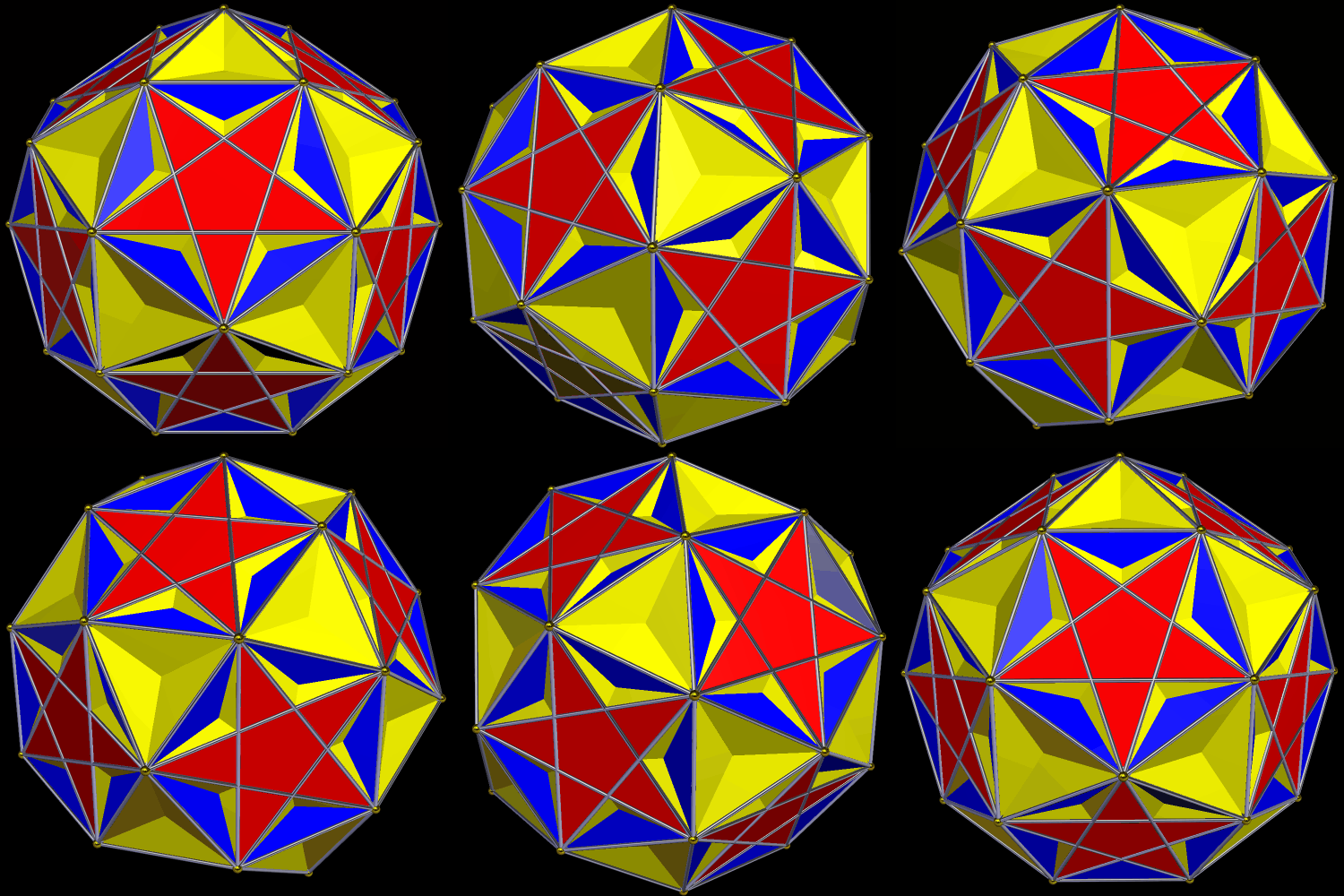
Three Facetings of the Icosidodecahedron

Faceted Icosidodeca.gif

Faceted Icosidodeca 2.gif

Faceted Icosidodeca 3

I made these using Stella 4d, which you can try for free here.

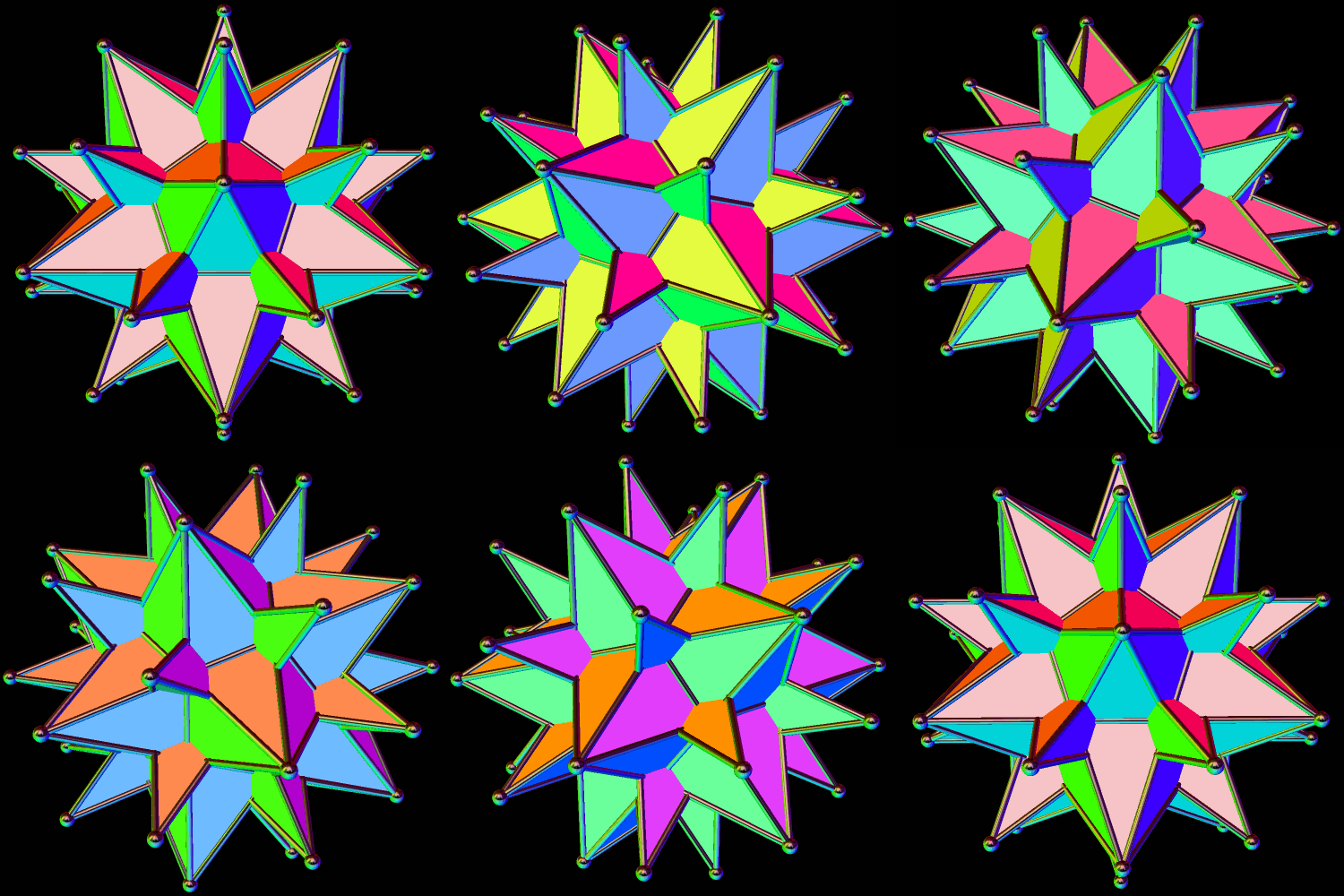
Three Versions of a Compound of the Great and Small Stellated Dodecahedra

In the first version of this compound shown here, the great stellated dodecahedron is shown in yellow, while the small stellated dodecahedron is shown in red.

Small Stellated Dodeca and Great Stellated Dodeca.gif

In the next version, each face has its own color, except for those in parallel planes, which have the same color.

Small Stellated Dodeca and Great Stellated Dodeca 2

Finally, the third version is shown in “rainbow color mode.”

Small Stellated Dodeca and Great Stellated Dodeca 3

All three of these images were created using Stella 4d: Polyhedron Navigator, software you can try for free right here.

A Faceted Version of the Truncated Cube

This is the truncated cube, which is one of the Archimedean solids.

Convex hull.gif

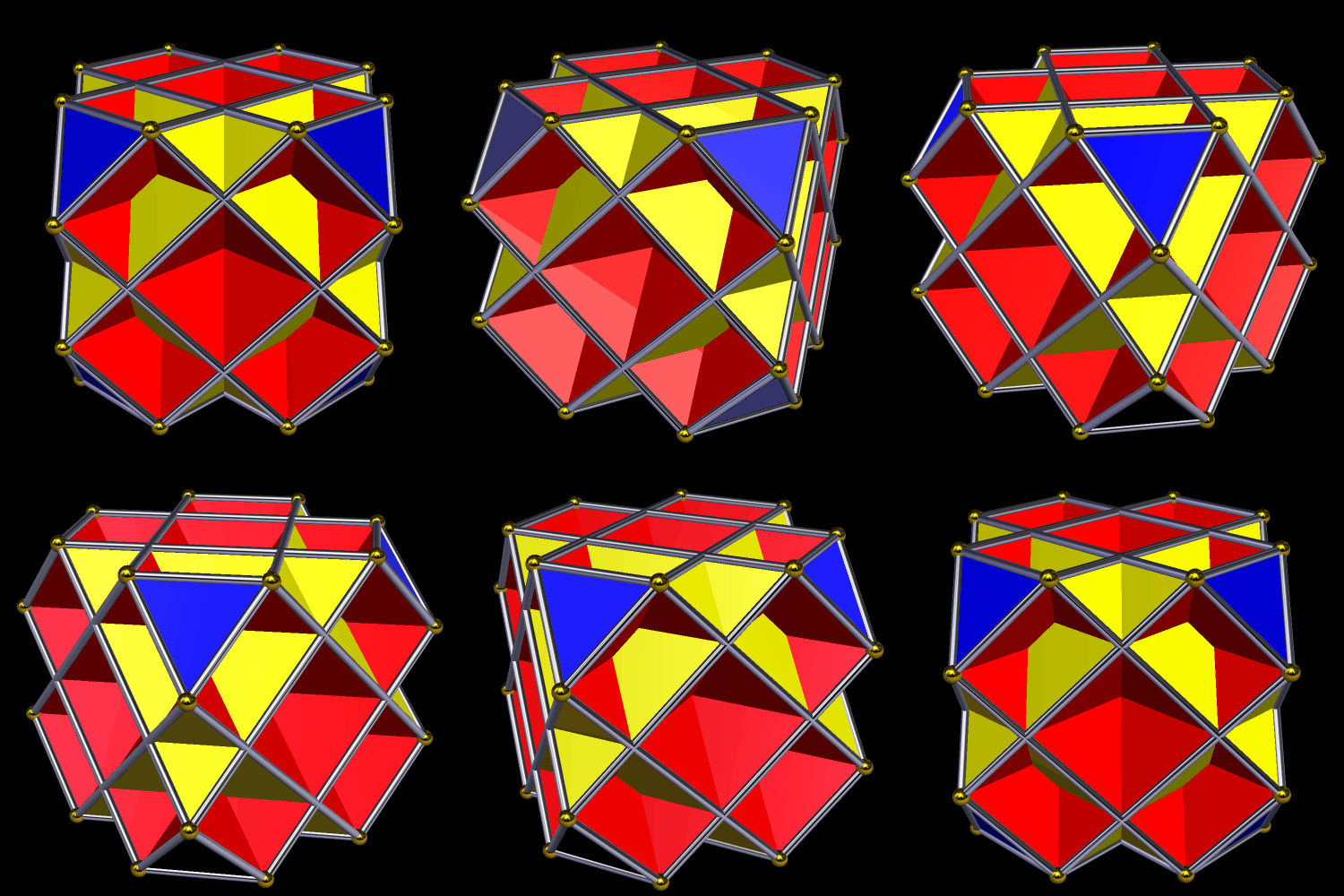
To make a faceted version of this solid, one must connect at least some of the vertices in different ways. Doing that creates new faces.

Faceted Trunc Cube 8 hexagons blue and yellow triangles.gif

This faceted version of the truncated cube includes eight blue equilateral triangles, eight larger, yellow equilateral triangles, and eight irregular, red hexagons. It’s easy to spot the yellow and blue triangles, but seeing the red hexagons is harder. In the final picture here, I have hidden all faces except for three of the hexagons, so that their positions can be more easily seen.

Faceted Trunc Cube 8 hexagons blue and yellow triangles some parts hidden.gif

I made all three of these images using Robert Webb’s program called Stella 4d: Polyhedron Navigator. It is available for purchase, or as a free trial download, at http://www.software3d.com/Stella.php.

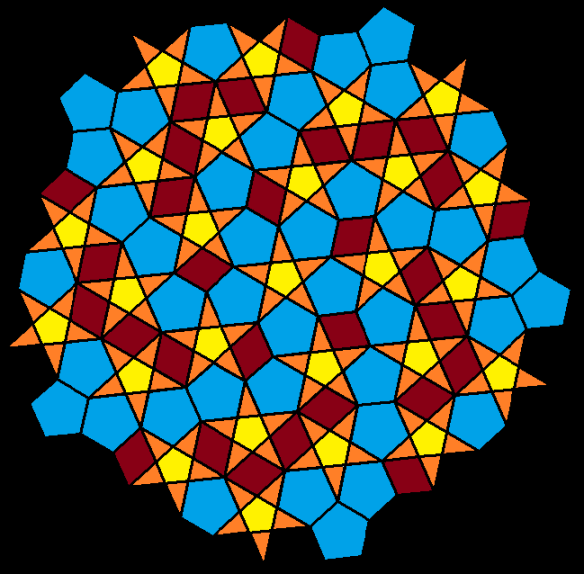
Stars, Pentagons, and Rhombi #2

stars pentagons and rhombi

This is an expansion of the last post here. It may be possible to continue this tiling outward indefnitely, forming an aperioidic tiling — or it may not. I am simply uncertain about this

Tessellation Featuring Regular Hexadecagons, Kites, and Isosceles Triangles

Image

hexadecagons

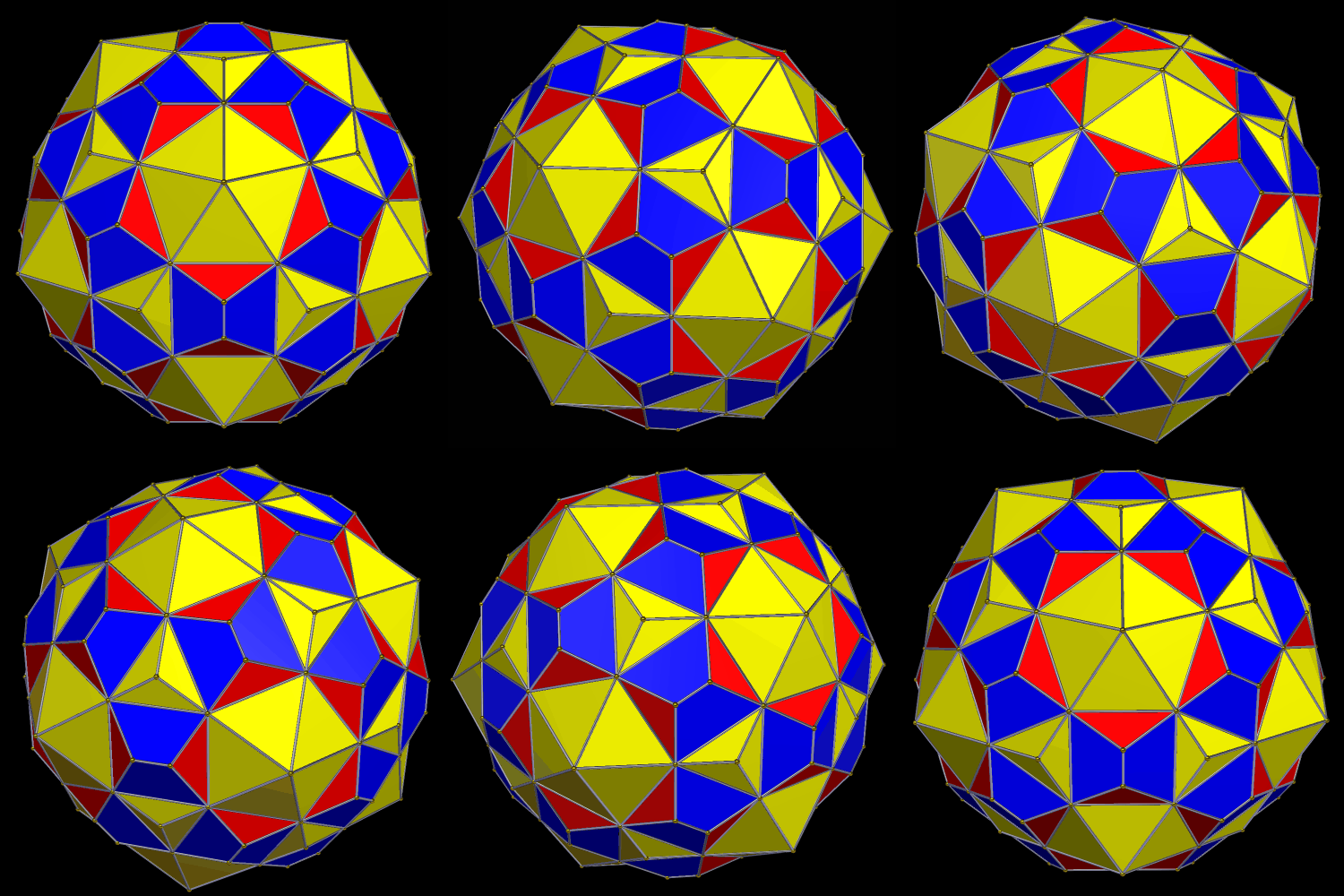
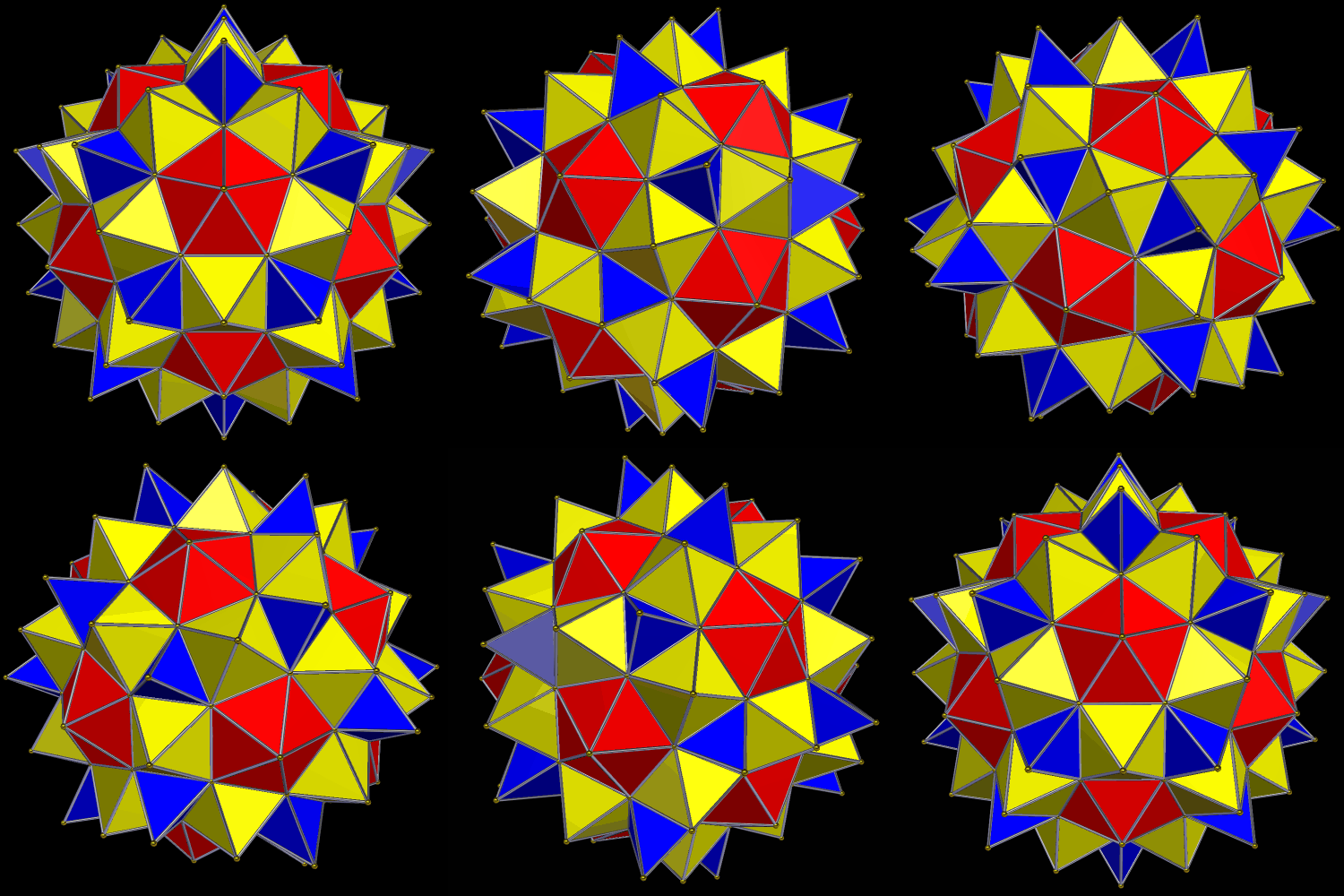
The Eighteenth Stellation of the Rhombicosidodecahedron Is an Interesting Polyhedral Compound

Rhombicosidodeca 18th stellation and an interesting compound

The 18th stellation of the rhombicosidodecahedron, shown above, is also an interesting compound. The yellow component of this compound is the rhombic triacontahedron, and the blue-and-red component is a “stretched” form of the truncated icosahedron. 

This was made using Stella 4d, which you can try for free right here.

The Equal-Edge-Length, Pyramid-Augmented Rhombicosidodecahedron

Augmented Rhombicosidodeca.gif

The only difference between these two images is that the lower one is in “rainbow color mode.” Both were created using Stella 4d, which you can try for free at this website.

Augmented Rhombicosidodeca rb.gif

I once made a physical model of this thing, when I was still new to the study of polyhedra. I wish I still had it, but it was lost many years ago.

A Tessellation of Star Octagons, and Two Sizes of Squares

Image

tessellation of star octagons and two sizes of squares

The Regular Enneagon, and Three Regular Enneagrams

enneagon and enneagrams

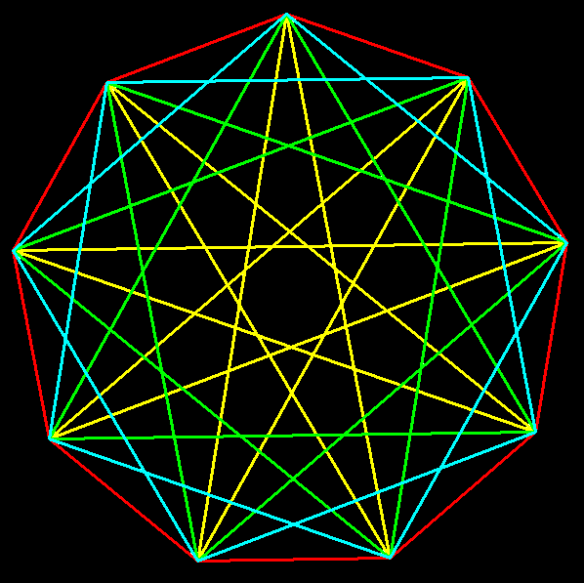
The red figure above is a regular enneagon, or nine-sided polygon, and it has three regular enneagrams (or “star enneagons”) inside it. The light blue figure is called a {9,2} enneagram. The green figure can be viewed two ways: as a {9,3} enneagram, or as a compound of three equilateral triangles. Finally, the yellow figure is a {9,4} enneagram.

To see what these numbers in braces mean, just take a look at one of the yellow enneagram’s vertices, then follow one of the yellow segments to the next vertex it touches. Count the vertices which are skipped, and you’ll notice each yellow segment connects every fourth vertex, giving us the “4” in {9,4}. The “9” in {9,4} comes from the total number of vertices in this enneagram, as well as the total number of segments it has. The blue and green enneagrams are analogous to the yellow one. These pairs of numbers in braces are known as Schläfli symbols.

I should mention that some people call these figures “nonagons” and “nonagrams.” Both “ennea- and “nona-” refer to the number nine, but the latter prefix is derived from Latin, while the former is based on Greek. I prefer to use the Greek, since that is consistent with such Greek-derived words as “pentagon” and “hexagon.”

Finally, there is also an “enneagram of personality,” in popular culture, which some use for analyzing  people. Aside from this mention of it, that figure is not addressed here — nor is the nine-pointed star used as a symbol for the Bahá’í faith. However, it’s easy to find information on those things with Google-searches, for those who are interested.