Three Compounds From the Stellation-Series of the Tetrakis Hexahedron

If you stellate the tetrakis hexahedron once, you get a compound of two pyritohedral dodecahedra.

The 16th stellation is a compound of three elongated octahedra.

Later, when you get to the 65th stellation, the result is a compound of four triangular dipyramids.

I found these compounds, and created these rotating images, using Stella 4d: Polyhedron Navigator. If you wish, you can try this program for free at http://www.software3d.com/Stella.php.

Having Fun With Zome

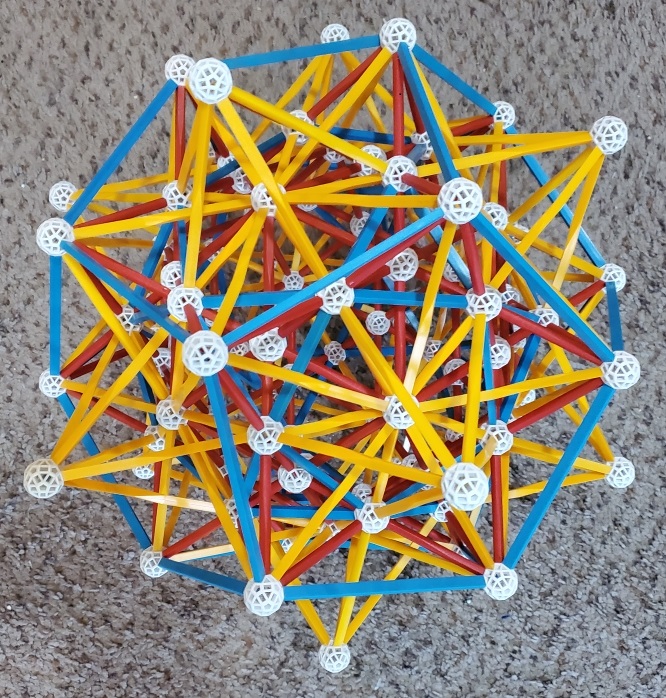
This isn’t exactly a polyhedron, or even a polyhedral compound, although it does contain several polyhedra in it. There’s a red rhombic triacontahedron in the center, a blue icosidodecahedron just outside that, and a blue dodecahedron closer to the outside. There are also twelve blue-and-yellow pentagonal pyramids, as well as twenty smaller blue-and-red triangular pyramids. That may not be a complete list, although I did try to include them all. I didn’t build it with the goal of making anything in particular — I was just having fun with Zome. In other words, I was playing.

Zome is available at http://www.zometool.com, if you’d like to try playing with it, or giving it as a gift to someone who would appreciate it. The small parts could cause a choking hazard for babies or toddlers, but they will delight and amaze school-age kids, as well as older people (like me) who still enjoy play for the sake of playing, and doing math for the sake of doing math.

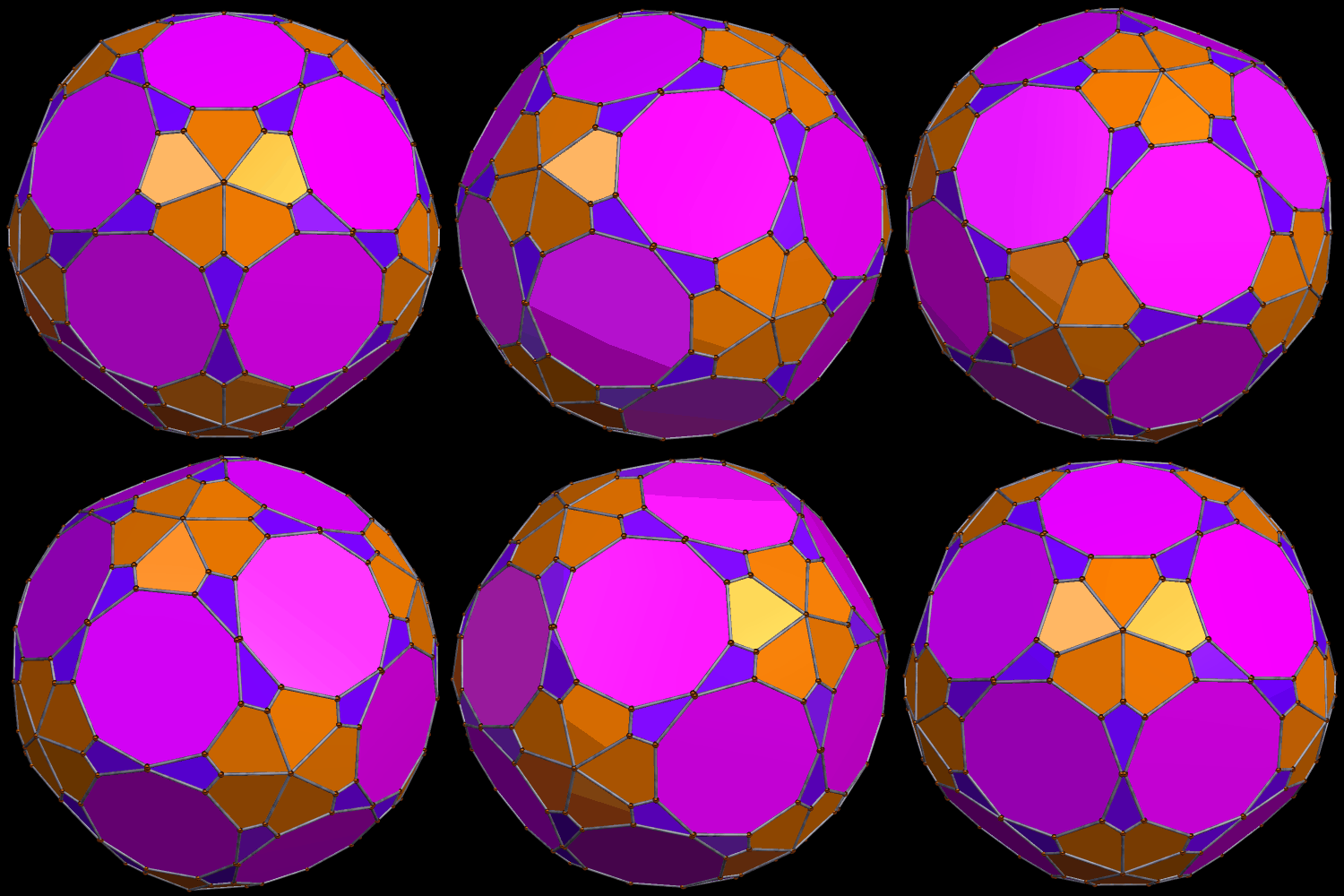
Two Polyhedra Which Both Feature Twenty Regular Enneagons

The first polyhedron shown here has 212 faces.

The next one has 120 faces, and all the non-enneagonal faces in it are convex pentagons — sixty each, of two types.

I made these polyhedra using Stella 4d, which you can try for free right here.

A Symmetrohedron Derived From the Rhombic Triacontahedron

I made this from a rhombic triacontahedron, using zonohedrification and faceting, with a program called Stella 4d. If you’d like to try this program for yourself, for free, you can do that at this website. This symmetrohedron’s faces include twenty equilateral triangles, thirty regular hexagons, and sixty kites.

Polyhedron X

This is the second stellation of the truncated octahedron. I made it using Stella 4d, which you can try for yourself right here.

A Compound of Ten Hexagonal Prisms

I made this by faceting a great rhombicosidodecahedron, using Stella 4d: Polyhedron Navigator. You can try this program for free at http://www.software3d.com/Stella.php.

Two Symmetrohedra, Both of Which Feature Eight Regular Enneagons

The first of these, shown above, also includes six squares, 24 isosceles trapezoids, and twelve rectangles among its faces.

The second one, shown below, also includes among its faces six regular octagons, and twelve pairs of “bowtie” trapezoids.

I made both of these models using Stella 4d, which you can try for free here. The starting point for making them was the enneagonal-faced polyhedron found in this program’s built-in set of near-misses to the Johnson solids.

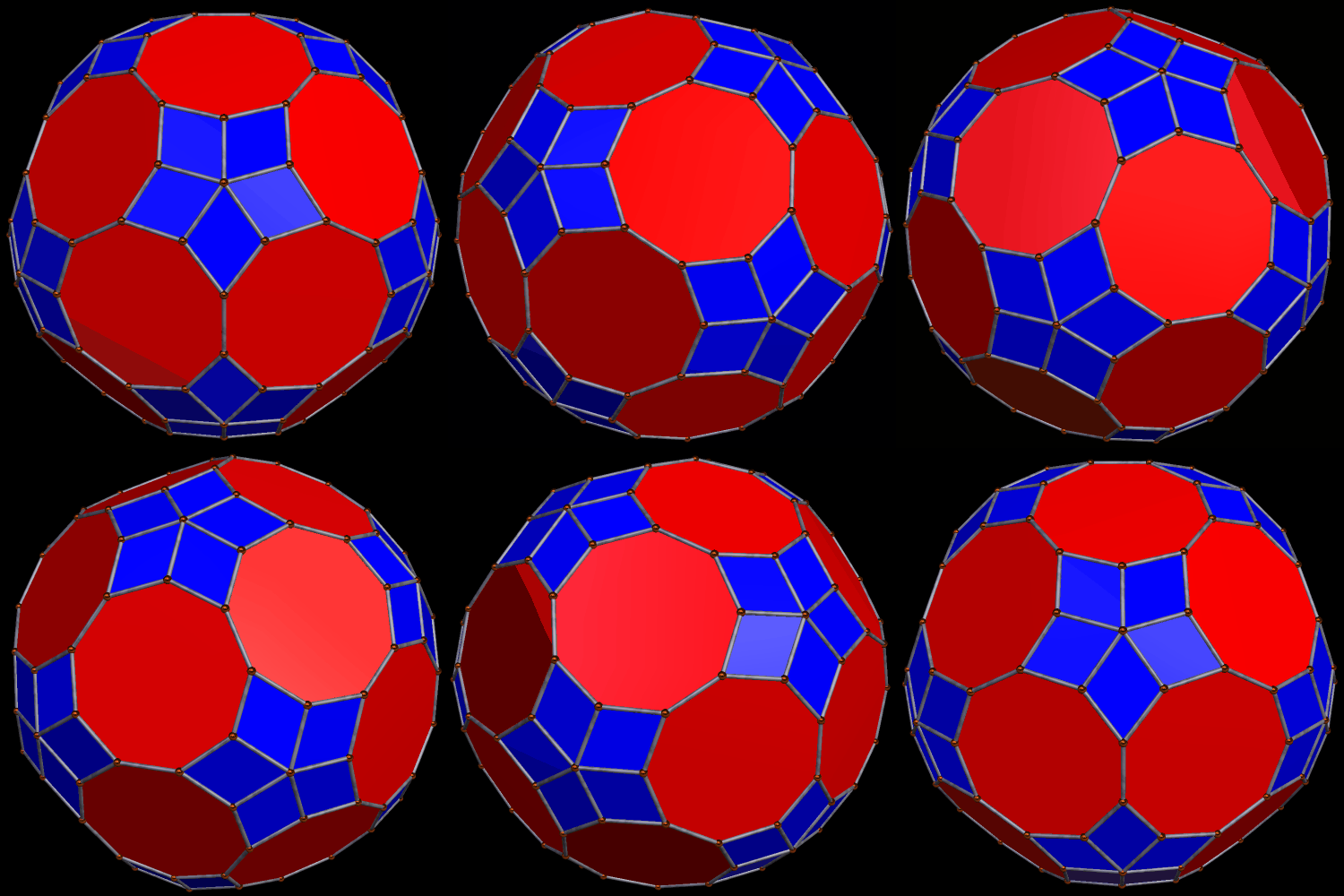
A Polyhedron Featuring Twenty Regular Enneagons and Sixty Kites

I made this using Stella 4d, which you can try for free at this website.

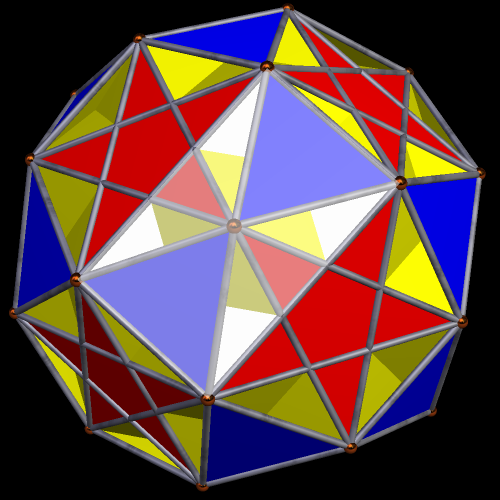
A Faceted Icosidodecahedron Featuring Golden Rectangles

This polyhedron has three face types. The blue triangles and the red star pentagons are easy to see, but it’s more challenging to see the yellow golden rectangles, since they are only partially visible. One of these golden rectangles is highlighted in the still image below, to make it easier to spot them.

I created these virtual models using Stella 4d: Polyhedron Navigator. This program may be tried out for free at http://www.software3d.com/Stella.php.

A Compound of the Icosahedron and a Pyramid-Augmented Dodecahedron

Sharp-eyed polyhedronists may wonder about the dodecahedron augmented with pentagonal pyramids, because it closely resembles the pentakis dodecahedron, which is one of the Catalan solids. I checked, though, and the red triangles’ angles are not quite correct for that designation.

I made this using Stella 4d, which you can try for free at http://www.software3d.com/Stella.php.