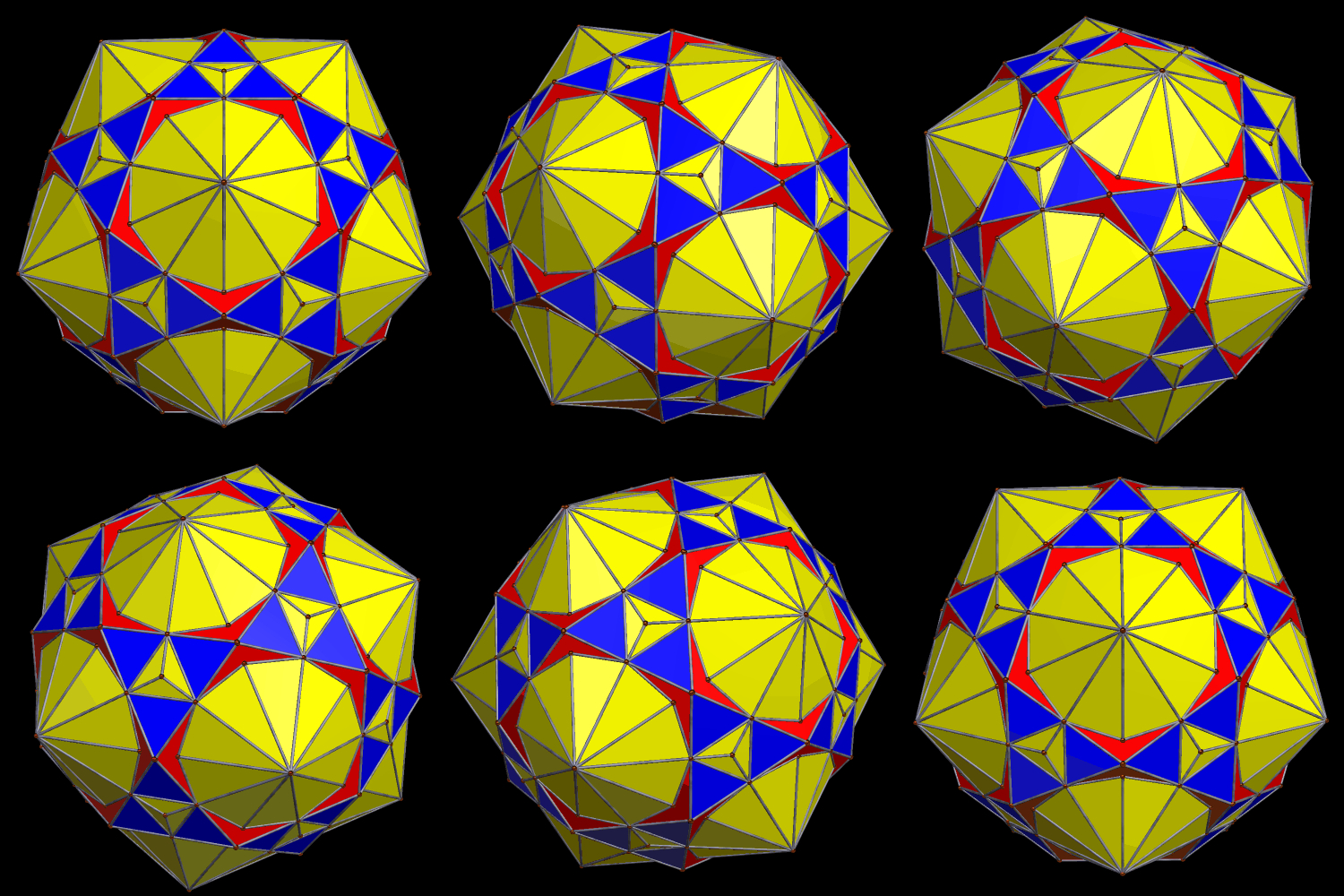
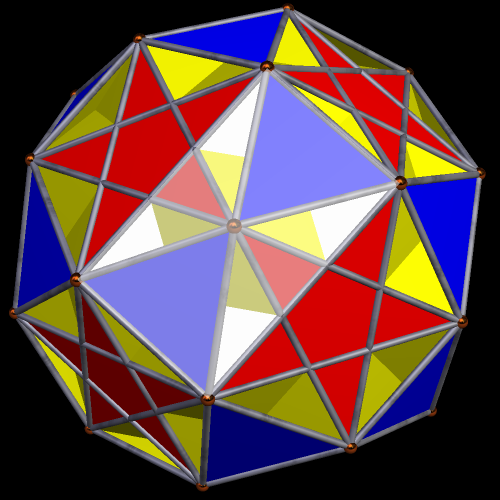
A Faceted Icosidodecahedron Featuring Golden Rectangles

This polyhedron has three face types. The blue triangles and the red star pentagons are easy to see, but it’s more challenging to see the yellow golden rectangles, since they are only partially visible. One of these golden rectangles is highlighted in the still image below, to make it easier to spot them.

I created these virtual models using Stella 4d: Polyhedron Navigator. This program may be tried out for free at http://www.software3d.com/Stella.php.

A Compound of the Icosahedron and a Pyramid-Augmented Dodecahedron

Sharp-eyed polyhedronists may wonder about the dodecahedron augmented with pentagonal pyramids, because it closely resembles the pentakis dodecahedron, which is one of the Catalan solids. I checked, though, and the red triangles’ angles are not quite correct for that designation.

I made this using Stella 4d, which you can try for free at http://www.software3d.com/Stella.php.

A Compound of the Icosidodecahedron and the Triakis Icosahedron

I made this compound using Stella 4d, a program you can try for free at http://www.software3d.com/Stella.php.

An Untidy Faceting of the Icosidodecahedron

I made this using Stella 4d, which you can try for free at http://www.software3d.com/Stella.php. Untidy facetings are like normal ones, except they do not use all the vertices of the “seed” polyhedron.

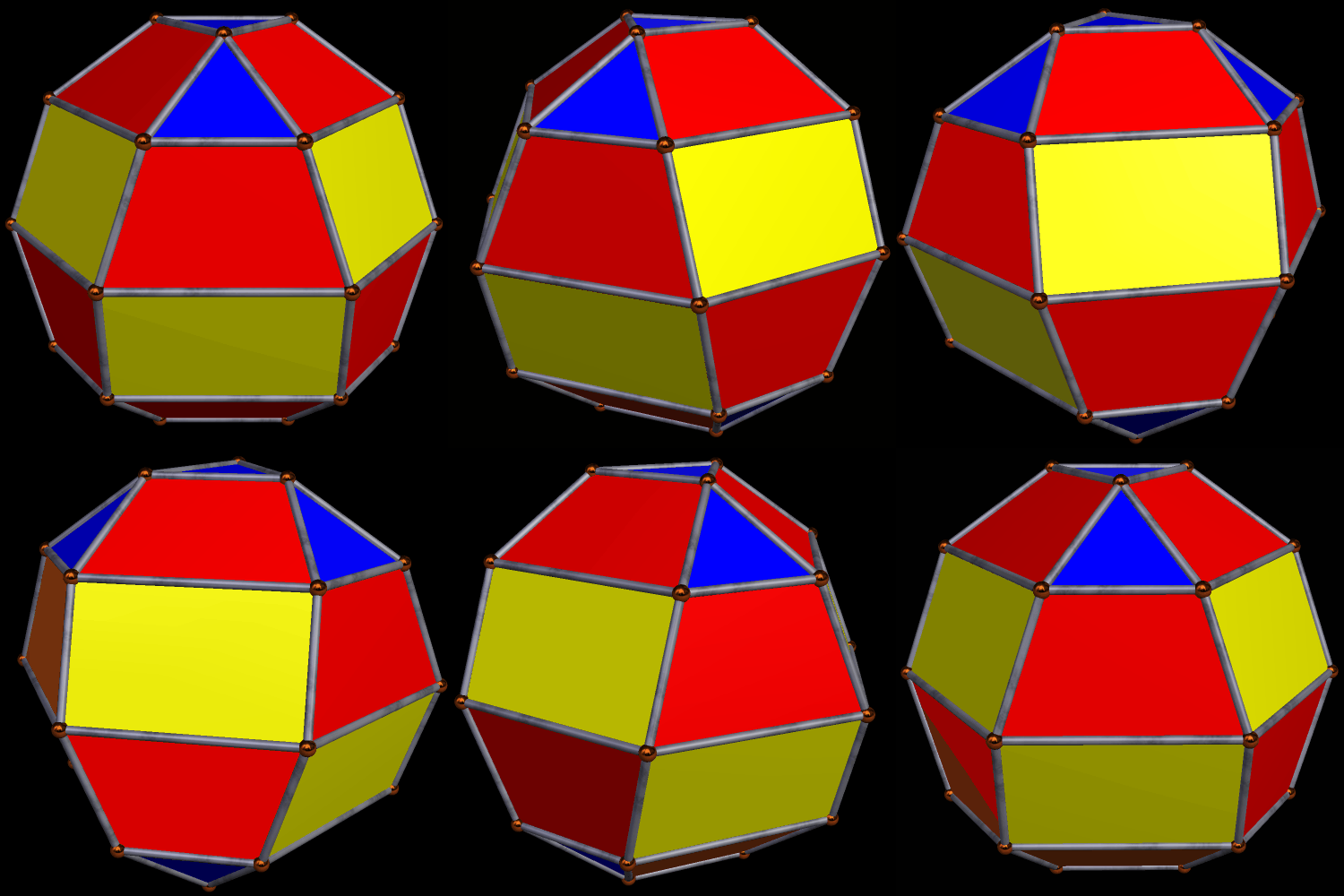
Two Views of a Faceted Great Rhombicosidodecahedron

This was the initial image that Stella 4d (free trial here) gave me when I first created this faceting. Every face type — and there are many — has a different color in this image.

It’s a little easier on the eyes to see this faceting if the face types are grouped into just three colors, as seen below.

The Medial Rhombic Triacontahedron, Rendered in Zome

This is the medial rhombic triacontahedron, constructed using Zometools. It is the dual of the uniform polyhedron known as the dodecadodecahedron.

If you’d like to have Zome for your home or classroom, the website to visit to get it is http://www.zometool.com. I give it an enthusiastic “two thumbs up.”

Three Different Views of the 600-Cell

The 600-cell is a four-dimensional, convex, regular polychoron. Its dual is the 120-cell, also known as the hyperdodecahedron. Since the dual of the dodecahedron is the icosahedron, the 600-cell is sometimes called the “hypericosahedron,” That might lead one to think that the cells of a 600-cell are icosahedra, but they are actually tetrahedra. These tetrahedra meet twenty at a vertex, which is another way the icosahedron is involved in this figure.

I just finished a Zome model of a three-dimensional “shadow” of a 600-cell. It’s a challenging model to make. Built with B1, Y1, R1, and R0 Zomestruts, it’s about the size of a basketball. Instructions for building it may be found at https://www.pmedig.com/Zome_600cell.html.

If you’d like to try Zometools for yourself, or want some for your kids, the website to visit is http://www.zometool.com. I’ve been a happy customer of theirs for over twenty years.

Here are two more models of the 600-cell. Rather than being physically built, these are virtual models. They show the polychoron rotating in hyperspace, thus changing the appearance of its three-dimensional “shadow” on a continual basis. This rotation in hyperspace differs in the two images shown, along with the coloring of the models.

These virtual models were created using Stella 4d, which you can try for free at http://www.software3d.com/Stella.php.

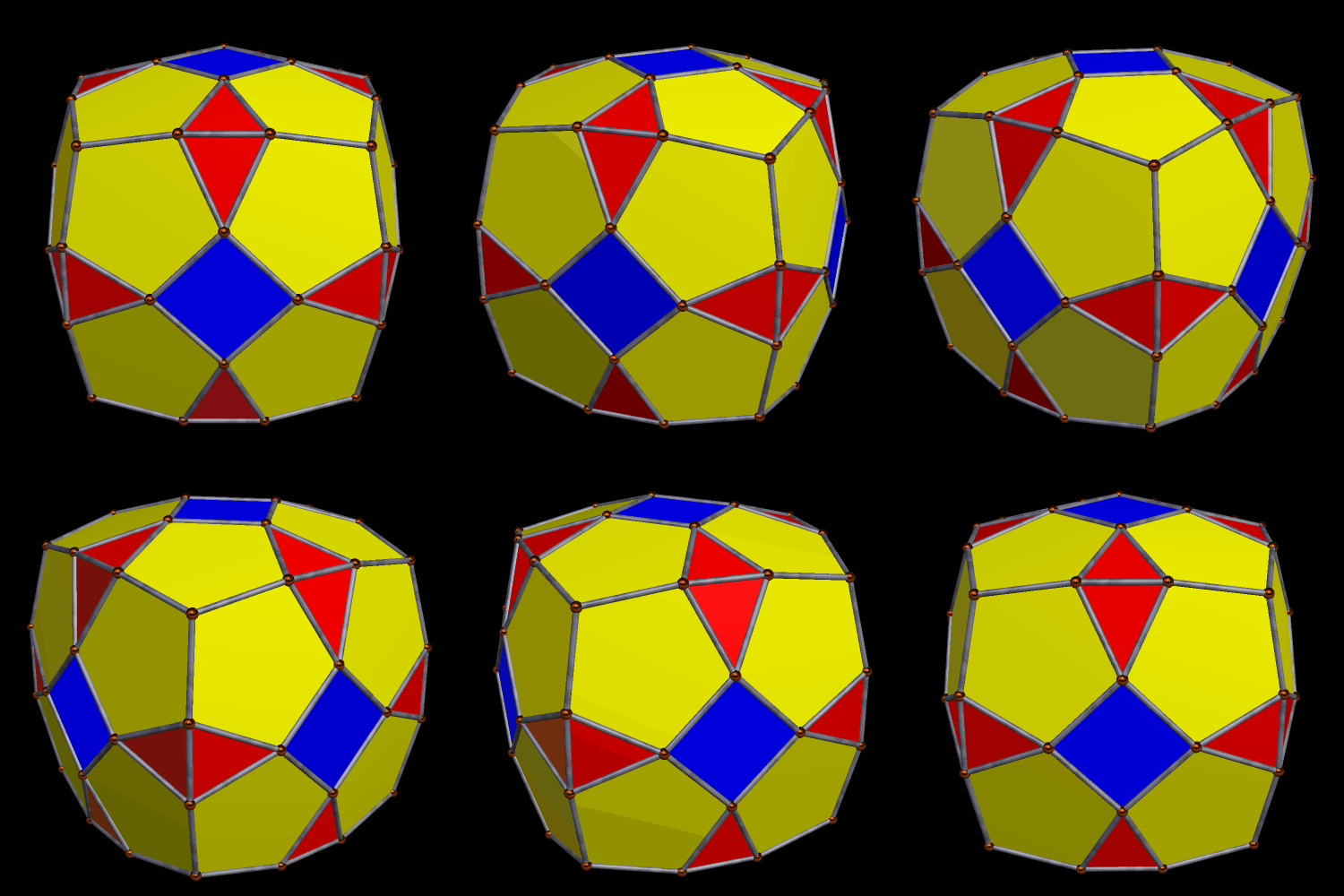
An Overinflated Cube, Made of Pentagons, Squares, and Isosceles Triangles

I made this while playing around with Stella 4d, a program you can try for free at http://www.software3d.com/Stella.php.

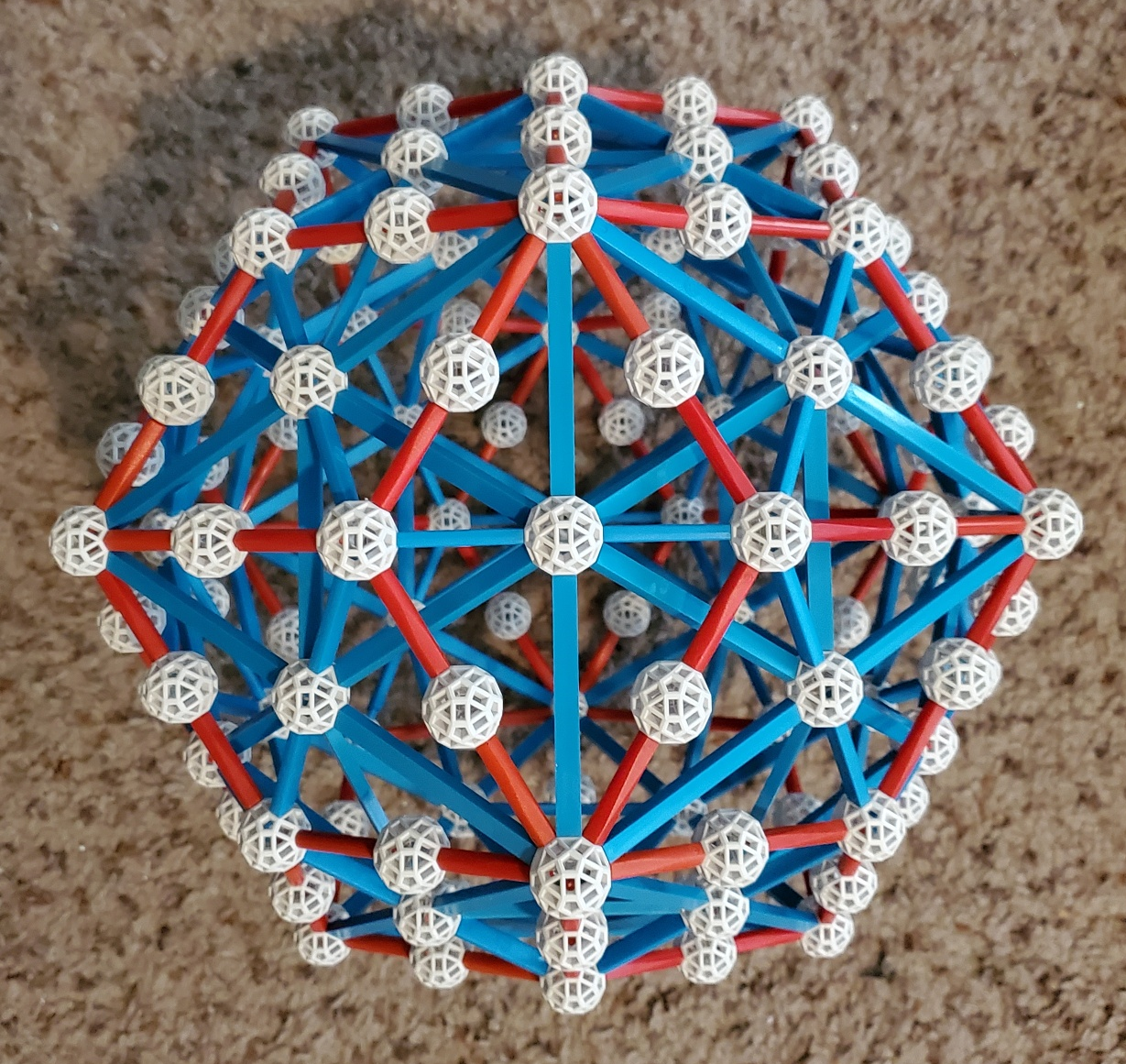
Can You Find All Four Polyhedra in This Ball of Zome?

The four polyhedra in the Zome structure above are well-known. Two are Platonic solids, one is an Archimedean solid, and one is a Catalan solid. When you think you’ve found all four, you can scroll down to check your answers.

.

.

.

.

.

.

.

.

.

.

.

.

.

The four polyhedra are the icosahedron (blue), the dodecahedron (blue), the icosidodecahedron (blue), and the rhombic triacontahedron (red). Also, if you’d like to try Zome for yourself, or your children, the website to visit is http://www.zometool.com.

Four Nested Rhombic Triacontahedra, Made of Zome

You can get Zome for yourself (or your kids) at http://www.zometool.com.