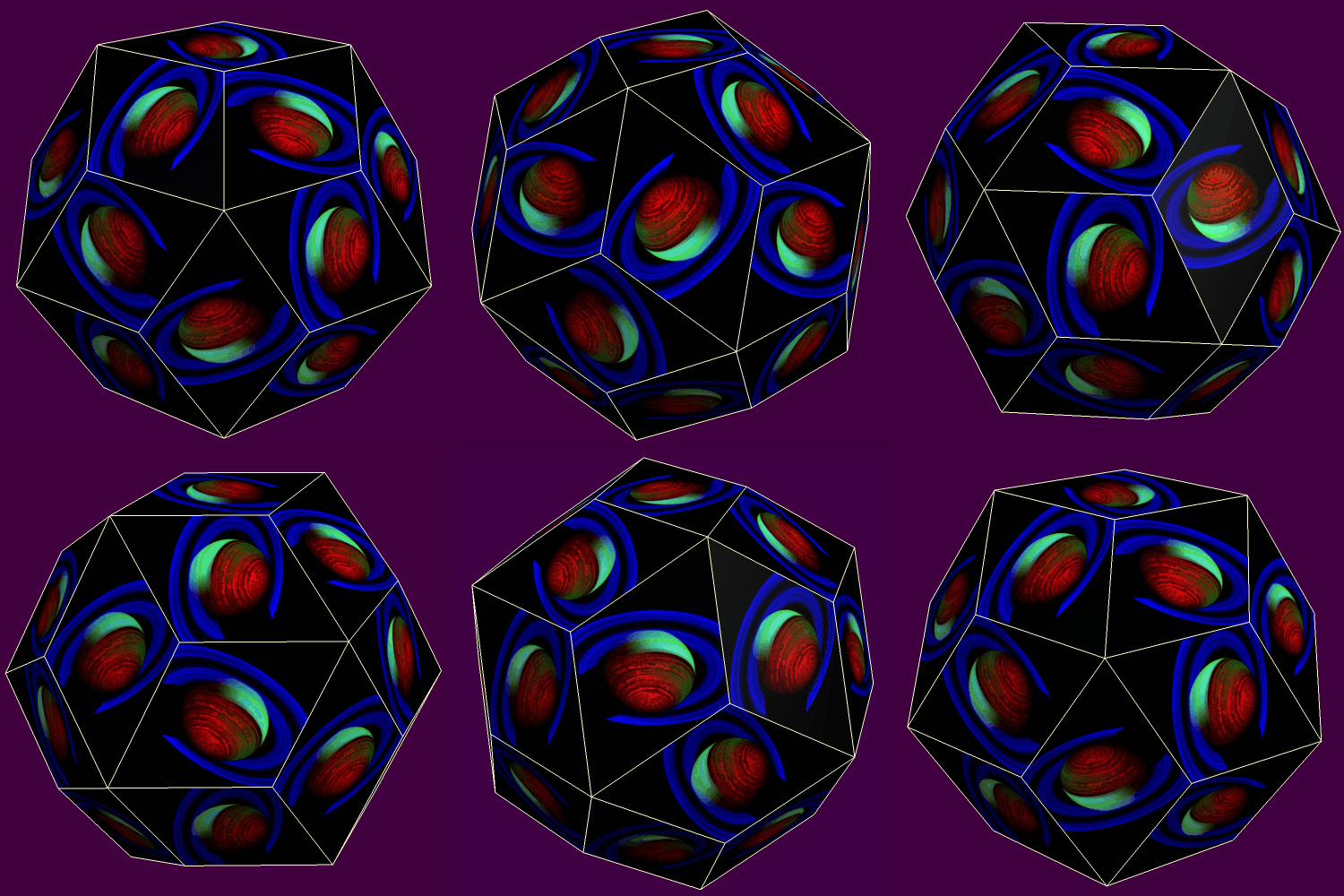
The Great Rhombicosidodecahedron, Adorned With Images From the Saturnian System

In this rotating image of a great rhombicosidodecahedron, the decagonal faces show images of Saturn and its rings. The hexagons show Saturn’s largest moon, Titan. The moon Mimas, with its giant crater that makes it resemble the “Death Star,” from Star Wars, is shown on the square faces. These either are, or are close to, the true colors of these astronomical images. Titan appears to have little or no detail because of its thick, hazy atmosphere. Also, these three images are not shown to scale.

I found these images using Google-searches, and the only one that requires personal credit is the photograph of Titan, which was taken by Kevin M. Gill. Also, I assembled them onto this polyhedron, and created the rotating .gif above, using Stella 4d, a program you can try for free at http://www.software3d.com/Stella.php.

The Four Gas Giants on the Faces of a Dodecahedron

These images of Jupiter, Saturn, Uranus, and Neptune were all acquired by NASA. I placed them on this polyhedron, and created this rotating .gif, using Stella 4d, which you can try for free at this website.

Saturnian Rhombic Dodecahedron

Rhombic Dodeca

The image of Saturn was taken by NASA, and I put it on the faces of a rhombic dodecahedron, and created this image, with a program called Stella 4d. You can try this program for free at http://www.software3d.com/Stella.php.

Oceans, Further from the Sun

Image

Oceans, Further from the Sun

Since earth’s oceans will be boiled away by the sun’s increasing luminosity, as I mentioned in my last post, we’ll eventually need to find other oceans elsewhere — or learn to do without water, which seems even less likely.

The news today is running a story about a subsurface ocean under Enceladus, a moon of Saturn. Here, in an obviously-photoshopped picture from one of those news stories, it’s shown in an impossible location, next to the U.K., for the purposes of size comparison. In addition to this moon, subsurface water is expected to exist on Titan, another moon of Saturn, as well as three of the four Galilean moons of Jupiter: Europa, Callisto, and Ganymede.

The Jovian system doesn’t get closer than 4.2 AUs from earth, and Saturn’s moons are further out still — but at least our descendants do have other places to go, once our oceans become too hot to stay liquid. They’re expected to be boiled away, by the sun’s increasing luminosity, in ~1.5 billion years.

Rhombic TriacontaSaturn

Image

Rhombic TriacontaSaturn

One of many photographs of Saturn provided by the Cassini spacecraft, and then projected onto the faces of a rhombic triacontahedron with the software available at http://www.software3d.com/stella.php.

Two Saturnian Moons Adorning a Rhombic Dodecahedron

Image

Two Saturnian Moons Adorning a Rhombic Dodecahedron

The larger moon shown, Saturn’s largest, is Titan, recognizable by its hazy atmosphere. The smaller one, which looks more like our own moon, is Rhea.

This image was captured by the Cassini spacecraft, which has been investigating the Saturnian system now for years.

Projecting the images onto the faces of a rhombic dodecahedron was done with Stella 4d, software you may try for free at http://www.software3d.com/stella.php.

Rhea Before Titan

Image

Rhea Before Titan

I found this here: http://www.nasa.gov/mission_pages/cassini/multimedia/gallery-indexRhea.html

If I had a “bucket list,” things like seeing this with my own eyes would be on it.