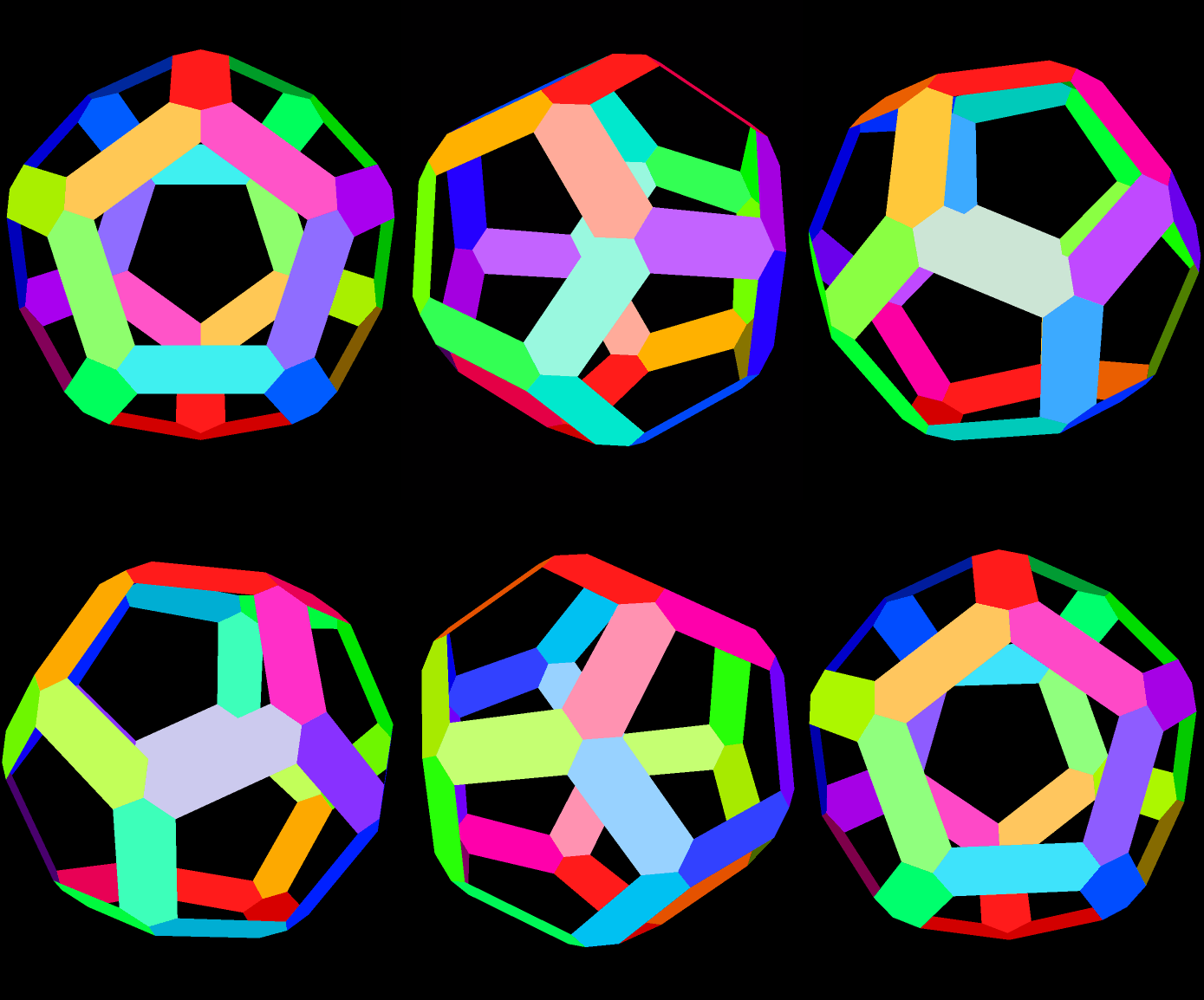
A Rainbow Dodecahedron, Made of Hexagons

Image

A Rainbow Dodecahedron, Made of Hexagons

Software credit: see http://www.software3d.com/Stella.php to try or buy the software I used to make this. It’s called Stella 4d.

On the Varieties of Water

Image

On the Varieties of Heavy Water

As many people know, there is more than one type of water. For example, the term “heavy water” often refers specifically to D2O, with “semi-heavy water” referring to DOH. Add tritium to the mix, and the new combinations possible — all radioactive — include HOT, DOT, and T2O. Along with diprotium oxide, plain old H2O, that’s six isotopic variants of this one simple compound.

However, that six needs to be multiplied by three. Why? Because there’s one set of six that includes an oxygen-16 atom (the usual kind), and another six for oxygen-17, and one more for oxygen-18, for a total of eighteen. So far. Both oxygen-17 and -18 are stable, and occur in nature, although they are both of very low abundance.

Eighteen kinds of water, half of them radioactive? No, that’s not quite enough. If the radioactive isotope of hydrogen is included, then so should be the radioisotopes of oxygen. That would include oxygen isotopes with mass numbers from 13 to 15 (add three more sets of six, or 18, which, when added to the original 18, gives a running total of 36), and 19 to 24 (add six more sets of six, or 36 more, to the 36 we just had, and we’re now at 72).

To leave it at 72 isotopic varieties of water is not necessary, but it is reasonable. Yes, there is oxygen-26, but with an estimated half-life of 40 nanoseconds, it isn’t reasonable to expect there to be time for it to form a water molecule. Could it happen? Possibly — but it’s extremely unlikely to ever be observed. For oxygen-12, the story is similar, but with an even shorter nuclide-lifetime than that of O-26.

Additional isotopes of hydrogen have also been detected, with mass numbers from 4 to 7, but they decay even more quickly than O-26 as well.

72 it is, then, counting nothing with a half-life under a millisecond. This is the sort of thing that happens when math compulsives think about chemistry a bit too long.
Three-Color Tessellation Using Biconcave Octagons

Image

Three-Color Tessellation Using Diconcave Octagons

Three-Color Tessellation: A Modification of the Tiling of the Plane with Regular Hexagons

Image

Three-Color Tessellation:  A Modification of the Tiling of the Plane with Regular Hexagons

In each case, modifications along hexagon-edges were made using equilateral triangles. Every segment in this tessellation has equal length, also, which required trisection of the original hexagons’ sides.

Pentagonal Mandala III

Image

Pentagonal Mandala III

I suspect that this could be continued outward indefinitely, as a radial and aperiodic tessellation, using only the four polygons you see, repeatedly, here. However, I have no proof of this.

Pentagonal Mandala II

Image

Pentagonal Mandala II

Octagons Can Tile a Plane

Image

Octagon Tessellation

This tessellation is made entirely of octagons. Half of them are regular, while the other half are equilateral and tetraconcave.

A Tessellation Using Tetraconcave Octagons, Convex Hexagons, and Concave Heptagons

Image

A Chiral Tessellation of Tetraconcave Octagons, Convex Hexagons, and Concave Heptagons

Hello, Out There!

Image

Hello Out There!

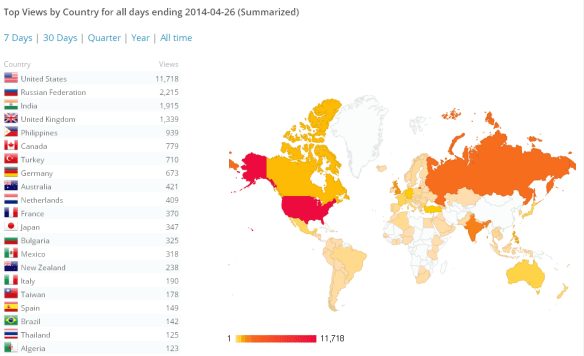
This map shows where the hits on this blog have come from, since its inception.

A notable exception: Iran shows zero hits. However, I know that people in Iran have seen https://robertlovespi.wordpress.com/2012/12/02/love-letters-from-iran/ — but access to the Internet from inside Iran is difficult. Hits from inside Iran show up on this map, no doubt, but they show up as hits from other, less repressive countries.

I also don’t believe for one moment that no one from China has seen my blog. The suspiciously high number of hits from Taiwan make me suspect Internet traffic is simply being routed from The People’s Republic, through Taiwan, to get to the rest of the world.

Information wants to be free. People do, too — and are finding ways around those forces which seek to control us.

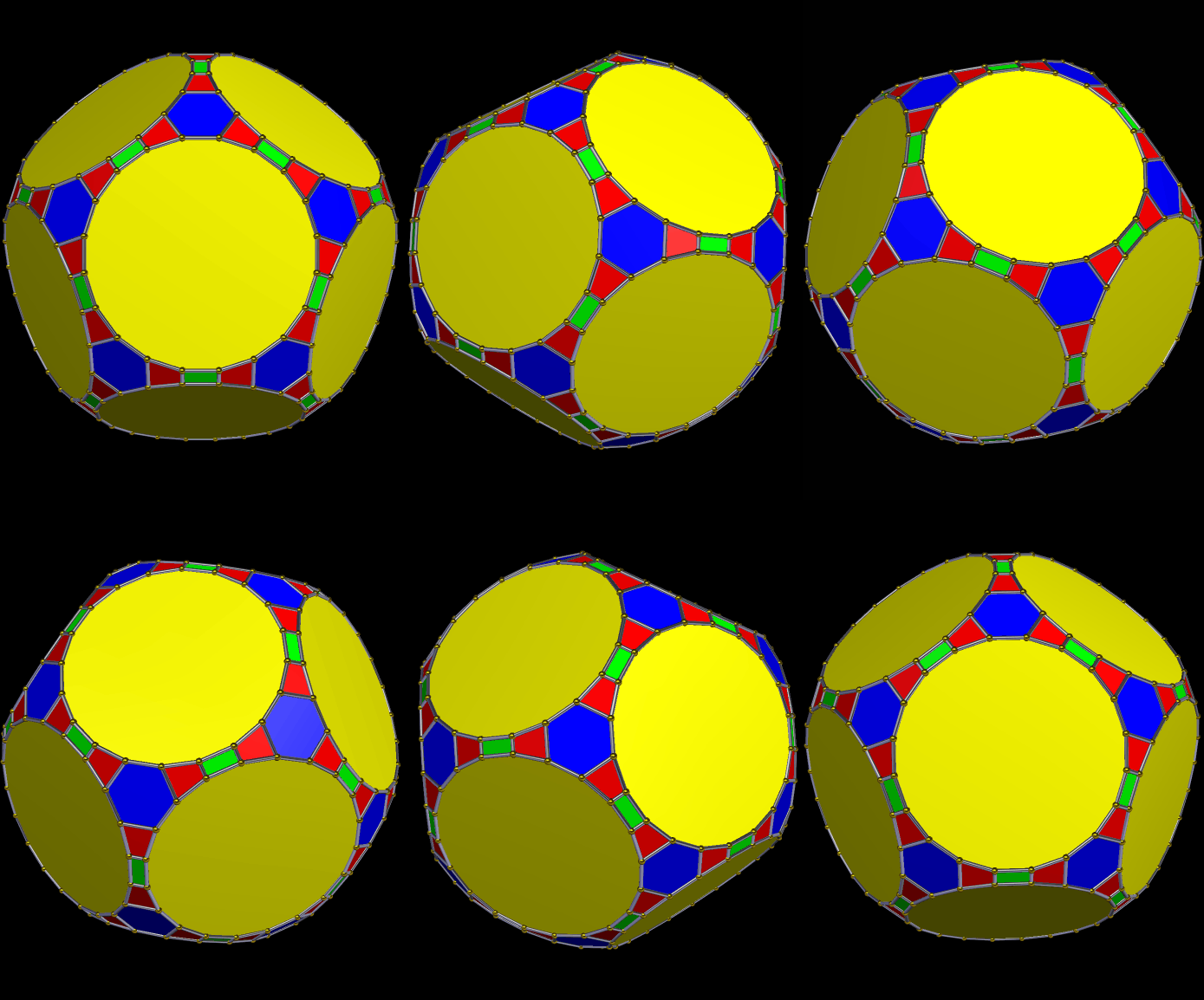
Dodecahedral Polyhedron Featuring Regular Icosagons, Regular Hexagons, Rectangles, and Isosceles Trapezoids

Image

Polyhedron Featuring Regular Icosagons, Regular Hexagons, Rectangles, and Isosceles Trapezoids

Created with Stella 4d, software you can try and/or buy at http://www.software3d.com/Stella.php.