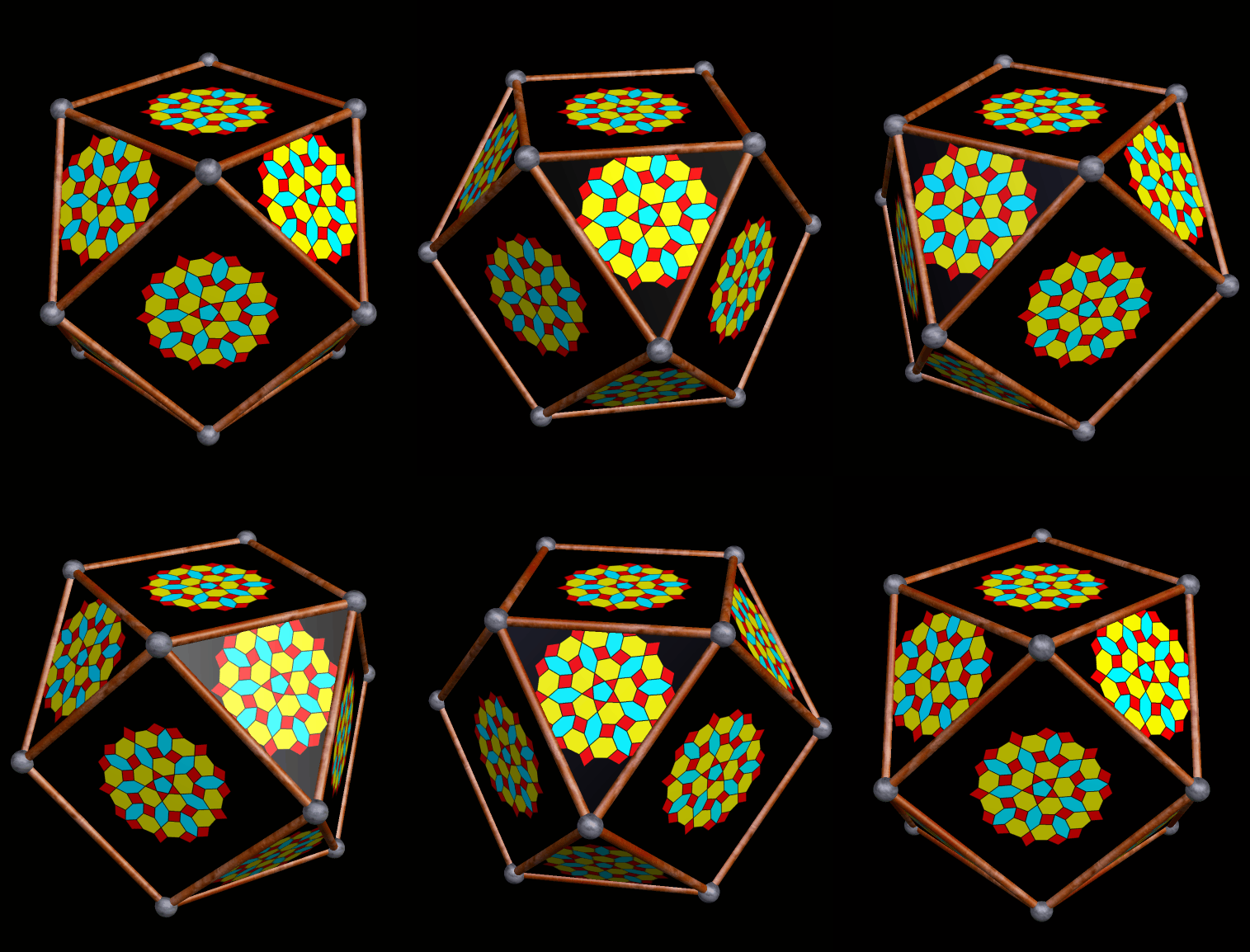
The Rhombic Dodecahedron / Rhombic Triacontahedron Compound

Icosidodeca + Cubocta dualStella 4d has this in its built-in library. You can try it at http://www.software3d.com/Stella.php.

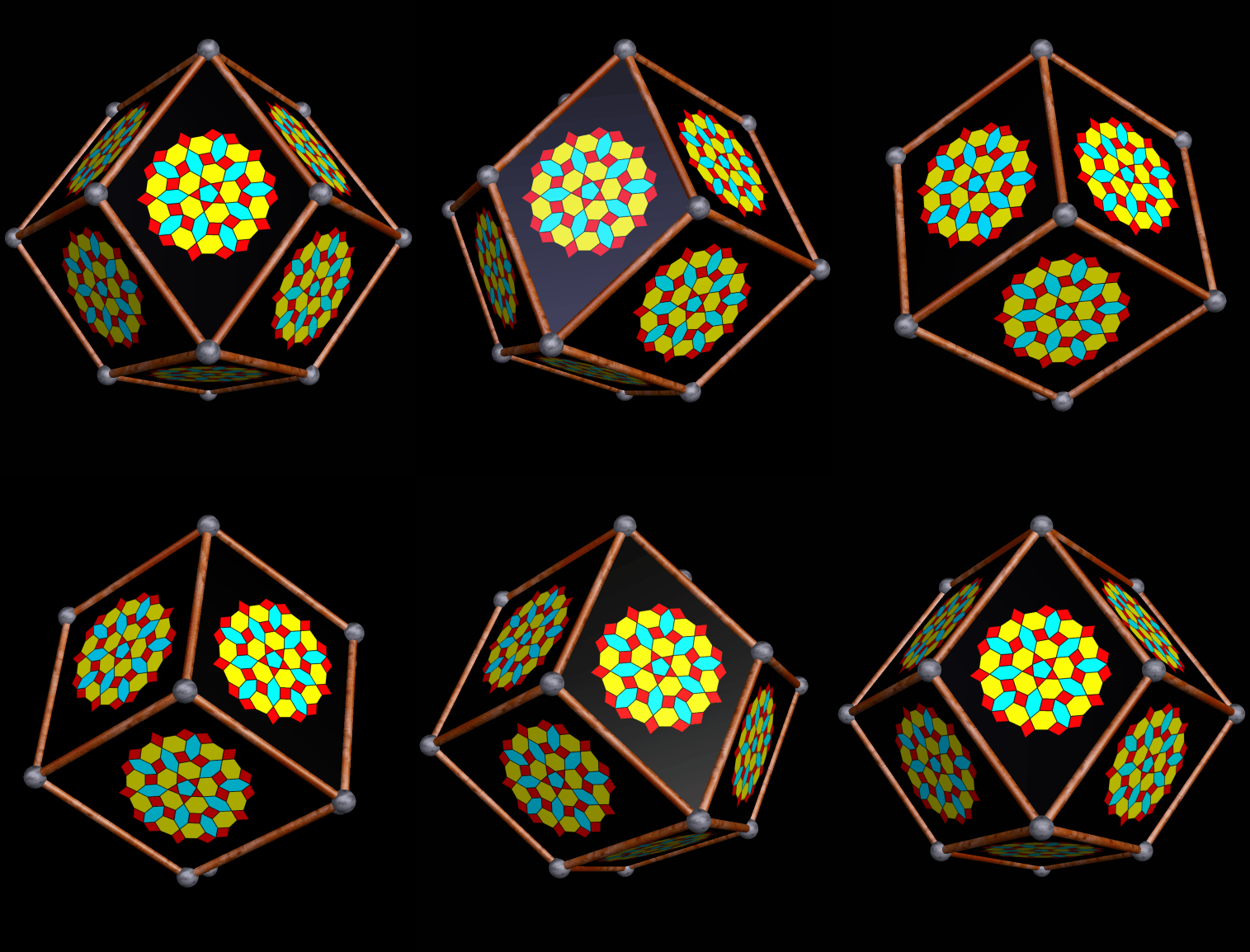
The Dodecahedron / Octahedron Compound

Dodeca + Octa

This rotating image was assembled using Stella 4d, available at http://www.software3d.com/Stella.php.

A Collection of Four Polyhedra Decorated with Mandalas

First, a cuboctahedron.

Rotating Cubocta with rotating mandalasNext, its dual, the rhombic dodecahedron.

Rotating RD with rotating mandalas

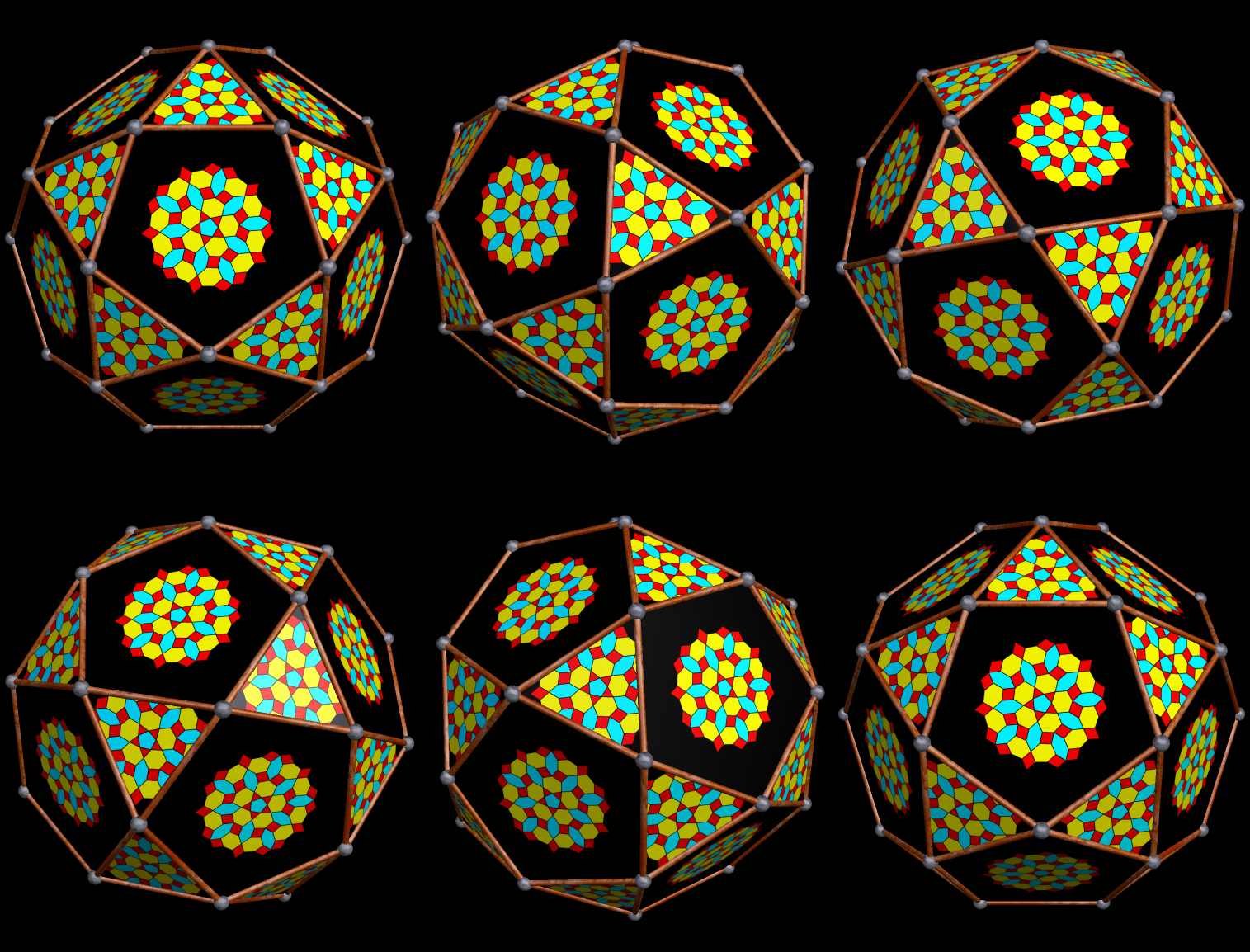
And, after that, the icosidodecahedron.

Rotating Icosidodeca with rotating mandalas

And finally, its dual, the rhombic triacontahedron.

Rotating RTC with rotating mandalas

All of these rotating images were assembled using Stella 4d, available at http://www.software3d.com/Stella.php.

Two Views of a Mandala with Fivefold Symmetry

Euclidean Mandala with construction lines

Euclidean Mandala without construction lines

Two Colorings of a Hollow Stella Octangula

hollow stella octangula 2

hollow stella octangula

Both of these versions of the stella octangula, or compound of two tetrahedra, were made with Stella 4d, software available at http://www.software3d.com/Stella.php.

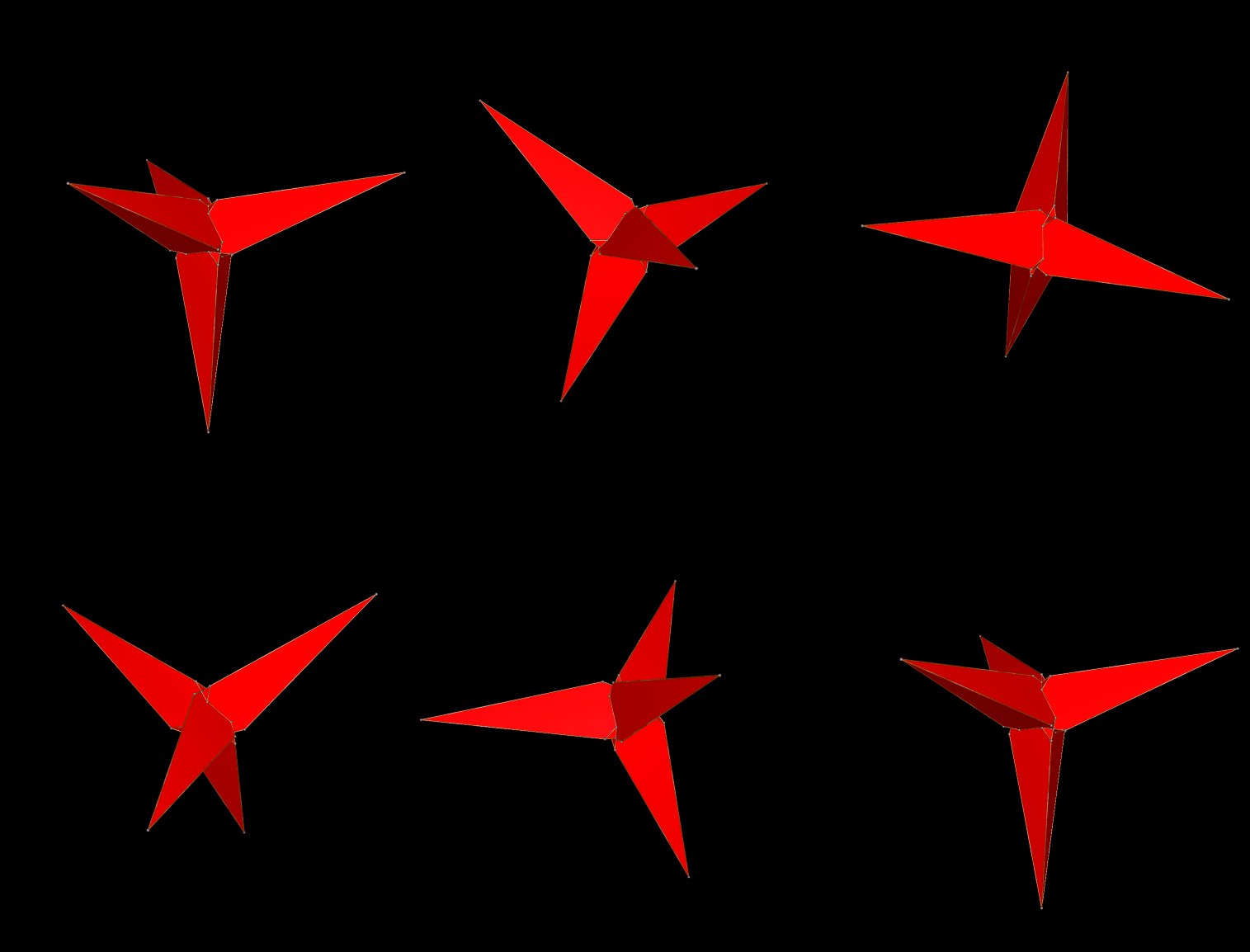
A Polyhedral Caltrop

caltrop

Created using Stella 4d, available at http://www.software3d.com/Stella.php.

A Great Dodecahedron, Augmented with Twelve Icosidodecahedra, and Its Dual

Augmented Great Dodeca with icosidodecahedra

Each face of a great dodecahedron is a regular pentagon, and each of those pentagonal faces has an icosidodecahedron attached to it, in the figure above. The dual of this figure appears below.

Augmented Great Dodeca with icosidodecahedra dual

Both images were created with Stella 4d, software available at www.software3d.com/Stella.php.

My Australia Story

australia

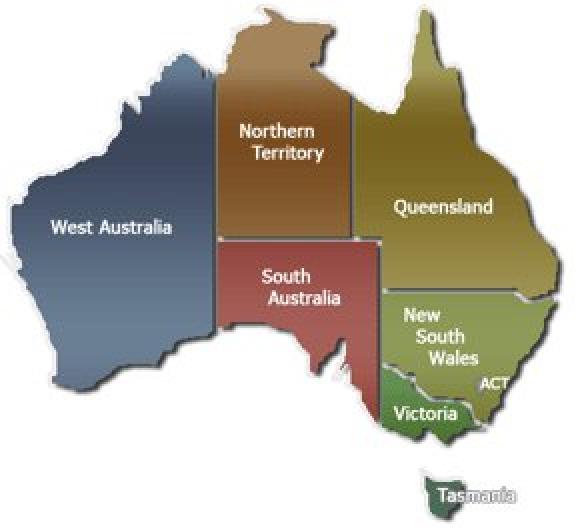
I once got into a huge argument, as a 7th grade student, in a “talented and gifted” section of Social Studies. The issue:  how many countries are there in the continent of Australia?

The assignment was to choose a continent, and draw a map of it on a full-size posterboard. I had worked for hours on this map, only to get it back, ruined, for the teacher had taken a red ball-point pen, slashed through my line “state and territorial boundaries” in my map’s key, and had written, as a correction, “not states — COUNTRIES.” She also docked points from my grade, but that was a minor issue, to me, compared to her ruining my map. She could have, at least, written her incorrect comment on the back of my map!

When I confronted her about her mistake, she maintained that the political divisions you see above are independent countries. In my opinion, “Northern Territory,” especially, doesn’t sound particularly sovereign, and I said so, but she may not have understood the definition of “sovereign,” for that did not work. Confronted with this absurd situation, I proceeded to grab the “Q” volume of a nearby encyclopedia, and began reading the article about Queensland, loudly enough for the entire class to hear: “Queensland: one of the states of Australia….” I freely admit that, at the time, my goal was to embarrass and humiliate her right out of the teaching profession — for the benefit of her present and future students. I’ve changed my approach, a lot, since then.

A huge brouhaha ensued, and we ended up taking each other to the assistant principal’s office:  her, to report a disruptive and defiant student; and me, to report an incompetent teacher, who, in my view, at that age, should have been fired on the spot. Dealing with this situation was probably one of the stranger, and more difficult, situations of that assistant principal’s career, for he knew that Australia is both a single country, and a continent — but he could not, for political reasons I did not yet understand, agree with me in front of this teacher. As for me, I was simply incredulous that someone could be a certified social studies teacher, and not know this basic fact about world geography. The whole scenario, to me, was surreal.

The assistant principal handled it well. To the teacher, he said, “You can go back to class — I’ll handle Robert.” He then “handled” me, after she left, in the only way that could have possibly worked: with an apology, and a polite request to do my best to endure her ignorance until the upcoming end of the year. I respect honesty, was being given a request, not an order, and he had conceded that I was correct. I therefore chose to cooperate — with his polite request.

If he had not taken this approach, I likely would have added him to the list I had, at the time, of people (a mixture of administrators and teachers) whom I was trying to drive out of the education profession, for the benefit of all — but he did the right thing, thus earning my respect.

As for the teacher, I survived the rest of her class, brain intact, and assume she is now retired, this being well over thirty years ago. I’m now in my twentieth year as a teacher, myself, and am pleased to report that average teacher quality has dramatically improved since this fiasco happened. (I wish I could say the same about average administrator quality, but there are, at least, a few competent people working in that field, as well.) During my years of teaching, I haven’t encountered a single teacher who lacked this basic bit of knowledge about world geography. In fact, I count, among my colleagues, many of the smartest people I know.

I am glad, however, that I don’t have to call the teacher in this story a colleague. I simply cannot respect willful, stubborn ignorance, especially in the face of evidence that one is wrong. When one of my students catches me making a mistake, I do the right thing: I thank them, make certain everyone understands the correction, and then we move on with the lesson. That’s what this 7th grade teacher of mine should have done, as well.

On Coming Out of the Closet

I have a strong belief that asking nosy questions is an incredibly rude thing to do, and I find it particularly appalling when person A asks person B to identify his or her sexual orientation. What could be more personal, and private, than what consenting adults do in their own bedrooms? For this reason, I don’t ask questions on this subject, nor do I tell (when asked). To ask would be rude, and to answer such a nosy question would be to encourage rudeness. I don’t wish to do either.

There is exactly one situation I can think of where person A needs such information from person B, and that is if person A wants to have sex with person B. Even then, though, are there not far better ways to begin a flirtatious conversation?

At a school where I used to teach, I co-sponsored a student-initiated GSA, or Gay-Straight Alliance. On the basis of this co-sponsorship, plus my wearing a rainbow-colored wristband, many assumed that I was gay. To make a statement about how such things do not matter, I refused to ever confirm, nor deny, such rumors. On Facebook, I didn’t answer the “interested in” questions, nor did my blog reveal my sexual orientation — until now.

At this time, having considered the ramifications carefully, I’ve decided it is time to come out. I’m teaching at a new school, and am no longer co-sponsoring a GSA. I’ve kept quiet on the subject of my own sexual orientation long enough to make my point. And, now, I’m going to make another point . . . by coming out, here and now.

coming out straight

Yes, world, I admit it . . . I am a raving heterosexual, and one who has finally decided to come out — as a straight person. I’m not ashamed of it; this is part of who I am. There may be some who do not approve of this, but I do not have to care what they think.

In case my point is escaping you, please consider what it is like for gays, lesbians, bisexuals, and others who don’t conform to society’s norms, to do what I just did. Imagine what it would be like, for “heteros,” if social pressure favored homosexuality, rather than heterosexuality. How many “straights,” in such a world, would be willing to risk being ostracized, losing their jobs, being shunned by former friends and family, etc., simply for admitting they have a preference for the other sex, rather than the same one? If you, yourself, are also straight, and lived in a gay-dominated world, would you have the courage to come out as one of “those people,” the “heteros,” with their allegedly-“disgusting” sexual practices?  

It’s ridiculous that anybody has to think about such things. “Live and let live” is not too much to ask — of anyone.

A True Story of a Young Aspie Getting in Trouble with “Show and Tell”

In elementary school, in the 5th grade, I managed to get in trouble for a “show and tell” project. As usual, getting in trouble was not my objective, but it happened anyway. This was decades before I learned I have Asperger’s, but, looking back, none of this would have happened were I not an “Aspie,” as we call ourselves.

This image, which I found here, is very much like the poster I made, by hand, and used for this project:

nuclear chain reaction

That was the “show” part of this “show and tell” project. For the “tell” part, I explained how nuclear chain reactions work, and then explained how nuclear bombs are made. It’s very simple:  you have two slightly sub-critical masses of uranium-235 or plutonium-239, and physically bring them together, so that the total mass exceeds the critical mass. At that point: boom.

The hard part, of course, is actually obtaining the U-235 or Pu-239, for those aren’t things you can simply buy at the local hardware store. Ironically, I did know where to find both uranium and plutonium — at the very same university, about an hour away, where I’d spent far too much time conducting mostly-unsupervised experiments with both elements, along with lots of liquid mercury, before my tenth birthday. (I still suspect that all that radiation may have turned me into a mutant.) However, I also knew that the uranium and plutonium there would not have nearly enough of the correct isotope of either element, making this information irrelevant to my “show and tell” report, and so, for this reason, I did not tell them where to find the uranium and plutonium I had previously used for experiments.

I didn’t figure this out in class that day, since I’m not particularly good at “reading” emotions, facial expressions, and body language, but, apparently, I really upset, and scared, my teacher. This became apparent when she called my mother, and, later, my mother asked me to tell her what I’d done in school that day. Being excited about the “show and tell” presentation I’d given that day, I immediately told my mother all about it. When she told me the teacher had called her, concerned about me explaining to my class how to build atomic bombs, I was confused, since I didn’t understand, at all, why what I had actually said posed any problem. To explain this to my mother, I simply said, “But, Mom, I didn’t tell the class where to actually get the uranium-235 or plutonium-239! I don’t know where to find those isotopes!”

This was enough to convince my mother that I had not, in fact, done anything wrong. She called the teacher back, and simply asked if I had, or had not, included that critical bit of information: where to find the actual fissionable material needed for a nuclear bomb to work. When the teacher replied that I had not done that, my mother’s response was both sensible, and logical:  “Well, then, what’s the problem?”

—–

Postscript, for those who might be worried about the childhood experiments I mentioned above: at around age 40, I asked a physician about my worries regarding early exposure to mercury vapor and radiation. He told me that any problems I might have, as a result of such experiments, would have already showed up by then, and that I could, therefore, stop worrying about this. Thus reassured, I did exactly that.