Eight Selections from the Stellation-Series of the Rhombic Enneacontahedron

33rd stellation of the rhombic triacontahedron

The stellation-series of the rhombic enneacontahedron has many polyhedra which are, to be blunt, not much to look at — but there are some attractive “gems” hidden among this long series of polyhedral stellations. The one above, the 33rd stellation, is the first one attractive one I found — using, of course, my own, purely subjective, esthetic criteria.

The next attractive stellation I found in this series is the 80th stellation. Unlike the 33rd, it is chiral.

80th stellation of the rhombic triacontahedron

And, after that, the 129th stellation, which is also chiral:

129th stellation of the rhombic triacontahedron

Next, the 152nd (and non-chiral) stellation:

152nd stellation of the rhombic enneacontahedron

I also found the non-chiral 158th stellation worthy of inclusion here:

158th stellation of the rhombic enneacontahedron

After that, the chiral 171st stellation was the next one to attract my attention:

171st stellation of the rhombic enneacontahedron

The next one to attract my notice was the also-chiral 204th stellation:

204th stellation of the rhombic enneacontahedron

Some polyhedral stellation-series are incredibly long, with thousands, or even millions, of stellations possible before one reaches the final stellation, after which stellating the polyehdron one more time causes it to “wrap around” to the original polyhedron. Knowing this, I lost patience, and simply jumped straight to the final stellation of the rhombic triacontahedron — the last image in this post:

final stellation of the rhombic enneacontahedron

All of these images were created using Stella 4d: Polyhedron Navigator, a program available at http://www.software3d.com/Stella.php. For anyone interested in seriously studying polyhedra, I consider this program an indispensable research tool (and, no, I receive no compensation for all this free advertising for Stella which appears on my blog). There’s a free trial version available — why not give it a try?

A Twice-Zonohedrified Dodecahedron, Together with Its Dual

Zonohedrified Dodeca

This polyhedron was created by performing vertex-based zonohedrifications of a dodecahedron — twice. The first zonohedrification produced a rhombic enneacontahedron, various version of which I have blogged many times before, but performing a second zonohedrification of the same type was a new experiment. It has 1230 faces, 1532 vertices, and 2760 edges. All of its edges have equal length. I created the models in this post using Stella 4d, a program you can buy, or try for free, right here.

Here is the dual of this zonohedron, which has 1532 faces, 1230 vertices, and 2760 edges. This “flipping” of the numbers of faces and vertices, with the number of edges staying the same, always happens with dual polyhedra. I do not know of a name for the class of polyhedra made of zonohedron-duals, but, if any reader of this post knows of one, please leave this name in a comment.

Zonohedrified Dodeca dual

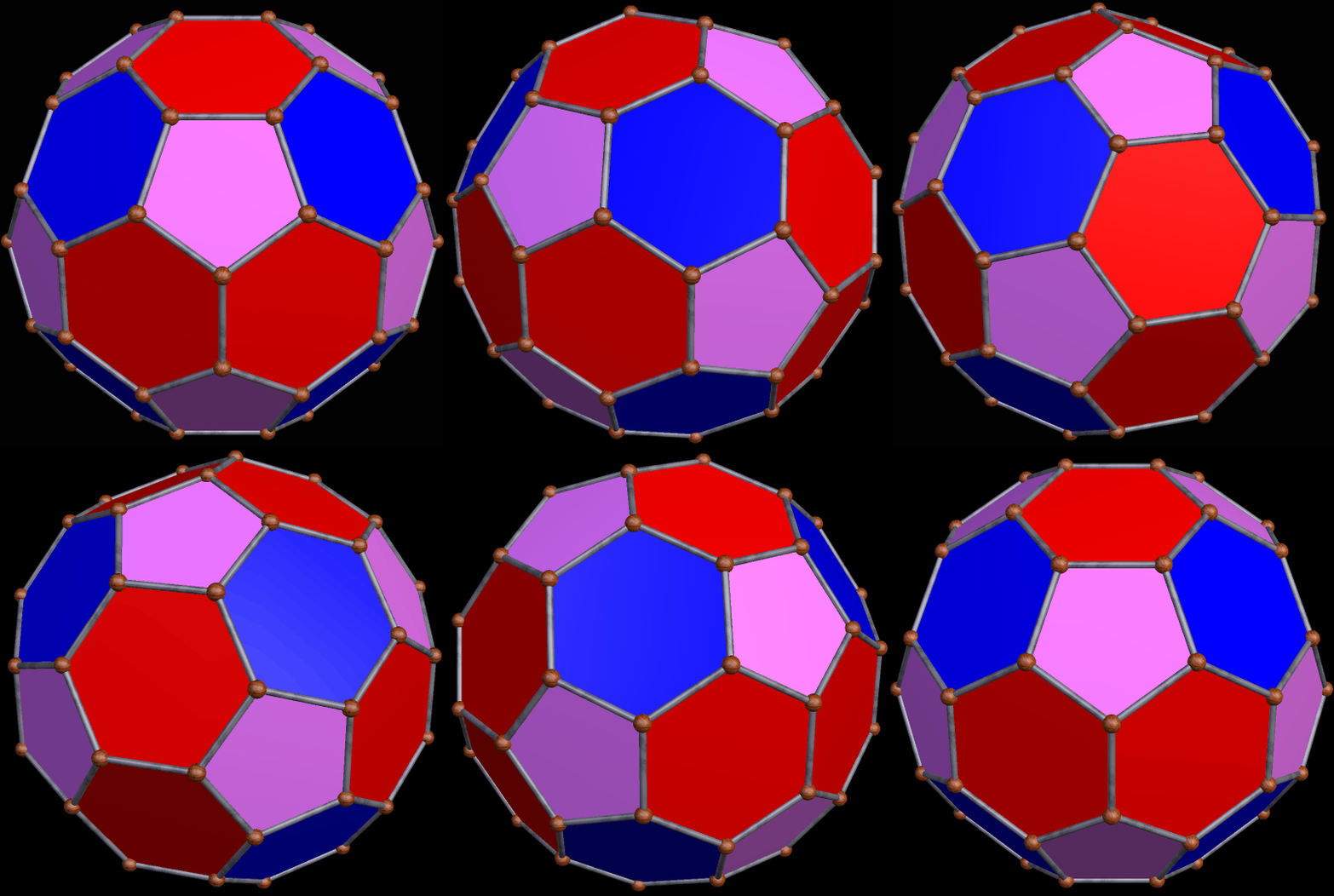
A Pyritohedral Coloring-Scheme for the Truncated Icosahedron

pyritohedral coloring of the truncated icosahedron

While the polyhedron above, informally known as the “soccer ball,” has icosidodecahedral symmetry, its coloring-scheme does not. Instead, I colored the faces in such a way that the coloring-scheme has pyritohedral symmetry — the symmetry of a standard volleyball. This rotating image was made with Stella 4d, a program you can buy, or try for free, right here: http://www.software3d.com/Stella.php.