To see a larger version of any rotating model, simply click on it.


Each of these polyhedral images was created using a program called Stella 4d, which is available here.
To see a larger version of any rotating model, simply click on it.
Each of these polyhedral images was created using a program called Stella 4d, which is available here.
To enlarge any of these images, simply click on the ones you choose.


All of these images were created using Stella 4d: Polyhedron Navigator, available at http://www.software3d.com/Stella.php.
To enlarge any single image, simply click on it.


Of the five polyhedra above, all appear to feature decagons. Upon close inspection, though, one of them actually features icosagons — with half their sides very short. Can you spot this polyhedron?
The next set of three polyhedra all feature pentadecagons.


That’s eight so far. Not enough!


Here are eight more, to round out the set of all sixteen, each of which I made using Stella 4d: Polyhedron Navigator. This program may be tried for free at http://www.software3d.com/Stella.php.
Individual images may be enlarged with a click. They were created using Stella 4d: Polyhedron Navigator, which may be tried for free at http://www.software3d.com/Stella.php.


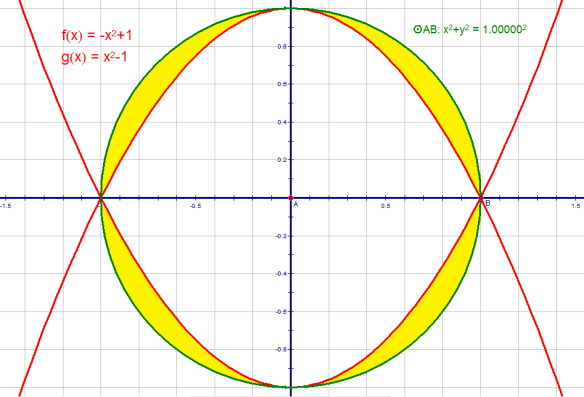
A circumparabolic region is found between a circle and a parabola, with the circle being chosen to include the vertex and x-intercepts of the parabola used, with the circle, to define the two circumparabolic regions for a given parabola-circle pair. There are four such regions shown above, rather than only two, because two parabolas are used above. The formulae for the parabolas, as well as the circle, are shown.
A puzzle which I will not be solving, I suspect, until I learn more integral calculus: what fraction of the circle’s area is shown in yellow?
To see larger versions of any of these, simply click on the images.


24 to this point….


That’s 40 so far…


Now the count is at four dozen.


That was 26 more, so there are 48 + 26 = 74 so far.


Now the count is up to 83.


So there were 91 of these stored on my hard drive, from all my “hard work” playing with polyhedra using Stella 4d: Polyhedron Navigator. (It will be good for my computer to get all that hard drive space back!) If you’d like to try playing with the same program — for free — just try the free download at http://www.software3d.com/Stella.php.


For some reason I do not fully understand, polyhedra featuring heptagons, even if irregular, do not appear often, at least not in my geometrical investigations — so I was pleased to find these three, using Stella 4d: Polyhedron Navigator, available at http://www.software3d.com/Stella.php.
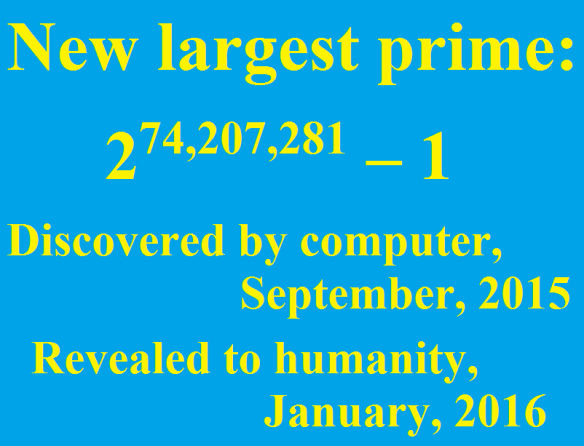
I find it hilarious that the computer which made this discovery actually kept it a secret for four whole months.
From that article: “[Curtis] Cooper’s computer actually found the prime on 17 September 2015, but a bug meant the software failed to send an email alert reporting the discovery, meaning it went unnoticed until some routine maintenance a few months later.”
To enlarge any individual image, simply click on it.


These polyhedral images were created using Stella 4d: Polyhedron Navigator, a program you can find at http://www.software3d.com/Stella.php, with a free trial download available.
Each of these polyhedral images (any of which may be enlarged with a click) was created using Stella 4d: Polyhedron Navigator, and this program may be tried for free at http://www.software3d.com/Stella.php.


Also, a question, for regular readers of my blog — you have probably noticed that this post has a different format, but it’s just an experimental thing I’m trying out.
Do you prefer this style of polyhedra-post, or the format I usually use?
 RobertLovesPi.net