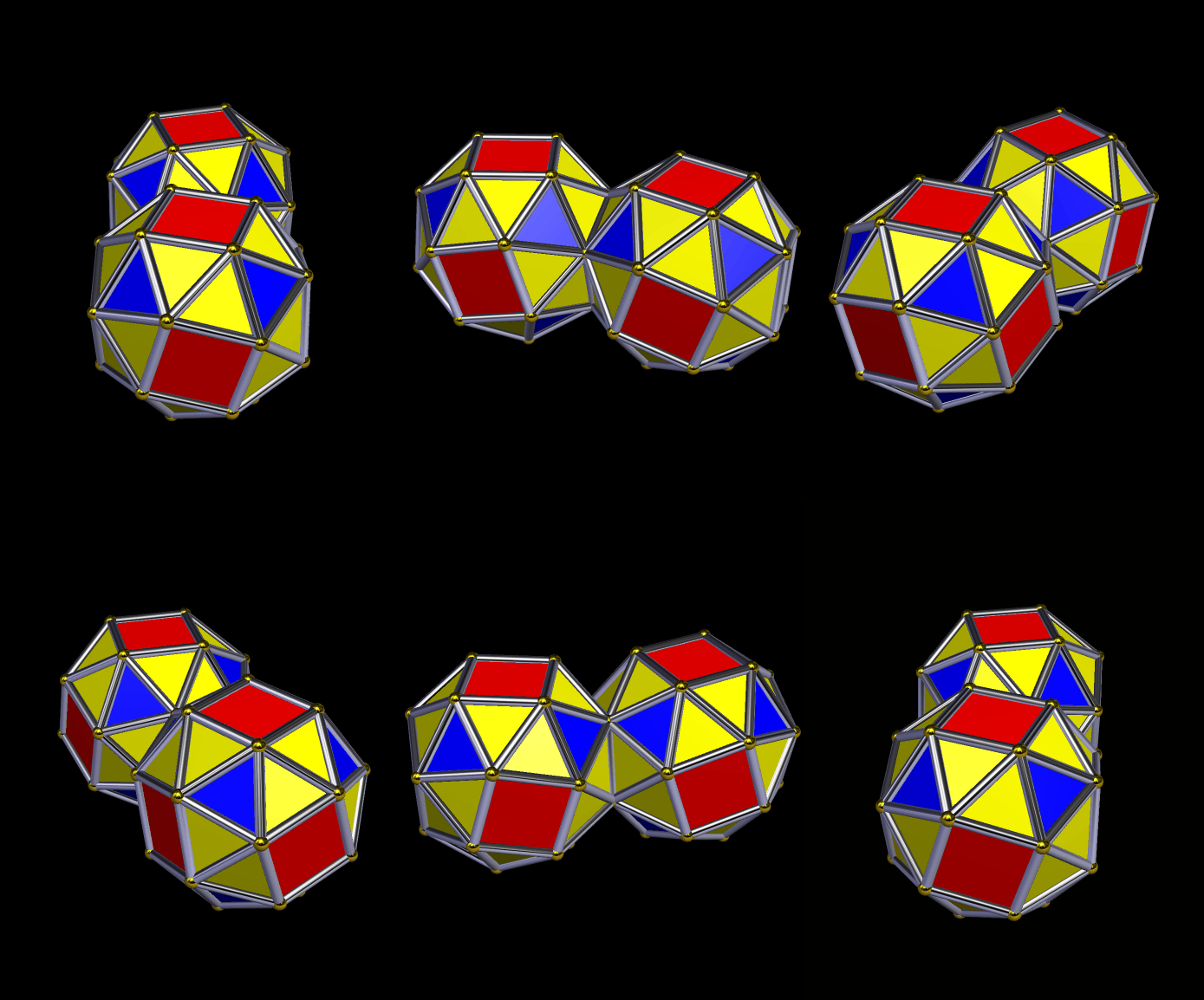
An Enantiomorphic Pair of Snub Cubes

Image

An Enantiomorphic Pair of Snub Cubes

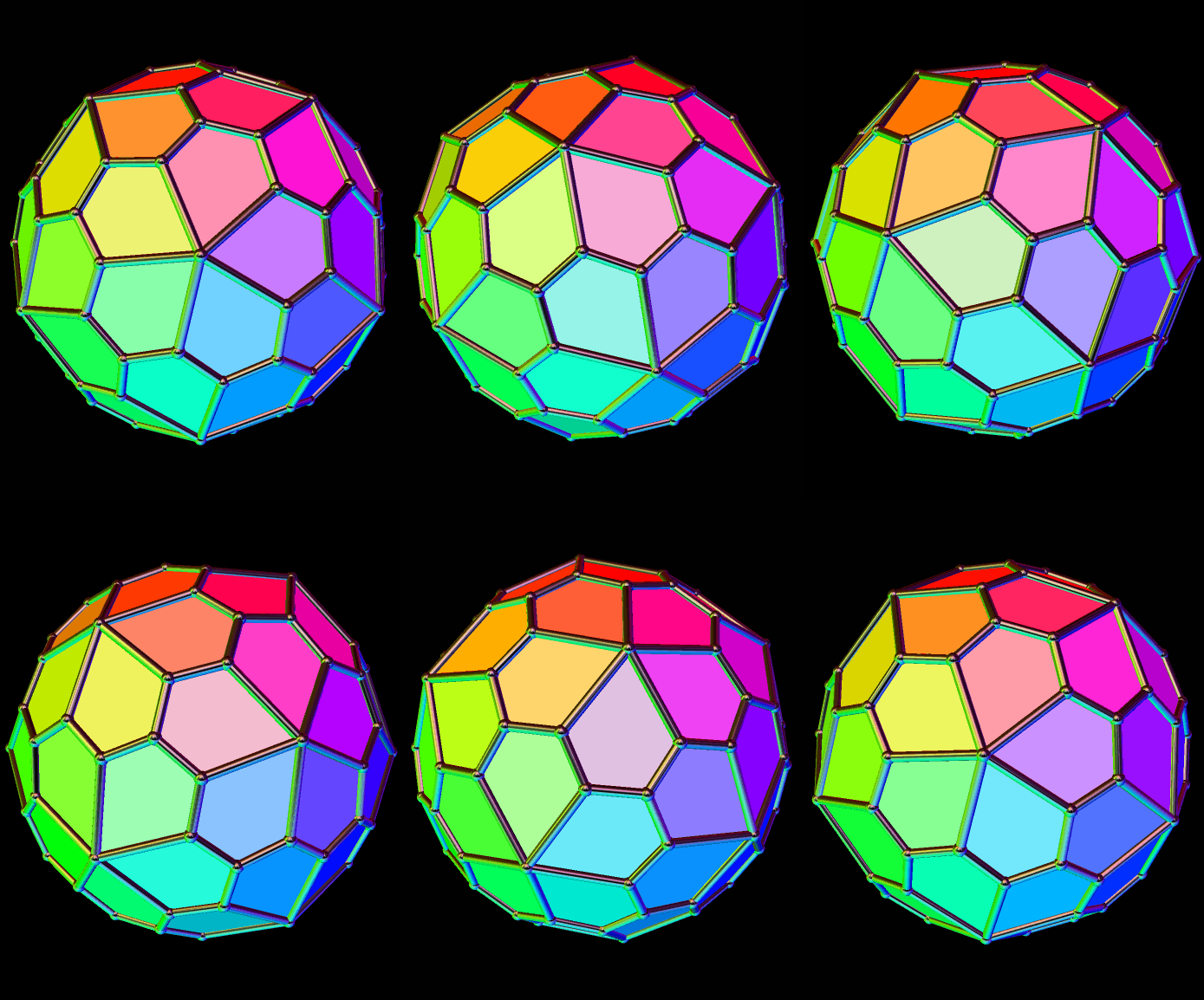
Unlike most polyhedra, the snub cube is chiral, meaning it exists in “left-handed” and “right-handed” forms. In this fused pair of snub cubes, there is one of each type.

Stella 4d was used to create this image, and you may try it for free at http://www.software3d.com/stella.php.

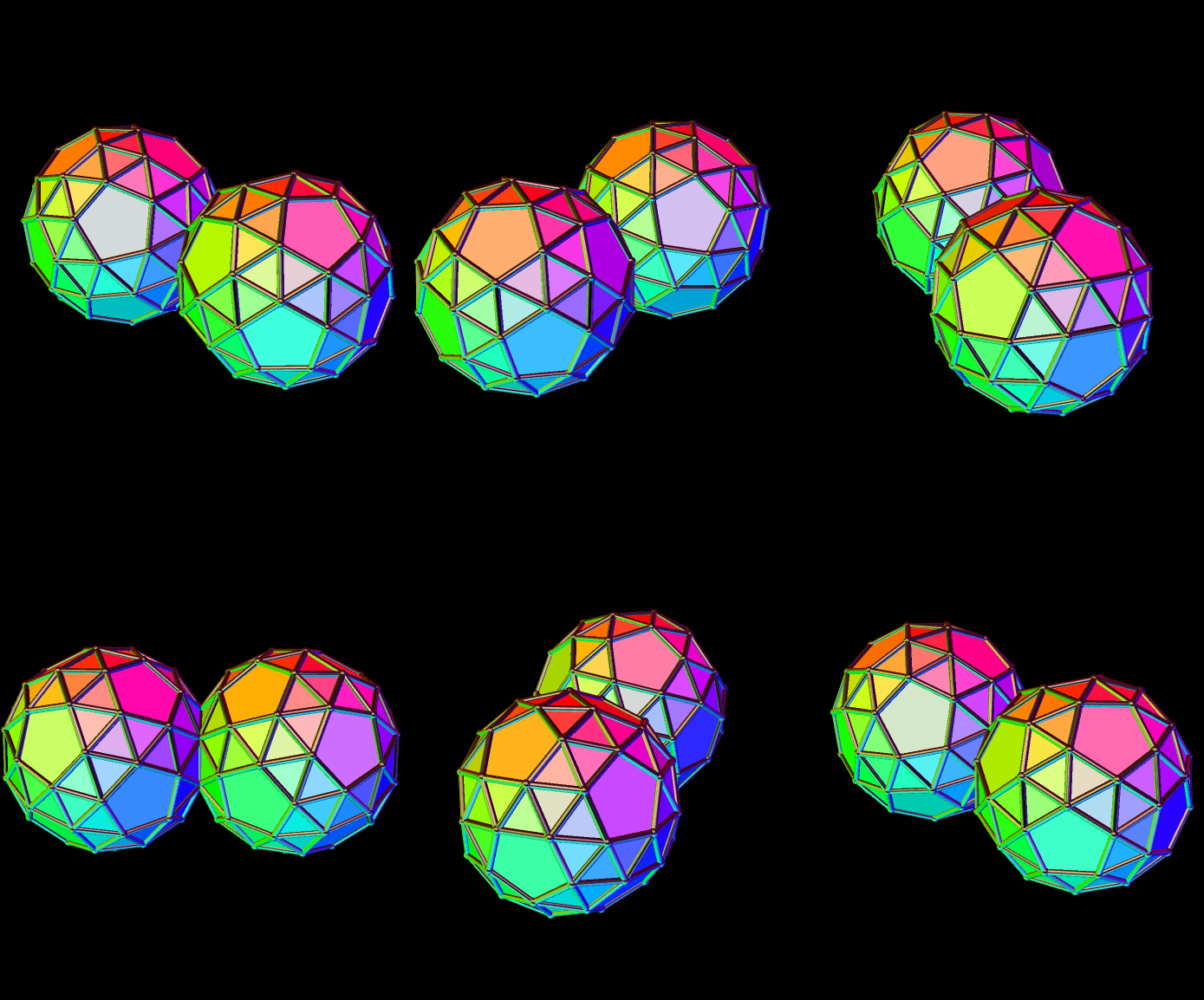
An Enantiomorphic Pair of Snub Dodecahedra

Image

An Enantiomorphic Pair of Snub Dodecahedra

Unlike most polyhedra, the snub dodecahedron is chiral, meaning it exists in “left-handed” and “right-handed” forms. In this fused pair of snub dodecahedra, there is one of each type.

Stella 4d was used to create this image, and you may try it for free at www.software3d.com/stella.php.

Rainbow Pentagonal Hexacontahedron

Image

The Pentagonal Hexacontahedron

This is a Catalan solid. Its dual among the Archimedean solid is the snub dodecahedron, which is chiral, causing this polyhedron to be chiral as well. This simply means that these polyhedra each exist in two forms, which are mirror-images of each other.

This virtual model was made using Stella 4d, which you can find at www.software3d.com/stella.php.

The Ninth Stellation of the Rhombic Triacontahedron

Image

The Ninth Stellation of the Rhombic Triacontahedron

Created using Stella 4d, which you may try at http://www.software3d.com/Stella.php.

Decorated Rhombic Triacontahedron II

Image

Decorated Rhombic Triacontahedron

Created using Geometer’s Sketchpad, MS-Paint, and Stella 4d. The last of these programs may be tried for free at http://www.software3d.com/stella.php.

A Concentric Dodecahedron, Icosahedron, and Rhombic Triacontahedron

Image

A Concentric Dodecahedron, Icosahedron, and Rhombic Triacontahedron

Created using Stella 4d, software you can find at www.software3d.com/Stella.php.

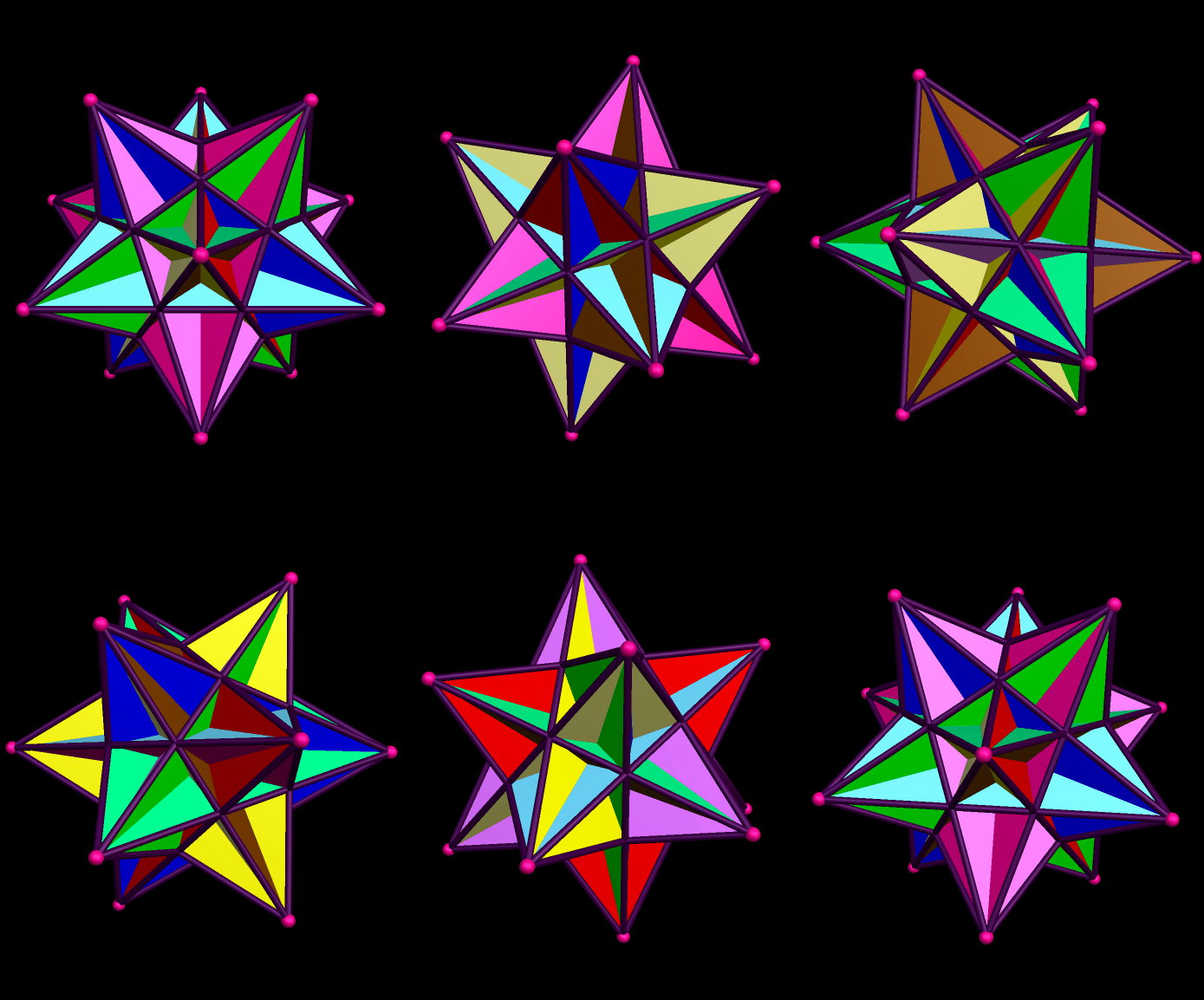
My Polyhedral Nemesis: The Great Icosahedron

Image

My Polyhedral Nemesis:  The Great Icosahedron

I used Stella 4d, a program you can find at http://www.software3d.com/stella.php, to make the rotating .gif file you see here. You can many such rotating pictures of other polyhedra elsewhere on this blog.

Older versions of this program would only create still images. In those days, I would also make actual physical models out of paper (usually posterboard or card stock). However, I’ve stopped doing that, now that I can make these rotating pictures.

There is one polyhedron for which I never could construct a physical model, although I tried on three separate occasions. It’s this one, the great icosahedron, discovered, to the best of my knowledge, by Johannes Kepler. Although it only has twenty faces (equilateral triangles), they interpenetrate — and each triangle has nine regions visible (called “facelets”), with the rest of each face hidden inside the polyhedron.

To create a physical model, 180 of these facelets must be individually cut out, and then glued or taped together, and there’s very little margin for error. On my three construction-attempts, I did make mistakes — but did not discover them until I had already built much more of the model. When making paper models, if errors are made, there is a certain point beyond which repair is impossible, or nearly so.

Although I never succeeded in making a physical model of the great icosahedron myself, and likely never will, I did once have a team of three students in a geometry class successfully build one. One of the students kept the model, and all three received “A” grades.
Rhombic Triacontahedron Featuring Octadecagonal Designs On Its Faces

Image

Rhombic Triacontahedron Featuring Octadecagonal Designs On Its Faces

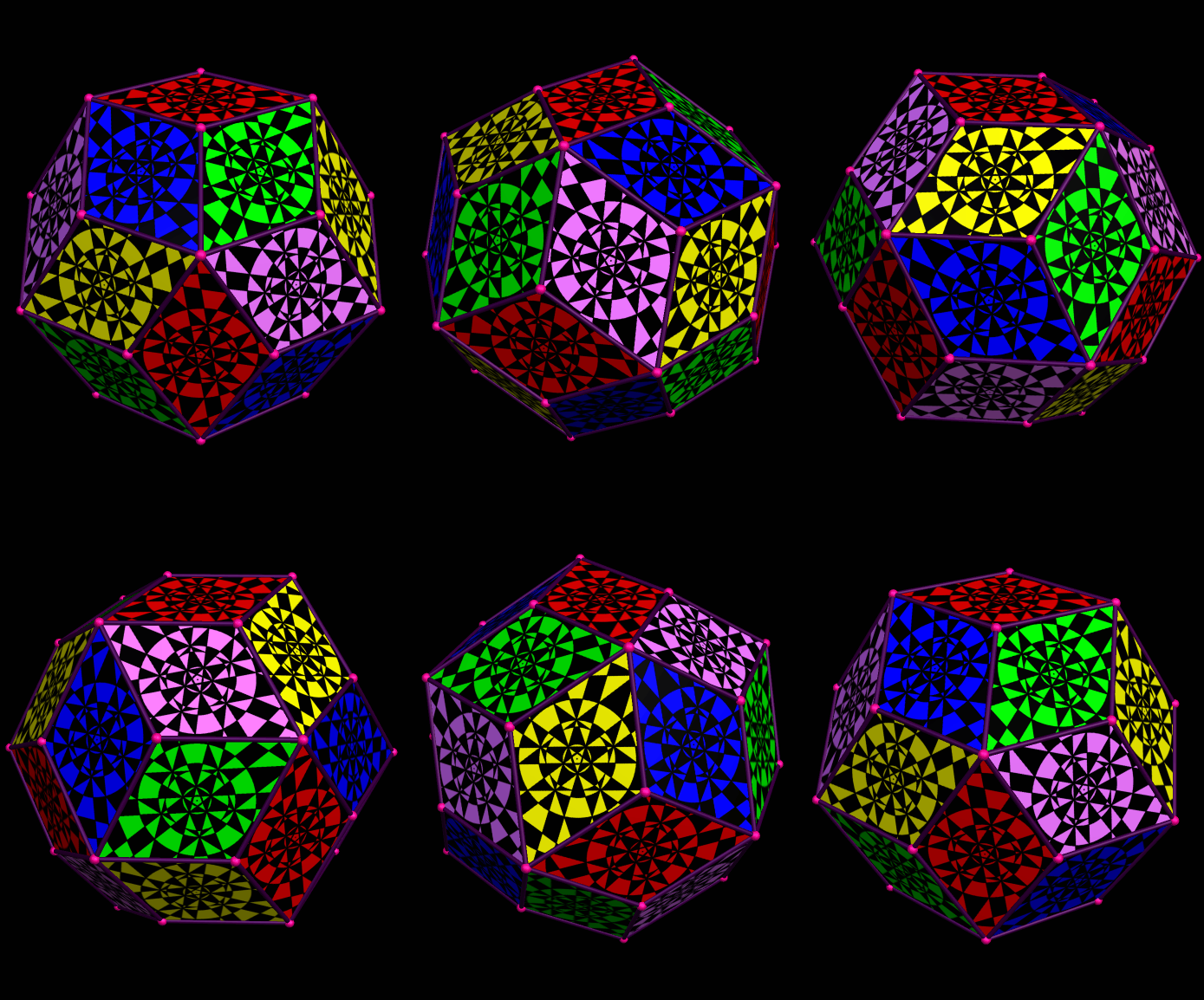
The octagonal design on each face appears in the last post here, and was made using both Geometer’s Sketchpad and MS-Paint. After cropping this image, I projected it onto the faces of this polyhedron, the rhombic triacontahedron, using Stella 4d, a program you can try for yourself at http://www.software3d.com/php.

An Octadecagon, with Its Circumscribed Circle, and the Lines Containing All of Its Sides and Diagonals

Image

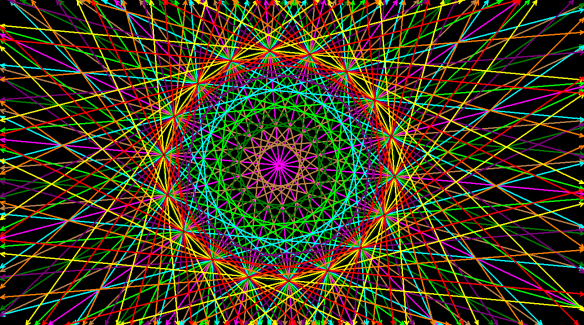
An Octadecagon, with Its Circumscribed Circle, and the Lines Containing All of Its Sides and Diagonals

A Tessellation of Regular Polygons for the New Year MMXIV

Image

A Quasi-Regular Tessellation for the New Year MMXIV

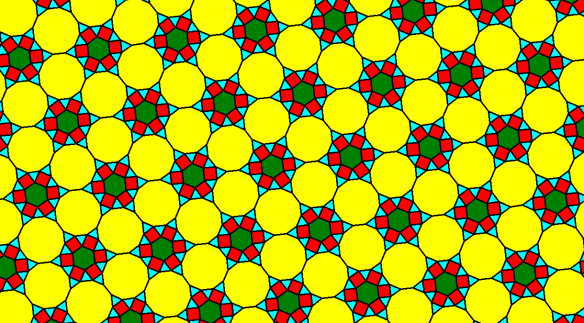
All of the polygons in this tessellation are regular. There are only three regular tessellations, and they use, respectively, equilateral triangles, squares, and regular hexagons to tile a plane. There is also a set of eight semi-regular (or Archimedean) tessellations, which you may see here. Archimedean tessellations include more than one type of polygon, but they are vertex-transitive, meaning that each vertex has the same set of polygons surrounding it.

This is a tessellation of regular polygons, but it lacks vertex-transitivity, so it cannot be called a semi-regular (or Archimedean) tessellation. In other words, in this tessellation, there is more than one type of vertex.

There are many such tessellations with an indefinitely repeating pattern. Has this particular one been seen before? I do not know the answer to this question — but if you do, please let me know, in a comment.