Star Polygon Enumeration

For any given regular convex polygon, how many star polygons exist?

Image

That’s the beginning. Here are two more:

Image


Since the pattern continues in this manner, it is easy to find the number of possible star polygons for a regular polygon with n sides. First, if (and only if) n is odd, add one. Next, divide by two. Lastly, subtract two, and you have your answer.

Twenty Interpenetrating, Rotating Equiangular Golden Hexagons

Image

Twenty Interpenetrating, Rotating Equiangular Golden Hexagons

Alternating sides of these hexagons have lengths in the Golden Ratio. I created this as a faceting of the rhombicosidodecahedron. It also has faces which are star pentagons and triangles, but those faces are hidden in this view.

(Created using software from www.software3d.com/stella.php)

Zome Icosahedron Encasing a Rhombic Enneacontahedron

Image

Zome Icosahedron Encasing a Rhombic Enneacontahedron

Zome is a three-dimensional ball-and-stick geometrical modeling system based on the Golden Ratio. I have a large collection, and have used it for years, both as a teaching tool, and for my own investigations. Zome is available for sale at www.zometool.com.

Here is a close-up shot, so you can better see the interior of this figure:

Photo02160907_1

Rotating Icosidodecahedral Shell

Image

Rotating Icosidodecahedral Shell

Website where you can try the software used to create this image: http://www.software3d.com/stella.php

I bought this program, Stella 4d, years ago, and have never regretted it. It is one of the most powerful tools available for doing work at the intersection of art and mathematics.

Icosidodecahedral Nulloid

Image

Icosidodecahedral Nulloid

Like all nulloids, this has zero volume. It may be seen as six intersecting, regular decagons. Some consider nulloids a subset of polyhedra; others do not.

I made this using Stella 4d, which you can find at http://www.software3d.com/stella.php.

Cuboctahedral Nulloid

Image

Cuboctahedral Nulloid

Like all nulloids, this has zero volume. It may be seen as four intersecting, regular hexagons. Some consider nulloids a subset of polyhedra; others do not.

I made this using Stella 4d, which you can find at http://www.software3d.com/stella.php.

Triangles, and the Circles for Which Their Sides Are Diameters

Image

triangle diameter circles

As you can see, these circles intersect on the sides of the triangles. I did not expect that, nor have I proven it. I have moved the triangle around to check to see if this remained true, and it did pass this test. If I can figure out a proof for this, I’ll post it; if one exists already, please post a comment letting me know where to find it.

Later edit: I found out that these points of intersection are the altitude feet. Here’s a diagram showing the lines containing the altitudes, meeting at the orthocenter. These blue lines also contain the angle bisectors of the brown triangle defined by the altitude feet.

triangle diameter circles

Dodecahedral Cluster of Icosahedra

Image

Dodecahedral Cluster of Icosahedra

If you are interested in the history of this polyhedral cluster, please see the previous two posts. Also, here’s another color scheme for it:

Icosahedrally Augmented Tetrahedra 5

These images were produced using Stella 4d, software you can find at www.software3d.com/Stella.php.

Cluster of Octahedra

Image

Cluster of Octahedra

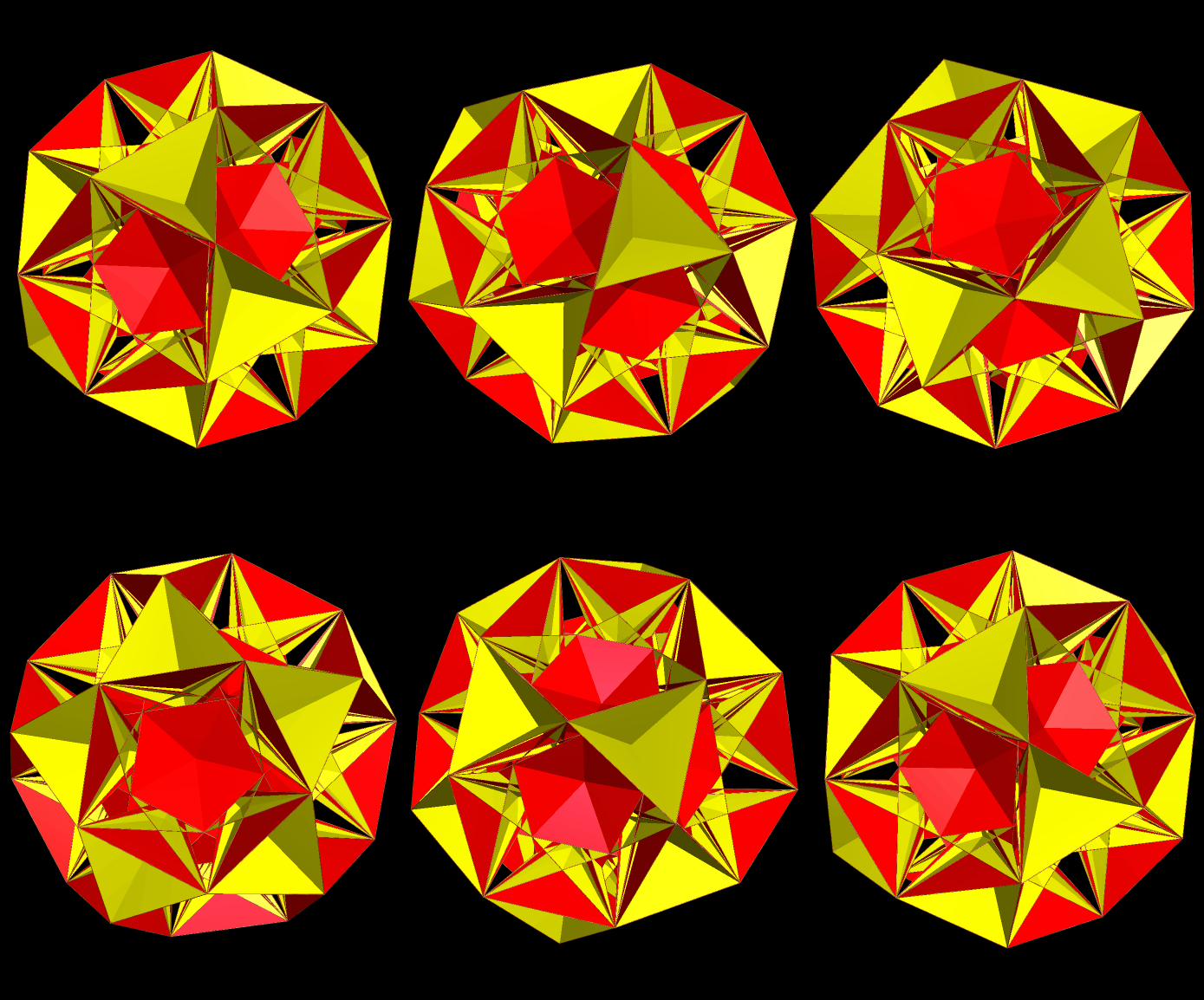
This cluster was formed by putting an octahedron of the same color on each face of the compound of five tetrahedra, seen in the previous post.

In the next post, each outermost face will be augmented with an icosahedron of the same color.

This image was produced using Stella 4d, software you can find at www.software3d.com/Stella.php.