The Story of the Void, Chapter Three

Image

The Story of the Void, Chapter Three

Previous chapters:

Ch. 2 — https://robertlovespi.wordpress.com/2014/01/19/the-story-of-the-void-chapter-two/

Ch. 1 — https://robertlovespi.wordpress.com/2014/01/18/the-story-of-the-void-chapter-one/

* * *

By the time Richard realized he was losing the details of his existence, he’d already forgotten his middle name. It wasn’t long before his last name was gone as well. Scared, it took Richard a long time, one night, after an unknown number of “nights” or “days” in solar orbit, where there is no true night nor day, for him to fall asleep.

When he slept, he rarely remembered his dreams. This one, he remembered.

He was plummeting to his doom, from a great height. As he got closer to the ground, he wished he were not there. And then he wasn’t. He fell right into the ground, and then kept going. What in hell is going on, he thought? He thought of his last science class, for the first time years.

He was trying to figure out what was going on when the direction of his fall reversed itself. It was an odd sensation. He felt as though he’d turned inside-out. However, he wasn’t too disoriented to think, and he realized he must be inside the earth. He didn’t know what would happen if he returned to his normal state while inside liquid or solid rock, but he didn’t want to find out, either. He waited, therefore, until he came flying out of the ocean on the other side of the earth.

He woke up. Earth was recognizable in front of him. Soon, it was larger in his field of view. He reasoned that he must be moving very fast. How fast, he thought? He didn’t know.

Richard didn’t want to come out the other side, above — what, the Indian Ocean? — some ocean, apparently, he thought, as he tried his best to picture all sides of a globe in his mind.

In the dream, he remembered having the idea that his density were under his conscious control. He had lowered it to essentially nothing, and had passed right into the ground. No longer dreaming, he raised a hand and looked at at.

Rather, he tried. It wasn’t there.

Panicked, he ran. On what? There didn’t seem to be a floor below him. A door did appear after a time, though, and he opened it, reasoning that what lay on the other side must be better than what there was here, where he apparently didn’t exist.

He opened the door, and saw two corridors before him. On the left, a bright light shone, but was very far away– he couldn’t tell how far. On the right, the passageway became darker as it receded from him, until an absolute darkness appeared, in which no detail could be seen.

He stepped just inside the passageway on the left, choosing light, at least for now, over darkness. He closed the door behind him, after passing through it, whereupon it promptly vanished. The earth grabbed his attention, which wasn’t difficult, considering that it appeared larger than before.

The corridors could no longer be seen, but they could be felt. He could control his density. The singularity had . . . had . . . told him this. So they knew. Wait — they? Who are we, he thought, and where did the singularity go?

It was then that he realized no one had told him about a singularity. He didn’t even know the word. The idea had been communicated to him, but not by anyone he could see. By the singularity itself, conscious, apparently, only from the time he, and his small space pod, had fallen into it.

The space pod had been destroyed — ripped apart. Richard remembered that. He did not remember losing his hand, nor the rest of his body. But, wait, there it was now — but faded. He could see stars through it.

With a thought, he increased his density. The stars vanished. He stayed that way for a time. He slept, and woke again. Earth was larger still. He could see South America, and remembered studying it in school.

He was obviously moving quickly, and chose to reduce his density to a very low amount (making the stars appear though him again) before encountering the atmosphere. It would be good, he reasoned, to slow down, and not repeat his dream with his actual life.

When the atmosphere came, he knew right away, for the thin bits of matter he was permitting into his body’s normal, human-shaped volume lit up, flaming from the friction. He became aware of the heat, but it did not hurt him. Arriving at sunrise, some from the unlit side of the earth thought they saw a meteor. On the sunlight side of earth, no one noticed, for the light of his re-entry was indistinguishable from the sunlit clouds watched in that morning’s sunrise.

For a time, Richard saw little but flame, but it began to fade once friction had slowed him down enough that the heat radiation produced was no longer visible. He could still perceive it, as a color he had never seen before (and would be helpless to explain), but he could use the parts of the spectrum normal humans can see to look “above” it.

He puzzled over his seeming to intuitively understand physics, which he had never studied, while he used this knowledge to slow himself down, and land, slowly, at normal density for a human. He was glowing red-hot, still, from the heat of re-entry, but did not feel uncomfortable. A lone tree nearby caught fire, and burned up quickly, but there were no other trees to which the fire could quickly spread. There was dried grass and leaves burning, though, and that could spread — just more slowly. Richard felt compelled by conscience (a completely new feeling for him, and he didn’t know why he had one now, but not before) to put the fire out. As soon as he had cooled off enough to do so, he put the fire out by stomping it out with his boots.

Boots? When had he put boots on, he wondered? How did they survive re-entry, as had, mysteriously, the clothes he had on, including a favorite t-shirt from when he had been a teenager, lost, in a move, years ago? He tried, but could not figure out how this was possible.

He wondered one thing, above everything else: where was he?

The question “What was he?” was a better question, but that didn’t occur to him for about twenty minutes after he stomped the last of the fire out.

Once he was sure it was extinguished, he started walking forward through a grassy area, along a gentle upward slope, following his shadow to keep himself going the same direction, and practicing his density-control as he walked, which caused his shadow to fade, disappear, and then gradually reappear, over and over. He found that he preferred walking at about half his normal density, simply because he didn’t weigh as much in that condition. He walked for many hours; later that day, he was walking away from his shadow, because the sun had passed overhead, and was now behind him in the sky. Later, the sun set. Richard then stopped walking, until a dozen or so stars were visible. Richard set his gaze on the brightest star he could see, near the horizon, that was in the general direction he was going, for he didn’t want to double back by mistake and come back to the burned remains of the tree near his landing-spot. He walked all night.

[to be continued]

Not “Dead Presidents”

Image

Not Dead Presidents

Attention, Americans:

These two men, Alexander Hamilton and Benjamin Franklin, are, indeed, dead. However, neither of them ever served as president. Therefore, please stop calling money “dead presidents,” unless you are excluding these two denominations, and, moreover, please stop this immediately.

Your cooperation is appreciated.

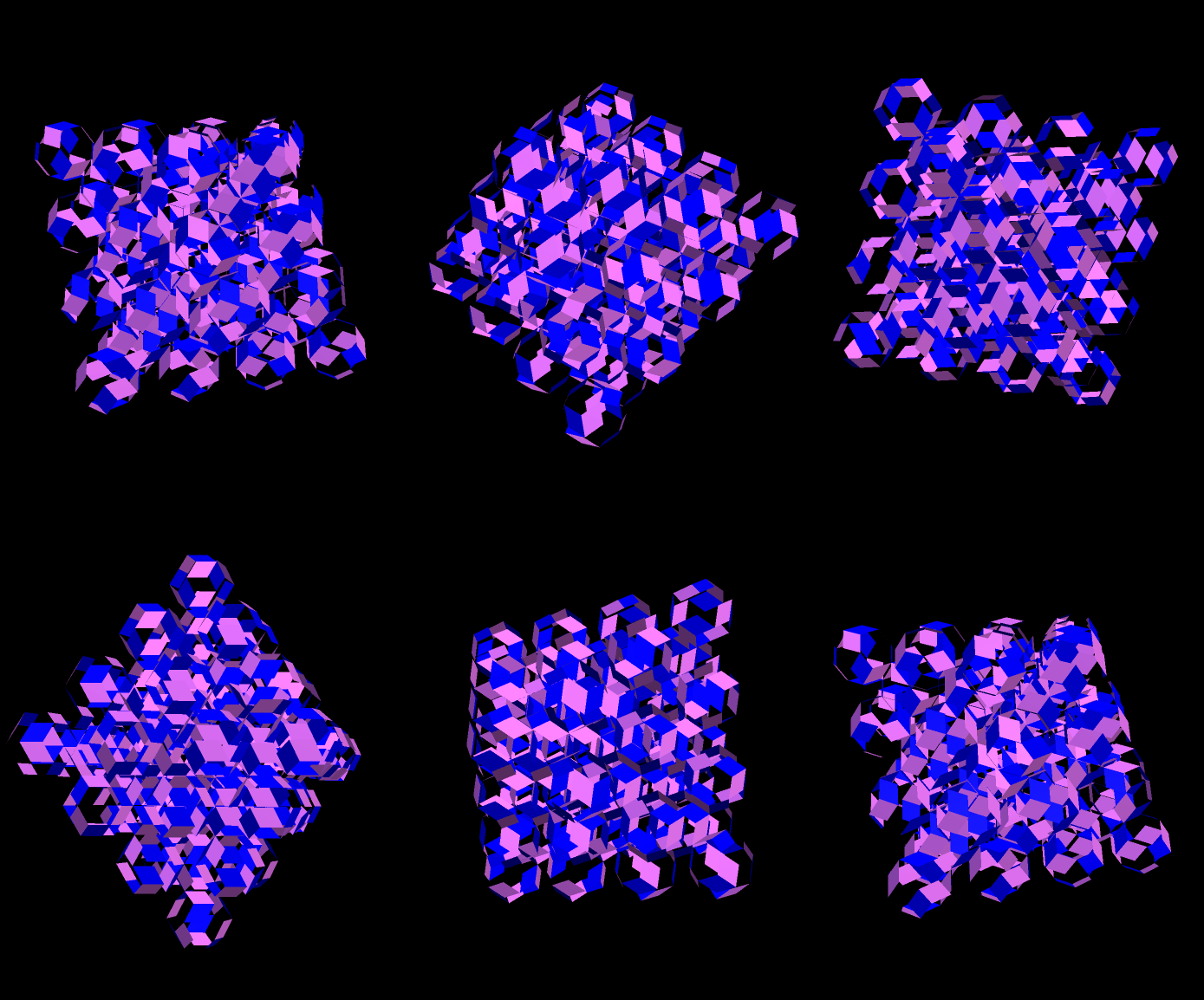
My Polyhedral Nemesis: The Great Icosahedron

Image

My Polyhedral Nemesis:  The Great Icosahedron

I used Stella 4d, a program you can find at http://www.software3d.com/stella.php, to make the rotating .gif file you see here. You can many such rotating pictures of other polyhedra elsewhere on this blog.

Older versions of this program would only create still images. In those days, I would also make actual physical models out of paper (usually posterboard or card stock). However, I’ve stopped doing that, now that I can make these rotating pictures.

There is one polyhedron for which I never could construct a physical model, although I tried on three separate occasions. It’s this one, the great icosahedron, discovered, to the best of my knowledge, by Johannes Kepler. Although it only has twenty faces (equilateral triangles), they interpenetrate — and each triangle has nine regions visible (called “facelets”), with the rest of each face hidden inside the polyhedron.

To create a physical model, 180 of these facelets must be individually cut out, and then glued or taped together, and there’s very little margin for error. On my three construction-attempts, I did make mistakes — but did not discover them until I had already built much more of the model. When making paper models, if errors are made, there is a certain point beyond which repair is impossible, or nearly so.

Although I never succeeded in making a physical model of the great icosahedron myself, and likely never will, I did once have a team of three students in a geometry class successfully build one. One of the students kept the model, and all three received “A” grades.

The Strange American Custom of Holiday Observance

Image

The Strange American Custom of Holiday Observance

Today is not Dr. Martin Luther King, Jr.’s actual birthday. The anniversary of his birth came, this year, last Wednesday. As you can see above, that’s January 15. However, it’s being observed today — the date circled above — to give people a three-day weekend.

That’s related to something else, apart from the sheer inaccuracy of moving a date on the calendar, that bugs me about “MLK Day,” as it is often called. It’s essentially the same thing that bothers me about Memorial Day, and Veteran’s Day. To honor people we respect and admire for their hard work — for civil rights, defending the nation in battle, or anything else — what do we often do, as a nation? We close schools, many businesses, the stock market, mail service, etc., all to give as many people as possible a day without work. How does a day off, of all things, honor the hard work of anyone?

Stephen Hawking, on His Own IQ, and IQs in General

Image

Stephen Hawking, On IQ

I have had my IQ tested, but, like Stephen Hawking, I have no idea what it is. The people conducting the test did not share the results with me.

This does not bother me in the slightest. Why? Because I agree with Hawking on this subject, that’s why!

Something You Likely Did Not Know, About the “Pledge of Allegiance”

Image

I thought I knew the (rather complicated) history of the “Pledge of Allegiance” well — until I saw this picture. This was the original “flag salute” pose American students were taught to use, nationwide, until World War II was well underway. It had been in use since 1892, and was called the “Bellamy salute.”

The current “hand over the heart” gesture didn’t go into effect until 1942, and was changed in reaction to the Nazis using essentially the same salute which you see American schoolchildren displaying in this (circa 1941) photograph. From where did this gesture really originate? A common belief is that it started in ancient Rome, but the article at http://en.wikipedia.org/wiki/Roman_salute — and the sources cited there — throw doubt on this idea. It seems that, instead, this gesture was depicted in an 1874 painting of an ancient Roman scene, spread into other neoclassical artworks, then plays and other performances, until it was well-established in the public consciousness as something the ancient Romans did — but that belief appears to be unsupported by the relatively small number of actual writings, or works of art, which have survived from ancient times.

It was twelve years after the change in the civilian American flag-salute gesture that Congress made another, much better-known change — the 1954 addition (unconstitutional, in my opinion) of the words “under God.” Just as the early gesture-change was made, in wartime, as a reaction against the practices of an enemy, arguments have been made that this change in the wording of the Pledge was made for similar reasons, given that we were then in the early years of the Cold War, with America’s enemies, in that long struggle, being what were often called the “Godless Communists.”

[Additional source, beyond the one given above: http://en.wikipedia.org/wiki/Pledge_of_Allegiance (with more sources cited at the bottom of that article)].

“Strong Grape Juice”

Image


My earliest memory of a church service involves a trip to visit relatives, and I started discovering how different from others I was at a very young age. This is one of the episodes which played a major role in that discovery.

I was only four of five years old, and had already developed an intense hatred of being bored. Ignoring the sermon seemed like an even more boring prospect that actually paying attention to it, so I consciously chose the latter, which I’ve observed is often not the choice young children make.

This church’s denomination is one of those that teaches that drinking alcohol is sinful. They are also Biblical literalists. This, of course, poses a problem, for there is a lot of drinking of wine to be found in the Bible. This preacher didn’t avoid the contradiction, though. His task, that Sunday morning, was to deal with it head-on, and he did so with the following claim: when Jesus, his disciples, and numerous other people from the Bible are described as drinking wine, that wine actually contained no alcohol. It was not wine as we know it today. It was, rather, merely “strong grape juice.” Those were his exact words.

Even at that young age, I had already started working on building, in my own mind, the best crap detector I could possibly create. (Improving it is still something I work on today.) I didn’t yet realize that real wine would be far safer, before refrigeration existed, than grape juice, simply because alcohol, at the concentrations found in wine, kills lots of disease-causing bacteria. However, that morning, I had learned enough to instantly recognize this “strong grape juice” claim as absolute crap.

Dismissing the preacher as not worthy of further attention, I stood up in our pew, and turned around to face the back of the church. We were sitting near the front, so this let me see most of the congregation. I didn’t need to speak to them — I just wanted to look at them. I remember being stunned by what I saw. Nearly everyone appeared quite attentive to the sermon. Some mouths were half-open, and numerous heads were nodding in agreement with the preacher’s droning nonsense. I figured it out: they were actually accepting what this man was saying as the truth, and were doing so without question! They believed him! At first, I felt dizzy, and then, later, I felt sick. The more I thought about the experience, the worse I felt, and I could think about nothing else for a long time after that church service finally ended.

I’d been exposed to religion many times before, but it always seemed to me that adults didn’t really believe what they were saying, any more than when they told children my age about the Tooth Fairy or Santa Claus. At that moment, though, I realized I had been mistaken. This was no act. These people, in that church that day, actually believed what they were told. Why? I didn’t know. I still don’t. If that man told them that two plus two equals six, would they believe that? I suspected they would.

I was surrounded by a herd of sheep. That moment of clarity, when I realized this fact, scared me. It made me wonder, and not for the last nor first time, if I had been secretly planted on earth by aliens, as a baby, and without a guidebook.

This is only one of many experiences that convinced me of the importance of skepticism. The fact that it is so clear, in my memory, leads me to think it was one of the more important of those experiences. It cemented, in my mind, a scary truth: the world is infested with large numbers of incredibly gullible, deluded people. They weren’t like me. I didn’t understand them. They were everywhere. I wasn’t anything like them, and didn’t want to be, either. I was, however, stuck here with them.

I was stranded on the wrong planet, with no prospect for escape, any time soon. That was over forty years ago, and I’m still here.