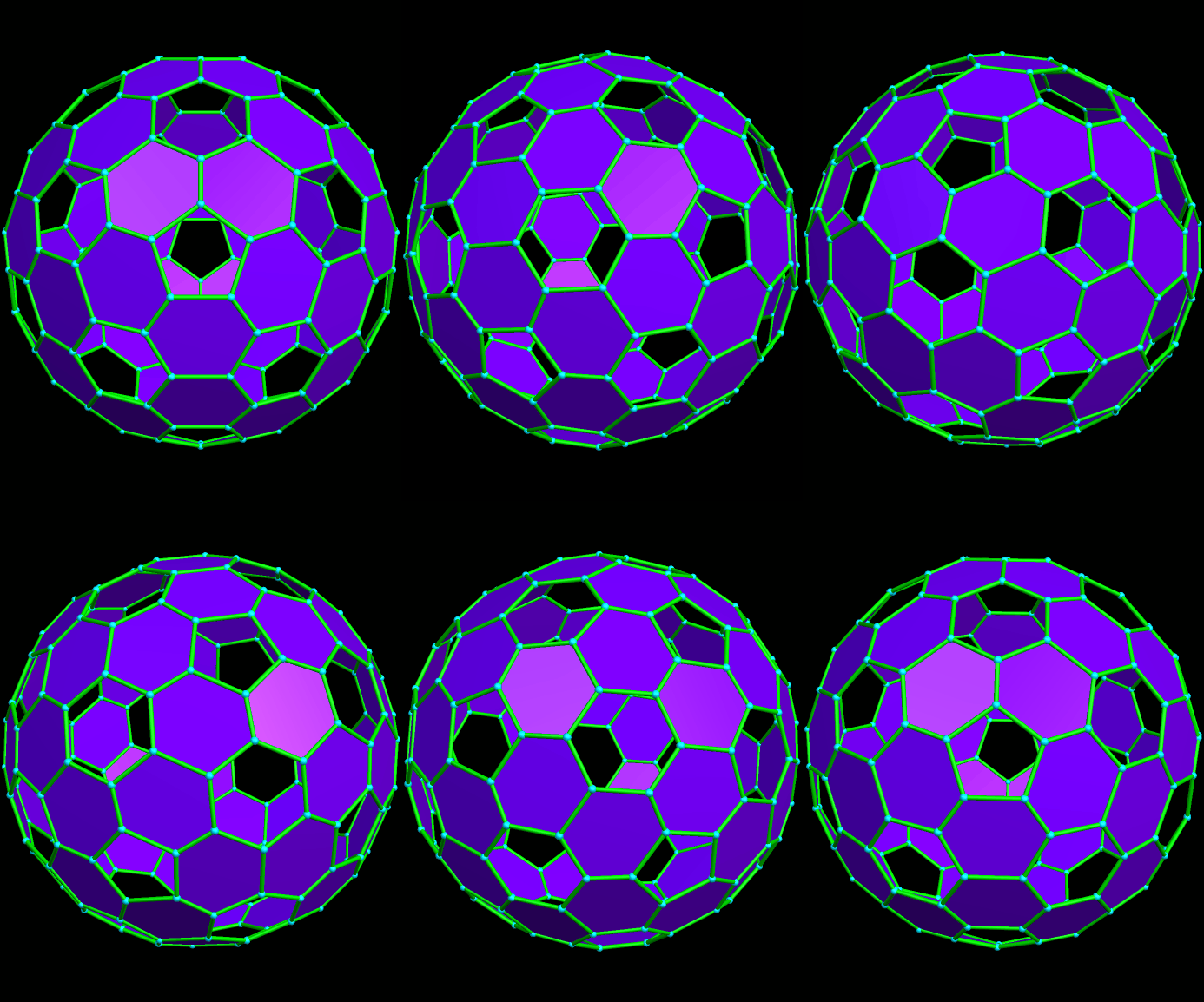
A Truncated Icosahedron with Sixty Extra Hexagons

Image

A Truncated Icosahedron with Sixty Extra Hexagons

I created this using Stella 4d, which is available (including a free trial download) at http://www.software3d.com/Stella.php. With adjustments in edge lengths to make the bond lengths correct, this would be the shape of a C180 fullerene molecule.

If the thirty-two faces of the truncated icosahedron are hidden, and only the sixty extra hexagons are visible, this polyhedron looks like this:

Dual of Geodesic Trunc Icosa

In “rainbow color mode,” it has an even more interesting appearance:

Dual of Geodesic Trunc Icosa

My Students’ Painting of the Periodic Table of the Elements

Image

My Students' Painting of the Periodic Table of the Elements

This is my last year teaching at my current school — I’ll be transferring to another school in the same district in the Fall. To create a farewell gift to the school where I have taught for the last three years, I brought a lot of paint and other art supplies from home, bought more when they ran out, and let my students (who are enrolled in Chemistry and Physical Science) paint a large painting of the periodic table on two large wooden boards, each measuring 4′ by 6′. In the Fall, the plan is for the painting to be mounted on the wall of the science wing of my current school, in a location to be chosen by my current department chair, a personal friend of mine.

I think my students did a very good job — better than this picture I took with my cell phone reveals, just due to camera-quality. I am proud of them.

On the Varieties of Water

Image

On the Varieties of Heavy Water

As many people know, there is more than one type of water. For example, the term “heavy water” often refers specifically to D2O, with “semi-heavy water” referring to DOH. Add tritium to the mix, and the new combinations possible — all radioactive — include HOT, DOT, and T2O. Along with diprotium oxide, plain old H2O, that’s six isotopic variants of this one simple compound.

However, that six needs to be multiplied by three. Why? Because there’s one set of six that includes an oxygen-16 atom (the usual kind), and another six for oxygen-17, and one more for oxygen-18, for a total of eighteen. So far. Both oxygen-17 and -18 are stable, and occur in nature, although they are both of very low abundance.

Eighteen kinds of water, half of them radioactive? No, that’s not quite enough. If the radioactive isotope of hydrogen is included, then so should be the radioisotopes of oxygen. That would include oxygen isotopes with mass numbers from 13 to 15 (add three more sets of six, or 18, which, when added to the original 18, gives a running total of 36), and 19 to 24 (add six more sets of six, or 36 more, to the 36 we just had, and we’re now at 72).

To leave it at 72 isotopic varieties of water is not necessary, but it is reasonable. Yes, there is oxygen-26, but with an estimated half-life of 40 nanoseconds, it isn’t reasonable to expect there to be time for it to form a water molecule. Could it happen? Possibly — but it’s extremely unlikely to ever be observed. For oxygen-12, the story is similar, but with an even shorter nuclide-lifetime than that of O-26.

Additional isotopes of hydrogen have also been detected, with mass numbers from 4 to 7, but they decay even more quickly than O-26 as well.

72 it is, then, counting nothing with a half-life under a millisecond. This is the sort of thing that happens when math compulsives think about chemistry a bit too long.

Can a Public School Student Read a Bible in Class?

Image

Can a public school student read a Bible in class?

Yes, but not loudly, waving it around, while I am explaining the safety protocols for laboratory use of silver nitrate in chemistry class.

It’s dangerous stuff, as you can see here: http://www.sciencelab.com/msds.php?msdsId=9927411.

Did this actually happen? Of course — I don’t think I could make up a story like that. It happened in a different class than the one I am teaching this year, though. The student’s name is being withheld, to protect his identity (and my job).

The Pseudo-Truncated-Icosahedron

Image

Continue reading

Halogenated Forms of Methane: An Exhaustive, Alphabetized List

r-bromochlorofluoroiodomethane-3d-balls

Note:  optical isomers are not counted separately on this list, although those five halomethane molecules for which left- and right-handed versions are possible are indicated in italics. Also, halogens are not used here unless they have at least one stable isotope. Finally, theoretically-possible halomethanes which have not yet been synthesized, such as bromochlorofluoroiodomethane (the molecule pictured, with this image source), are included in this list.

  1. bromochlorodifluoromethane
  2. bromochlorodiiodomethane
  3. bromochlorofluoroiodomethane
  4. bromochlorofluoromethane
  5. bromochloroiodomethane
  6. bromochloromethane
  7. bromodichlorofluoromethane
  8. bromodichloroiodomethane
  9. bromodichloromethane
  10. bromodifluoroiodomethane
  11. bromodifluoromethane
  12. bromodiiodomethane
  13. bromofluorodiiodomethane
  14. bromofluoroiodomethane
  15. bromofluoromethane
  16. bromoiodomethane
  17. bromomethane, also known as methyl bromide
  18. bromotrichloromethane
  19. bromotrifluoromethane
  20. bromotriiodomethane
  21. chlorodifluoromethane
  22. chlorodifluoroiodomethane
  23. chlorodiiodomethane
  24. chlorofluorodiiodomethane
  25. chlorofluoroiodomethane
  26. chlorofluoromethane
  27. chloroiodomethane
  28. chloromethane, also known as methyl chloride
  29. chlorotrifluoromethane
  30. chlorotriiodomethane
  31. dibromochloromethane
  32. dibromochlorofluoromethane
  33. dibromochloroiodomethane
  34. dibromodichloromethane
  35. dibromodifluoromethane
  36. dibromodiiodomethane
  37. dibromofluoroiodomethane
  38. dibromofluoromethane
  39. dibromoiodomethane
  40. dibromomethane
  41. dichlorodifluoromethane
  42. dichlorodiiodomethane
  43. dichlorofluoroiodomethane
  44. dichlorofluoromethane
  45. dichloroiodomethane
  46. dichloromethane
  47. difluorodiiodomethane
  48. difluoroiodomethane
  49. difluoromethane
  50. diiodomethane
  51. fluorodiiodomethane
  52. fluoroiodomethane
  53. fluoromethane, also known as methyl fluoride
  54. fluorotriiodomethane
  55. iodomethane, also known as methyl iodide
  56. tetrabromomethane, also known as carbon tetrabromide
  57. tetrachloromethane, also known as carbon tetrachloride
  58. tetrafluoromethane, also known as carbon tetrafluoride
  59. tetraiodomethane, also known as carbon tetraiodide
  60. tribromochloromethane
  61. tribromofluoromethane
  62. tribromoiodomethane
  63. tribromomethane
  64. trichlorofluoromethane
  65. trichloroiodomethane
  66. trichloromethane
  67. trifluoroiodomethane
  68. trifluoromethane
  69. triiodomethane

If any have been omitted, the fault is purely my own — and please let me know about the omission in a comment. Thanks!