When We Build Our Dyson Sphere, Let’s Not Use Enneagonal Antiprisms

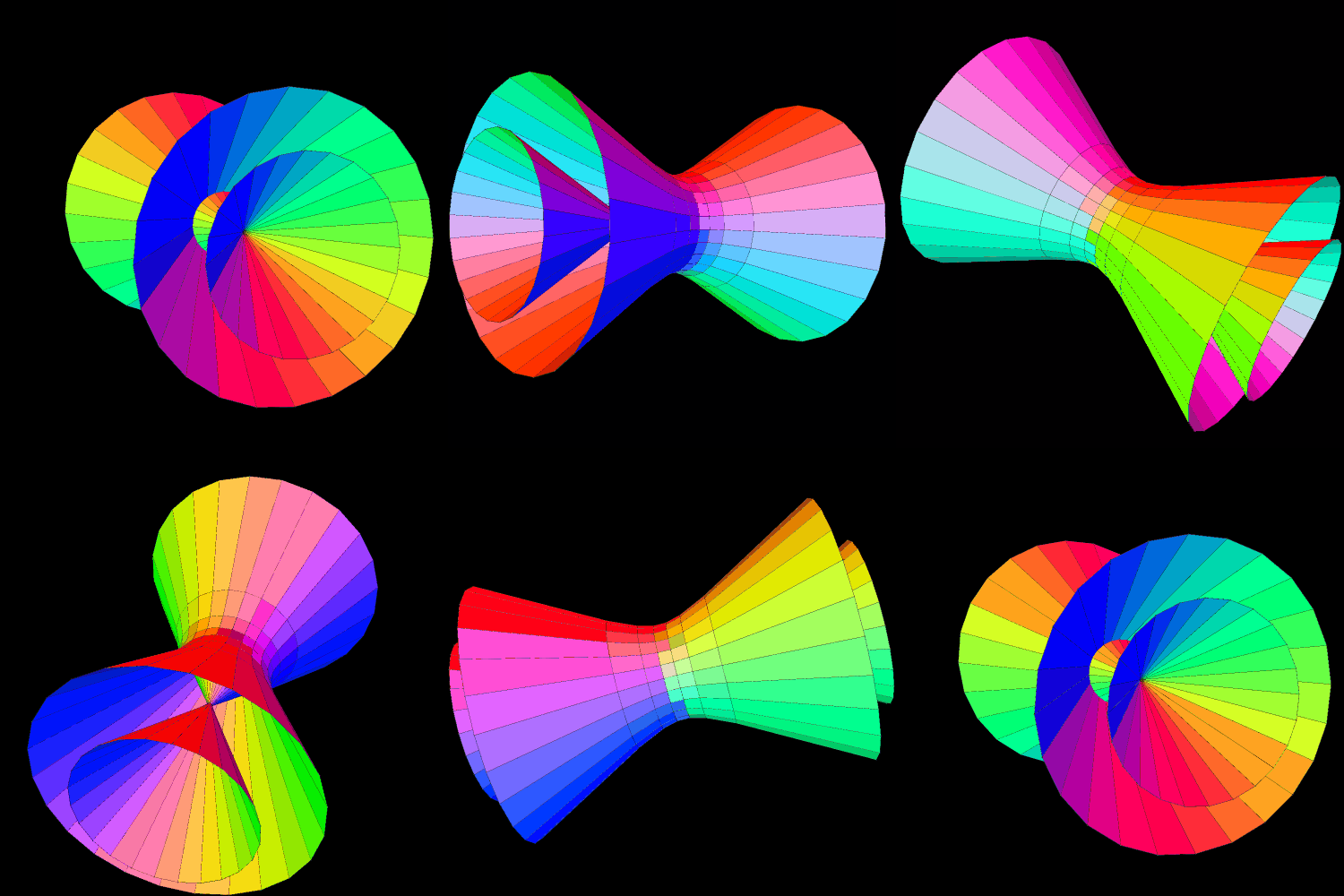
Before an undertaking as great as building a Dyson Sphere, it’s a good idea to plan ahead first. This rotating image shows what my plan for an enneagonal-antiprism-based Dyson Sphere looked like, at the hemisphere stage. At this point, the best I could hope for is was three-fold dihedral symmetry.

Augmented 9- Antiprism

I didn’t get what I was hoping for, but only ended up with plain old three-fold polar symmetry, once my Dyson Sphere plan got at far as it could go without the unit enneagonal antiprisms running into each other. Polyhedra-obsessives tend to also be symmetry-obsessives, and this just isn’t good enough for me.
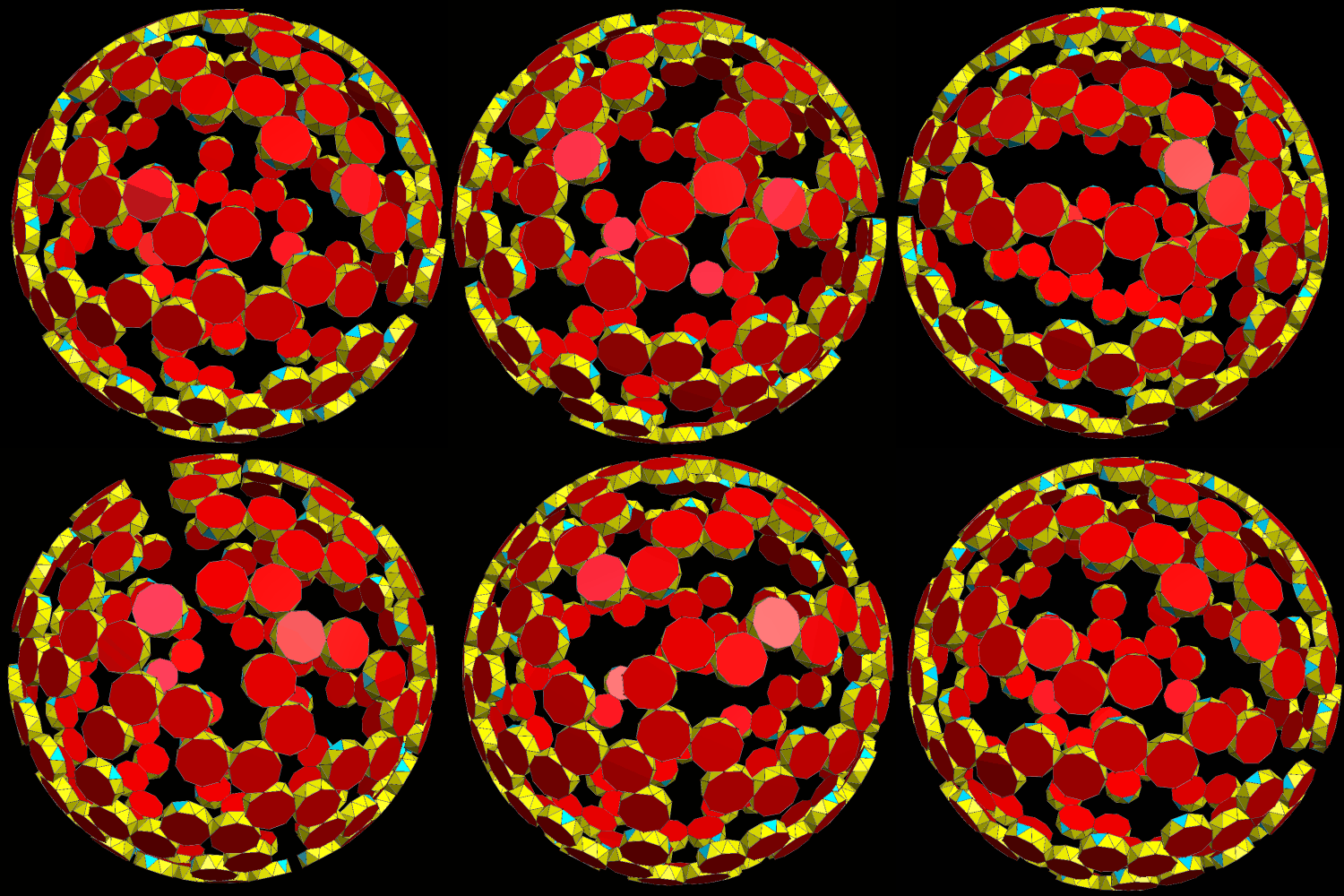
Augmented 9- Antiprism complete

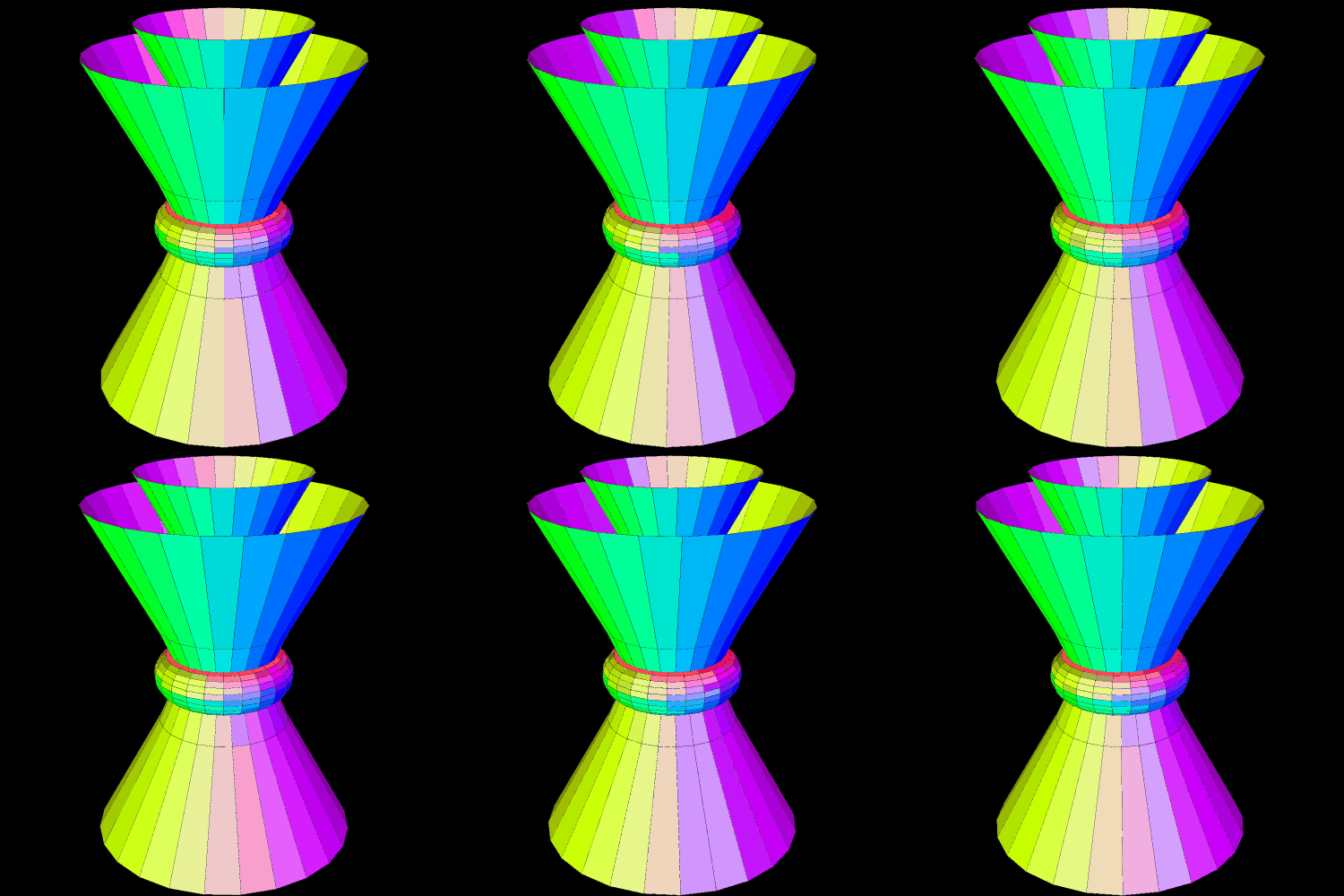
If we filled in the gaps by creating the convex hull of the above complex of enneagonal antiprisms, in order to capture all the sun’s energy (and make our Dyson Sphere harder to see from outside it), here’s what this would look like, in false color (the real thing would be black) — and the convex hull of this Dyson Sphere design, in my opinion, especially when colored by number of sides per face, really reveals how bad an idea it would be to build our Dyson sphere in this way.

Dyson Sphere Convex hull

We could find ourselves laughed out of the Galactic Alliance if we built such a low-order-of-symmetry Dyson Sphere — so, please, don’t do it. On the other hand, please also stay away from geodesic spheres or their duals, the polyhedra which resemble fullerenes, for we certainly don’t want our Dyson Sphere looking like all the rest of them. We need to find something better, before construction begins. Perhaps a snub dodecahedron? But, if we use a chiral polyhedron, how do we decide which enantiomer to use?

[All three images of my not-good-enough Dyson Sphere plan were created using Stella 4d, which you can get for yourself at this website.]

A Second Coloring-Scheme for the Chiral Tetrated Dodecahedron

For detailed information on this newly-discovered polyhedron, which is near (or possibly in) the “fuzzy” border-zone between the “near-misses” (irregularities real, but not visually apparent) and “near-near-misses” (irregularities barely visible, but there they are) to the Johnson solids, please see the post immediately before this one. In this post, I simply want to introduce a new coloring-scheme for the chiral tetrated dodecahedron — one with three colors, rather than the four seen in the last post.

chiral tet dod 2nd color scheme

In the image above, the two colors of triangle are used to distinguish equilateral triangles (blue) from merely-isosceles triangles (yellow), with these yellow triangles all occurring in pairs, with their bases (slightly longer than their legs) touching, within each pair. This is the same coloring-scheme used for over a decade in most images of the (original and non-chiral) tetrated dodecahedron, such as the one below.

Tetrated Dodeca

Both of these images were created using polyhedral-navigation software, Stella 4d, which is available here, both for purchase and as a free trial download.

[Later edit: I have now found out I was not the first person to find what I had thought, earlier today, was an original discovery. What I have simply named the chiral tetrated dodecahedron has been on the Internet, in German, since 2008, or possibly earlier, and may be seen here: http://3doro.de/polyeder/.]

The Chiral Tetrated Dodecahedron: A New Near-Miss?

The images above show a new near-miss (to the Johnson solids) candidate I just found using Stella 4d, software you can try here. Like the original tetrated dodecahedron (a recognized near-miss shown at left, below), making this polyhedron relies on splitting the Platonic dodecahedron into four three-pentagon panels, moving them apart, and filling the gaps with triangles. Unlike that polyhedron, though, this new near-miss candidate is chiral, as you can see by comparing the left- and right-handed versions, above. The image at the right, below, is the compound of these two enantiomers.

Next are shown nets for both the left- and right-handed versions of the chiral tetrated dodecahedron (on the right, top and bottom), along with the dual of this newly-discovered polyhedron (on the left). Like the rest of the images in this post, any of them may be enlarged with a click.

A key consideration when it is decided if the chiral tetrated dodecahedron will be accepted by the community of polyhedral enthusiasts as a near-miss (almost a Johnson solid), or will be relegated to the less-strict set of “near-near-misses,” will be measures of deviancy from regularity.The pentagons and green triangles are regular, with the same edge length. The blue and yellow triangles are isosceles, with their bases located where blue meets yellow. These bases are each ~9.8% longer than the other edges of the chiral tetrated dodecahedron. By comparison, the longer edges of the original tetrated dodecahedron, where one yellow isosceles triangle meets another, are ~7.0% longer than the other edges of that polyhedron. Also, in the original, the vertex angle of these isosceles triangles measures ~64.7°, while the corresponding figure is ~66.6° for the chiral tetrated dodecahedron.

[Later edit: I have now found out I was not the first person to find what I had thought, earlier today, was an original discovery. What I have simply named the chiral tetrated dodecahedron has been on the Internet, in German, since 2008, or possibly earlier, and may be seen here: http://3doro.de/polyeder/.]

Standard and Faceted Versions, Side by Side, of Each of the Thirteen Archimedean Solids

These two polyhedra are the truncated tetrahedron on the left, plus at least one faceted version of that same Archimedean solid on the right. As you can see, in each case, the figures have the same set of vertices — but those vertices are connected in a different way in the two solids, giving the polyhedra different faces and edges.

(To see larger images of any picture in this post, simply click on it.)

The next three are the truncated cube, along with two different faceted truncated cubes on the right. The one at the top right was the first one I made — and then, after noticing its chirality, I made the other one, which is the compound of the first faceted truncated cube, plus its mirror-image. Some facetings of non-chiral polyhedra are themselves non-chiral, but, as you can see, chiral facetings of non-chiral polyhedra are also possible.

The next two images show a truncated octahedron, along with a faceted truncated octahedron. As these images show, sometimes faceted polyhedra are also interesting polyhedra compounds, such as this compound of three cuboids. 

The next polyhedra shown are a truncated dodecahedron, and a faceted truncated dodecahedron. Although faceted polyhedra do not have to be absurdly complex, this pair demonstrates that they certainly can be.

Next are the truncated icosahedron, along with one of its many facetings — and with this one (below, on the right) considerably less complex than the faceted polyhedron shown immediately above.

The next two shown are the cuboctahedron, along with one of its facetings, each face of which is a congruent isosceles triangle. This faceted polyhedron is also a compound — of six irregular triangular pyramids, each of a different color.

The next pair are the standard version, and a faceted version, of the rhombcuboctahedron, also known as the rhombicuboctahedron.

The great rhombcuboctahedron, along with one of its numerous possible facetings, comes next. This polyhedron is also called the great rhombicuboctahedron, as well as the truncated cuboctahedron.

The next pair are the snub cube, one of two Archimedean solids which is chiral, and one of its facetings, which “inherited” its chirality from the original.

The icosidodecahedron, and one of its facetings, are next.

The next pair are the original, and one of the faceted versions, of the rhombicosidodecahedron.

The next two are the great rhombicosidodecahedron, and one of its facetings. This polyhedron is also called the truncated icosidodecahedron.

Finally, here are the snub dodecahedron (the second chiral Archimedean solid, and the only other one, other than the snub cube, which possesses chirality), along with one of the many facetings of that solid. This faceting is also chiral, as are all snub dodecahedron (and snub cube) facetings.

Each of these polyhedral images was created using Stella 4d: Polyhedron Navigator, software available at this website.

Five Faceted Polyhedra

Above, on the left, is a faceted cuboctahedron. To its right are a faceted snub dodecahedron (upper right) which is also a ten-part compound, and a faceted truncated cube below that. Any of these images may be enlarged by clicking on it.

Below, the left figure is a faceting of the great rhombcuboctahedron — one which is also a three-part compound of octagonal prisms. To its right is a faceting of the snub dodecahedron which is markedly different in appearance from the snub dodecahedron faceting shown above. 

Faceted polyhedra have the same vertices as the polyhedra from which they are derived, but those vertices are connected in different ways, changing the faces and edges.

All of these were made using Stella 4d, a program you may try for yourself, for free, right here.

A Pyritohedral and Pentagon-Faced Polyhedron

pyritohedral 36 pentagons

Twelve of the faces of this polyhedron are pink, and the other twenty-four are blue. It has no faces which are not pentagons. I made it using Stella 4d: Polyhedron Navigator, which is avialable at http://www.software3d.com/Stella.php

Unsquashing the Squashed Meta-Great-Rhombcuboctahedron

I noticed that I could arrange eight great rhombcuboctahedra into a ring, but that ring, rather than being regular, resembled an ellipse.

Augmented Trunc Cubocta

I then made a ring of four of these elliptical rings.

Augmented Trunc Cubocta B

After that, I added a few more great rhombcuboctahedra to make a meta-rhombcuboctahedron — that is, a great rhombcuboctahedron made of rhombcuboctahedra. However, it’s squashed. (I believe the official term for this is “oblate,” but “squashed” also works, at least for me.)

Augmented Trunc Cubocta 3

So now I’m wondering if I can make this more regular. In other words, can I “unsquash” it? I notice that even this squashed metapolyhedron has regular rings on two opposite sides, so I make such a ring, and start anew.

Augmented Trunc Cubocta a

I then make a ring of those . . . 

Augmented Trunc Cubocta AA

. . . And, with two more ring-additions, I complete the now-unsquashed meta-great-rhombcuboctahedron. Success!

Augmented Trunc Cubocta AAA

To celebrate my victory, I make one more picture, in “rainbow color mode.”

Augmented Trunc Cubocta AAAR

[All images made using Stella 4d, available here: http://www.software3d.com/Stella.php.]

A Torus and Its Dual, Part II

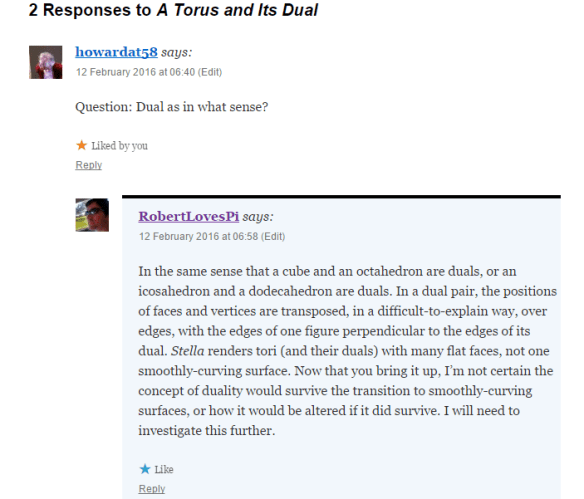
After I published the last post, which I did not originally intend to have two parts, this comment was left by one of my blog’s followers. My answer is also shown.

torus talk

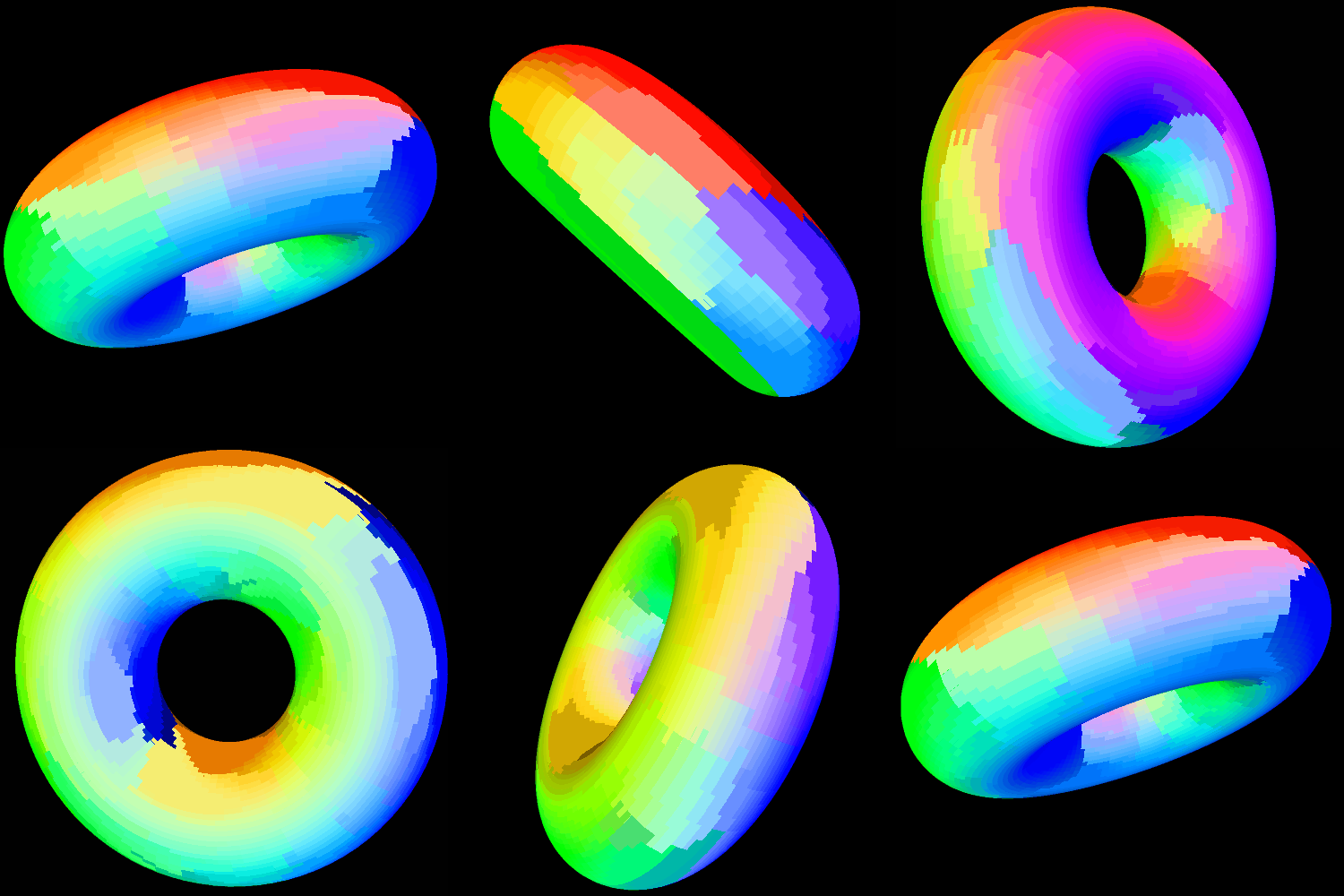
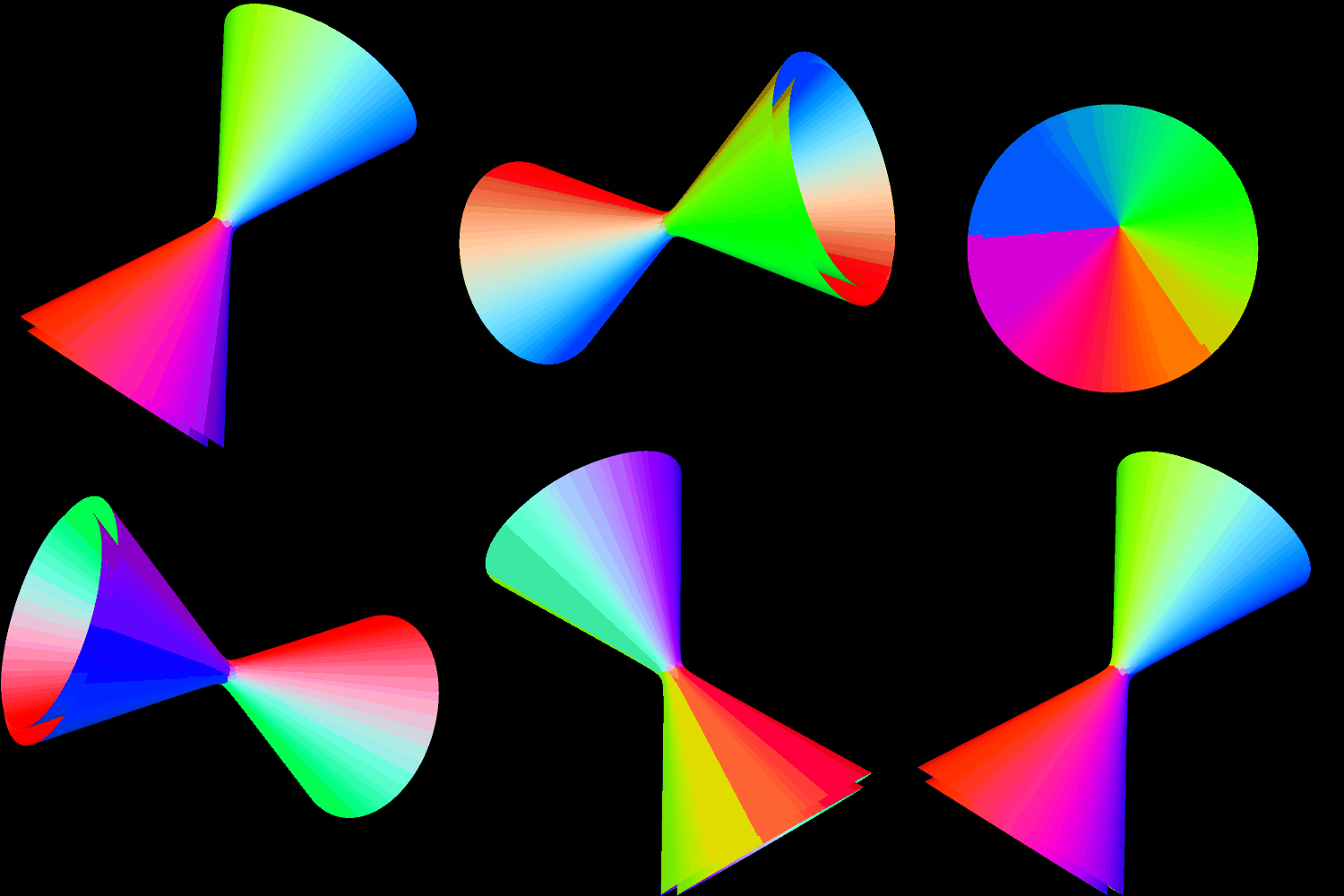
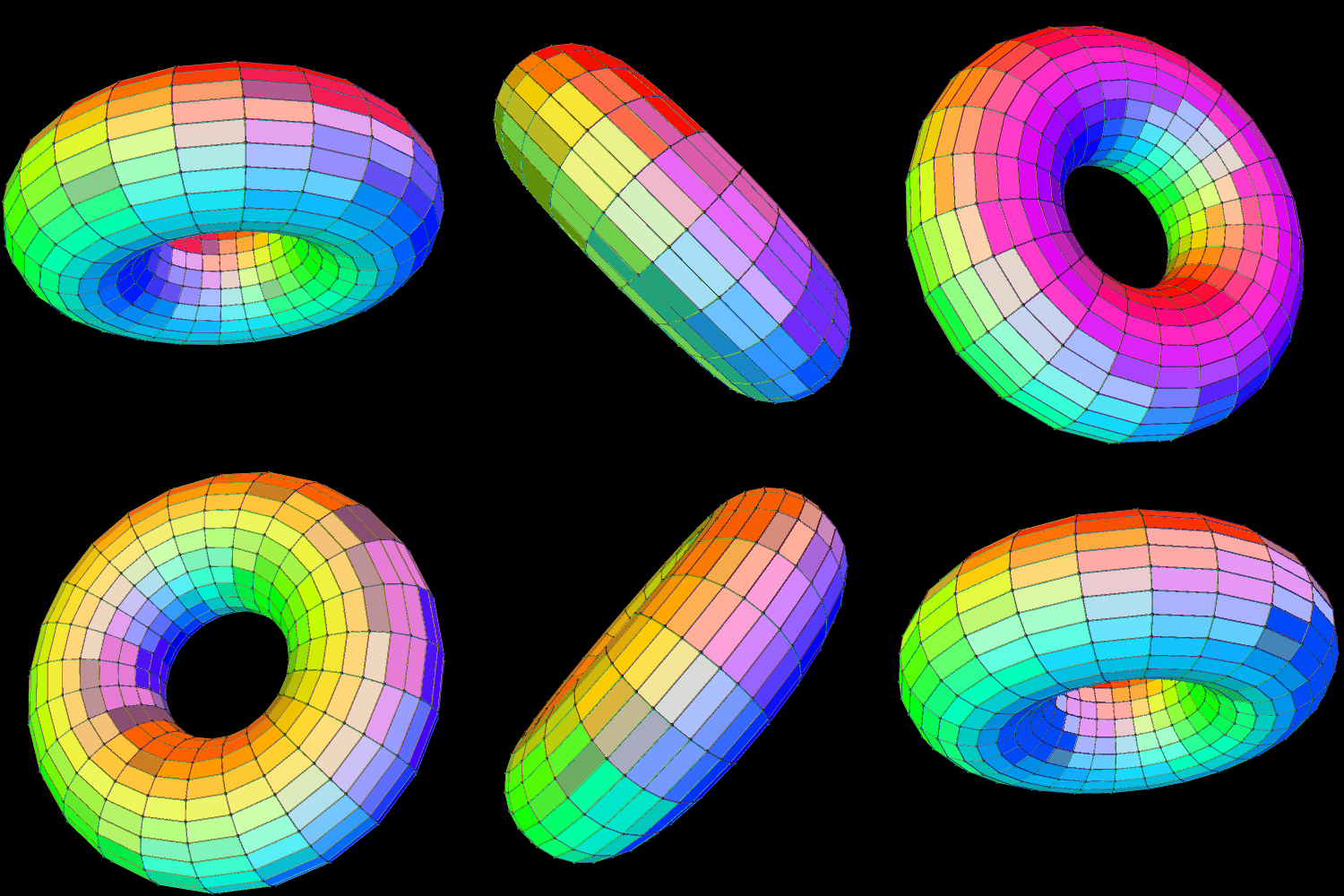
A torus can be viewed as a flexible rectangle rolled into a donut shape, and I had used 24 small rectangles by 24 small rectangles as the settings for Stella 4 for the torus, and its dual, in the last post — which, due to the nature of that program, are actually rendered as toroidal polyhedra. To investigate my new question, I increased 24×24 to 90×90, and these three images show the results. The first shows a 90×90 torus, the second shows its dual, and the third shows the compound of the two.

Torus90.gif


Torus90dual

Torus90dualcompound

When I compare these images to those in the previous post, it is clear that these figures are approaching a limit as n, in the expression “nxn rectangle,” increases. What’s more, I recognize the dual now, of the true torus, at the limit, as n approaches infinity — it’s a cone. It’s not a finite-volume cone, but the infinite-volume cone one obtains by rotating a line around an axis which intersects that line. This figure, not a finite-volume cone, is the cone used to define the conic sections: the circle, ellipse, parabola, and hyperbola.

What’s more, I smell calculus afoot here. I do not yet know enough calculus.

“Learn a lot more about calculus” is definitely on my agenda for the coming Summer, for several reasons, not the least of which is that I plainly need it to make more headway in my understanding of geometry. 

[Note: Stella 4d, the program used to make these images, may be found at http://www.software3d.com/Stella.php.]

A Torus and Its Dual, Part I

Torus

The torus is a familiar figure to many, so I chose a quick rotational period (5 seconds) for it. The dual of a torus — and I don’t know what else to call it — is not as familiar, so, for it, I extended the rotational period to 12 seconds.

Torus dual

By viewing the compound of the torus and its dual, one can see the the dual is the larger of the two, by far:

Torus dual with torus

I used Stella 4d to make these images. It’s a program you can buy, or try for free, at this website: http://www.software3d.com/Stella.php.

Beginning the Fractiles-7 Refrigerator Experiment

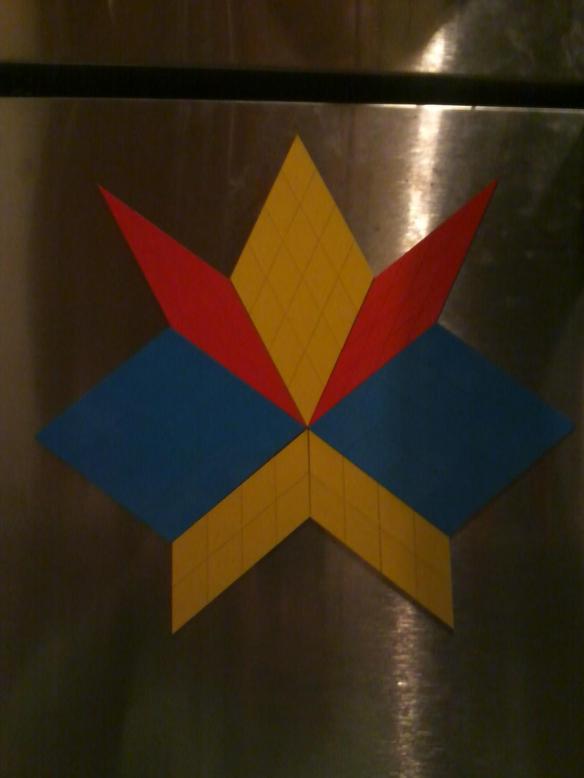
To begin this experiment, I first purchased two refrigerator-sized Fractiles-7 sets (available at http://fractiles.com/), and then, early on a Sunday, quietly arranged these rhombus-shaped magnets on the refrigerator in our apartment (population: 4, which includes two math teachers and two teenagers), using a very simple pattern.

160207_0000

Here’s a close-up of the center. There are 32 each, of three types of rhombus., in this double-set, for a total of 96 rhombic magnets, all with the same edge length.

160207_0001

The number of possible arrangements of these rhombi is far greater than the population of Earth.

The next step of the experiment is simple. I wait, and see what happens.

It should be noted that there is a limit on how long I can wait before my inner mathematical drives compel me to play with these magnets more, myself — but I do not yet know the extent of that limit.