The Zonish Cuboctahedron: A New Near-Miss Discovery?

Image

The Zonish Cuboctahedron:  A New Near-Miss Discovery?

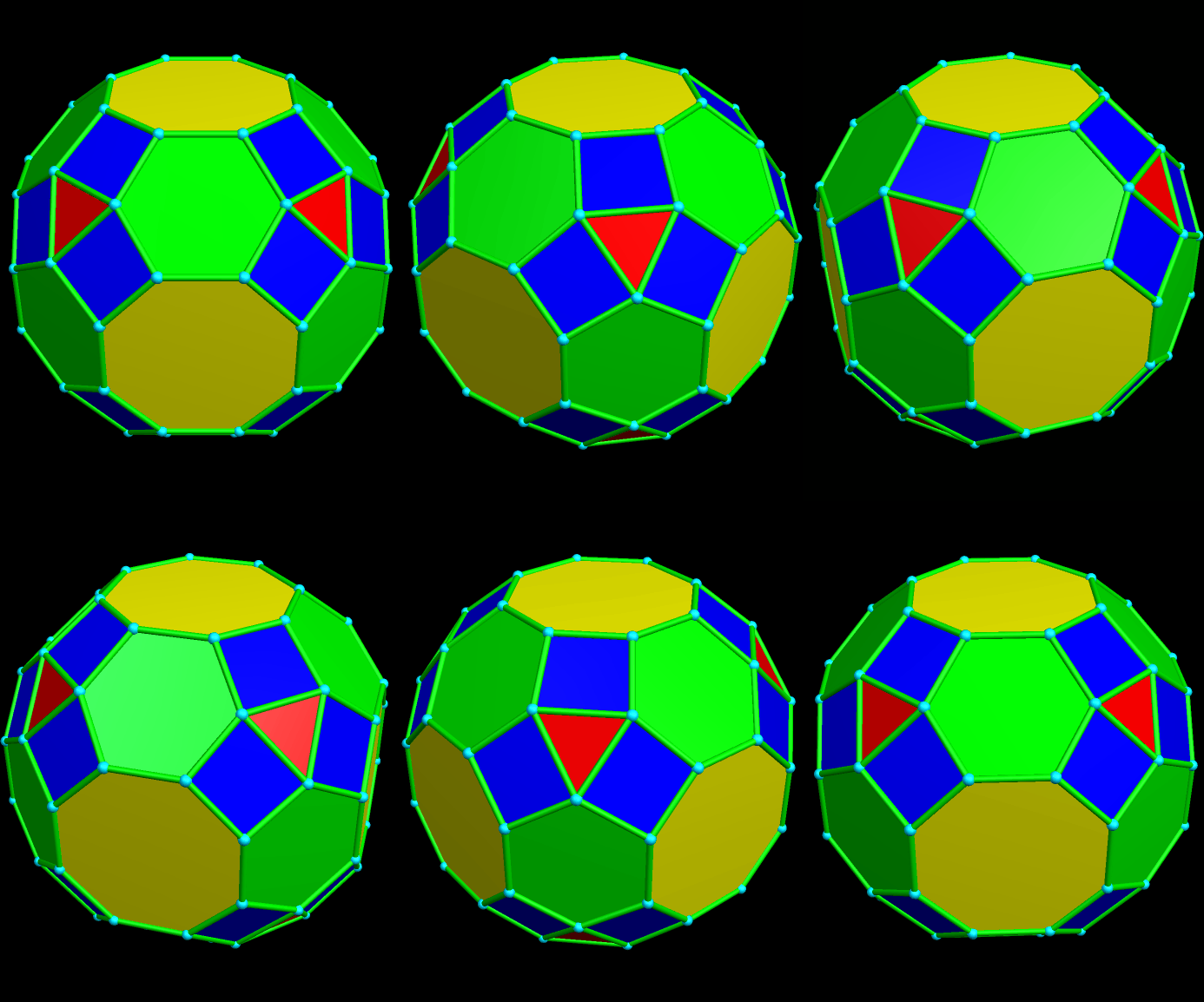
If one starts with a cuboctahedron, and then creates a zonish polyhedron from it, adding zones (based on the faces) to the faces which already exist, here is the result, below, produced by Stella 4d: Polyhedron Navigator (software you may buy or try at http://www.software3d.com/Stella.php):

new nearmiss before making faces regular its a face based zonish cuboctahedron

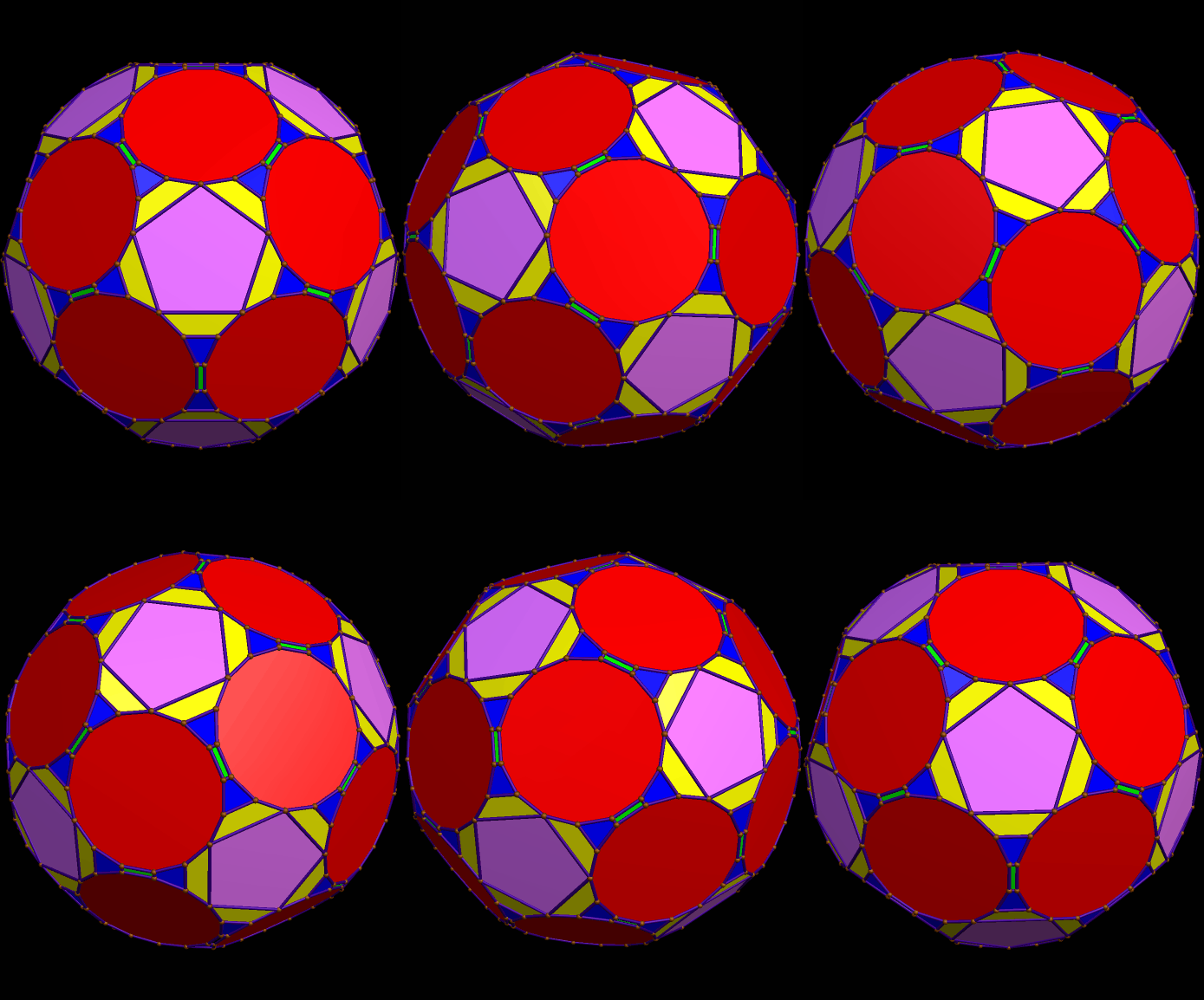
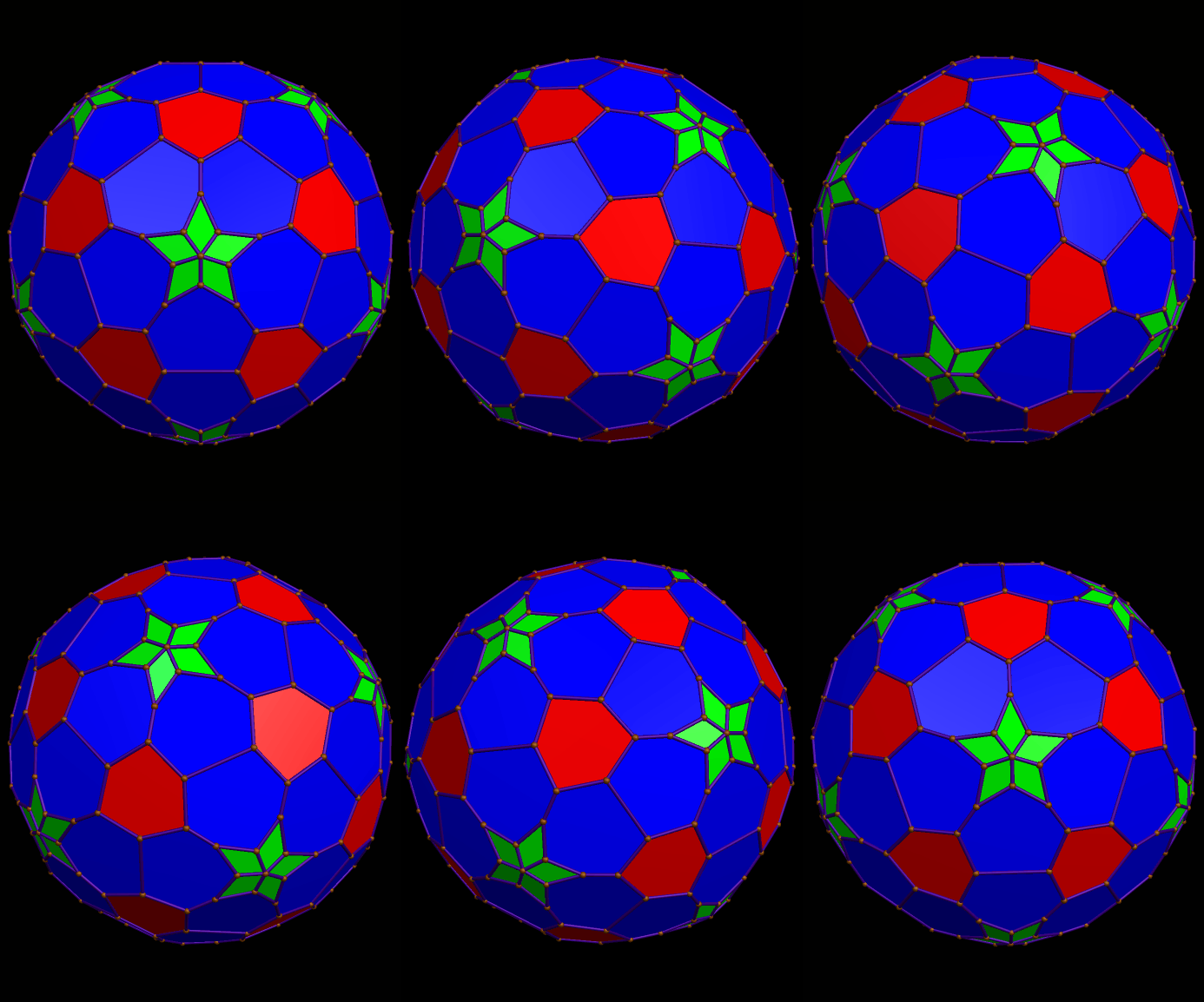
The hexagons here, in this second image, are visibly irregular. The four interior hexagon-angles next to the octagons each measure more than 125 degrees, and the other two interior angles of the hexagons each measure less than 110 degrees — too irregular for this to qualify as a near-miss to the Johnson solids. However, Stella includes a “try to make faces regular” function, and applying it to the second polyhedron shown here produces the polyhedron shown in a larger image, at the top of this post.

It is this larger image, at the top, which I am proposing as a new near-miss to the 92 Johnson solids. In it, the twelve hexagons are regular, as are the eight triangles and six octagons. The only irregular faces to be found in it are the near-squares, which are actually isosceles trapezoids with two angles (the ones next to the octagons) measuring ~94.5575 degrees, and two others (next to the triangles) measuring 85.4425 degrees. Three of the edges of these trapezoids have the same length, and this length matches the lengths of the edges of both the hexagons and octagons. The one side of each trapezoid which has a different length is the one it shares with a triangle. These triangle-edges are ~15.9% longer than all the other edges in this proposed near-miss.

My next step is to share this find with others, and ask for their help with these two questions:

    1. Has this polyhedron been found before?
    2. Is it close enough to being a Johnson solid to qualify as a near-miss?

Once I learn the answers to these questions, I will update this post to reflect whatever new information is found. If this does qualify as a near-miss, it will be my third such find. The other two are the tetrated dodecahedron (co-discovered, independently, by myself and Alex Doskey) and the zonish truncated icosahedron (a discovery with which I was assisted by Robert Webb, the creator of Stella 4d).

More information about these near-misses, one of my geometrical obsessions, may be found here:  https://en.wikipedia.org/wiki/Near-miss_Johnson_solid

The Dual of a Rhombcuboctahedral Cluster of Great Rhombcuboctahedra

Image

Two Duals of Clusters of Great Rhombcuboctahedra

This is the dual of the one polyhedral cluster found here which has more than one color-scheme shown: https://robertlovespi.wordpress.com/2014/05/29/the-great-rhombcuboctahedron-as-a-building-block/

It’s the dual of a rhombcuboctahedron made of great rhombcuboctahedra, and was created using software called Stella 4d:  Polyhedron Navigator. This software may be purchased at http://www.software3d.com/Stella.php — and there is a free trial version available to download there, as well.

My name made the “Stella 4d” library discovery credits!

Image

My name made the Stella library discovery credits!

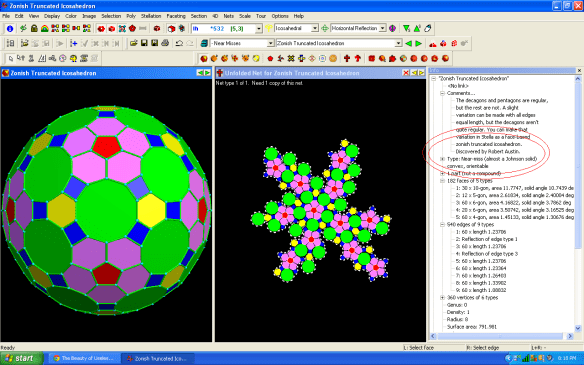
Stella’s creator just came out with a new version of Stella 4d, and a discovery of mine made the built-in library that comes with that software. This is my blog, so I get to brag about that, right? My legal name appears in the small print on the right side, at the end of the first long paragraph. I added the red ellipses to make it easier to find.

You can see the earlier posts related to my discovery of this zonish truncated icosahedron here:

https://robertlovespi.wordpress.com/2013/05/10/a-new-near-miss-to-the-92-johnson-solids/

https://robertlovespi.wordpress.com/2013/05/13/a-second-version-of-my-new-near-miss/

If you’d like to try (as a free trial) or buy this software (I recommend Stella 4d over the other available options), here’s the link for that: http://www.software3d.com/Stella.php.

By Request: The Compound of Five Rhombic Dodecahedra, with Nets

Image

By Request:  The Compound of Five Rhombic Dodecahedra, with Nets

I’ve been asked by a reader of this blog to post nets for this polyhedral compound. Printing nets with Stella 4d is easy, and I’m happy to post them here, in response to that request. Warning, though: there are many nets needed for this compound.

Each of these smaller images may be enlarged with a single click.

Cuboctahedra 5 net one

Here’s the first net type needed (above). You’ll need thirty copies of this net. The gray parts show, and the white parts are tabs to help put it together. Below is the second type needed, of which you need sixty copies.

Cuboctahedra 5 net two

There’s also a third type of net, and these last two types may need to be rescaled before you print them, to fit the net of the first type, also. You’ll need sixty copies of this third net (below) as well, It’s the mirror-image of the net of the second type.

Cuboctahedra 5

Finally, here’s a non-rotating image of the completed polyhedron, to help with the construction:

Cuboctahedra 5

I recommend using card stock or posterboard, and trying to get as much tape as possible on the inside of the model, making an uncolored version — and then painting it with five different colors of your choice, after the model is assembled. Happy building!

[Software credit:  I used Stella 4d:  Polyhedron Navigator to create all these images. It’s available at http://www.software3d.com/Stella.php. Downloading and trying a trial version is free, but you have to buy the fully-functioning version to print nets, or to make these rotating .gif files I post all over this blog.]

The Great Rhombcuboctahedron As a Building-Block

Image

The Great Rhombcuboctahedron As a Building-Block

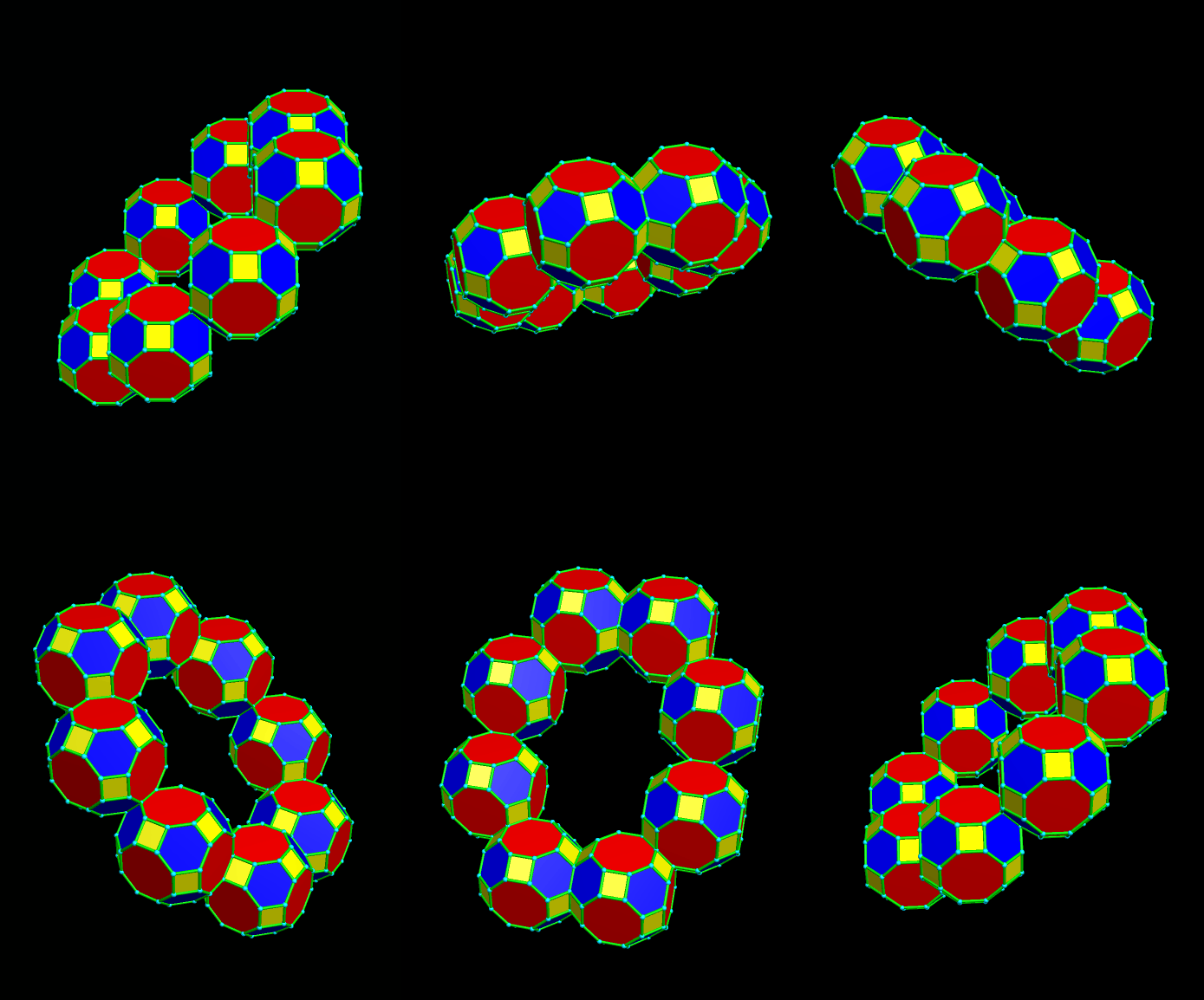
This solid, also known as the great rhombicuboctahedron, and the truncated icosidodecahedron, can be used to build many other things. In addition to the elongated ring of eight above, for example, there’s this octagonal prism.

Augmented Trunc Cubocta2

Augmented Trunc Cubocta 2

Remember the elongated ring at the top of this post? This pic, directly above, is of a ring of four of those rings.

Augmented Trunc Cubocta3

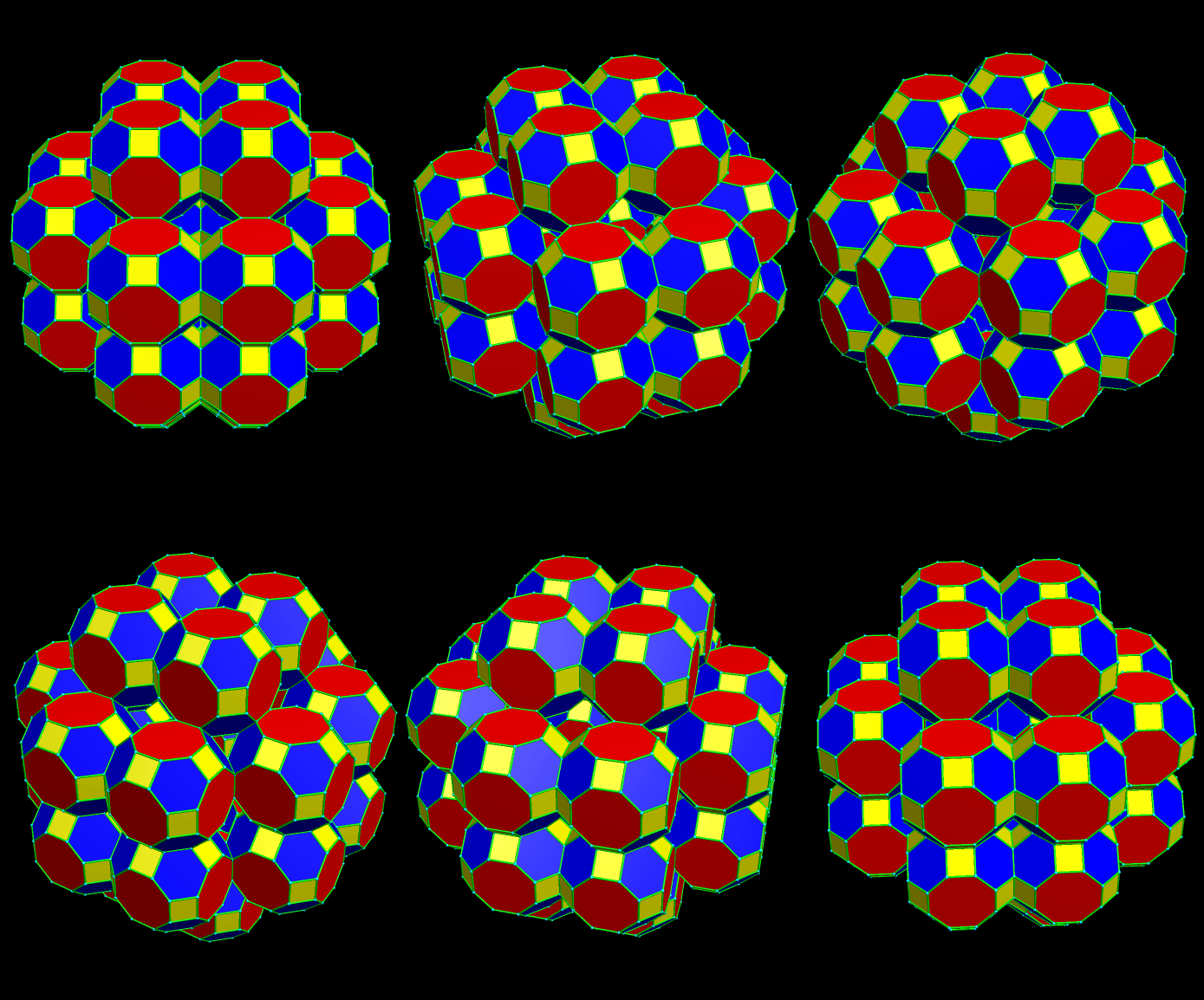
And, yes, that’s a (non-great) rhombcuboctahedron made of great rhombcuboctahedra. Here it is again, with a different color-scheme.

Augmented Trunc Cubocta4

For the last of these constructions, eight more great rhombcuboctahedra are added to the figure in the two posts above, which is also returned to its original color-configuration. These eight new polyhedra have positions which correspond to the corners of a cube.

augmented rhombcuboctahedron made of great rhombcuboctahedra

Manipulating polyhedra in this manner is easy with Stella 4d, the program I used to do all of this. You may buy it, and/or try a free trial version first, at www.software3d.com/Stella.php.

The Royal Octahedron, with Half-a-Dozen Crowns

Image

The Royal Octahedron, with Half-a-Dozen Crowns

Software credit: see http://www.software3d.com/Stella.php to check out Stella 4d, the program I used to make this. A free trial download is available.

Seventeen Truncated Tetrahedra Rotating in Symmetrical Formation

Image

Seventeen Truncated Tetrahedra in Symmetrical Formation

Software credit: you can try the free trial download of Stella 4d at http://www.software3d.com/Stella.php.

Three Polyhedra Which Feature Regular Pentadecagons

Image

Some Polyhedra Which Feature Regular Pentadecagons

I haven’t encountered many polyhedra which feature regular pentadecagons, and geometry textbooks generally don’t even use that word, calling them “15-gons,” instead. The pentadecagon happens to be one of my favorite polygons, though, and has been ever since I independently figured out, a few years back, how to duplicate the ancient Greeks’ accomplishment of combining the Euclidean constructions for the regular pentagon and equilateral triangle, in order to construct a regular pentadecagon.

15Unnamed

The one above also includes regular decagons as faces — but I had to let the pentadecagons intersect each other to get that to work.

Co15nvex hull

This third polyhedron resembles a truncated icosahedron, but with pentadecagons replacing that solid’s twenty hexagons. The pentagons are still in place, with two types of trapezoid and some very thin rectangles needed to fill the gaps.

These images were all created using Stella 4d, software you may try or buy at http://www.software3d.com/Stella.php.

Two Polyhedra Which Feature Heptagons

Image

Some Polyhedra Which Feature Heptagons

It’s unusual to encounter heptagons in any survey of polyhedra . . . so I made a couple. I didn’t see any reason to limit myself to regular heptagons, though.

sixty heptagons 20 hexagons sixty kites 140 faces total

I made these using Stella 4d, which is available at http://www.software3d.com/Stella.php.

Octahedral Lattice of Truncated Octahedra, Meeting At Their Square Faces

Image

Octahedral Lattice of Truncated Octahedra, Meeting At Their Square Faces

The second image here resulted from stellating the first one many times. It can be enlarged with a click.

sTELL Augmented Trunc Octa

The software used to create these rotating images, Stella 4d, may be tried for free at http://www.software3d.com/Stella.php.