The Vacuum Cleaner Enigma

Image

The Vacuum Cleaner Enigma

A vacuum is, by definition, a region of space devoid of matter. While a perfect vacuum is a physical impossibility, very good approximations exist. Interplanetary space is good, especially far from the sun. Interstellar space is better, and intergalactic space is even better than that.

Along come humans, then, and they invent these things:

vacuum-cleaner-upright

. . . and call them “vacuum cleaners.”

Now, this makes absolutely no sense. There isn’t anything cleaner than a vacuum — and the closer to an ideal vacuum a real vacuum comes, the cleaner it gets. Since vacuums are the cleanest regions of space around already, why would anyone pay good money for a machine that supposedly cleans them? They’re already clean!

Even cleaning in general is a puzzle, without vacuums being involved at all. To attempt to clean something — anything — is, by definition, an attempt to fight the Second Law of Thermodynamics. Isn’t it obvious that any such effort is, in the long run, doomed from the outset?

—–

[Image note:  I didn’t create the images for this post, but found them using Google. I assume they are in the public domain.]
The Obelisk from “2001: A Space Odyssey”

Image

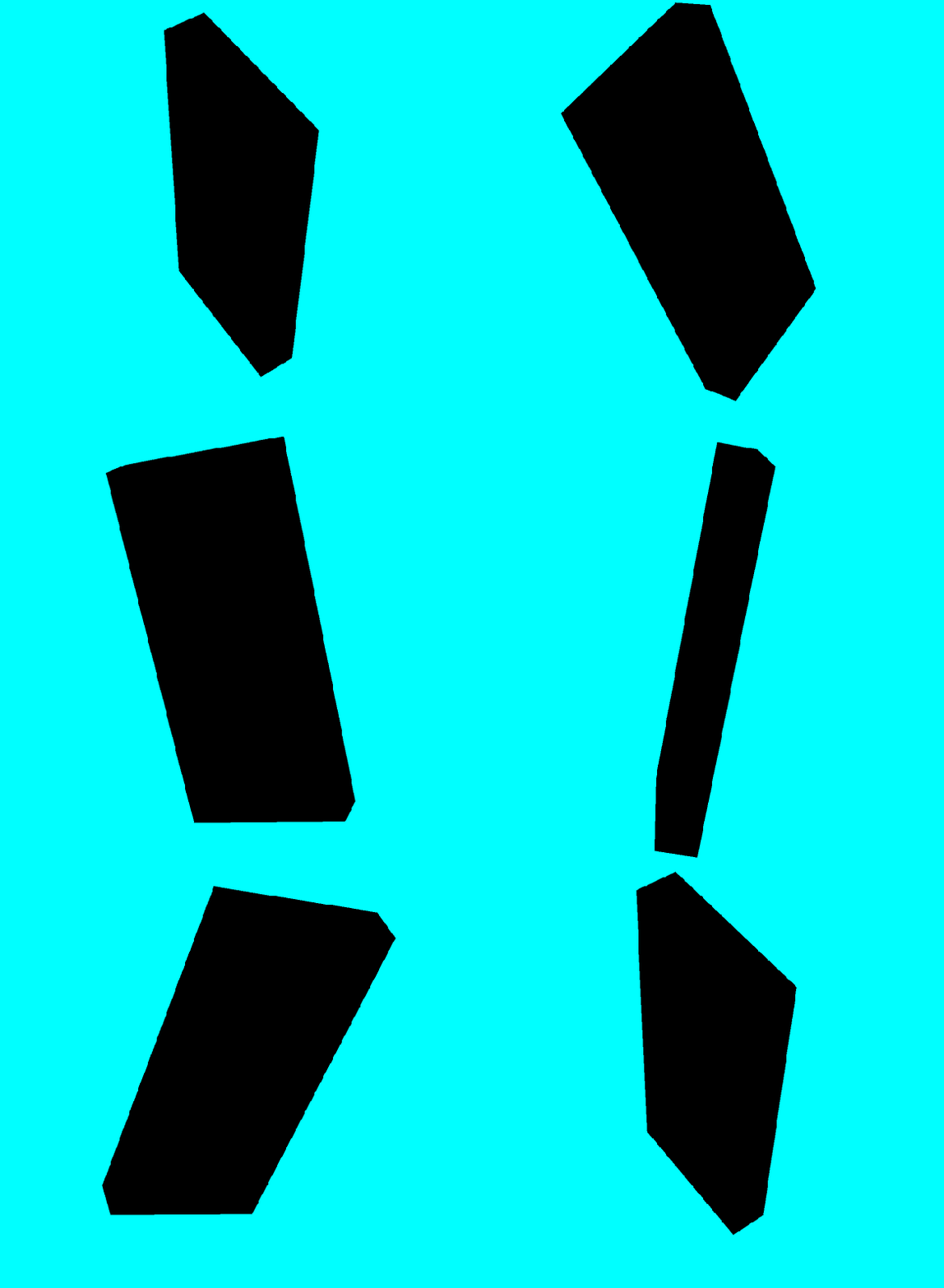
Software credit: just visit http://www.software3d.com/Stella.php to try or buy the software, Stella 4d, which I used to make this 1 x 4 x 9 virtual recreation of the mysterious obelisk from one of my favorite films/novels, 2001: A Space Odyssey.

M33, the Triangulum Galaxy, Adorning the Faces of a Pentagonal Icositetrahedron

Image

M33, the Triangulum Galaxy, Adorning the Faces of a Pentagonal Icositetrahedron

Evidence suggests that M33 is a satellite galaxy of the even better-known Andromeda Galaxy (M31), which happens to be on a collision course with our own Milky Way. In 1.5 billion years or so, Andromeda and the Milky Way will merge to form a giant elliptical galaxy already pre-named Milkomeda. At that point, the Triangulum Galaxy may become a satellite of Milkomeda (probably one of several), or be gravitationally ejected, or simply be absorbed into Milkomeda itself.

Here, it is projected on each face of the Catalan solid which is dual to the snub cube, using software you can try at http://www.software3d.com/Stella.php.

Oceans, Further from the Sun

Image

Oceans, Further from the Sun

Since earth’s oceans will be boiled away by the sun’s increasing luminosity, as I mentioned in my last post, we’ll eventually need to find other oceans elsewhere — or learn to do without water, which seems even less likely.

The news today is running a story about a subsurface ocean under Enceladus, a moon of Saturn. Here, in an obviously-photoshopped picture from one of those news stories, it’s shown in an impossible location, next to the U.K., for the purposes of size comparison. In addition to this moon, subsurface water is expected to exist on Titan, another moon of Saturn, as well as three of the four Galilean moons of Jupiter: Europa, Callisto, and Ganymede.

The Jovian system doesn’t get closer than 4.2 AUs from earth, and Saturn’s moons are further out still — but at least our descendants do have other places to go, once our oceans become too hot to stay liquid. They’re expected to be boiled away, by the sun’s increasing luminosity, in ~1.5 billion years.

A Close-Packing of Space, Using Three Different Polyhedra

Image

A Close-Packing of Space, Using Three Different Polyhedra

This is like a tessellation, but in three dimensions, rather than two. The pattern can be repeated to fill all of space, using cubes (yellow), truncated octahedra (blue), and great rhombcuboctahedra, also known as truncated cuboctahedra (red).

Software credit: see www.software3d.com/stella.php to try or buy Stella 4d, the software I used to create this image.

Mostly Empty Space

Image

Mostly Empty Space

Ask any chemist or physicist, and they’ll verify that ordinary matter is mostly empty space. (The physicist may then go on to confuse you by explaining how that “empty” space isn’t really empty,  if inspected closely enough, but that’s not my subject here.)

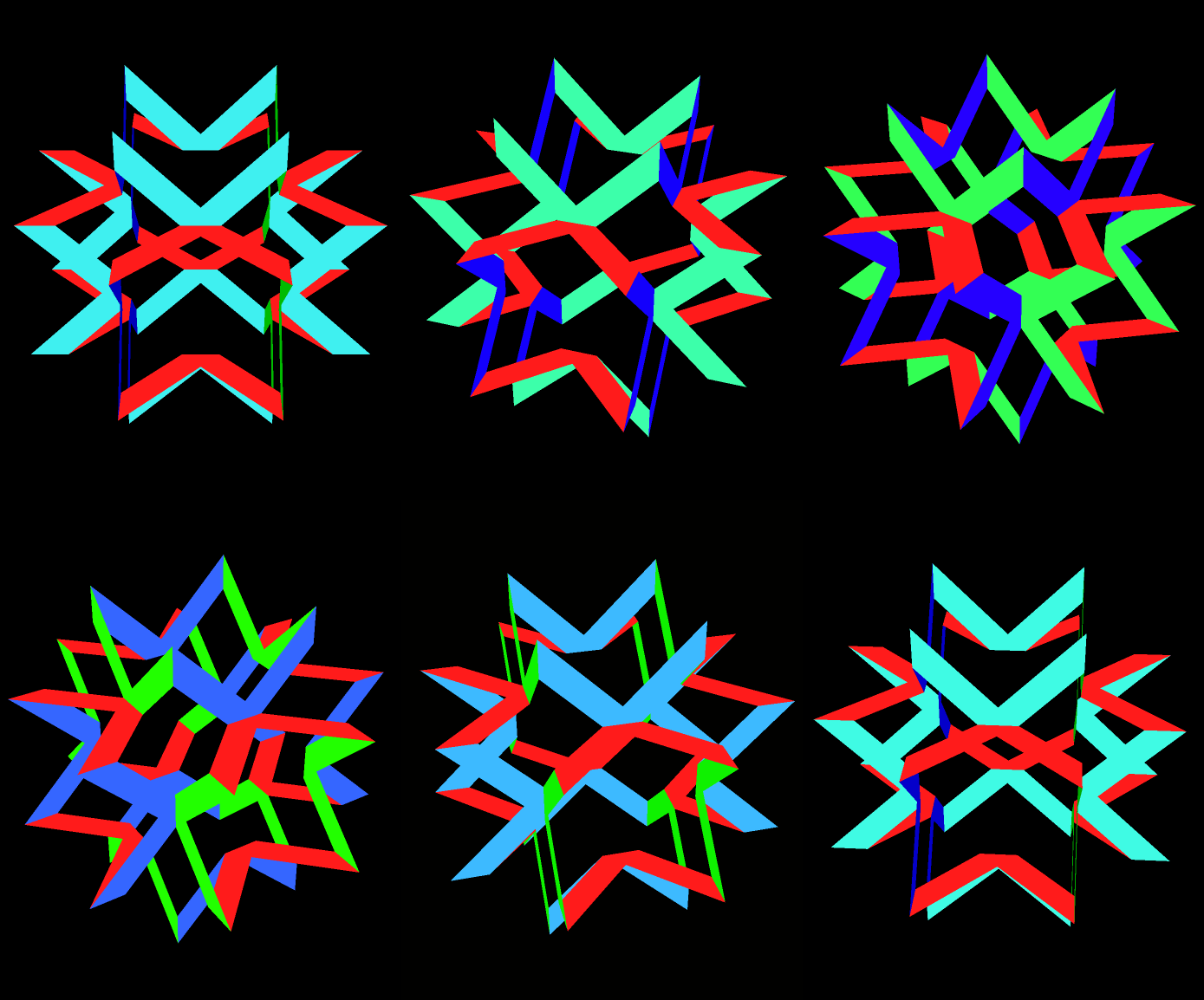
This image, geometrically created, is also mostly empty space. To make it, I started with the polyhedron seen in the last post — itself created by stellation of the post before it — and continued stellating, many more times. By doing so, I stumbled across a polyhedron with these “X” shapes included, plus some other stuff. To finish making this, I simply rendered everything except the “X” shapes invisible, then changed the coloring scheme of the result.

Stella 4d was used to create this image, and you may try it for free at http://www.software3d.com/stella.php.

Russian Impact Crater Found in Frozen Lake By Fishermen

Image

Russian Impact Crater Found in Frozen Lake By Fishermen

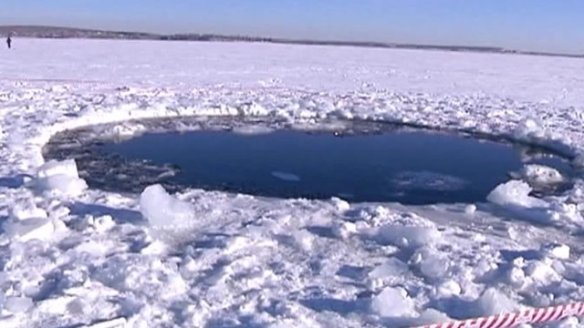
Can you imagine what it would be like to encounter such a thing as this crater?

Can you imagine what it is like to have every window in your whole region suddenly turned into a shower of broken glass, with the temperature at -15 degrees Celsius, as many thousands did?

Thus far, no deaths are known to have happened from this February 15 airburst, nor the 1908 Tunguska Event, the largest in recorded history. In that sense, the Russians lucked out. Twice.

[image source: screenshot posted to Wikipedia]