Star and Protostar

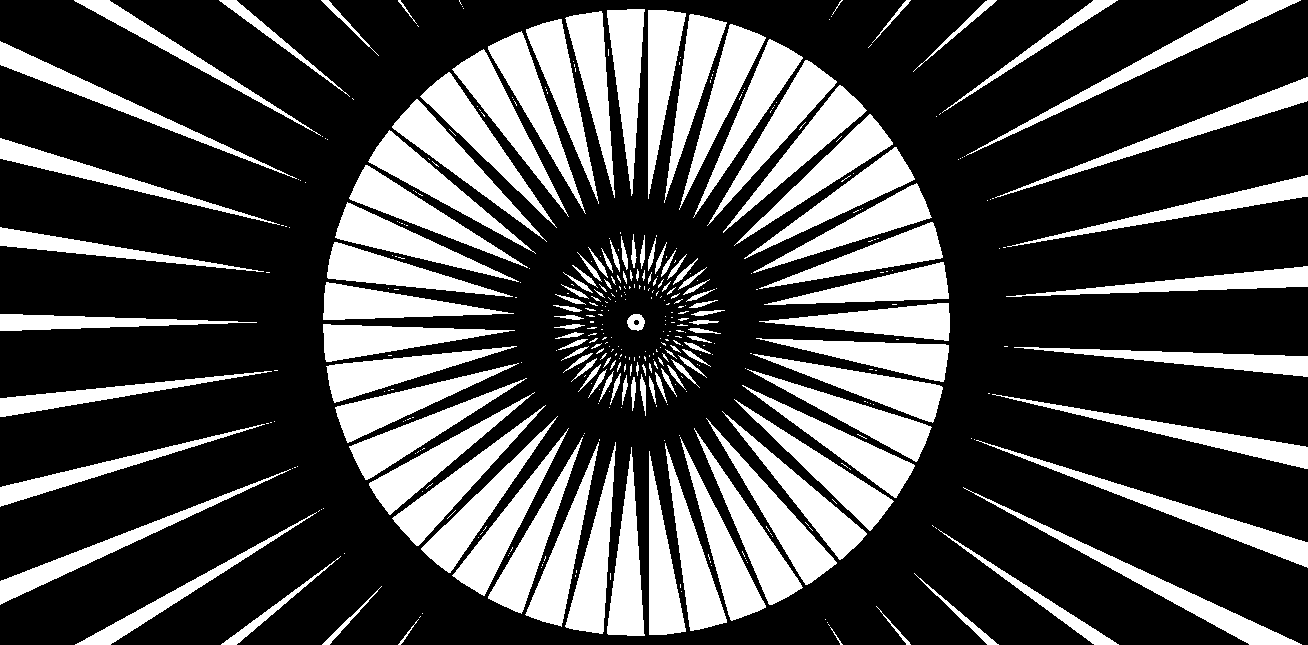
First, Protostar:

2012 protostar ic

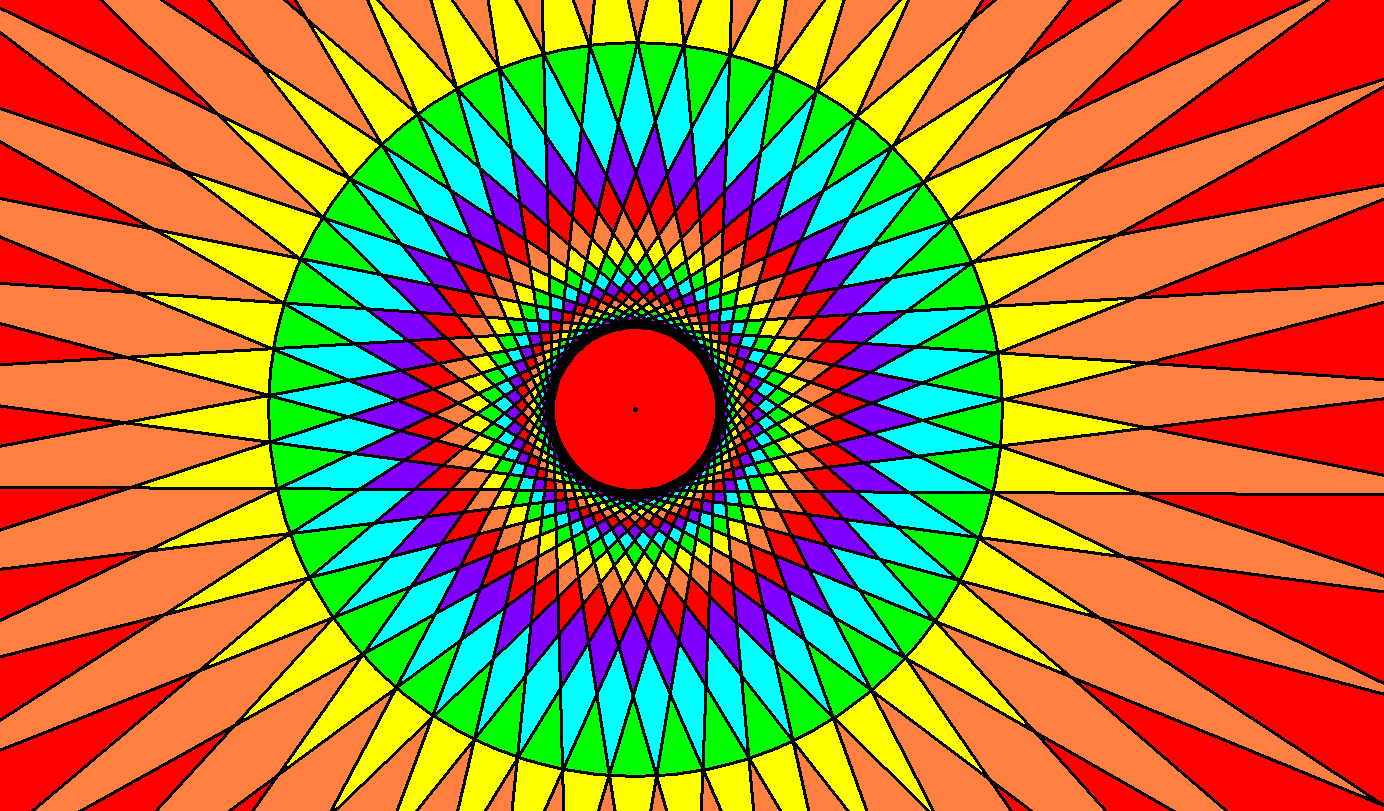
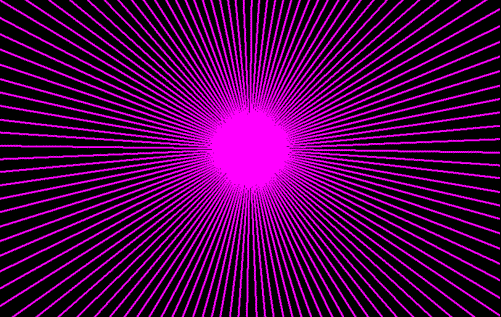
In nature, protostars collapse under their own gravity until enough heat is generated to ignite nuclear fusion, at which point they become stars. The image above is my interpretation of a protostar, just before the moment it becomes a star. As for Star, my post-ignition interpretation, here it is:

2012 star ic

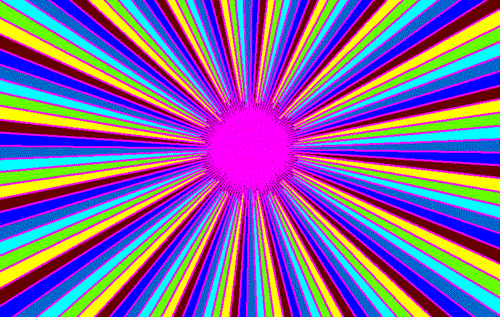
While I did just make these images, they are simply inverted-color versions of images I made back in 2012, using Geometer’s Sketchpad. Here are the original-color versions (which I don’t like as much, myself), presented in a smaller size. You may enlarge either or both with clicks, if you wish.

2012 protostar2012 star

The Seventh Star

Seventh Star

Star 27

sun background

Do not attempt to construct this with compass and straight edge . . . unless you just have extra time you want to waste. If constructing this were possible, then also possible would be the construction of a regular enneagon, and that has been proven impossible. To make this, I had to “cheat” by using rotations of 40°, using Geometer’s Sketchpad, which will let you play the construction-game by Euclid’s rules, or not, as you choose.

At 47, My Age Is a Prime Number Again =D

For some reason, I like having my age be a prime number of years. Today, I turn 47, so I get to have a prime-number-age for a whole year now. This hasn’t happened since I was 43, so I made this 47-pointed star to celebrate:

47

I also make birthday-stars for composite-number ages as well, just because it’s fun, and you can find at least two others on this blog, on January 12, in past years. Also, I wouldn’t want to have to wait until I’m 53 (my next prime age) to make another one of these.

At the moment, I certainly don’t feel 47. There are times when I feel twenty-two . . .

There are also times when I feel six.

calvin-on-learning

At the moment, however, I feel about thirty. For that reason, I put the 47-pointed stars on the thirty faces of a rotating rhombic triacontahedron, because (a) it’s my birthday, (b) I want to, and (c) I can.

Rhombic Triaconta

Image/music credits:

  1. I created this using Geometer’s Sketchpad and MS-Paint.
  2. “When Yer Twenty-Two,” by The Flaming Lips, via a YouTube posting.
  3. Two panels from a Calvin and Hobbes cartoon, by Bill Watterson. (Calvin is perpetually six years old.)
  4. Created using the image at the top of this post, and the program Stella 4d: Polyhedron Navigator, which is available here.

A Star with 49 Points, to Celebrate the 49-Hour Weekend Caused by the End of Daylight Saving Time, Tomorrow, in Most of the USA

49

This is the weekend that Daylight Saving Time (or DST) ends in most parts of the USA, which means that this is the only weekend of the year, here, which lasts 49 hours, rather than the usual 48.

To celebrate this once-a-year event, I created the design above, based on the number 49. I started by making one heptagram, inscribed in a circle. The heptagram I used is one of two which exist, and is also called the {7/3} star heptagon. It looks like this:

7star

After making one of these, I then rotated it 1/49th of a full rotation, repeatedly, until I had seven of them inscribed in the circle. Seven times seven, of course, is 49, so this created one type (many are possible) of 49-pointed star. Also, I had already extended the line segments to form lines, so that this geometrical design would extend outside the circle. Next came thickening and blackening these lines, as well as the circle, and re-coloring the red points to be black, as well.

All of this work was performed using Geometer’s Sketchpad. I then took a screenshot, moved the design to MS-Paint, and used that program to add the colors seen in the image at the top of this post.

I don’t like Daylight Saving Time, and never have, but I do enjoy the end of it, when it arrives once each year, and we get our “missing” hour returned to us — the one which was stolen from one of our weekends in the Spring.

To those who live in areas which do not observe DST, such as most of Arizona, you are fortunate — at least in this one respect. Heart attacks actually increase when DST starts each year — a fact which can be easily verified with Google. There are other problems with DST, as well. Daylight Saving Time (one of the worst ideas Benjamin Franklin ever had) should be abolished. Everywhere.

A Graph Showing Approximate Mass-Boundaries Between Planets, Brown Dwarfs, and Red Dwarf Stars

planet and brown dwarfs and red dwarf stars


I found the data for this graph from a variety of Internet sources, and it is based on a mixture of observational data, as well as theoretical work, produced by astronomers and astrophysicists. The mass-cutoff boundaries I used are approximate, and likely to be somewhat “fuzzy” as well, for other factors, such as chemical composition, age, and temperature (not mass alone), also play a role in the determination of category for individual objects in space.

Also, the mass range for red dwarf stars goes much higher than the top of this graph, as implied by the thick black arrows at the top of the chart. The most massive red dwarfs have approximately 50% of the mass of the Sun, or about 520 Jovian masses.

Proposed Mechanisms for New and Different Types of Novae

Theoretical New Type of Nova

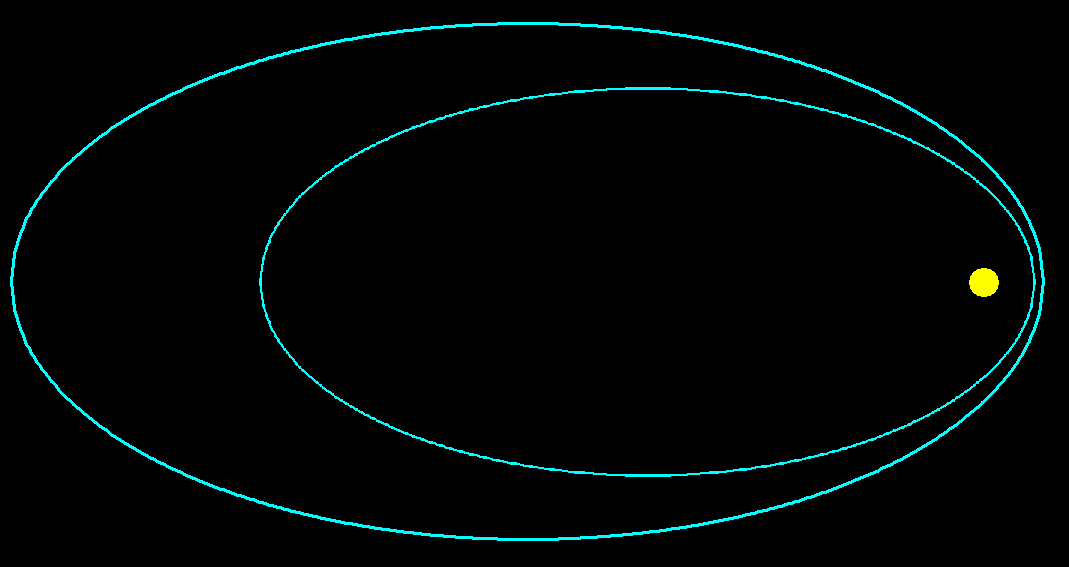
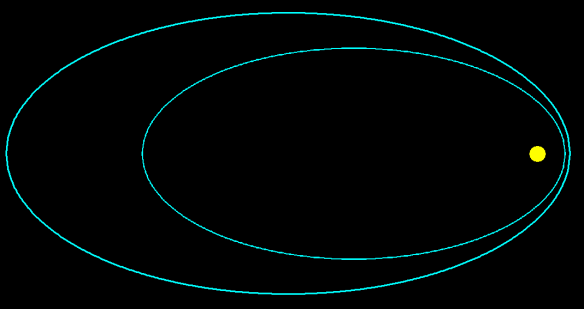
The picture above shows a proposed model for the production of a sudden increase in the brightness of a star — or rather, what is apparently a single star, optically, but would actually be a suddenly-produced binary stellar system.

The yellow object is a star, the system’s primary, and it has high mass (at least a few solar masses), when its mass is compared to those of the brown dwarfs in the two highly elliptical orbits shown in blue. These brown dwarfs aren’t quite stars, lacking enough mass to fuse hydrogen-1, which requires 75 to 80 Jupiter masses, but one of them (the larger one) is close to that limit. The smaller brown dwarf has perhaps half the mass of the larger brown dwarf. Their high orbital eccentricities give them very long orbital periods, on the order or 100,000 years. In a very small fraction of orbits, both brown dwarfs will be near perihelion (closest point to the primary) at the same time, and, during those rare periods, the two brown dwarfs become much closer to each other than they are to the primary.

When the two brown dwarfs become close enough to each other, matter from the smaller one could be drawn, by gravity, into the larger brown dwarf, increasing its mass, at the expense of its smaller sibling. At some point, in such a system, the larger brown dwarf’s mass could then reach the threshold to begin fusing hydrogen-1, and “turn on” as a true star — a red dwarf. From Earth, this red dwarf would not be distinguishable from the system’s most massive star, shown in yellow, until much later, when the two moved further apart. There would, however, be a sudden increase in luminosity from the system as a whole. Unlike other types of novae, this increase in luminosity would not fade away quickly, for red dwarfs have very long lifespans. This would enable them, upon discovery, to be distinguished from other single-brightening stellar events. Confirmation could then come from resolution of the new red dwarf component, as it recedes from the primary, making detection easier.

For a variation on this mechanism, the primary star could be somewhat more massive, and the two large brown dwarfs could be replaced by two large red dwarf stars. The larger red dwarf could draw matter from the smaller one, until the larger red dwarf became large enough to cross a higher mass threshold, and brighten substantially, with its color suddenly changing to orange or yellow.

A problem for this model:  no such events are known to have happened. If they do happen, a likely explanation for their rarity is the likelihood that such orbits would be unstable, in a large fraction of similar cases, preventing the stellar-brightening event from having time to happen — in all but a few cases, none of which humans have (yet) both seen, and understood. If one of these things goes off nearby, though, we will learn about it quickly, for it will make itself known.

For another possible mechanism, there is another option:  remove the primary altogether, and let the two objects of near-threshold mass orbit their common center of mass directly. They could then create a new star, or brighter star, by the mechanism described, one which might even produce a detectable accretion disk. A actual merger of the two brown dwarfs, or red dwarf stars, would be a variation of this idea, and would presumably be more likely if the two objects had masses very close to each other, so that neither would have an advantage in the gravitational tug-of-war.
Two Rotating Polyhedral Stellations

3rd stellation of Triamond Pentagonal Bifrustum

These are the third (above) and fifth (below) stellations of the triamond pentagonal bifrustrum, which I previously posted here: https://robertlovespi.wordpress.com/2014/07/30/my-lost-discovery-from-2006-the-triamond-pentagonal-bifrustrum/. These rotating images are made with Stella 4d, a program available at www.software3d.com/Stella.php.

5th stellation of Triamond Pentagonal Bifrustum

Spiraling Stars

spiraling stars

Tessellation Featuring Kites and Six-Pointed Stars #2

Image

Tessellation Featuring Kites and Six-Pointed Stars #2