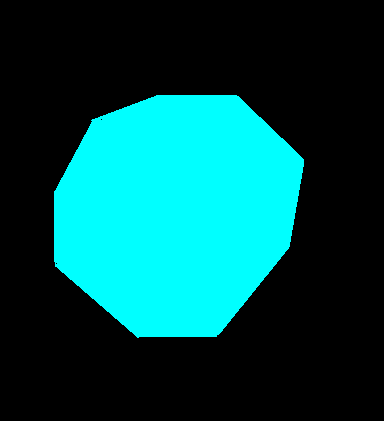
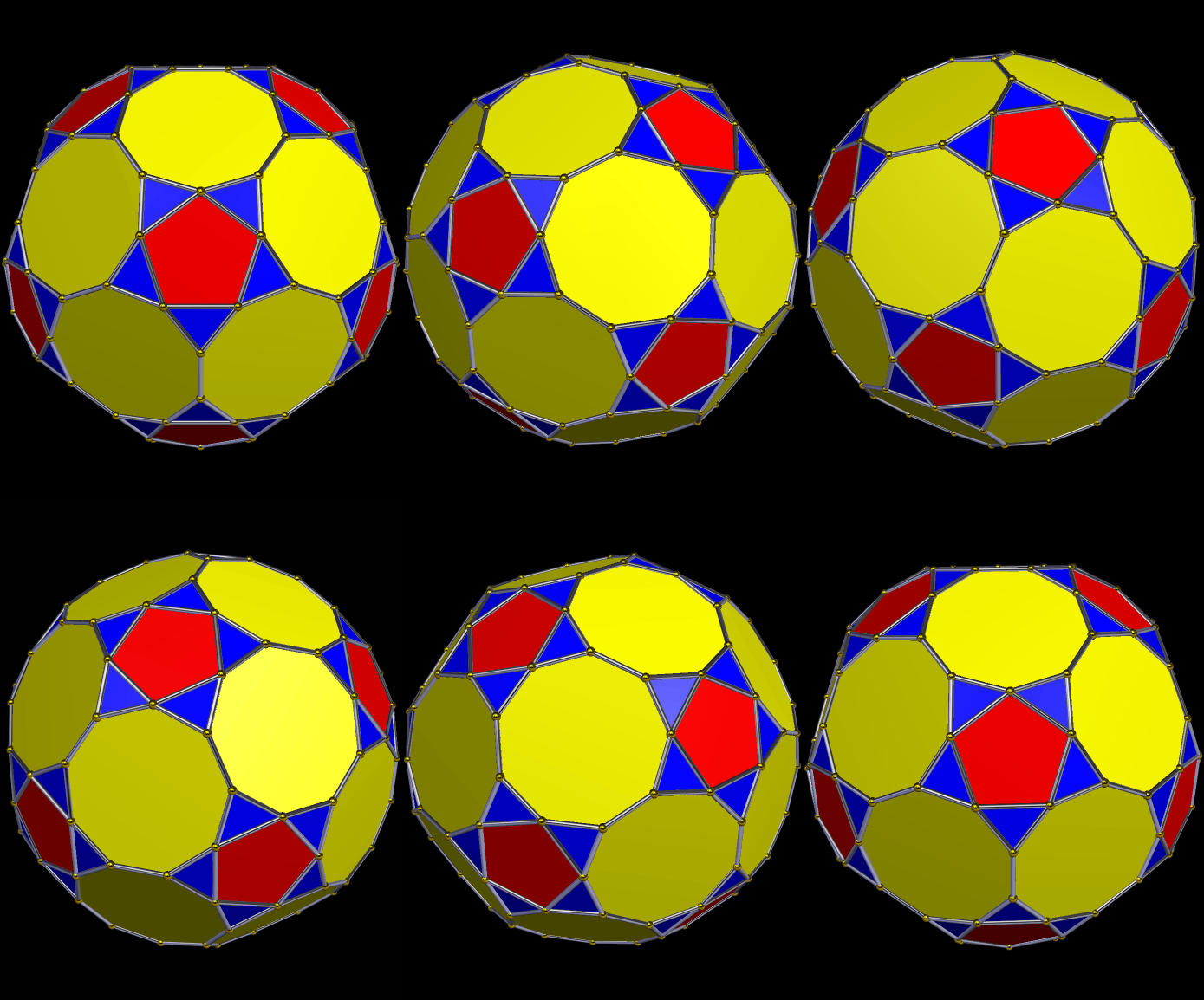
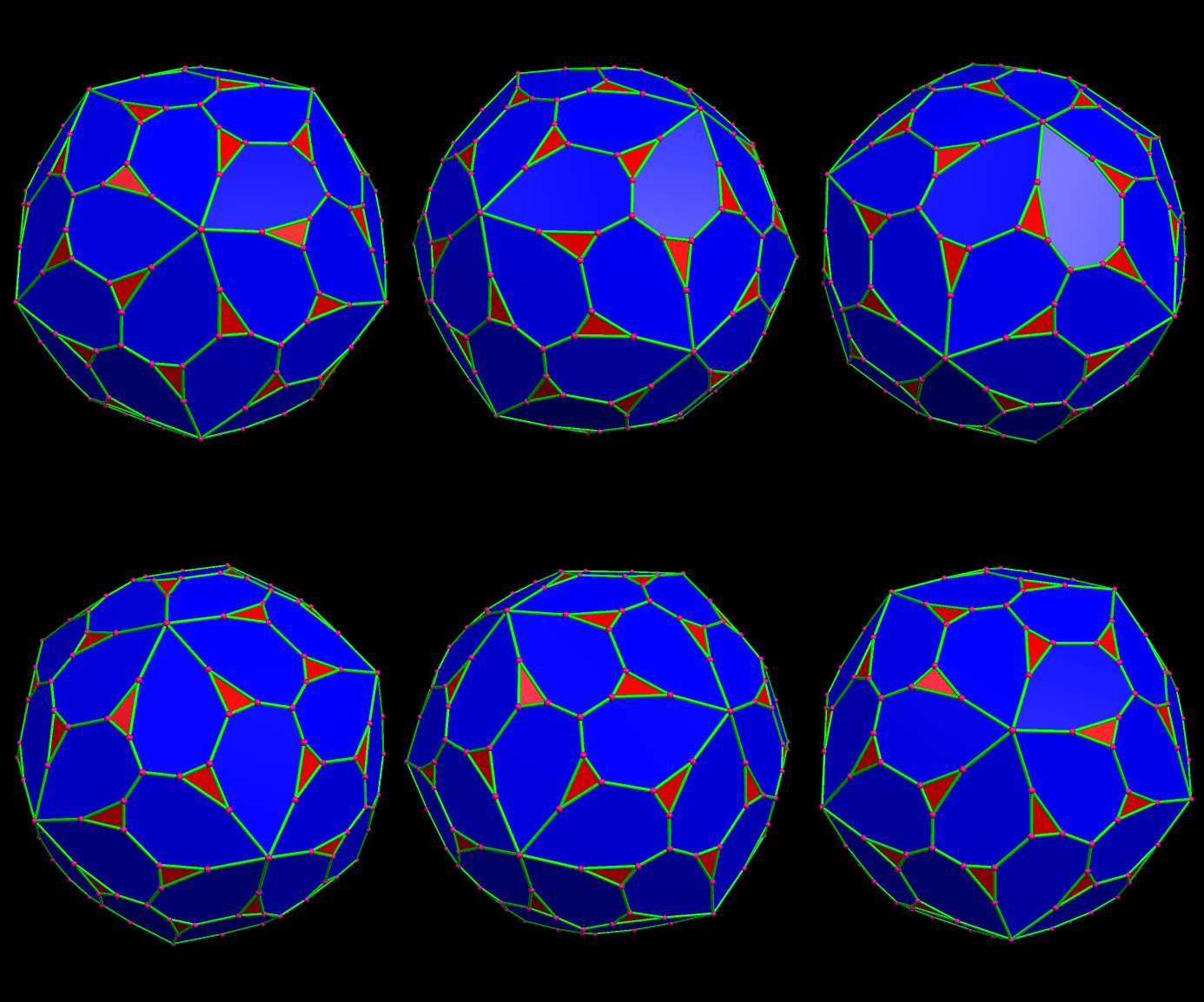
A Polyhedron Featuring Sixty Octagons and Sixty Triangles

Image

A Polyhedron Featuring Sixty Octagons and Sixty Triangles

If someone had asked me if it were possible to form a symmetric polyhedra out of irregular triangles and octagons, using exactly sixty of one type each, I would have guessed that it were not possible. Why does it work here? Part of the reason is that each triangle borders three octagons, and each octagon borders three triangles — a necessary, but not sufficient, condition. This is a partial truncation of an isomorph of the pentagonal hexacontahedron, the dual of the snub dodecahedron. As such, no surprise — it’s chiral.

This was made while stumbling about in the wilderness of the infinite number of possible polyhedra using Stella 4d: Polyhedron Navigator. You can get it here: http://www.software3d.com/Stella.php.

A Chiral Tessellation

A Chiral Tessellation

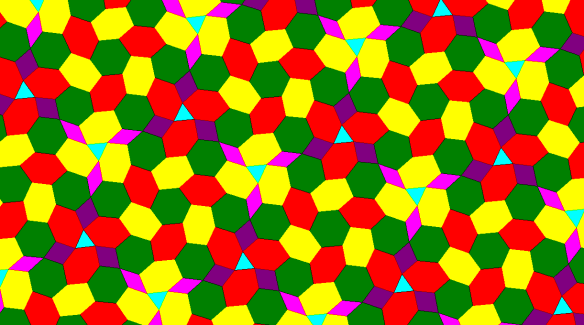
In this chiral tessellation, the blue triangles and green hexagons are regular. The yellow hexagons are “Golden Hexagons,” which are what you get if you reflect a regular pentagon over one of its own diagonals, then unify the two reflections. The pink and purple quadrilaterals are two types of rhombi, and the red hexagons are a third type of equilateral hexagon. All of the edges of all polygons here have the same length.

There are three different types of points of three-fold rotational symmetry repeated here. Two of these types are centered in the middle of blue triangles, while the third is centered in the middle of some of the green hexagons — specifically, the ones surrounded only by alternating red and yellow hexagons.

When I try to generate the mirror-image of this tessellation, it overloads Geometer’s Sketchpad, and crashes the program. However, inverting the colors of the same reflection, in MS-Paint, to make a color-variant, is easy:

weird tessellation

Some Polygons with Irritating Names

Image

Some Polygons with Irritating Names

These polygons are known to virtually all speakers of English as the triangle and the quadrilateral, but that doesn’t mean I have to like that fact, and, the truth is, I don’t. Why? There are a couple of reasons, all involving lack of consistency with the established names of other polygons.

Consider the names of the next few polygons, as the number of sides increases: the pentagon, hexagon, heptagon, and octagon. The “-gon” suffix refers to the corners, or angles, of these figures, and is derived from Greek, The end of the word “triangle” also refers to the same thing — but not in Greek. For the sake of consistency, triangles should, instead, be called “trigons.”

In the case of the quadrilateral, the problem is twofold. The suffix “-lateral” refers to sides, not angles. For the sake of consistency, “-gon” should be used instead. The prefix “quadri-” does mean four, of course, but is derived from Latin, not Greek. We use the Greek prefix “tetra-” to refer to four when naming polyhedra (“tetrahedron”), so why not use it for polygons with four sides, also? The best name available for four-sided polygons requires a change in both the prefix and suffix of the word, resulting in the name “tetragon” for the figure on the right.

When I listed the names of higher polygons above, I deliberately stopped with the octagon. Here’s the next polygon, with nine sides and angles:

polygons

I’m guilty of inconsistency with the name of nine-sided polygons, myself. All over this blog, you can find references to “nonagons,” and the prefix “nona-” is derived from Latin. Those who already know better have, for years, been calling nine-sided polygons “enneagons,” using the Greek prefix for nine, rather than the Latin prefix, for reasons of consistency. I’m not going to go to the trouble to go back and edit every previous post on this blog to change “nonagon” to “enneagon,” at least right now, but, in future posts, I will join those who use “enneagon.”

Here’s one more, with eleven sides:

polygons

I don’t remember ever blogging about polygons with eleven sides, but I have told geometry students, in the past, that they are called “undecagons.” I won’t make that mistake again, for the derivation of that word, as is the case with “nonagon,” uses both Latin and Greek. A better name for the same figure, already in use, is “hendecagon,” and I’m joining the ranks of those who use that term, derived purely from Greek, effective immediately.

With “hendecagon” and “enneagon,” I don’t think use of these better names will cause confusion, given that they are already used with considerable frequency. Unfortunately, that’s not the case with the little-used, relatively-unknown words “trigon” and “tetragon,” so I’ll still be using those more-familiar names I don’t like, just to avoid being asked “What’s a trigon?” or “What’s a tetragon?” repeatedly, for three- and four-sided polygons. Sometimes, I must concede, it is necessary to choose the lesser of two irritations. With “triangle” and “quadrilateral,” this is one of those times.

Polyhedron Featuring Twenty Regular Enneagons, Twelve Regular Pentagons, and Sixty Isosceles Triangles

Image

Polyhedron Featuring Twenty Regular Nonagons, Twelve Regular Pentagons, and Sixty Isosceles Triangles

If the isosceles triangles in this polyhedron were close enough to being equilateral that close inspection would be required to tell the difference, this would be a near-miss to the Johnson Solids. However, in my opinion, this doesn’t meet that test — so I’m calling this a “near-near-miss,” instead.

Software credit: visit this website if you would like to try a free trial download of Stella 4d, the program I used to create this image.

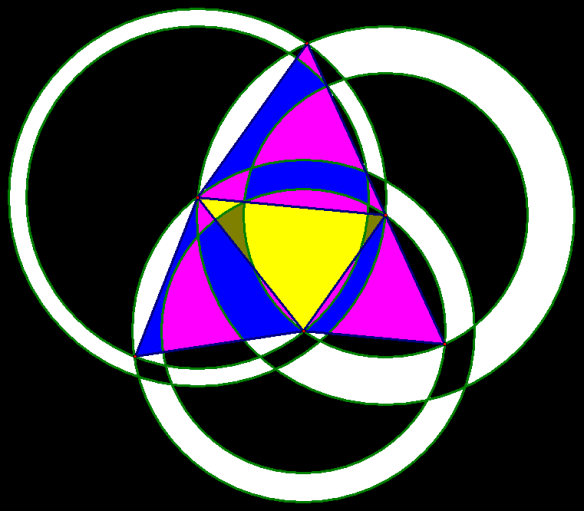
A Triangle, The Equilateral Triangles on Its Sides, and the Vertex-Centered Circles for Which Its Sides Are Radii

Image

A Triangle, The Equilateral Triangles on Its Sides, and The Circl

I Have Found a (Possibly) “New” Point On the Euler Line — But I Also Need Help Nailing Down Its Properties and Definition.

Image

In this diagram, the original triangle is ABC, and is yellow. The brown line, u, is that triangle’s Euler Line, which contains the triangle’s orthocenter (O), circumcenter (K), centroid (R), and nine-point circle center (circle shown, centered at Q). The point I have found on the Euler Line is at W.

To find W, do the following: reflect triangle ABC over the Euler Line to form triangle A’B’C’ (shown uncolored, and with thick black edges). Both triangles, ABC and A’B’C’, have the same circumcircle (shown in green, with uncolored interior). Because of this, a cyclic hexagon may be formed by joining A, A’, B, B’, C, and C’ with segments, linking each in turn as one encounters them on a mental trip once around this circumcircle (the order in which these six points are encountered can change as A, B, and/or C are moved).

A hexagon has 9 diagonals. Of these, six are the sides of ABC and A’B’C’. Here, they are shown in black, and the other three diagonals are shown in red. These red diagonals are not necessarily concurrent, but any two of them do have to intersect, and those three intersections are points T, V, and W. At least one of those points — W, in this case — must be on the Euler Line. To get the other two points on the Euler Line, make the triangle approach regularity. As this is done, K, R, Q, O, and W converge, making the definition of the Euler Line itself problematical.

Point W needs a better definition. Which two of the three hexagon-diagonals which aren’t sides of the original triangle, nor its reflection, intersect on the Euler Line? I haven’t figured that out yet. Also, a formal proof for most of what I have described here is beyond my present abilities.

Why, then, do I believe the statements to be true? Answer: the evidence provided by experiment. This image is a screenshot from Geometer’s Sketchpad — but I don’t know how to post an animation of what happens when A, B, or C are moved. However, I can move them myself, with the program in operation, and observe how everything changes (this is one of the best features of Sketchpad, in my opinion). As these points are moved around, pairs of the heavy red segments (hexagon sides, and three of its diagonals) sometimes “flip” — a side becomes a diagonal, and that diagonal becomes a side. At that point, T, V, and W must be relabeled. Also, some positions of A, B, and C make the area of triangle TVW approaches zero — it collapses to a point on the Euler Line.

Odd things also happen if you make triangle ABC isosceles, because the Euler Line for an isosceles triangle is the perpendicular bisector of the base, which causes triangle A’B’C’, upon reflection of triangle ABC across the Euler Line, to map onto triangle ABC. When this happens, the hexagon becomes a single triangle, making its diagonals vanish — and point W goes and “hides” at the vertex opposite the base of isosceles triangle ABC, by which I mean W approaches that vertex as scalene triangles get closer to being isosceles.

Also, things change a bit if triangle ABC is obtuse:
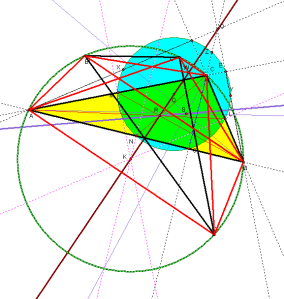
new point on Euler Line see point W obtuse case

The Nagel Line (that line which contains the incenter, S, and the centroid, R, where it intersects the Euler Line) has been added, and is shown in purple. As you can see, point W is not on the Nagel Line. With the triangle being obtuse, the earlier all-red convex hexagon is now gone, because two of its sides are black, due to them being sides of triangles ABC and A’B’C’. Point W persists, though, still on the Euler Line, and located in the area between the vertices of these two triangles’ obtuse angles. My hope, in pointing this last fact out, is that it might help define which two hexagon-diagonals’ intersection defines the location of W. It might also be possible to use this to distinguish between the first diagram’s points T, V, and W, for, in the first diagram, W, which is what I am calling the only one of these three points to be on the Euler Line, was the one nearest the largest interior angle of triangle ABC — and the same is also true of triangle A’B’C’, as well. However, the matter of picking W out of the “T, V, and W” set of points may have nothing to do with angle size — it could be, instead, a matter of proximity of A, B, and C, as well as their reflections, to the Euler Line itself. In other words, “Which one is W?” might be answerable simply by examination of which member of the “T, V, and W” set is closest to the member of the set “A, B, and C,” as well as “A’, B’, and C’,” which is, itself, closest to the Euler Line. This matter needs further investigation, with which I would welcome help from anyone.

Also:  there are two easier-to-define points on the Euler Line, unlabeled in the diagrams above, which are the two points where triangles ABC and A’B’C’ intersect. The existence of these points on the Euler Line is simply a consequence of the fact that A’B’C’ was formed by reflecting the original triangle over the Euler Line. These two points could use special names, but nothing is immediately springing to my mind which would be appropriate. Another point on the Euler Line, also a consequence of reflection, appears as the midpoint of segment TV in the first diagram, and the midpoint of BB’ in the second — segments which appear analogous. This also seems to apply to the midpoints of AA’ and CC’. At this stage of the discovery process, though, appearances can be misleading.

I want to work out a better definition for this point, W, on the Euler Line, perhaps as an as-yet-undiscovered member of the large collection of triangle centers. I also need to know if it has already been found. If you have information pertinent either of these things, or to any part of this post, please leave it here, in a comment.
Changing the “Nine” in the Nine-Point Circle

Image

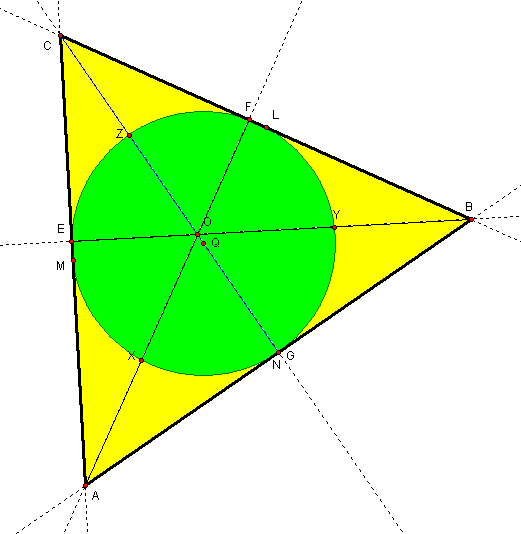
Constructing the nine-point circle is an interesting exercise in geometry. In the above triangle ABC, the segments inside the triangle are its three altitudes, with the “feet” of the altitudes labeled E, F, and G. The midpoints of the sides of the triangle are labeled L, M, and N. The orthocenter, where the three altitudes meet, is labeled O, and then the midpoints of the three segments connecting the orthocenter to each of the triangle’s vertices are labeled X, Y, and Z.

It has been long proven that these three sets of three points each (E, F, G; L, M, N; and X, Y, Z) lie on the same circle, for any triangle. Point Q is at the center of this nine-point circle.

The diagram above uses, as triangle ABC, a triangle which is both acute and scalene — and in such a triangle, the nine points in question are in nine different locations. Of course, triangles do not have to be acute and scalene — and for some other types of triangle, the nine points end up in fewer than nine distinct locations.

9PC obtuse scalene

Of other classifications of triangle, only this one, an obtuse and scalene triangle, still has the nine points in nine different locations. With other triangles, the number of such locations decreases.

As a next step, consider a triangle which is acute and isosceles:

9pc acute isos 8

The base of this isosceles triangle is segment AB, and it is on segment AB that two of the nine points end up in the same place. Point G, the foot of the altitude to the base, is at the same place as point N, the midpoint of the base. Since the other seven points remain distinct, this type of triangle has its nine points in eight locations.

9PC obtuse isosceles 8

Another triangle which has eight distinct “nine-point circle” points is the obtuse, isosceles triangle, for the same reason:  the foot of the altitude to the base (G) and the midpoint of the base (N) are in the same place. Eight is not the limit, though — this number can be reduced still further. As one attempts to do so, it doesn’t take long to figure out that there is no way to reduce this number to seven . . . but six is possible:

9pc equilateral 6

For the nine points under examination to end up in only six distinct locations, as seen immediately above, a triangle is needed which is equilateral (and equiangular as well, for you can’t have one without the other when dealing with triangles). In such a triangle, each side-midpoint ends up at the same place as an altitude-foot, providing three of the distinct six points. The other three are the midpoints of the segments connecting the orthocenter to each vertex. Also, it is only for this type of triangle that the orthocenter (O) is the center of the nine-point circle itself (Q). One might think that this type of triangle, being regular, would minimize the number of distinct locations for the “nine” points . . . but that is not the case.

9pc right scalene 5

To reduce this number below six, right triangles are needed. With a scalene right triangle, there end up being five such locations:  the midpoint of each side, the vertex of the right angle, and the foot of the altitude to the hypotenuse. However, five is not quite the minimum.

9pc right isosceles 4

If a right triangle is isosceles, rather than scalene, the foot of the altitude to the hypotenuse moves to the midpoint of the hypotenuse, and this reduces the number of distinct “nine-point circle” points to its absolute minimum:  four. Such a triangle is also called, of course, a 45-45-90 triangle. Interestingly, these four points may be used as the vertices of a square (not shown in the diagram above) which has an area exactly one-half that of triangle ABC. The proof of this is left as an exercise for the reader.

{Later edit, March 2018:  an alert reader pointed out to me that I “missed some obtuse [triangles] that have only eight or six points on the nine-point circle.” Good catch, F.D.!}

A Collection of Nine-Point Circles

Image

A Collection of Nine-Point Circles

[Note:  if you are not familiar with the nine-point circle already, you may wish to see the next post on this blog, where it is explained in detail.]

The largest circle shown here is the circumscribed circle for a large equilateral triangle, and its nine-point circle is shown as well. Also, each altitude of an equilateral triangle splits it into two 30-60-90 triangles. Since there are three such altitudes, there are six 30-60-90 triangles of this size — and all their nine-point circles are shown as well. These three altitudes, taken together, also split the equilateral triangle into six smaller 30-60-90 triangles, and their nine-point circles are also shown here.

Three-Color Tessellation: A Modification of the Tiling of the Plane with Regular Hexagons

Image

Three-Color Tessellation:  A Modification of the Tiling of the Plane with Regular Hexagons

In each case, modifications along hexagon-edges were made using equilateral triangles. Every segment in this tessellation has equal length, also, which required trisection of the original hexagons’ sides.

Polyhedron with 180 Triangular Faces

Image

Polyhedron with 180 Triangular Faces

Created with Stella 4d, software available at http://www.software3d.com/Stella.php.