Expanding the Rhombic Octagonoid, Using Equilateral Triangles

I first named the rhombic octagonoid, a ninety-faced zonohedron, right here. I’ve added a new twist to it now, though, and that is to expand this polyhedron using twenty equilateral triangles. This causes the octagons of the rhombic octagonoid to become decagons. This new solid has 110 faces, and is not a zonohedron, although it is a “zonish” polyhedron. The only faces it has which are not zonogons are the triangles.

I built this new polyhedron with Zome. If you’d like to try out Zome for yourself, the website to visit is at http://www.zometool.com.

Having Fun With Zome

This isn’t exactly a polyhedron, or even a polyhedral compound, although it does contain several polyhedra in it. There’s a red rhombic triacontahedron in the center, a blue icosidodecahedron just outside that, and a blue dodecahedron closer to the outside. There are also twelve blue-and-yellow pentagonal pyramids, as well as twenty smaller blue-and-red triangular pyramids. That may not be a complete list, although I did try to include them all. I didn’t build it with the goal of making anything in particular — I was just having fun with Zome. In other words, I was playing.

Zome is available at http://www.zometool.com, if you’d like to try playing with it, or giving it as a gift to someone who would appreciate it. The small parts could cause a choking hazard for babies or toddlers, but they will delight and amaze school-age kids, as well as older people (like me) who still enjoy play for the sake of playing, and doing math for the sake of doing math.

Three Different Views of the 600-Cell

The 600-cell is a four-dimensional, convex, regular polychoron. Its dual is the 120-cell, also known as the hyperdodecahedron. Since the dual of the dodecahedron is the icosahedron, the 600-cell is sometimes called the “hypericosahedron,” That might lead one to think that the cells of a 600-cell are icosahedra, but they are actually tetrahedra. These tetrahedra meet twenty at a vertex, which is another way the icosahedron is involved in this figure.

I just finished a Zome model of a three-dimensional “shadow” of a 600-cell. It’s a challenging model to make. Built with B1, Y1, R1, and R0 Zomestruts, it’s about the size of a basketball. Instructions for building it may be found at https://www.pmedig.com/Zome_600cell.html.

If you’d like to try Zometools for yourself, or want some for your kids, the website to visit is http://www.zometool.com. I’ve been a happy customer of theirs for over twenty years.

Here are two more models of the 600-cell. Rather than being physically built, these are virtual models. They show the polychoron rotating in hyperspace, thus changing the appearance of its three-dimensional “shadow” on a continual basis. This rotation in hyperspace differs in the two images shown, along with the coloring of the models.

These virtual models were created using Stella 4d, which you can try for free at http://www.software3d.com/Stella.php.

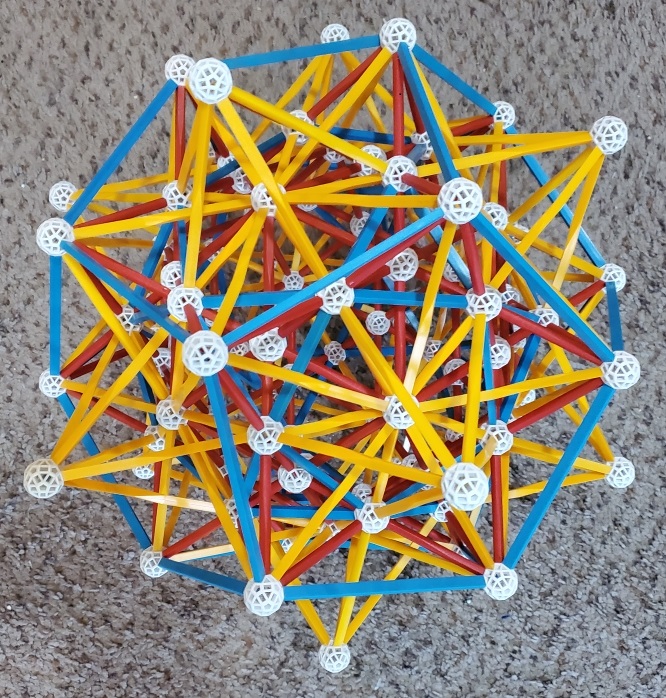
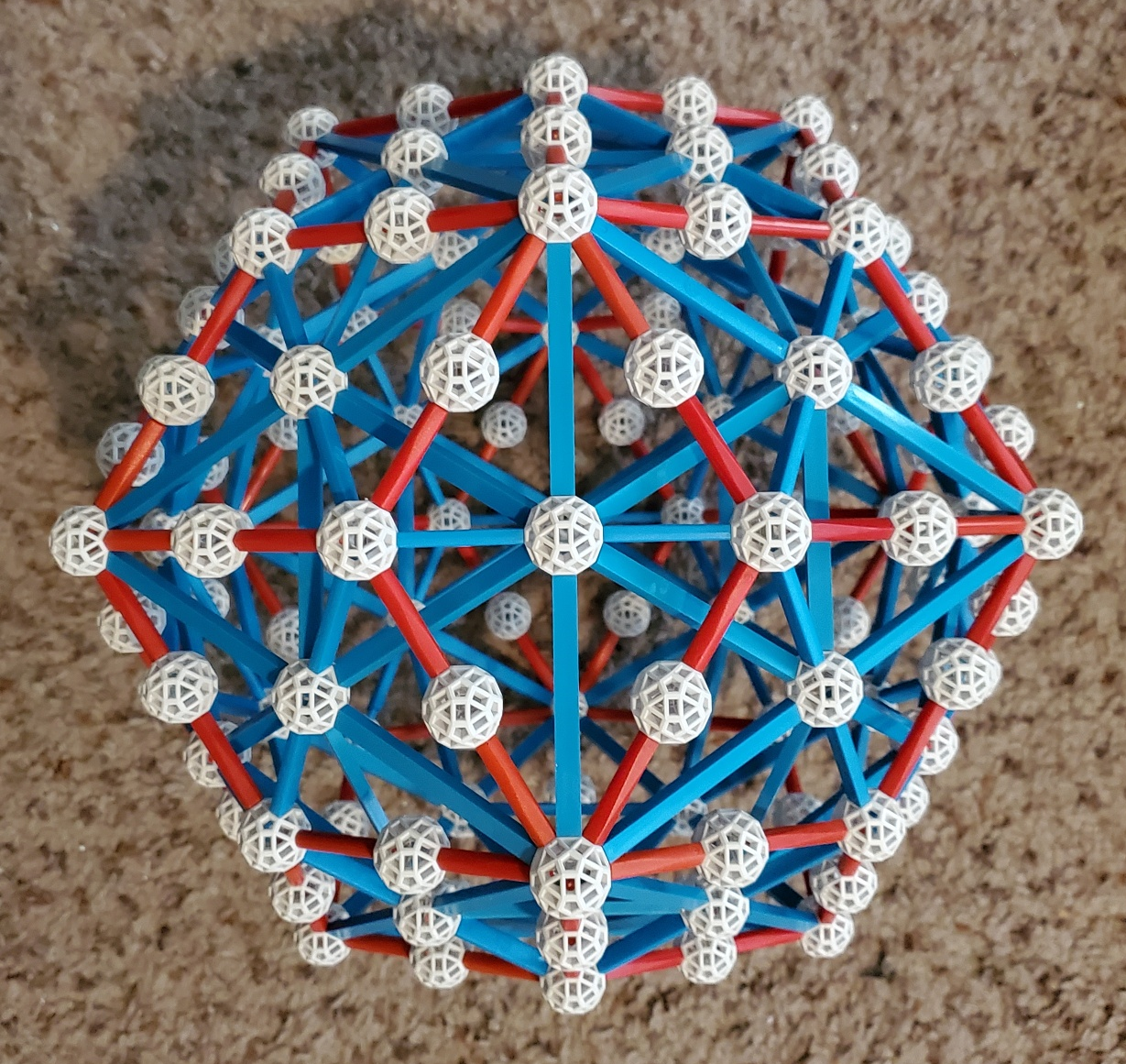
Can You Find All Four Polyhedra in This Ball of Zome?

The four polyhedra in the Zome structure above are well-known. Two are Platonic solids, one is an Archimedean solid, and one is a Catalan solid. When you think you’ve found all four, you can scroll down to check your answers.

.

.

.

.

.

.

.

.

.

.

.

.

.

The four polyhedra are the icosahedron (blue), the dodecahedron (blue), the icosidodecahedron (blue), and the rhombic triacontahedron (red). Also, if you’d like to try Zome for yourself, or your children, the website to visit is http://www.zometool.com.

Four Nested Rhombic Triacontahedra, Made of Zome

You can get Zome for yourself (or your kids) at http://www.zometool.com.

Seven Rhombi, Made of Zome

If you want to get Zome of your own, the website to visit is http://www.zometool.com.

Stellating the Tetrahedrally-Diminished Dodecahedron, Using Zometools

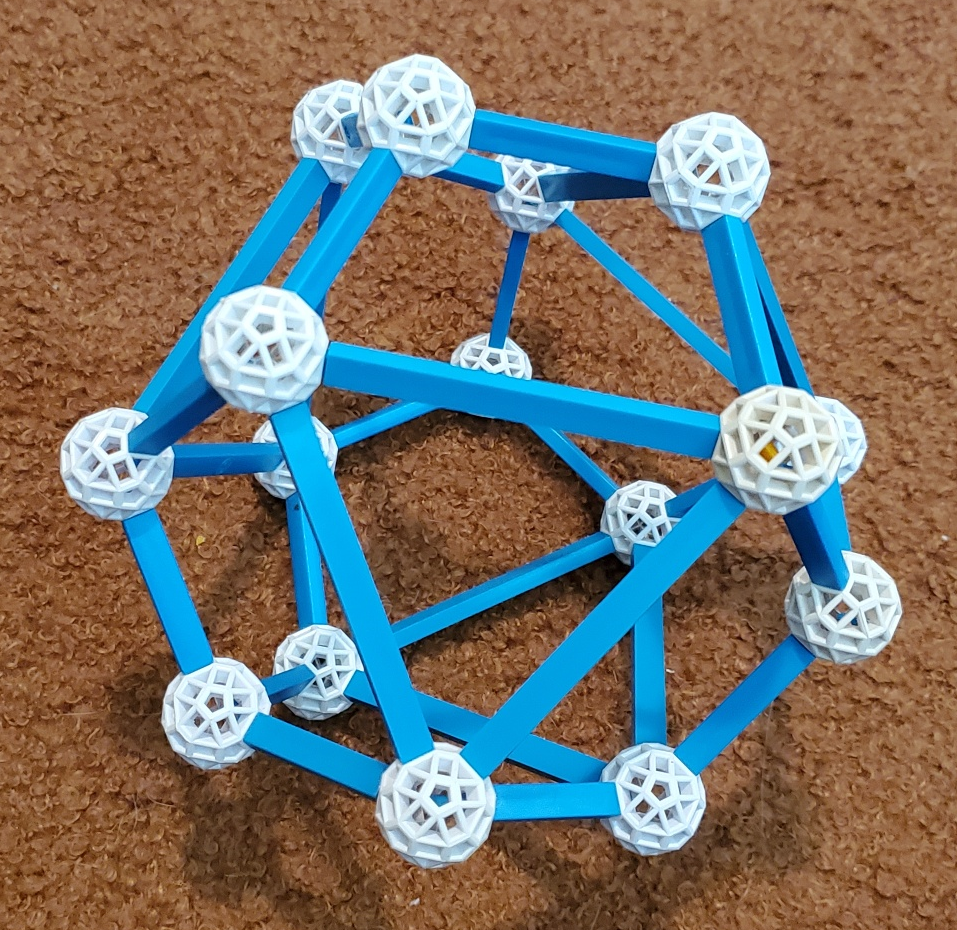
This is the tetrahedrally-diminished dodecahedron, which can be formed from the Platonic dodecahedron by using faceting. In this case, I used Zometools. If you’d like to look into buying some Zome of your own, the website to visit is http://www.zometool.com.

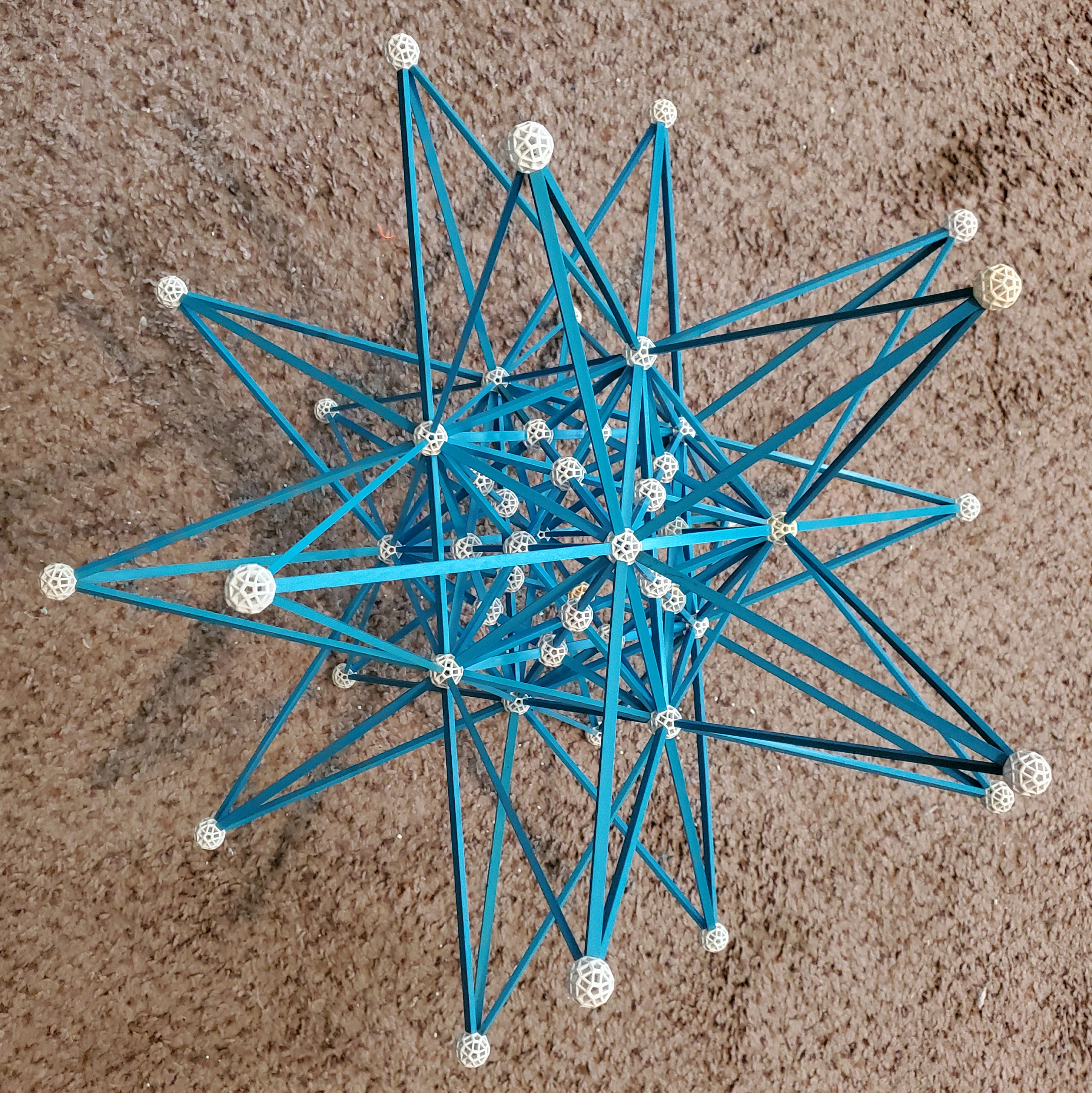
Stellating polyhedra is one of the things Zome was invented for. The images below are two different rotations of a stellated tetrahedrally-diminished dodecahedron.

Some Concentric, All-Blue Zome Polyhedra

In the center of this figure is a regular dodecahedron, but it’s hard to spot. It is then stellated to form a small stellated dodecahedron. Next, its outer vertices are joined by new edges: those of an icosahedron. This also results in the formation of a great dodecahedron. Finally, the icosahedron is stellated to form the great stellated dodecahedron. To take this further, one could connect the outer vertices with new edges: those of a dodecahedron. The entire process can begin again, then, and this could continue without limit, filling all of space.

Here’s a closer view of the interior:

Zometools may be purchased at http://www.zometool.com.

A Zome Construction, Mostly of Rhombi

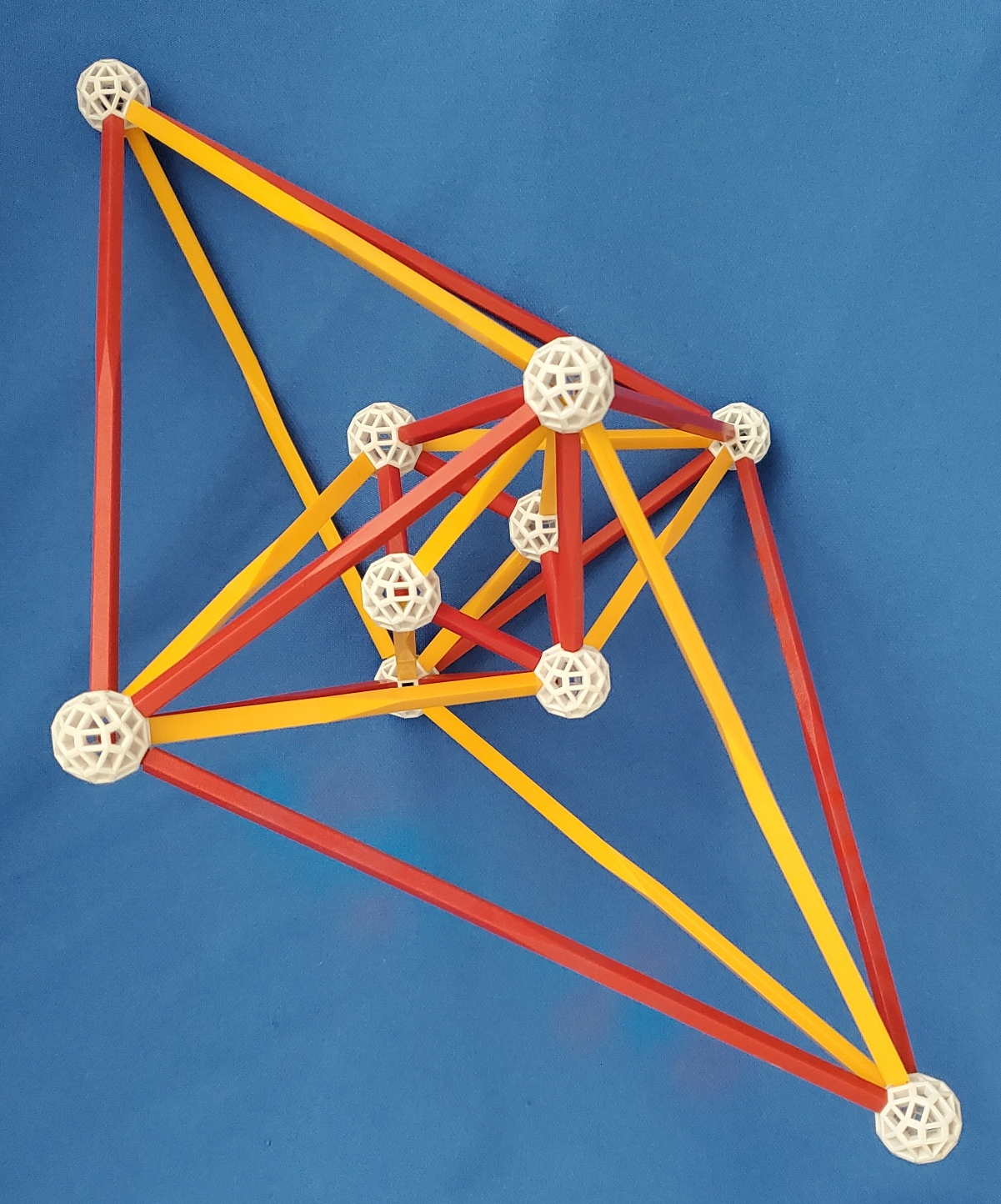
The yellow figure is a rhombic dodecahedron, and the red pieces form six rhombi which intersect the faces of the yellow figure. There are also hypershort red struts connecting the red rhombi to each other. It’s not exactly a polyhedron, but I had fun making it. I built it using Zome, which you can buy for yourself at http://www.zometool.com.

Two Zome Compounds: Five Cubes, and Five Rhombic Dodecahedra

The blue figure in the center of this model is the compound of five cubes. If you take a cube, and build pyramids of just the right height on each of that cube’s faces, those pyramids form a rhombic dodecahedron, as seen below.

In the model at the top of this post, yellow rhombic dodecahedra have been built around each cube in the compound of five cubes. The yellow figure in the top is, therefore, the compound of five rhombic dodecahedra.

I made these models out of Zome. If you’d like to try Zome for yourself, the place to go to buy it is http://www.zometool.com.