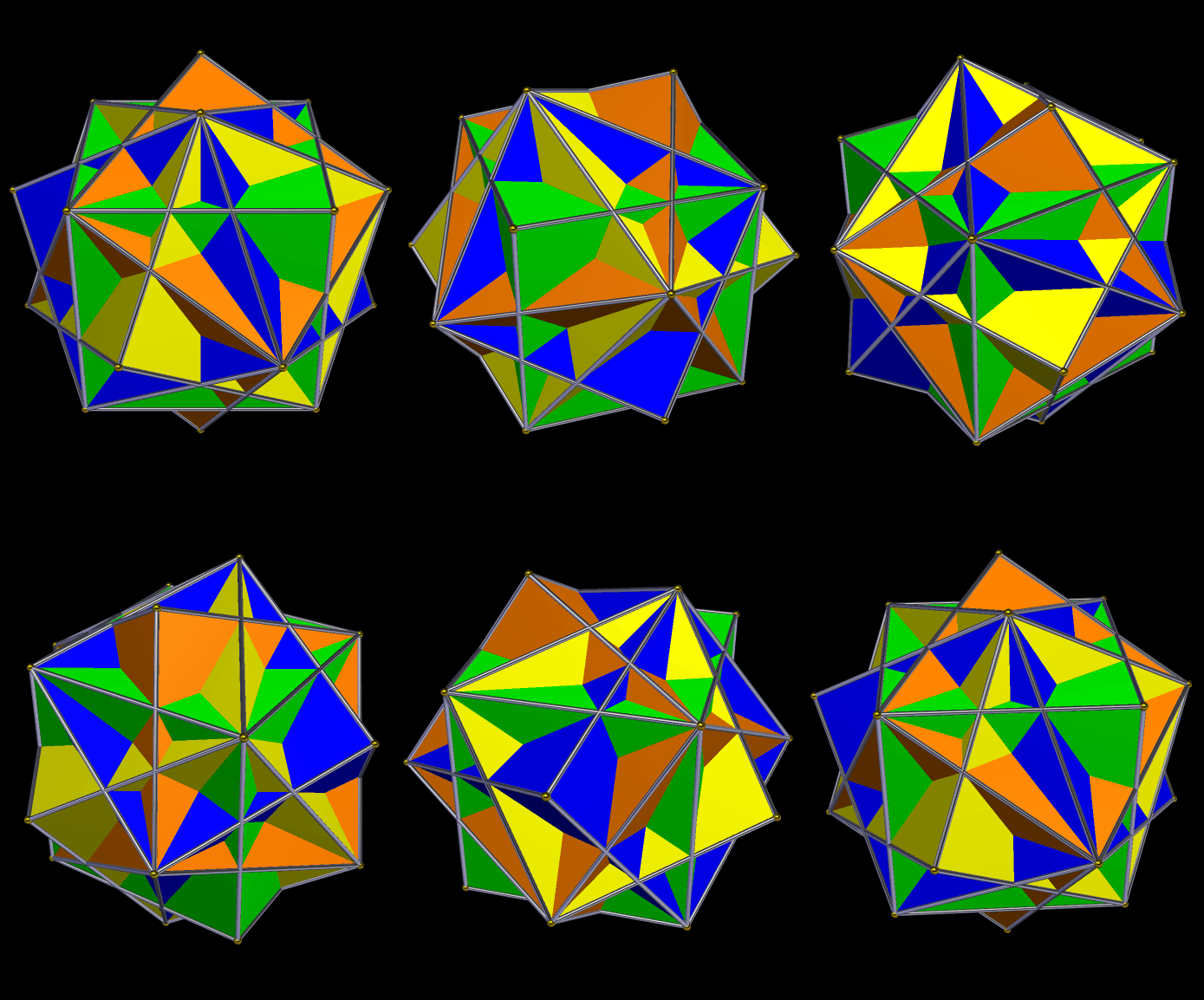
The Convex Hull of the Compound of the Snub Cube and Its Dual, the Pentagonal Icositetrahedron

Image

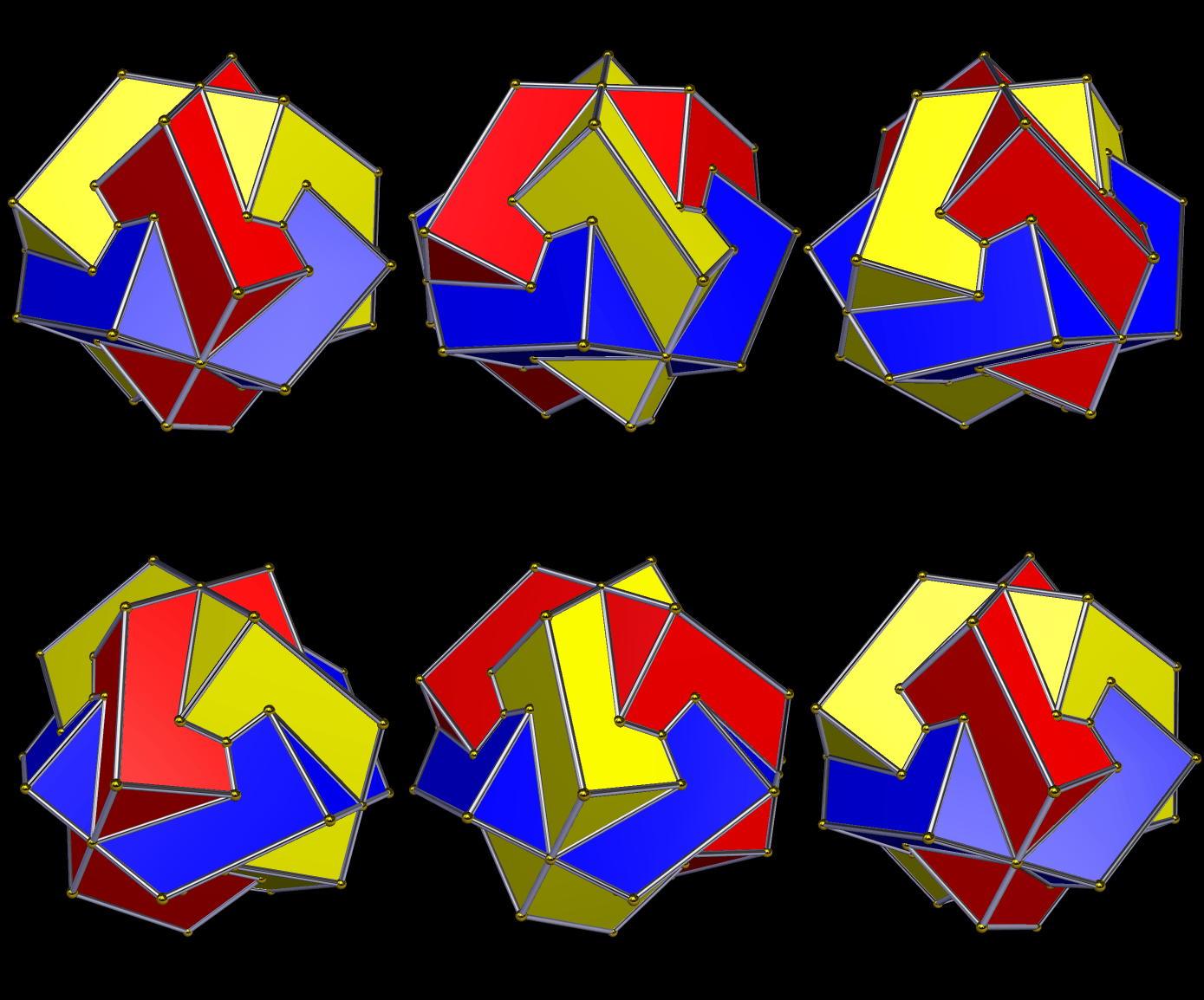
The Convex Hull of the Compound of the Snub Cube and Its Dual, the Pentagonal Icositetrahedron

(Image created with Stella 4d — software you can try yourself at http://www.software3d.com/Stella.php.)

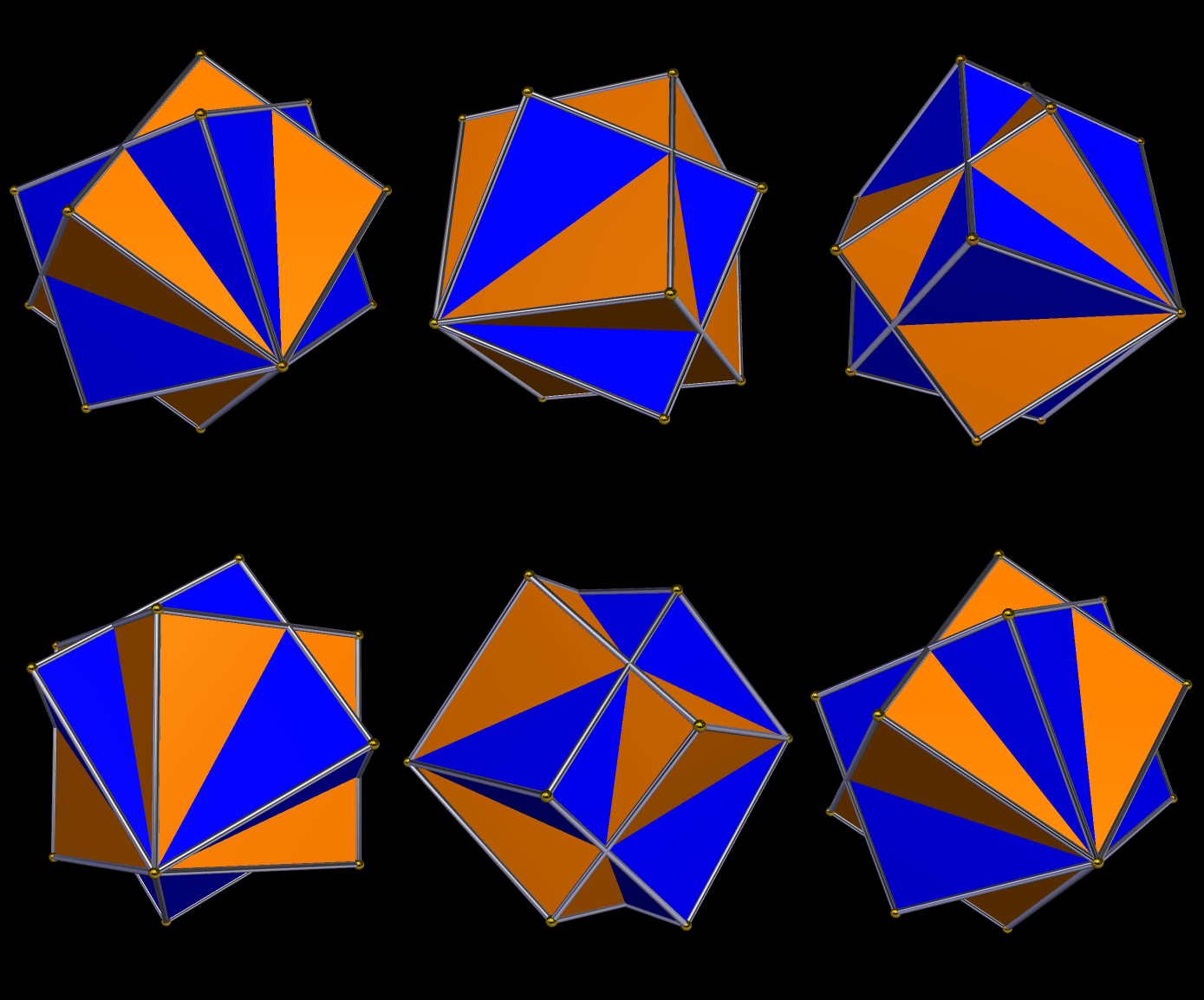
The Sixth Stellation of the Triakis Octahedron

Image

The Sixth Stellation of the Triakis Octahedron

The triakis octahedron, a Catalan solid, is the dual of the truncated cube. When stellated six times, the triakis octahedron yields this polyhedral compound with three parts. The parts themselves appear to be unusual, irregular, dipolar octahedra with eight kites for faces, each in sets of four, with their smallest angles meeting at one vertex. However, given that these vertices are, in each case, hidden under the other parts of the compound, there is uncertainty in this.

(Image created with Stella 4d — software you can try yourself at http://www.software3d.com/Stella.php.)

On the Geography of Eurasia, and Its Major Divisions

Image

On the Geography of Eurasia, and Its Major Divisions

By any reasonable non-political definition, Eurasia is a single continent. Its area is 54,759,000 km², which is over one-third the earth’s total land area.

The politics of history have created, however, the “continents” of Europe, with an area of 10,180,000 km² (18.59% of Eurasia), and Asia, with an area of 44,579,000 km² (81.41% of Eurasia). These figures for Asia’s land area include that of the “subcontinent,” India, which has an area of 4,400,000 km². (Note: the subcontinent of India is a geographical term, and does not match the borders of the nation of India perfectly. The major reason for this is that India the subcontinent includes the nations of Pakistan and Bangladesh, in addition to the politically-defined nation of India.)  The subcontinent’s area is 8.04 % that of Eurasia, and 9.87% that of Asia.

Europe is a large peninsula, a part of Eurasia with a sizeable portion of its area. So is the Indian subcontinent. So, for that matter, are the Southern portions of both South America and Africa, yet no one calls them separate continents, nor even subcontinents.

Giving India a special designation of “subcontinent” makes no sense, nor does the designation of Europe as a separate continent. Both are simply parts of Eurasia.

A Half-Solved Mystery: Rotating a Sine Wave

Image

A Half-Solved Mystery

A few minutes ago, I wondered how to write a function whose graph would be a sine curve, but one that undulated above and below the diagonal line y=x, rather than the x-axis, as is usually the case. How to accomplish such a 45 degree counterclockwise rotation?

Well, first, I abandoned degrees, set Geometer’s Sketchpad to radians, and then simply constructed plots for both y = x and y = sin(x). Next, I added them together. The result is the green curve (and equation) you see above.

This only half-solves the problem. Does it undulate above and below y=x? Yes, it does. However, if you rotate this whole thing, clockwise, one-eighth of a complete turn, so that you are looking at the green curve going along the x-axis, you’ll notice that it is not a true sine curve, but a distorted one. Why? Because it was generated by adding y-values along the original x-axis, not by a true rotation.

I’m not certain how to correct for this distortion, or otherwise solve the problem. If anyone has a suggestion, please leave it in a comment. [Note: an astute follower of this blog has now done exactly that, so I refer the reader to the comments for the rest of the story here.]

Basic Trigonometric Functions, Viewed On a Polar Coordinate System

Image

Basic Trigonometric Functions, Viewed On a Polar Coordinate System

The last post made me curious about other trigonometric functions’ graphs, in a polar coordinate system. They were not what I expected. Here they are.

When A Sine Wave Is a Circle

Image

When A Sine Wave Is a Circle

When y=sin(x) is plotted on a polar coordinate system, with everything set, consistently, to radians, the resulting graph is a circle sitting atop the origin, with unit diameter.

Spin

Image

Spin

The Deconstruction of the Compound of Five Cubes

An Examination of the Compound of Five Cubes

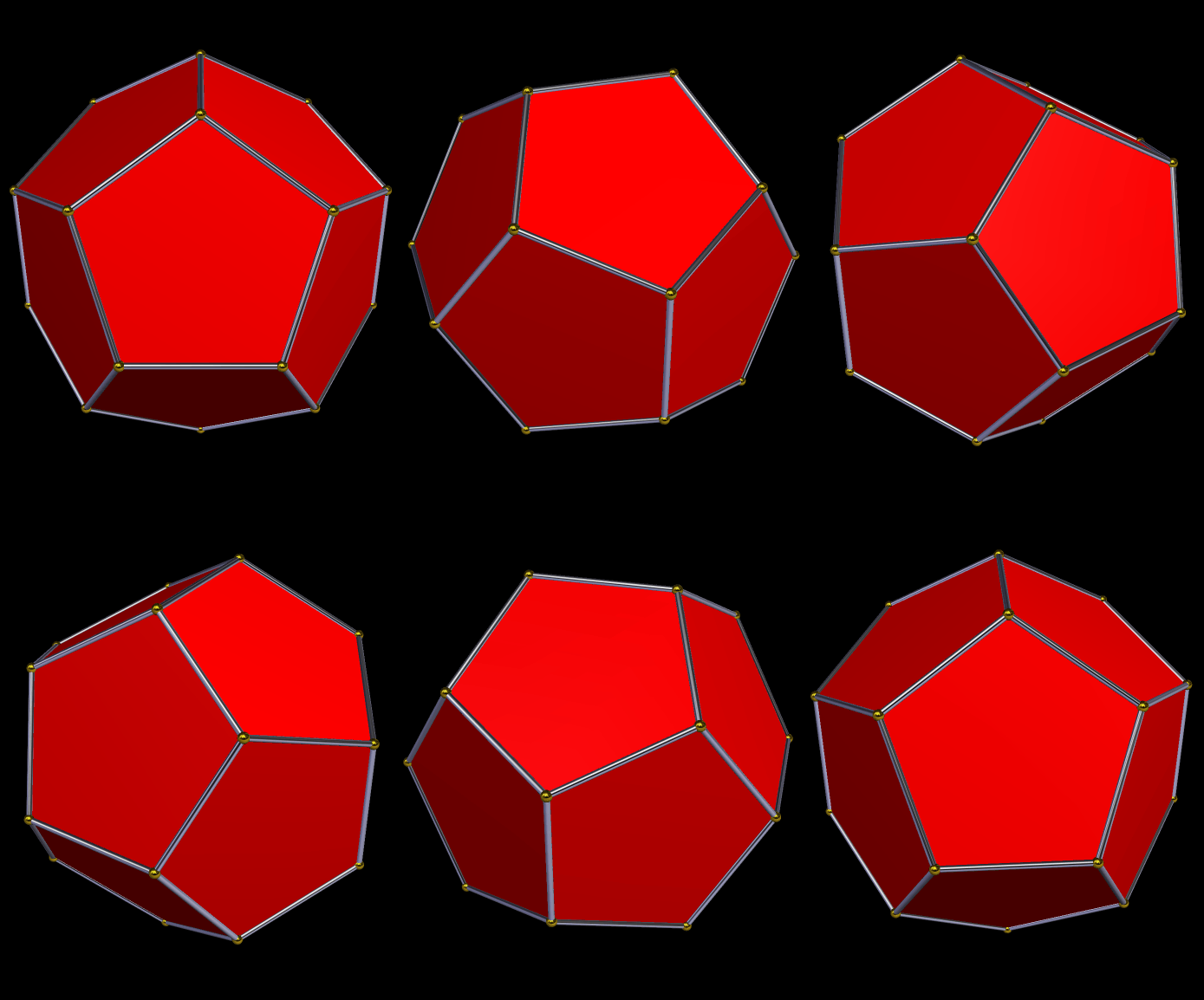
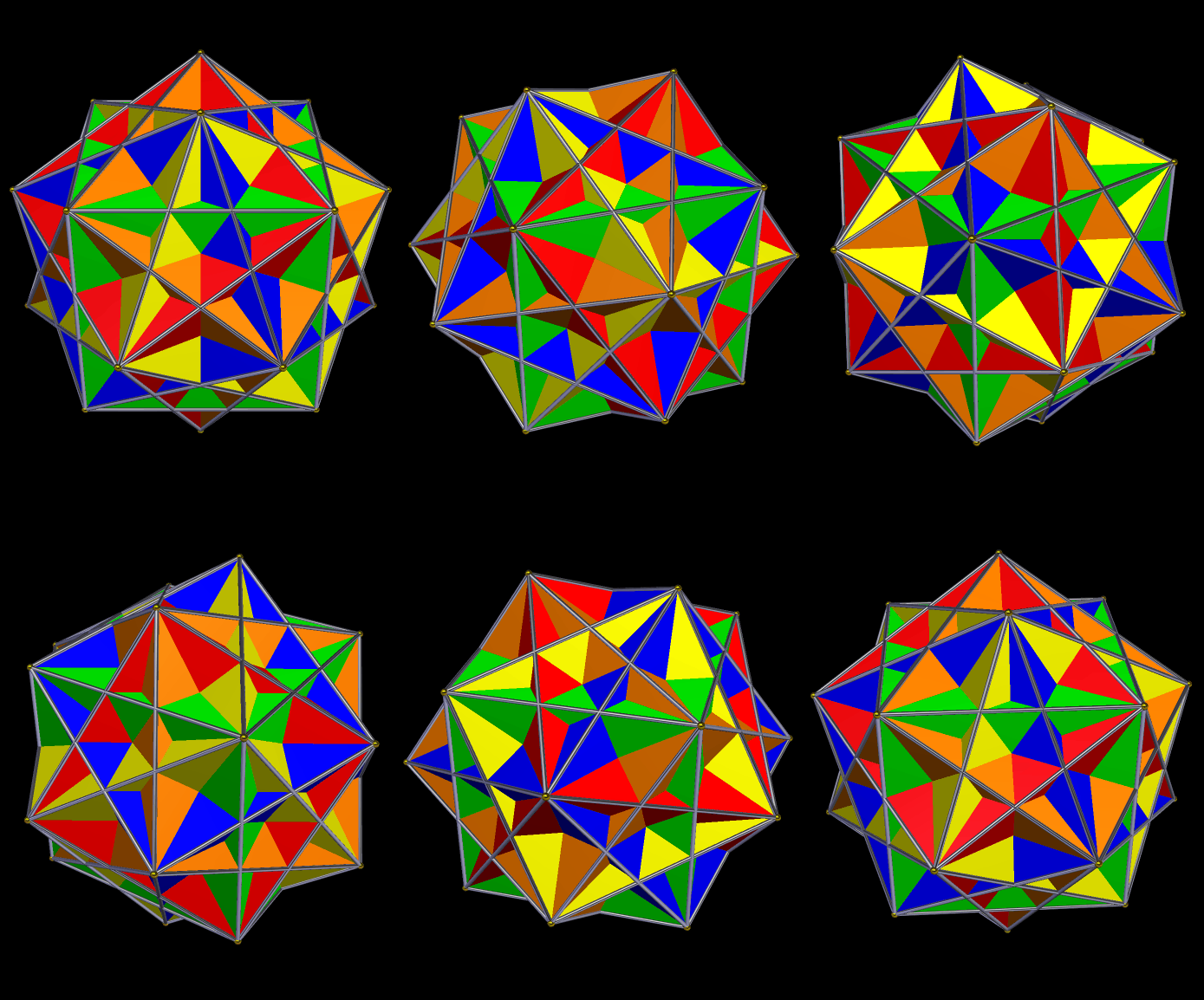
To make the compound of five cubes, begin with a dodecahedron, as seen above. Next, add segments as new edges, and let them be all of the diagonals of all the dodecahedron’s faces. Then, remove the pentagonal faces, as well as the original edges. What’s left is five cubes, in this arrangement.

Cubes 5

Using polyhedral manipulation software called Stella 4d (available at www.software3d.com/Stella.php), these five cubes can be removed one at a time. The first removal has this result:

Cubes 5-1

That left four cubes, so the next removal leaves three:

Cubes 5-2

And then only two:

Cubes 5-3

And, finally, only one remains:

Cubes 5-4

Because their edges were pentagon-diagonals for the original dodecahedron, each of these cubes has an edge length equal to the Golden Ratio, (1 + √5)/2, times the edge length of that dodecahedron.

An Alphabetical Listing of Known Exotic Atoms

  • Antiprotonic helium:  an atom of helium, with one electron replaced by an antiproton.
  • Antiprotonic lithium:  an atom of lithium, with one electron replaced by an antiproton.
  • Exciton:  a bound state of an electron and an electron hole.
  • Hypernuclear atoms:  any of several observed atoms with a hypernucleus.  Hypernuclei are any nuclei which contain (in addition to protons and neutrons) at least one hyperon, a subclass of baryons which contain strange quarks. These atoms are studied primarily for their nuclear behavior, and so fall better into the subfield of nuclear physics, rather than atomic physics or chemistry.
  • Kaonic helium:  a helium atom, with one electron replaced by a negative kaon, which is a meson composed of a strange quark, and an antiup quark.
  • Kaonic hydrogen:  a hydrogen atom, with the electron replaced by a negative kaon, a meson composed of a strange quark and an antiup quark.
  • Kaonium:  a bound state of a positive and negative kaon. Positive kaons are mesons composed of up and antistrange quarks, while negative kaons are mesons composed of a strange quark, and an antiup quark.
  • Muonic helium:  an atom of helium, with one electron replaced by a muon.
  • Muonic hydrogen:  an atom of hydrogen, with the electron replaced by a muon.
  • Muonium:  a bound state of a positive muon (also known an an antimuon) and an electron. There is also predicted to exist what is called “true muonium,” a bound state of a muon on an antimuon, but it has yet to be observed.
  • Onium:  this is the general term for the bound state of a particle with its own antiparticle. Pionium and positronium are examples.
  • Pionic helium:  an atom of helium, with one electron replaced by a negative pion. Pions are mesons, and the negative pion is composed of an up and an antidown quark.
  • Pionic hydrogen:  an atom of hydrogen, with one electron replaced by a negative pion, a meson composed of an up and an antidown quark.
  • Pionium:  a bound state of two pions, one positive and one negative. The negative pion is described above, and the positive pion, also a meson, is composed of a down and an antiup quark.
  • Positronium:  a bound state of a positron and an electron. This exotic atom can form an exotic molecule, together with a hydrogen atom; such an exotic molecule is called positronium hydride, and has the formula PsH. Another exotic molecule involving positronium is a bound state of two positronium atoms; it is called di-positronium. Positronium also forms halides and a cyanide.
  • Protonium:  a bound state of a proton and an antiproton.
  • Quarkonium:  a term for a meson which is the bound state of any quark and its own antiquark.  While one can find examples in the literature where various forms of quarkonium are discussed as though they are exotic atoms, I prefer to view them simply as a subset of mesons, not a category of exotic atom.
  • Sigmaonic atoms are thought to be possible, via such methods as replacing an electron in a hydrogen or helium atoms with a negatively-charged sigma baryon. However, I have found no evidence of actual observation of such particles.
  • Tau-containing exotic atoms are predicted to occur, but have not been observed, yet, due to the short lifetime (less than a trillionth of a second) of the tau particle, a lepton. “Tauonium” is a term which has been used for these hypothetical exotic atoms.

M33, the Triangulum Galaxy, Adorning the Faces of a Pentagonal Icositetrahedron

Image

M33, the Triangulum Galaxy, Adorning the Faces of a Pentagonal Icositetrahedron

Evidence suggests that M33 is a satellite galaxy of the even better-known Andromeda Galaxy (M31), which happens to be on a collision course with our own Milky Way. In 1.5 billion years or so, Andromeda and the Milky Way will merge to form a giant elliptical galaxy already pre-named Milkomeda. At that point, the Triangulum Galaxy may become a satellite of Milkomeda (probably one of several), or be gravitationally ejected, or simply be absorbed into Milkomeda itself.

Here, it is projected on each face of the Catalan solid which is dual to the snub cube, using software you can try at http://www.software3d.com/Stella.php.