The Vacuum Cleaner Enigma

Image

The Vacuum Cleaner Enigma

A vacuum is, by definition, a region of space devoid of matter. While a perfect vacuum is a physical impossibility, very good approximations exist. Interplanetary space is good, especially far from the sun. Interstellar space is better, and intergalactic space is even better than that.

Along come humans, then, and they invent these things:

vacuum-cleaner-upright

. . . and call them “vacuum cleaners.”

Now, this makes absolutely no sense. There isn’t anything cleaner than a vacuum — and the closer to an ideal vacuum a real vacuum comes, the cleaner it gets. Since vacuums are the cleanest regions of space around already, why would anyone pay good money for a machine that supposedly cleans them? They’re already clean!

Even cleaning in general is a puzzle, without vacuums being involved at all. To attempt to clean something — anything — is, by definition, an attempt to fight the Second Law of Thermodynamics. Isn’t it obvious that any such effort is, in the long run, doomed from the outset?

—–

[Image note:  I didn’t create the images for this post, but found them using Google. I assume they are in the public domain.]

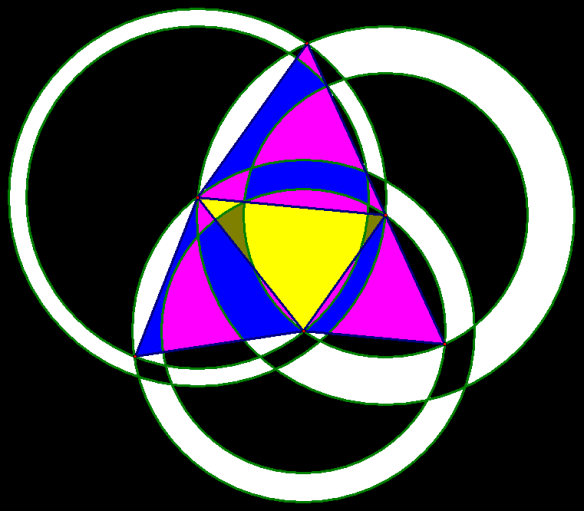
A Triangle, The Equilateral Triangles on Its Sides, and the Vertex-Centered Circles for Which Its Sides Are Radii

Image

A Triangle, The Equilateral Triangles on Its Sides, and The Circl

Statement of the Obvious, in Venn Diagram Form

Image

Statement of the Obvious, in Venn Diagram Form

Fifteen

Image

Fifteen

On the Constructible Angles

Image

The Constructible Angles

The Ancient Greeks figured out how to combine the Euclidean constructions of the regular pentagon and triangle to obtain constructions for the regular pentadecagon, which has central angles (between adjacent radii) of 360/15 = 24 degrees. Here’s an example, showing how this can be performed:

15

Also, it’s easy to construct an equilateral triangle, and then bisect an angle of it, to obtain a 30 degree angle.

The existence of angle difference identities in trigonometry is tied to the fact that you can subtract angles, on paper, with Euclidean constructions. Therefore, an angle of 24 degrees may be subtracted from a 30 degree angle to obtain a 6 degree angle. This can be bisected to get a 3 degree angle, and then bisected again to obtain a 1.5 degree angle, then a 0.75 degree angle, and so on.

However, a one degree angle is impossible to construct. Were this not the case, a 24 degree angle’s constructibility would imply that of the 23 degree angle, by subtraction of a one degree angle. After that, subtract three degrees more, and you have a 20 degree angle . . . and with that, you can construct a regular enneagon, also known an a nonagon. But we know — it has been proven — that regular enneagons have no valid Euclidean constructions. Therefore, one degree angles are also non-constructible, by reductio ad absurdam.

Carl Friedrich Gauss’s much more recent proof (1796; he was 19 years old) that a regular polygon of 17 sides can also be constructed — the first significant advance in this field since the time of the ancient Greeks — adds more constructible angles. Building on his work, other mathematicians have also shown that regular polygons with 257 and 65,537 sides can also be constructed, adding yet more constructible angles, but they are all for angles measuring fractional numbers of degrees, since none of these numbers are factors of 360, which equals (2³)(3²)(5). It’s also possible to combine these possible constructions to construct more regular polygons, as was shown above for the pentadecagon. For example, one can construct a regular pentagon with 51 sides, since 51 = (17)(3) — but, again, combinations of this type only lead to possible constructions of angles with measures which are fractional numbers of degrees. For angles with degree measures which are integers, it’s multiples of three — and that’s it.

[Note regarding images: the photograph of a compass at the top of this page was not taken by me, but simply found with a Google image-search. The pentadecagon-construction image, though, I did make, using both Geometer’s Sketchpad and MS-Paint.]

The Obelisk from “2001: A Space Odyssey”

Image

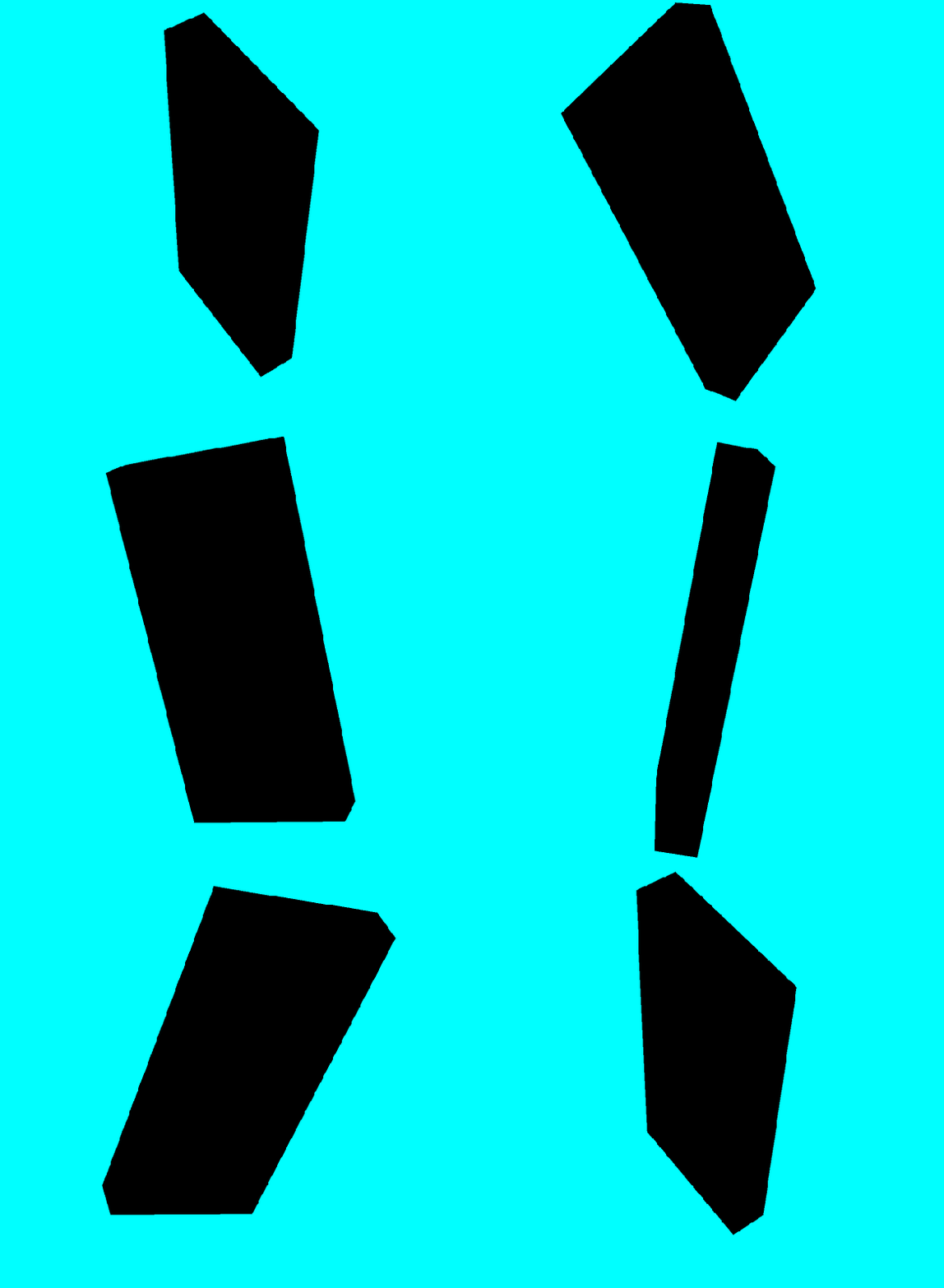
Software credit: just visit http://www.software3d.com/Stella.php to try or buy the software, Stella 4d, which I used to make this 1 x 4 x 9 virtual recreation of the mysterious obelisk from one of my favorite films/novels, 2001: A Space Odyssey.

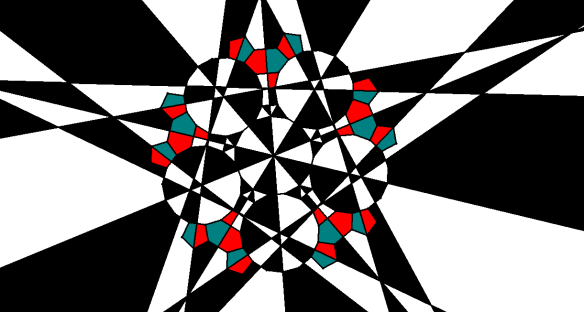
140-Faced Polyhedron Featuring Twenty Nonagons, Plus Sixty Each of Two Types of Pentagon

Image

140-Faced Polyhedron Featuring Twenty Nonagons, Plus Sixty Each of Two Types of Pentagon

Software credit: just visit http://www.software3d.com/Stella.php to try or buy the software, Stella 4d, which I used to make this polyhedron.

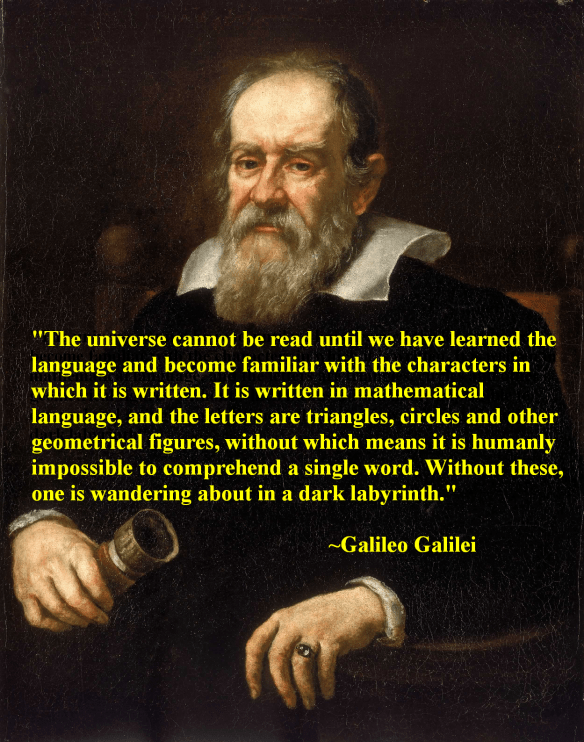
Galileo Galilei, on the Language of the Universe

Image

Galileo Galilei, On the Language of the Universe

Source for quote: https://en.wikipedia.org/wiki/Portal:Mathematics

I Have Found a (Possibly) “New” Point On the Euler Line — But I Also Need Help Nailing Down Its Properties and Definition.

Image

In this diagram, the original triangle is ABC, and is yellow. The brown line, u, is that triangle’s Euler Line, which contains the triangle’s orthocenter (O), circumcenter (K), centroid (R), and nine-point circle center (circle shown, centered at Q). The point I have found on the Euler Line is at W.

To find W, do the following: reflect triangle ABC over the Euler Line to form triangle A’B’C’ (shown uncolored, and with thick black edges). Both triangles, ABC and A’B’C’, have the same circumcircle (shown in green, with uncolored interior). Because of this, a cyclic hexagon may be formed by joining A, A’, B, B’, C, and C’ with segments, linking each in turn as one encounters them on a mental trip once around this circumcircle (the order in which these six points are encountered can change as A, B, and/or C are moved).

A hexagon has 9 diagonals. Of these, six are the sides of ABC and A’B’C’. Here, they are shown in black, and the other three diagonals are shown in red. These red diagonals are not necessarily concurrent, but any two of them do have to intersect, and those three intersections are points T, V, and W. At least one of those points — W, in this case — must be on the Euler Line. To get the other two points on the Euler Line, make the triangle approach regularity. As this is done, K, R, Q, O, and W converge, making the definition of the Euler Line itself problematical.

Point W needs a better definition. Which two of the three hexagon-diagonals which aren’t sides of the original triangle, nor its reflection, intersect on the Euler Line? I haven’t figured that out yet. Also, a formal proof for most of what I have described here is beyond my present abilities.

Why, then, do I believe the statements to be true? Answer: the evidence provided by experiment. This image is a screenshot from Geometer’s Sketchpad — but I don’t know how to post an animation of what happens when A, B, or C are moved. However, I can move them myself, with the program in operation, and observe how everything changes (this is one of the best features of Sketchpad, in my opinion). As these points are moved around, pairs of the heavy red segments (hexagon sides, and three of its diagonals) sometimes “flip” — a side becomes a diagonal, and that diagonal becomes a side. At that point, T, V, and W must be relabeled. Also, some positions of A, B, and C make the area of triangle TVW approaches zero — it collapses to a point on the Euler Line.

Odd things also happen if you make triangle ABC isosceles, because the Euler Line for an isosceles triangle is the perpendicular bisector of the base, which causes triangle A’B’C’, upon reflection of triangle ABC across the Euler Line, to map onto triangle ABC. When this happens, the hexagon becomes a single triangle, making its diagonals vanish — and point W goes and “hides” at the vertex opposite the base of isosceles triangle ABC, by which I mean W approaches that vertex as scalene triangles get closer to being isosceles.

Also, things change a bit if triangle ABC is obtuse:
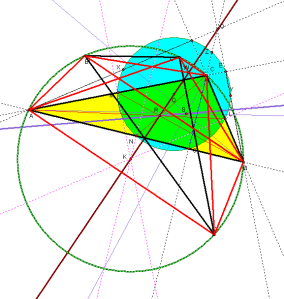
new point on Euler Line see point W obtuse case

The Nagel Line (that line which contains the incenter, S, and the centroid, R, where it intersects the Euler Line) has been added, and is shown in purple. As you can see, point W is not on the Nagel Line. With the triangle being obtuse, the earlier all-red convex hexagon is now gone, because two of its sides are black, due to them being sides of triangles ABC and A’B’C’. Point W persists, though, still on the Euler Line, and located in the area between the vertices of these two triangles’ obtuse angles. My hope, in pointing this last fact out, is that it might help define which two hexagon-diagonals’ intersection defines the location of W. It might also be possible to use this to distinguish between the first diagram’s points T, V, and W, for, in the first diagram, W, which is what I am calling the only one of these three points to be on the Euler Line, was the one nearest the largest interior angle of triangle ABC — and the same is also true of triangle A’B’C’, as well. However, the matter of picking W out of the “T, V, and W” set of points may have nothing to do with angle size — it could be, instead, a matter of proximity of A, B, and C, as well as their reflections, to the Euler Line itself. In other words, “Which one is W?” might be answerable simply by examination of which member of the “T, V, and W” set is closest to the member of the set “A, B, and C,” as well as “A’, B’, and C’,” which is, itself, closest to the Euler Line. This matter needs further investigation, with which I would welcome help from anyone.

Also:  there are two easier-to-define points on the Euler Line, unlabeled in the diagrams above, which are the two points where triangles ABC and A’B’C’ intersect. The existence of these points on the Euler Line is simply a consequence of the fact that A’B’C’ was formed by reflecting the original triangle over the Euler Line. These two points could use special names, but nothing is immediately springing to my mind which would be appropriate. Another point on the Euler Line, also a consequence of reflection, appears as the midpoint of segment TV in the first diagram, and the midpoint of BB’ in the second — segments which appear analogous. This also seems to apply to the midpoints of AA’ and CC’. At this stage of the discovery process, though, appearances can be misleading.

I want to work out a better definition for this point, W, on the Euler Line, perhaps as an as-yet-undiscovered member of the large collection of triangle centers. I also need to know if it has already been found. If you have information pertinent either of these things, or to any part of this post, please leave it here, in a comment.

Changing the “Nine” in the Nine-Point Circle

Image

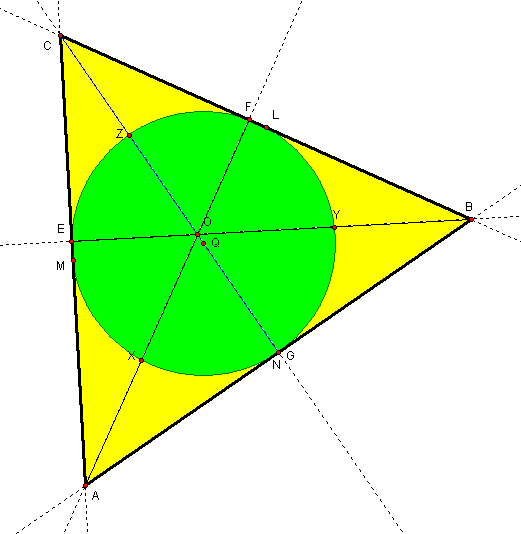
Constructing the nine-point circle is an interesting exercise in geometry. In the above triangle ABC, the segments inside the triangle are its three altitudes, with the “feet” of the altitudes labeled E, F, and G. The midpoints of the sides of the triangle are labeled L, M, and N. The orthocenter, where the three altitudes meet, is labeled O, and then the midpoints of the three segments connecting the orthocenter to each of the triangle’s vertices are labeled X, Y, and Z.

It has been long proven that these three sets of three points each (E, F, G; L, M, N; and X, Y, Z) lie on the same circle, for any triangle. Point Q is at the center of this nine-point circle.

The diagram above uses, as triangle ABC, a triangle which is both acute and scalene — and in such a triangle, the nine points in question are in nine different locations. Of course, triangles do not have to be acute and scalene — and for some other types of triangle, the nine points end up in fewer than nine distinct locations.

9PC obtuse scalene

Of other classifications of triangle, only this one, an obtuse and scalene triangle, still has the nine points in nine different locations. With other triangles, the number of such locations decreases.

As a next step, consider a triangle which is acute and isosceles:

9pc acute isos 8

The base of this isosceles triangle is segment AB, and it is on segment AB that two of the nine points end up in the same place. Point G, the foot of the altitude to the base, is at the same place as point N, the midpoint of the base. Since the other seven points remain distinct, this type of triangle has its nine points in eight locations.

9PC obtuse isosceles 8

Another triangle which has eight distinct “nine-point circle” points is the obtuse, isosceles triangle, for the same reason:  the foot of the altitude to the base (G) and the midpoint of the base (N) are in the same place. Eight is not the limit, though — this number can be reduced still further. As one attempts to do so, it doesn’t take long to figure out that there is no way to reduce this number to seven . . . but six is possible:

9pc equilateral 6

For the nine points under examination to end up in only six distinct locations, as seen immediately above, a triangle is needed which is equilateral (and equiangular as well, for you can’t have one without the other when dealing with triangles). In such a triangle, each side-midpoint ends up at the same place as an altitude-foot, providing three of the distinct six points. The other three are the midpoints of the segments connecting the orthocenter to each vertex. Also, it is only for this type of triangle that the orthocenter (O) is the center of the nine-point circle itself (Q). One might think that this type of triangle, being regular, would minimize the number of distinct locations for the “nine” points . . . but that is not the case.

9pc right scalene 5

To reduce this number below six, right triangles are needed. With a scalene right triangle, there end up being five such locations:  the midpoint of each side, the vertex of the right angle, and the foot of the altitude to the hypotenuse. However, five is not quite the minimum.

9pc right isosceles 4

If a right triangle is isosceles, rather than scalene, the foot of the altitude to the hypotenuse moves to the midpoint of the hypotenuse, and this reduces the number of distinct “nine-point circle” points to its absolute minimum:  four. Such a triangle is also called, of course, a 45-45-90 triangle. Interestingly, these four points may be used as the vertices of a square (not shown in the diagram above) which has an area exactly one-half that of triangle ABC. The proof of this is left as an exercise for the reader.

{Later edit, March 2018:  an alert reader pointed out to me that I “missed some obtuse [triangles] that have only eight or six points on the nine-point circle.” Good catch, F.D.!}