
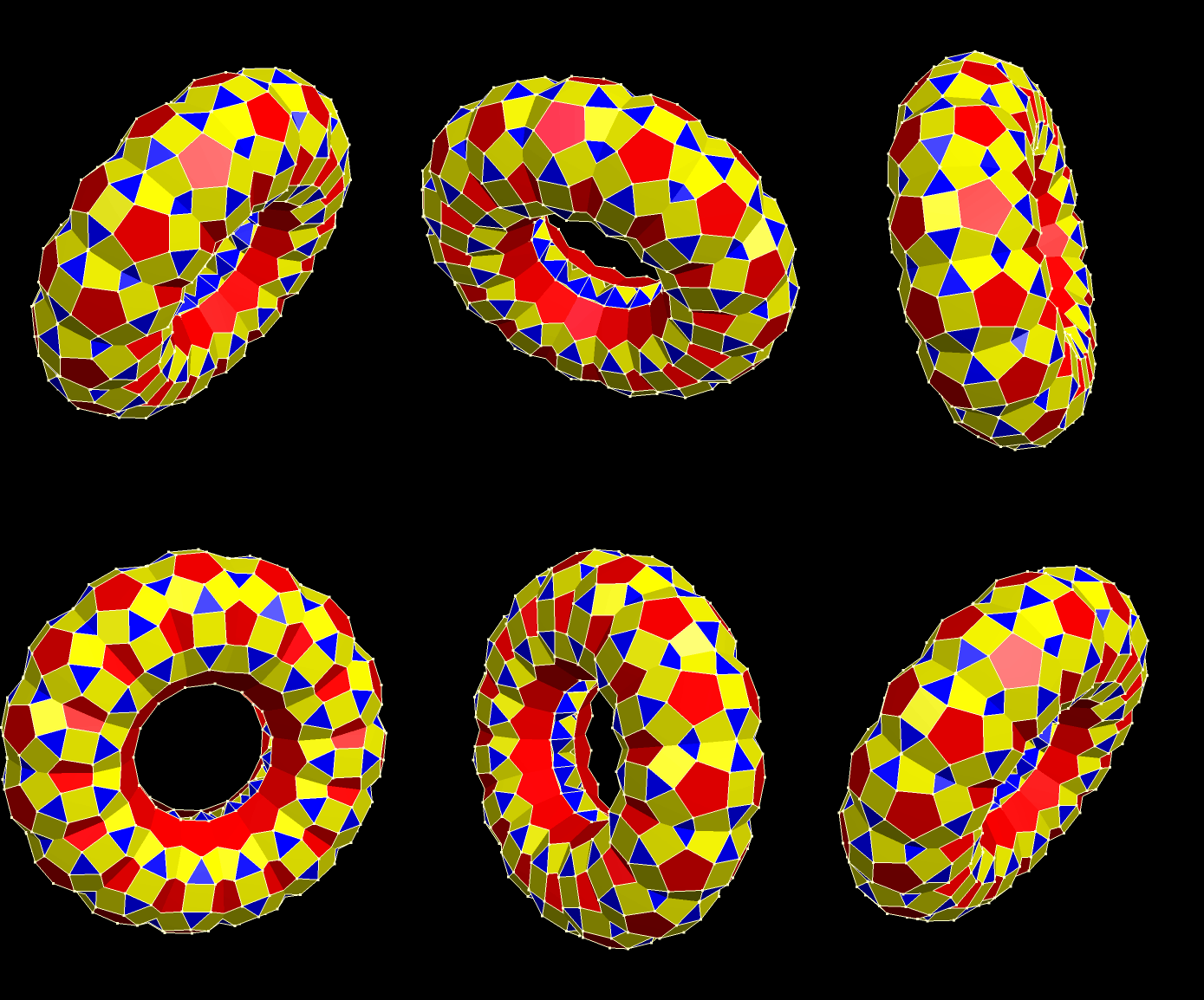
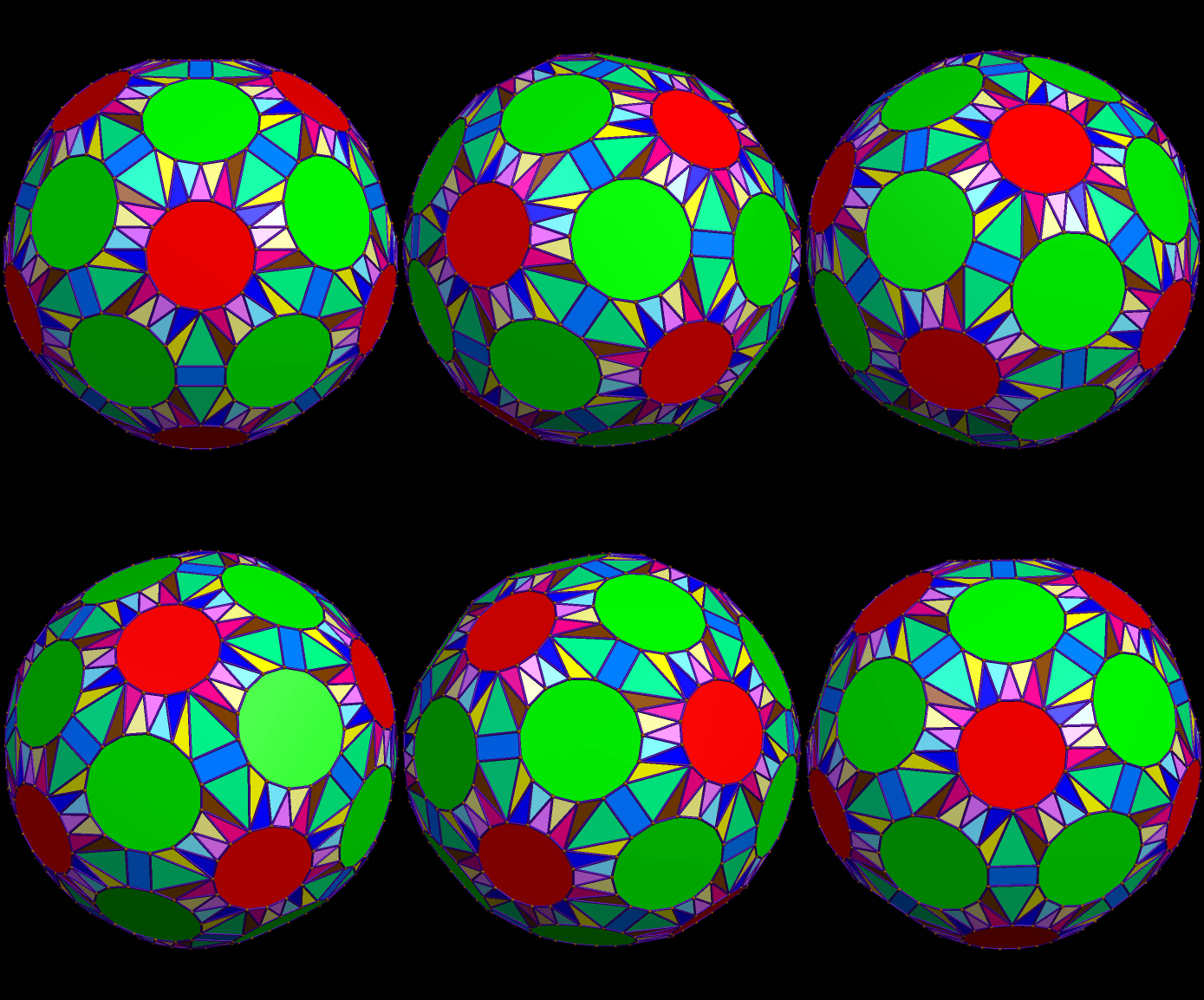
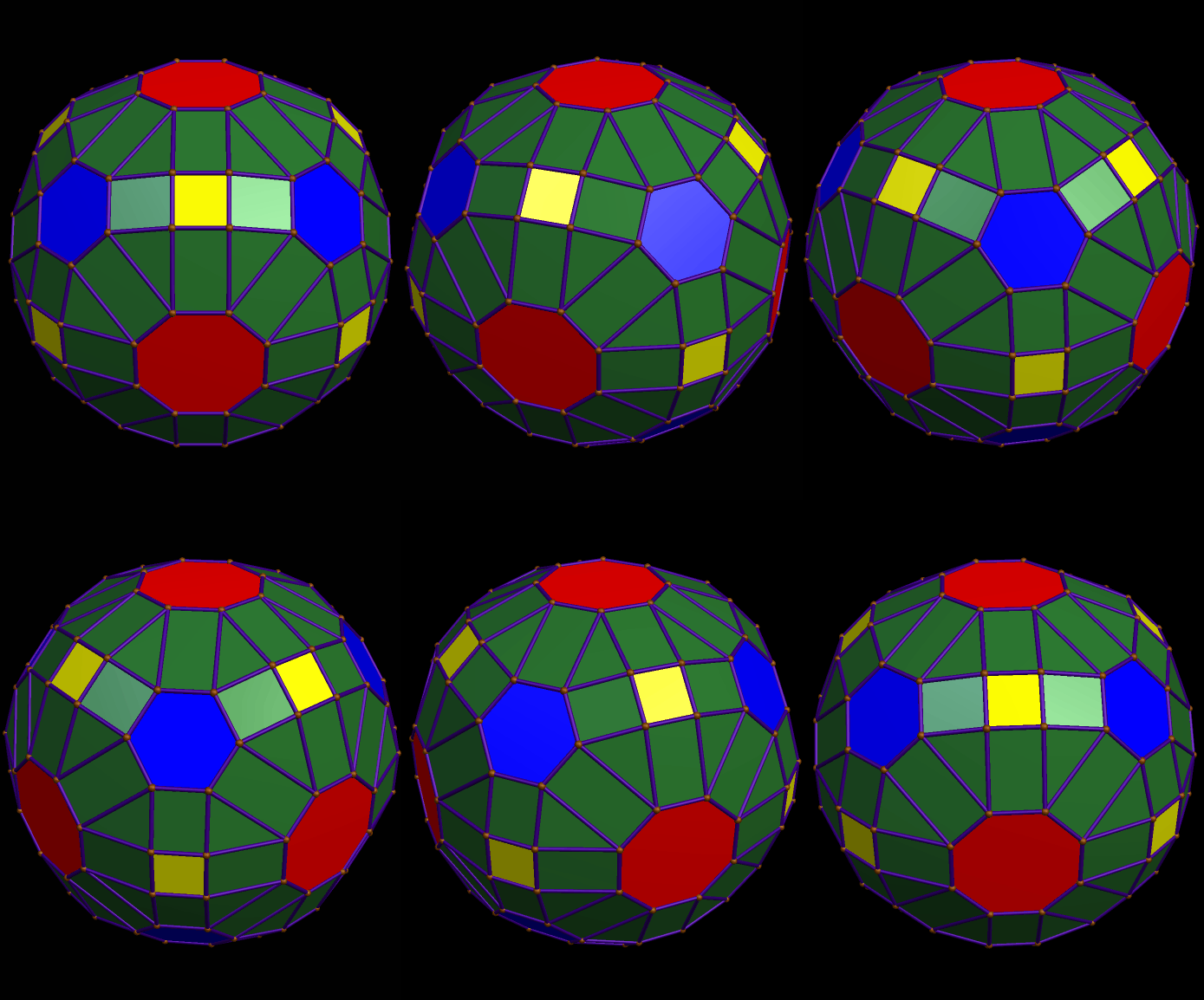
Itaumiped and Almausoped are artificial rogue planets, each an identical member of a double-planet system bound into orbit, and tidally-locked, by gravity. The energy source used by the planets’ inhabitants, which uses a radioactive isotope with a very long half-life, causes the faces of these hollow polyhedral planets to radiate heat and light, both on the inside and outside, which is why you can see them here, but do not see a “night” side on either planet.
Long ago, the common ancestors of the Itaumipedeans and the Almausopedeans, living on the natural planet Loorohmude where their species evolved, built each of these planets as a heavily-populated, multi-generational, interstellar colony-ship. They built two, using materials from large asteroids, and launched them together, for a perfectly good reason: if something happened to one of the planet-ships, the survivors could find refuge in the other one. A large pentagonal hole was even built into each planet’s polyhedral design, and set to face the other one, simply to allow ease of communication, and travel, between them. Their journey was to last “only” twelve generations . . . but things don’t always go as planned.
An idea took root, and spread during the long journey, that viewed the old stories of Loorohmude as primitive, dangerous superstitions, with no evidence to support their veracity — other than ancient written records, which the anti-Loorohmudeans viewed as dangerous fabrications. Civil war broke out on each planet, and the anti-Loorohmudeans achieved two of their goals: they killed a lot of their enemies (who returned the favor in kind), and they destroyed the ancient records, despite the attempts of their enemies to save them. On each planet, some of the inhabitants on each side survived — but, on both, the old records were utterly obliterated.
The information lost wasn’t all mere history for history’s sake, but also included essential technical material, such as instructions for building the device, while in transit, which would allow Itaumiped and Almausoped to slow their velocity in time to achieve orbit when they reached their destination, the distant planet Stidennatio. For this reason, this planned deceleration never happened, and the twin war-ravaged planets flew right past Stidennatio at a high fraction of the speed of light. Inertia carried them right through Stidennatio’s solar system, and into the uncharted space beyond. With civil wars still raging on each planet, however, the combatants took little notice of the solar system they rapidly flew through, and those few who did notice any of it did not understand what they were seeing.
The reduced populations of each planet, simply due to their smaller numbers, now had supplies for a much longer journey, and eventually, the civil wars stopped . . . because both sides ran out of long-range weapons. They could have continued fighting without weapons, or with such things as knives and clubs . . . but by that time, the population was so reduced, so dispersed, and so war-weary, that hostilities on each side simply dwindled slowly away.
It took a long time — just under three generations — for the smoke to clear, and the population to start to rebound. By this time, no one thought of themselves as pro- or anti-Loorohmudeans anymore, but simply as the descendants of the survivors of a terrible war.
Naturally, and gradually, everyone started looking for someone to blame for the atrocities that always accompany warfare. By this time, the ravages of war had rendered the exterior surfaces of both Itaumiped and Almausoped uninhabitable, so everyone lived in the hollow interiors of each planet-ship. From this inside vantage point, thanks to the pentagonal holes which were part of the original design, everyone could see one convenient scapegoat: the other planet, always in view, and close enough that evidence of habitatation could be seen with telescopes.
Lasers aren’t all that difficult to make, and so the first shot fired in the new, second period of warfare, between the planets this time, took the form of an intense pulse-laser blast exiting one pentagonal hole, and entering its counterpart. It destroyed the top of an abandoned building, and killed no one . . . but it was noticed, and so a retaliatory strike soon took the same path, but in the opposite direction. This time, there were fatalities. More weapons were built, and immediately deployed. Soon, full-scale interplanetary war was raging.
This new war won’t last forever. It may stop when supplies run out, to be followed by famine, or the supplies might hold out until everyone simply kills each other. Does it matter which of these outcomes happens? No, not really. Itaumiped and Almausoped passed their destination generations ago, and now they’re going nowhere, at a high rate of speed . . . in more than one way.
Unlike their inhabitants, though, the planet-ships Itaumiped and Almausoped, soon to be devoid of life, will continue much longer. Just as they have since their construction, they will keep orbiting their common center of mass, and keep getting further away from their original, long-forgotten launch point, as well as their intended destination, until the heat death of the universe finally catches up with them, as well.
###
Notes: Itaumiped (anagram for “I made it up”) and Almausoped (anagram for “also made up”) have different characteristics every time they appear. This is one of the nicer things about having my own imaginary astronomical objects — I don’t have to memorize things like planetary radius, mass, etc., because, since they’re mine to play with as I please, I can change their features according to my whims. For example, Almausoped was always previously depicted as the star orbited by Itaumiped. In this incarnation, however, there’s no star around. Also, Loorohmude is an anagram for “our old home,” and Stidennatio is an anagram for “destination.” The image that accompanies this story was created using Stella 4d, which you may try or buy at http://www.software3d.com/Stella.php.






 RobertLovesPi.net