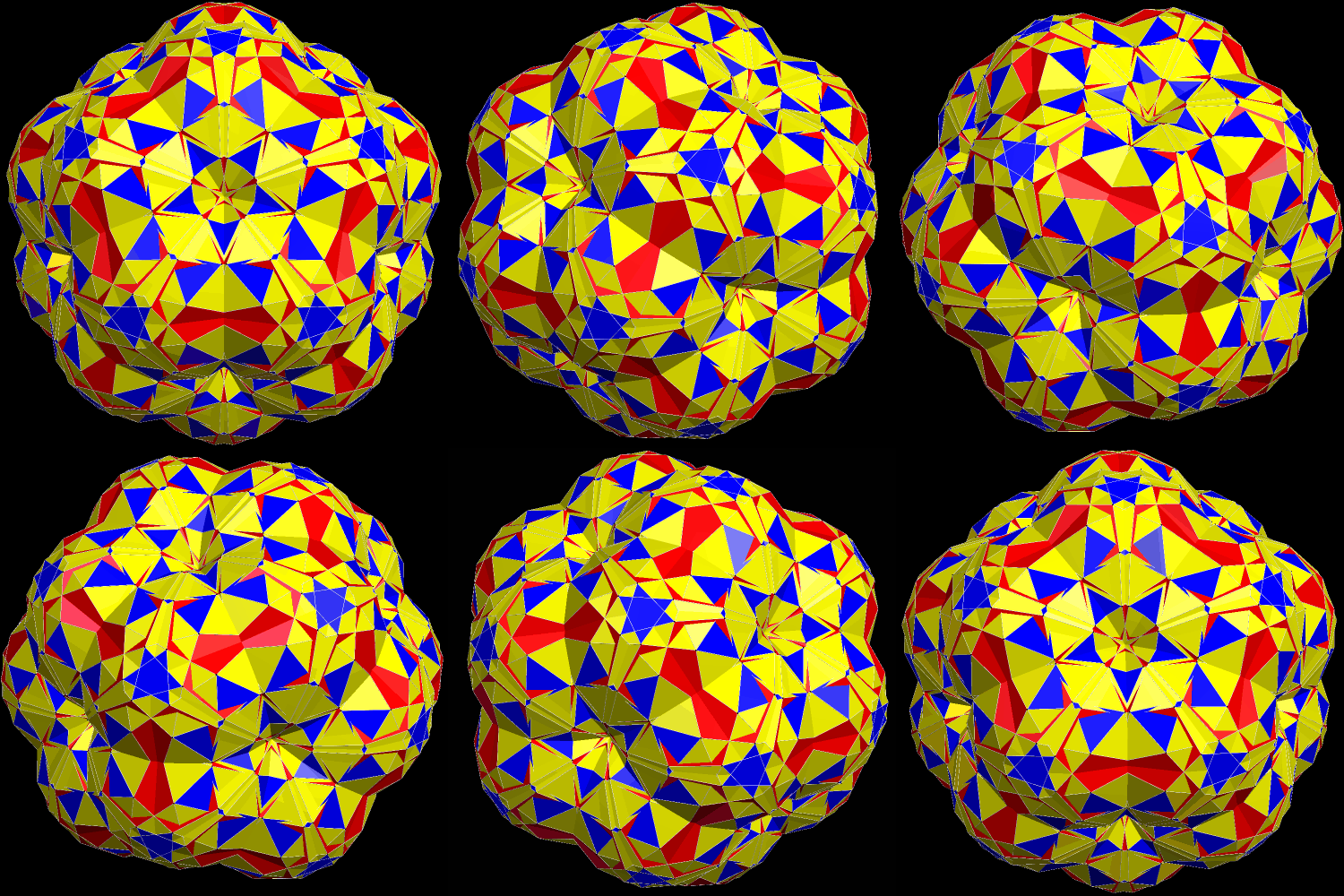
Sharp-eyed, regular readers of this blog will notice that this is the same polyhedron shown in the previous post, which was described as the “final stellation of the compound of five cubes,” due to the coloring scheme used in the first image there, which had five colors “inherited” from each of the differently-colored cubes in the five-cube compound. This image, by contrast, is shown in rainbow-color mode.
How can the rhombic triacontahedron and the compound of five cubes have the same final stellation? Simple: the compound of five cubes is, itself, a member of the stellation-series of the rhombic triacontahedron. Because of this, those two solids end up at the same place, after all possible stellations are completed, just as you will reach 1,000, counting by ones, whether you start at one, or start at, say, 170.
I am grateful to Robert Webb for pointing this out to me. He’s the person who wrote Stella 4d, the software I use to make these images of rotating polyhedra. His program may be found at http://www.software3d.com/Stella.php — and there is a free trial version available for download, so you can try Stella before deciding whether or not to purchase the fully-functioning version.
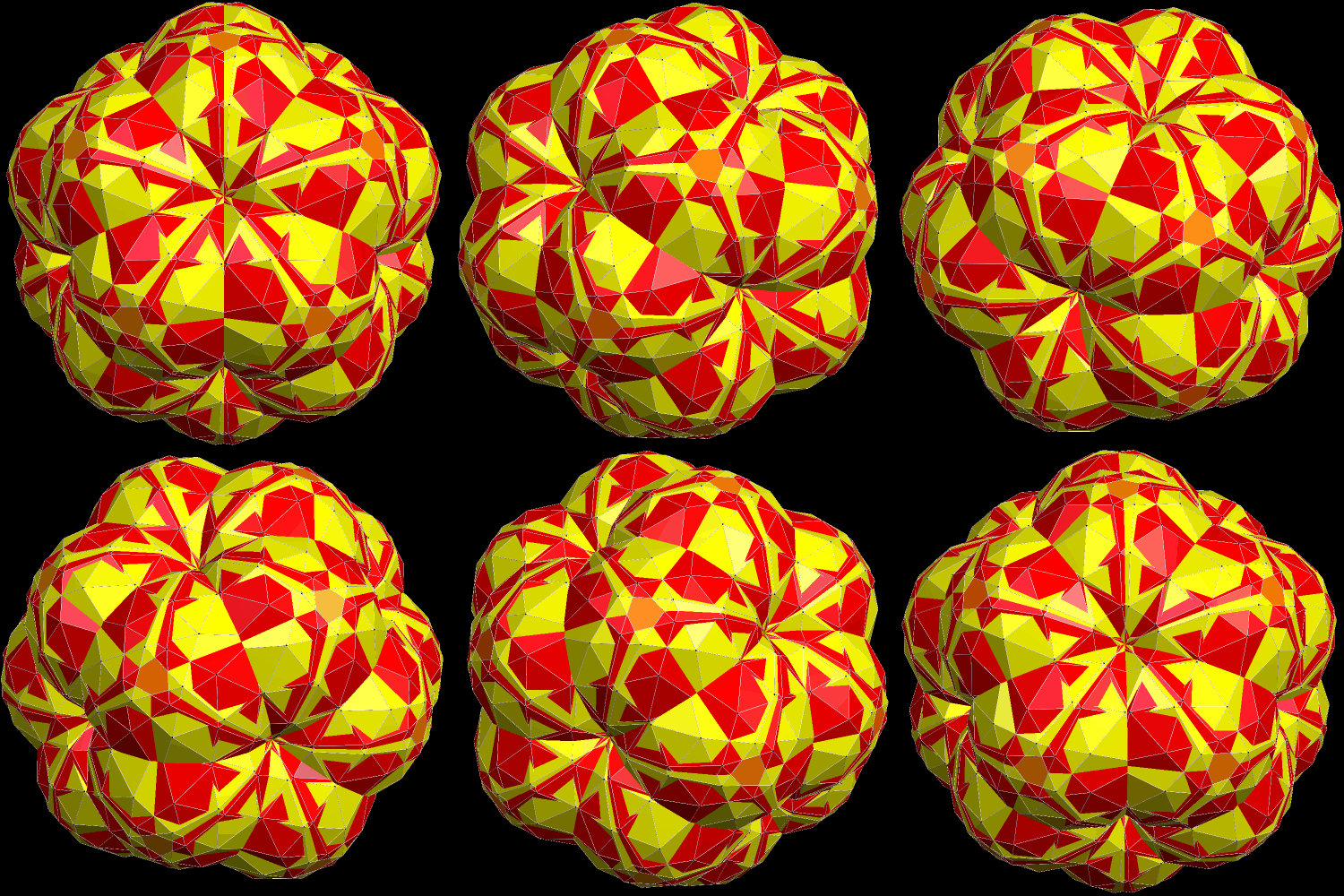
Since faceting is the reciprocal process of stellation, the dual of the polyhedron above is a faceted icosidodecahedron, for the icosidodecahedron is the dual of the rhombic triacontahedron. Here is an image of that particular faceting of the icosidodecahedron, colored, this time, by face-type:
The version of the final stellation of the compound of five cubes shown above has its colors derived from the traditional five-color version of the original compound, itself. The one below, by contrast, has its colors selected by face-type, without regard for the original compound.
Both of these virtual models were created with Stella 4d: Polyhedron Navigator, software available at this website. Also, for more about this particular polyhedron, please see the next post.
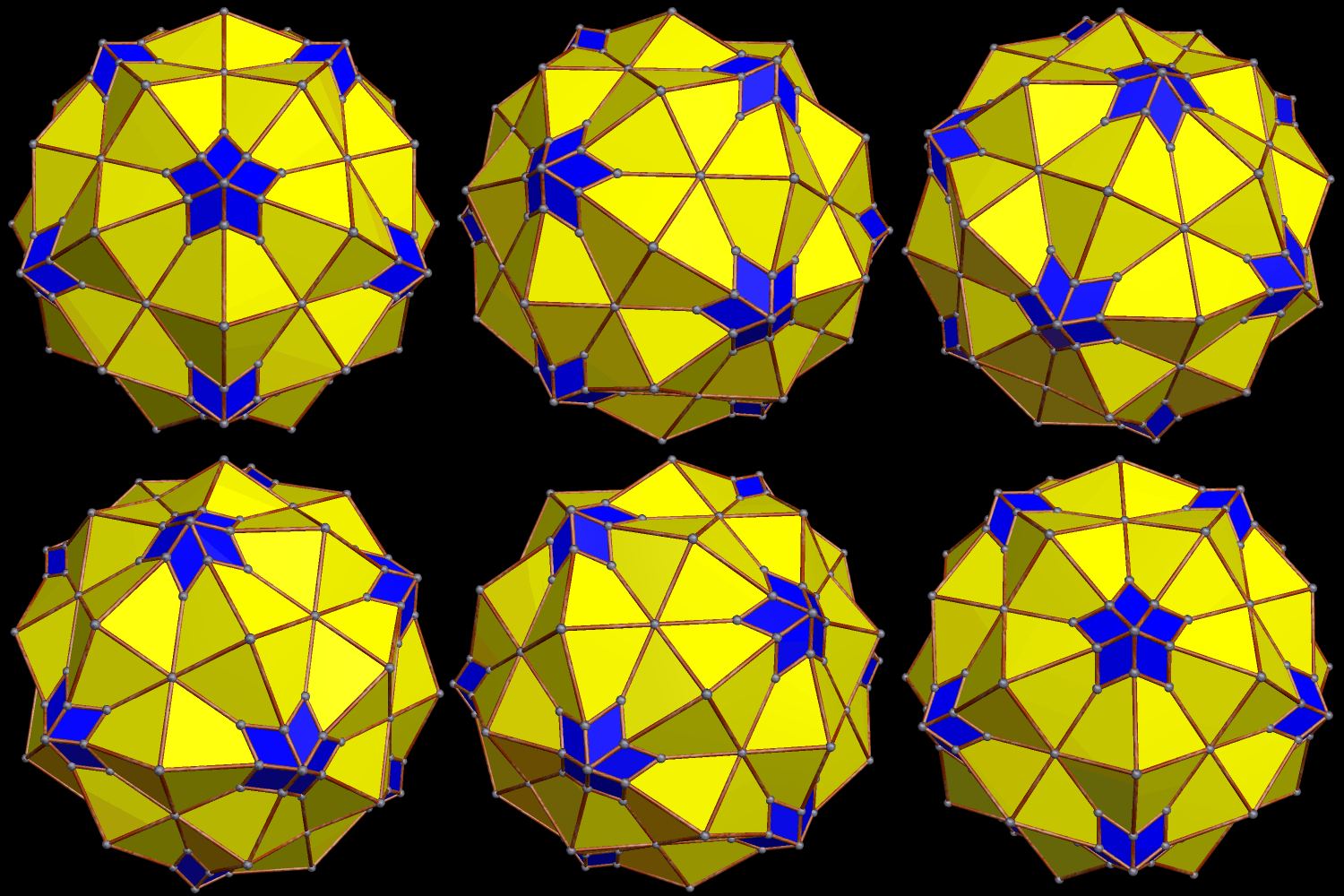
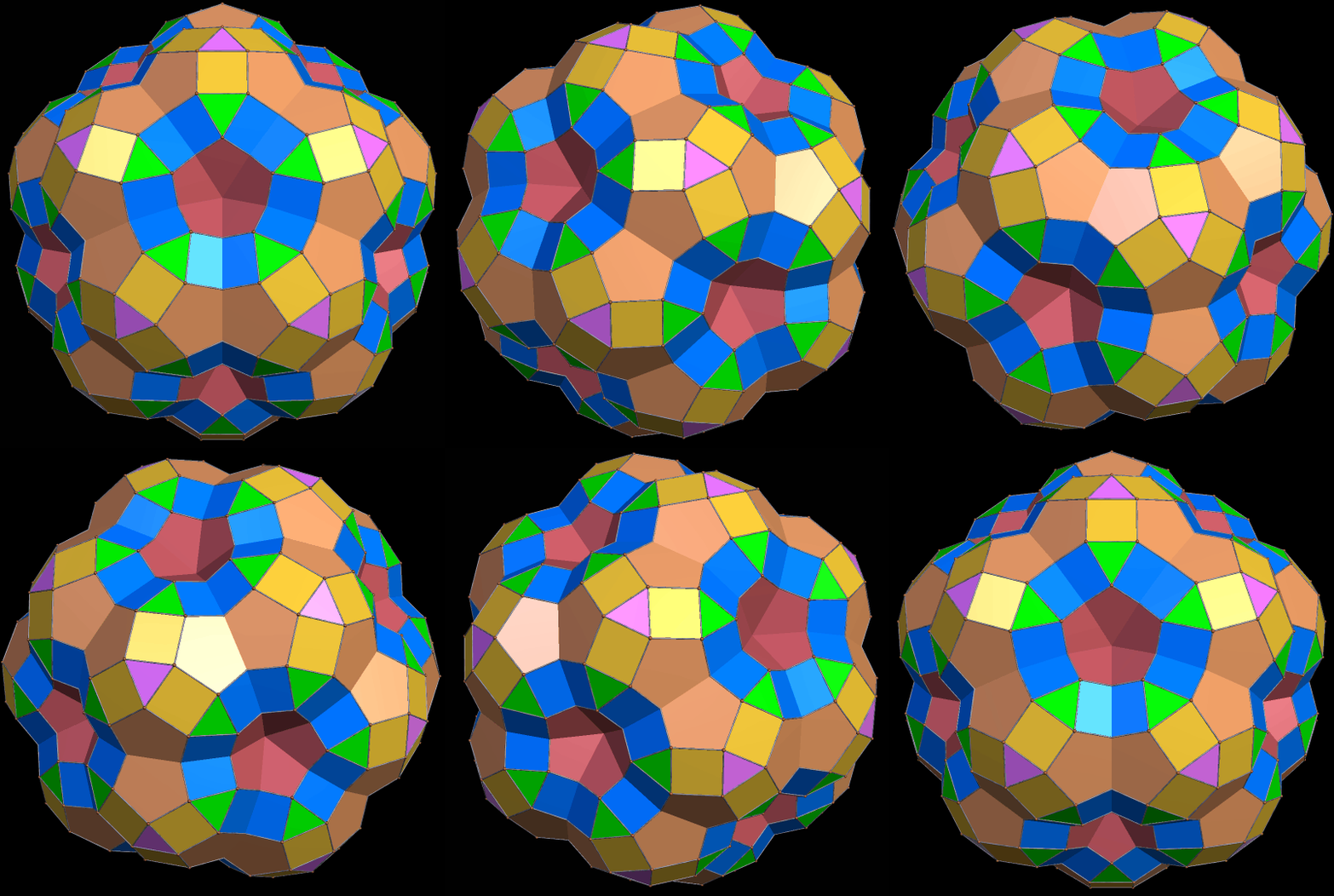
To make a faceted version of the rhombicosidodecahedron, one first (1) starts with a rhombicosidodecahedron, one of the Archimedean solids, then (2) removes the faces and edges of this polyhedron, leaving all the vertices in place, and then (3) connects these vertices in a different way than they were connected in the original polyhedron, forming new edges and faces. Faceting is the reciprocal operation to polyhedral stellation.
This polyhedron was made using Stella 4d, software available here.
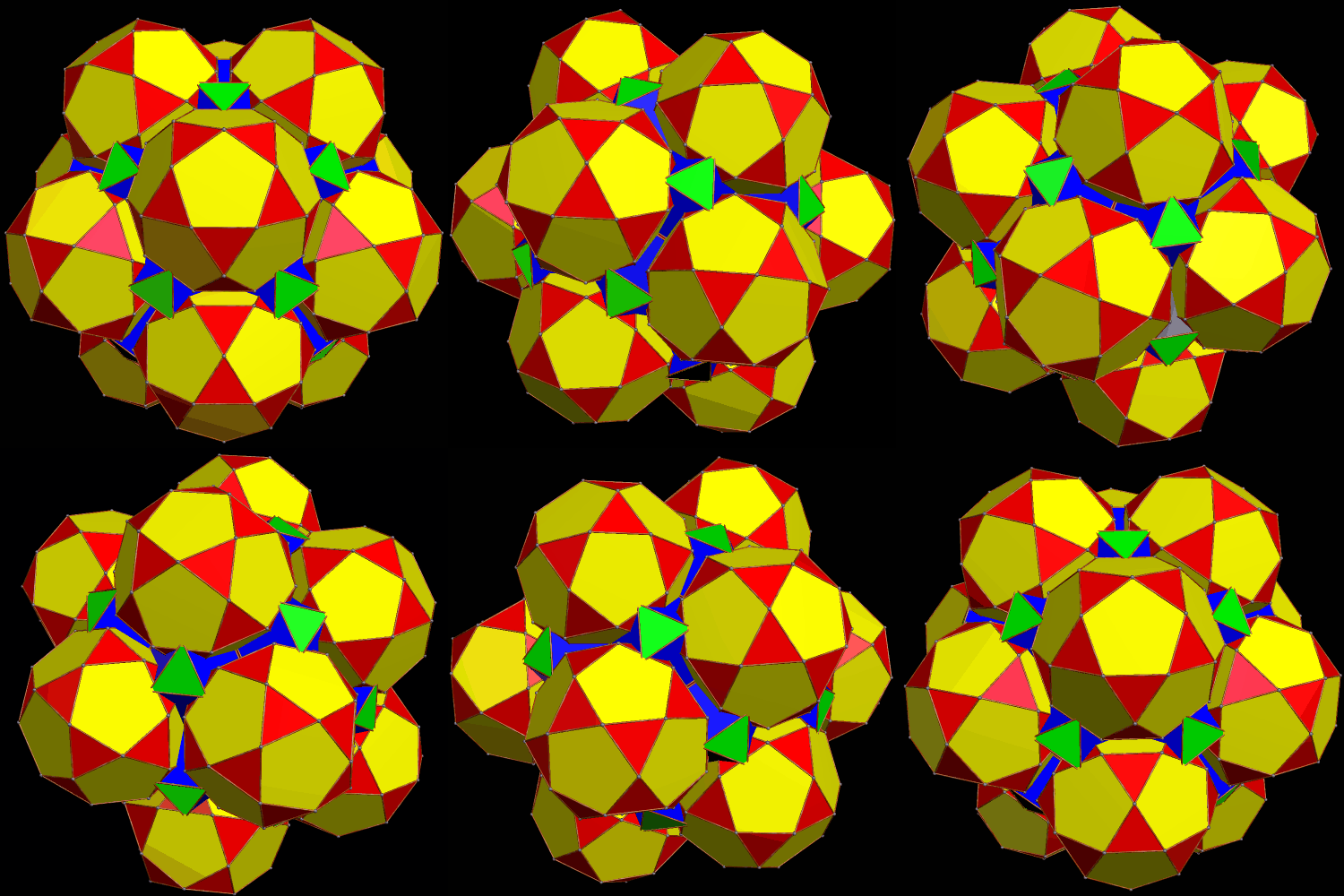
Because the snub dodecahedron is chiral, the polyhedral cluster, above, is also chiral, as only one enantiomer of the snub dodecahedron was used when augmenting the single icosahedron, which is hidden at the center of the cluster.
As is the case with all chiral polyhedra, this cluster can be used to make a compound of itself, and its own enantiomer (or “mirror-image”):
The image above uses the same coloring-scheme as the first image shown in this post. If, however, the two enantiomorphic components are each given a different overall color, this second cluster looks quite different:
All three of these virtual models were created using Stella 4d, software available at this website.
I made this compound using software called Stella 4d: Polyhedron Navigator. This program may be purchased (or a trial download tried for free) at this website.
All four of these rotating images were created using software called Stella 4d: Polyhedron Navigator. You can buy this program, or try it for free, at this website. Faceting is the inverse function of stellation, and involves connecting the vertices of an already-established polyhedron in new ways, to create different polyhedra from the one with which one started. For each of these, the convex hull is the great rhombcuboctahedron, itself.
Above and below, you will find two different coloring-schemes for this particular cluster of polyhedra. I made both of these rotating images using Stella 4d, software you can buy, or try for free, right here.
A model this complex would have taken days to build by hand. With software called Stella 4d: Polyhedron Navigator, however, making this “virtual model” was easy. This program is available for purchase at this website — and there is a free trial download available there, as well.
I’ve been a fan of John Lennon for as long as I can remember, and October 9, his birthday, has always been a special day for me. In 1983, when I was a high school junior, celebrating his birthday changed from something I simply did, by choice, into what, at the time, I considered a moral imperative.
In October of ’83, I was a student — a junior — at McClellan High School in Little Rock, Arkansas, and October 9th happened to be the day that all juniors were, according to that school’s administration, required to take the ASVAB: the Armed Services Vocational Aptitude Battery. While this is a standardized test, it isn’t like other standardized tests — it is actually a recruitment tool for the United States military.
At the time, Ronald Reagan was president, and we were in one of the many scary parts of the Cold War, with the threat of global thermonuclear war looming over us at all times. If you are too young to remember the Reagan era well, it may be hard to understand just how real, and how scary, it was to grow up with a president who did such things as making “jokes,” like this, in front of a microphone:
Reagan made this extremely unfunny “joke” the next year, in 1984, but the climate of fear in which he thought such a thing would be funny was already firmly in place in 1983, and I was already openly questioning the sanity of our president. My own anti-war attitudes, very much influenced by Lennon and his music, were already firmly in place. For the few unfamiliar with it, here is a sample of Lennon’s music.
So here I was, a high school junior, being told I had to take a test, for the military, on John Lennon’s birthday. I reacted to this in pretty much the same way a devout Jew or Muslim would react to being told to eat pork chops: I absolutely refused to cooperate. “Blasphemy” is not a word I use often now, and it wasn’t then, either, but to cooperate with this would have been the closest thing to blasphemy which I was capable of understanding at that age (I was 15 years old when this happened).
The other juniors got up and shuffled off, like good, obedient soldiers, when the intercom told them to go take the ASVAB. I simply remained seated.
The teacher told me it was time to go take the ASVAB. I replied, calmly, that no force on earth could compel me to take a test for the military on John Lennon’s birthday. At that point, I was sent to the office. Going to the office posed no ethical nor moral dilemmas for me, for I wanted the people there to know, also, that it was wrong for them to give a test for the military on October 9, of all days.
The principal, a man already quite used to dealing with me and my eccentricities, knew it would be pointless to argue with me about the ASVAB. He simply showed me a chair in the main office, and told me I could sit there that day, all day, and I did. To the school, this might have been seen as a single day of in-school suspension, but I saw it for what it really was: a one-person, sit-down protest for peace, in honor of the greatest activist for peace the world has ever known. It was an act of civil disobedience, and I regret nothing about it.
I will be sharing this story with Lennon’s widow, Yoko Ono, a woman I very much admire, and the greatest living activist for peace in the world today. Yoko, I do hope you enjoy this story. You and John have done great things, and they will not be forgotten, as long as people remain alive to tell about them.
Peace to all.
[Credits: photo from rollingstone.com; videos from YouTube.]
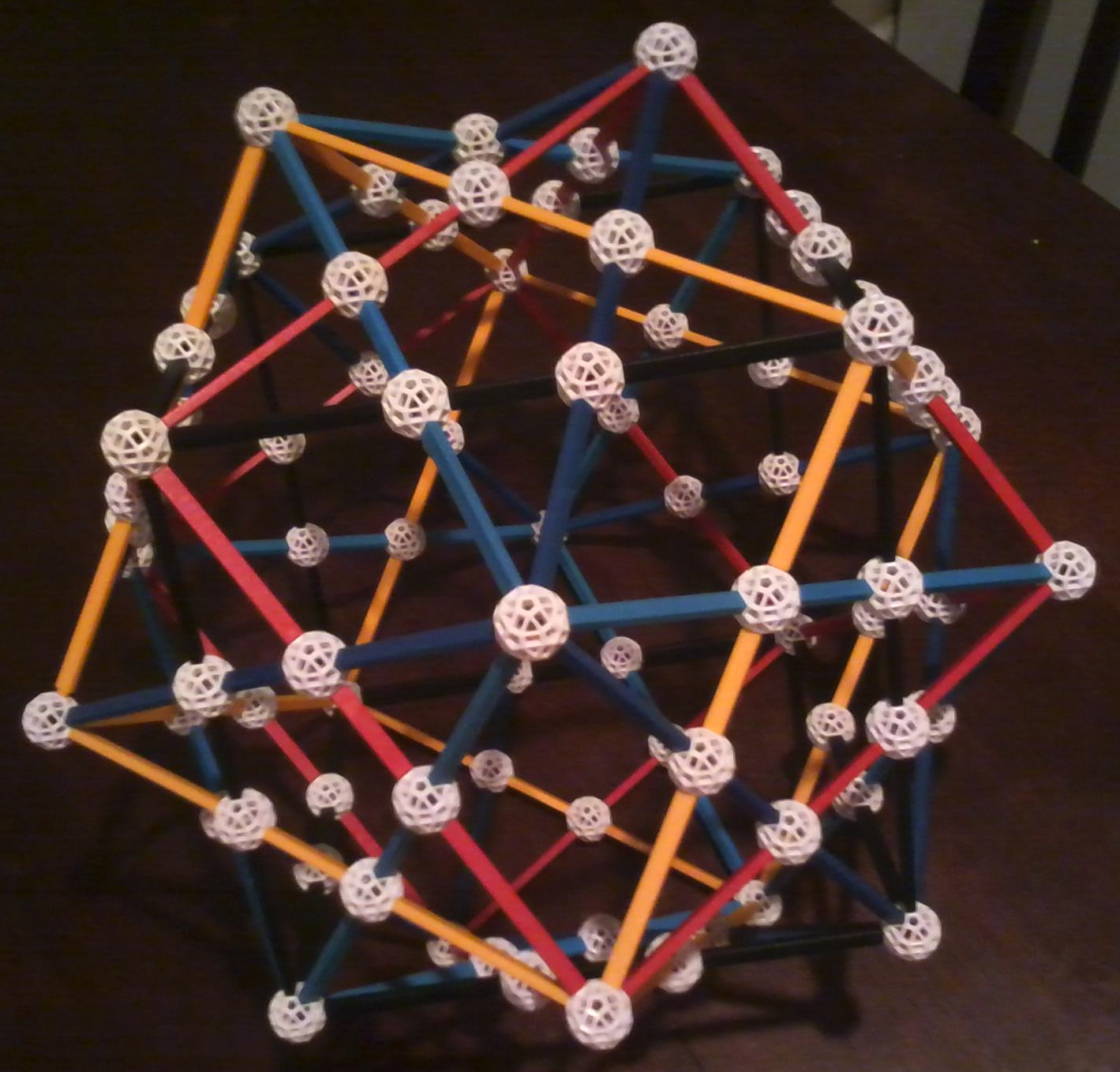
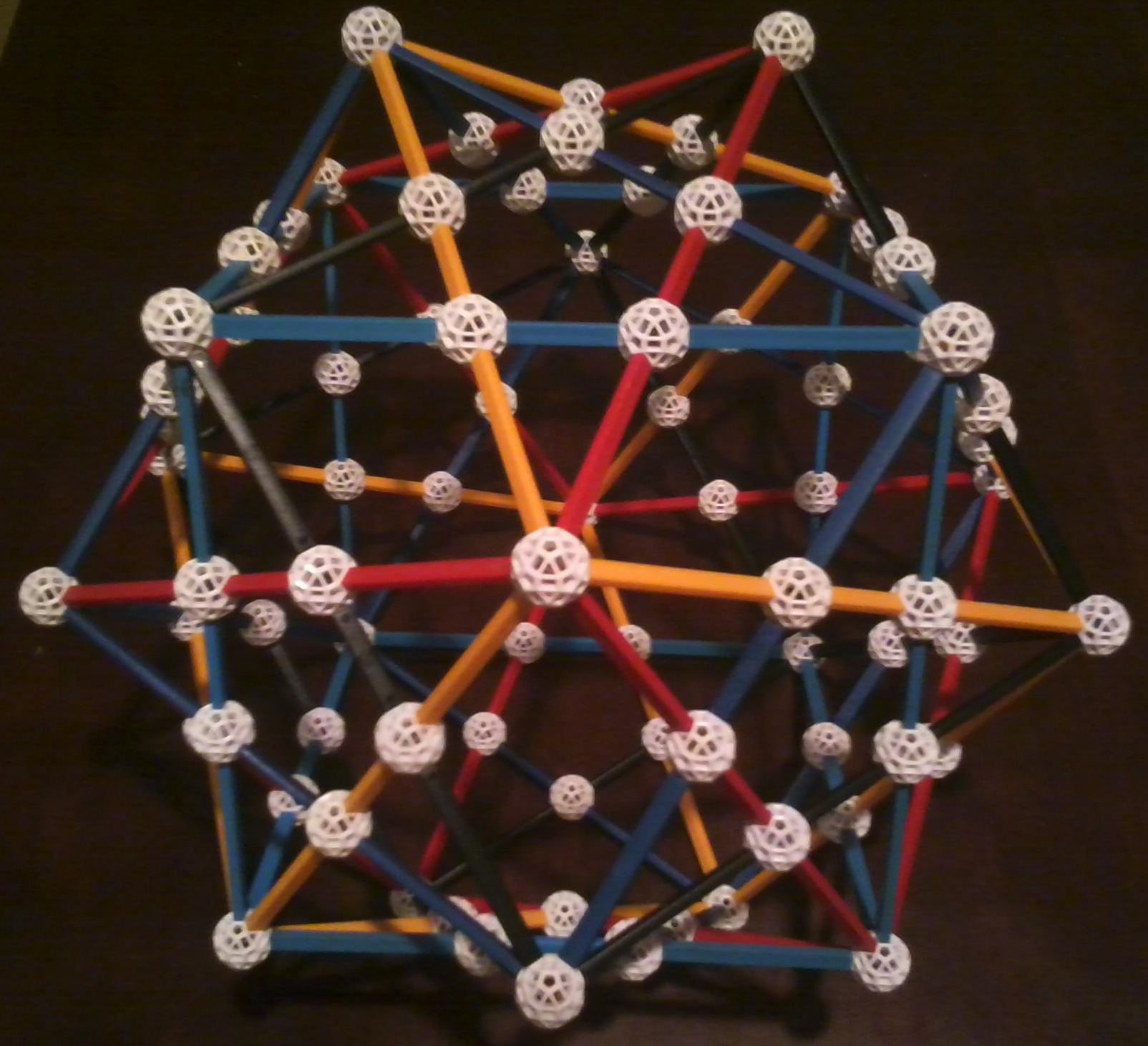
Ordinarily, with Zometools, the compound of five cubes is an all-blue model. However, I wanted to build one in which each cube is a different color, so I made a special request to the Zometool Corporation (their website: http://www.zometool.com) for some off-color parts, to make this possible.
The five colors used in this model are standard blue, a darker shade of blue, red, yellow, and black.
I also received the struts needed to build this model with one cube in white, so I will be making a second version of this soon. I didn’t want the Zomeballs used to match any strut color, though, so I will have to wait for the shipment of purple Zomeballs I ordered, today, to arrive, before I can build that model.
Zome is a fantastic tool to use for mathematical investigations, as well as education, and other applications as well. I recommend this product highly, and without reservation.










 RobertLovesPi.net