Near-Miss Candidate Update #1

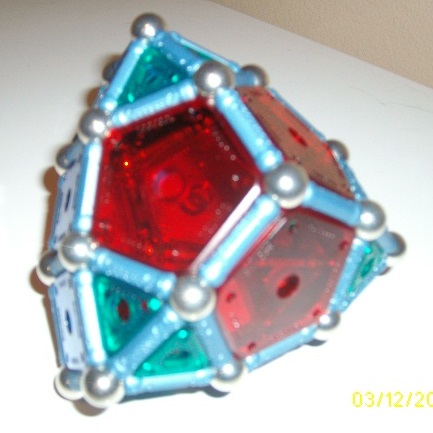
With help from friends on Facebook, I was able to figure out how to make the second of the near-miss candidates in the last post, using Stella 4d: Polyhedron Navigator, a program available here. This is quite helpful, for Stella has a “measurement mode” than lets me determine just how far off from regularity a given polyhedron is. This is what the “unbelted” polyhedron from the last post looks like, with the pentagons regular:

near near miss

In this polyhedron, although the pentagons are regular, the triangles are scalene, with angles measuring ~55.35, ~60.81, and ~63.84 degrees. Of the three edge lengths needed for this, the longest is ~9.1% longer than the shortest, and the triangles are definitely non-regular — by visual inspection alone. It is possible to “tidy up” the triangles a bit, but only at the cost of making the pentagons visibly irregular. This is enough to make the call on the “unbelted” near-miss candidate from the last post — it’s a “near near miss,” not a true “near miss.”

All polyhedra in the last post, as it turns out, are related to another near-miss, the discovery of which I had nothing to do with. It has six pentagonal faces, and four which are quadrilaterals. This near-miss may be found here: http://www.mathcurve.com/polyedres/enneaedre/enneaedre.shtml.

[Note: see the next post, also, for more about these polyhedra.]
Two (New?) “Near-Miss” Candidates

Yesterday, I played for the first time with GeoMag toys, which I recently purchased. I was quite surprised to have what I believe to be a near-miss to the Johnson solids appear before me, one I’ve never seen, within just a few minutes:

SANYO DIGITAL CAMERAHere’s what it looks like, when viewed from two other angles.

The faces of this three-fold dihedral polyedron are six pentagons, twelve triangles, and nine quadrilaterals. The fact that it has been proven that only 92 Johnson solids exist means that all of these faces cannot be regular. However, the irregularity is so small that I could not detect it in this model.

Next, I used Polydrons to build a net of this near-miss candidate.

SANYO DIGITAL CAMERA

What to do next was obvious: remove the “belt” of nine quadrilaterals, creating a net for a second near-miss candidate.

SANYO DIGITAL CAMERA

Having constructed this net, I then returned  GeoMags to build a 3-d model of this second, “unbelted” near-miss candidate.

I then wondered if I could make a third such solid by removal of the triangles, all of which appeared to be the lateral faces of pyramids.

Could I remove them? Yes, and I did so. Did this create a third near-miss candidate? No. The resulting polyhedron, shown immediately above, is non-convex, and therefore cannot be a near-miss. The faces with dihedral angles greater than 180° are the triangle-pairs found where the pyramids were in the previous model.

With the “belted” and “unbelted” polyhedra before this non-convex non-candidate, the next step is to share them with other polyhedra enthusiasts, get their input regarding the question of whether these are genuine near-misses, and see if these polyhedra have already been found, unknown to me, by someone else. 

[Update: please see the next two posts for more on these near-miss candidates.]