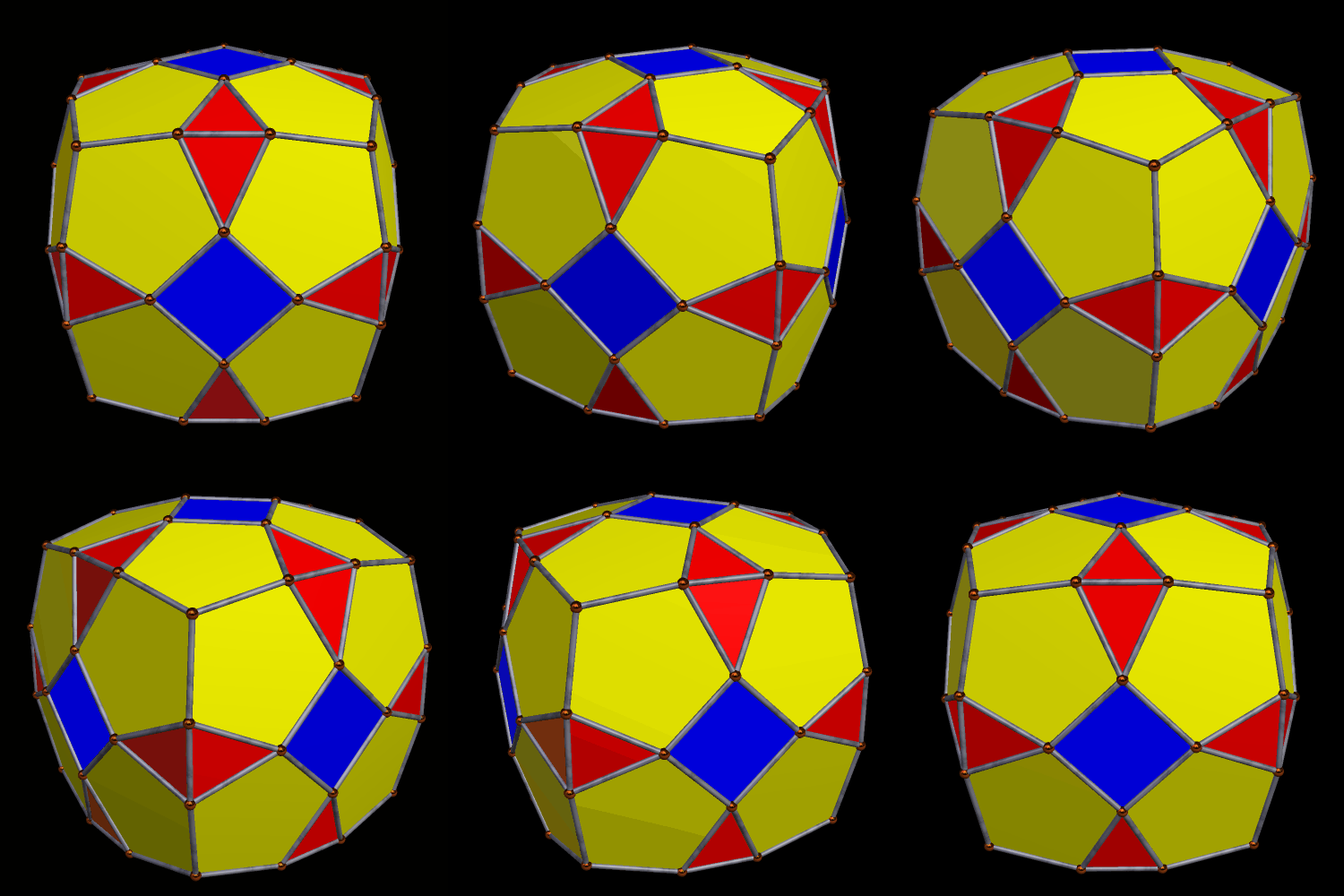
I made this while playing around with Stella 4d, a program you can try for free at http://www.software3d.com/Stella.php.
I made this while playing around with Stella 4d, a program you can try for free at http://www.software3d.com/Stella.php.
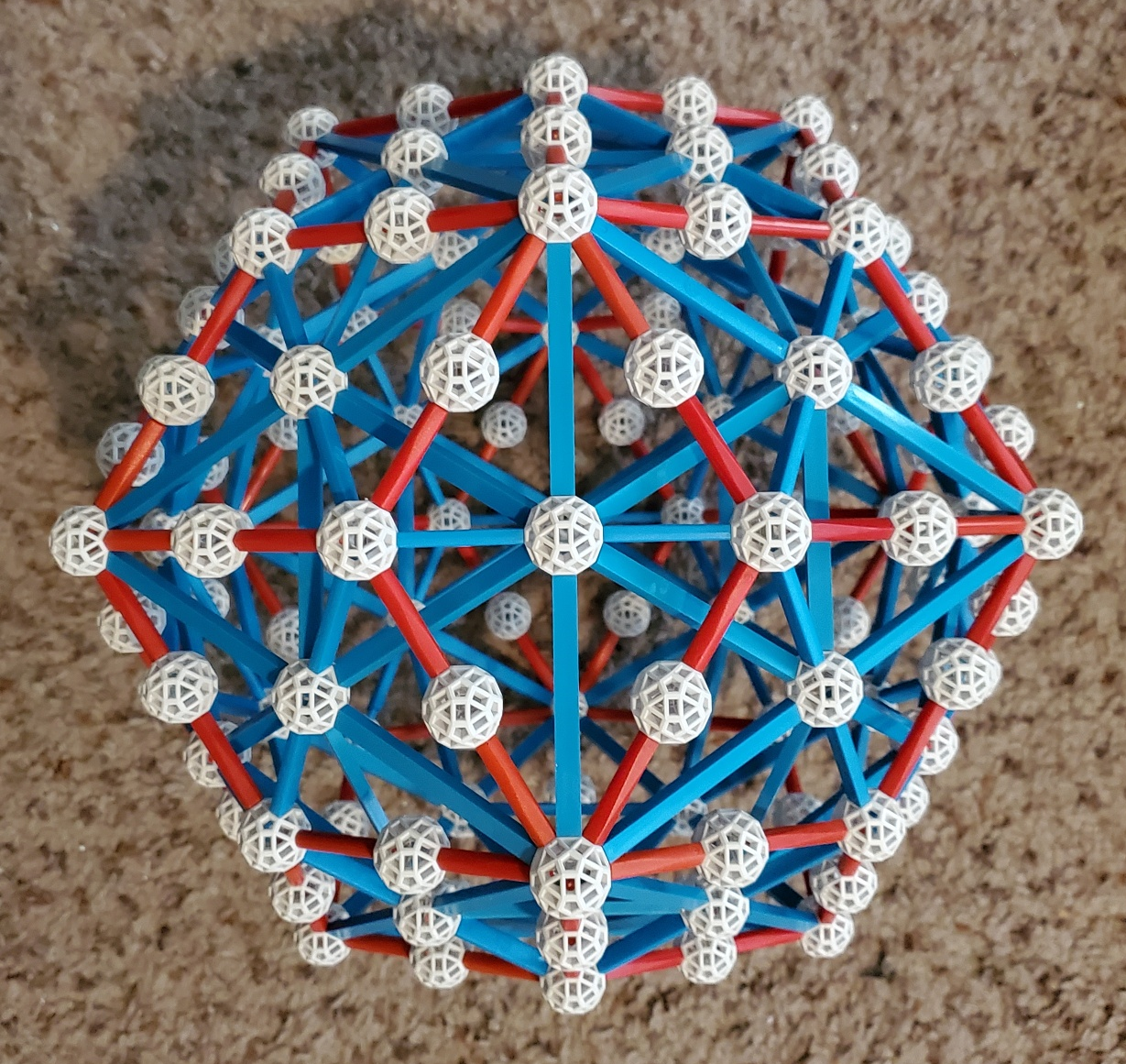
The four polyhedra in the Zome structure above are well-known. Two are Platonic solids, one is an Archimedean solid, and one is a Catalan solid. When you think you’ve found all four, you can scroll down to check your answers.
.
.
.
.
.
.
.
.
.
.
.
.
.
The four polyhedra are the icosahedron (blue), the dodecahedron (blue), the icosidodecahedron (blue), and the rhombic triacontahedron (red). Also, if you’d like to try Zome for yourself, or your children, the website to visit is http://www.zometool.com.

You can get Zome for yourself (or your kids) at http://www.zometool.com.
If you want to get Zome of your own, the website to visit is http://www.zometool.com.
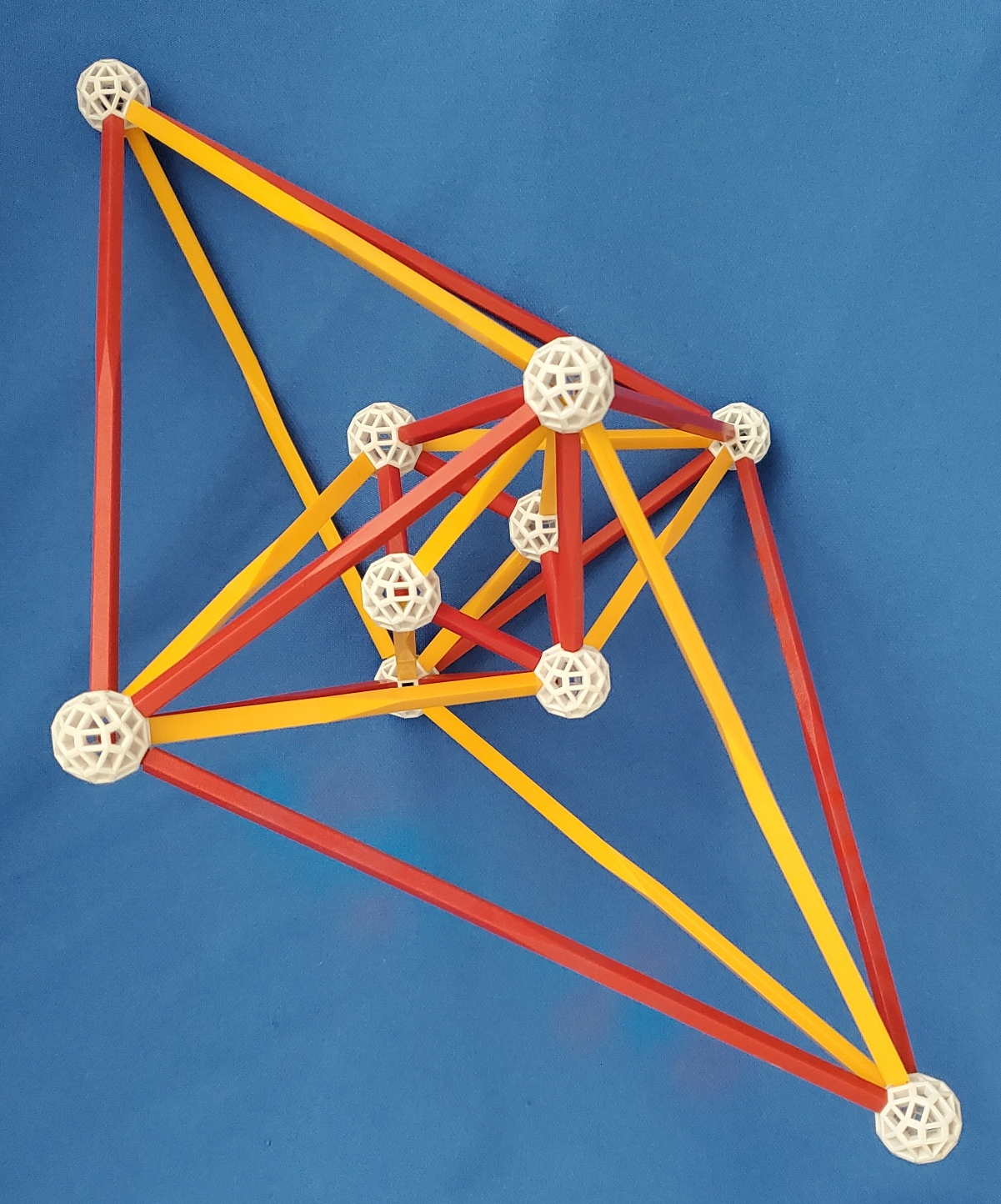
Here’s an icosahedron.

Here is is again, with prisms attached to each face. The prisms are 2.1 times as long as the triangle-edges.

This is a Stewart G3.
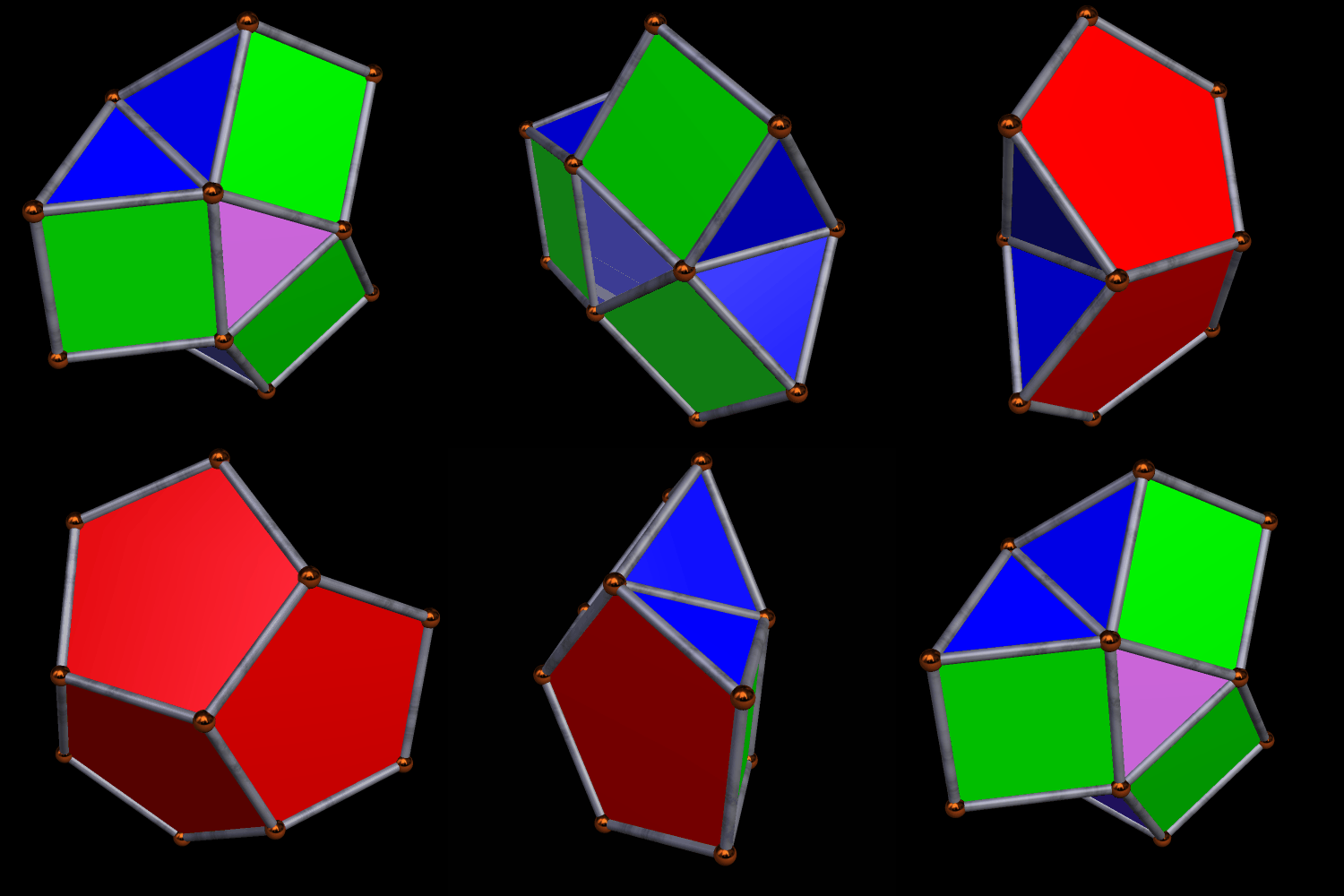
The final step is to attach these Stewart G3s to the ends of the long prisms shown above.

I think I’ll stop there. All these polyhedron-manipulations were performed using Stella 4d: Polyhedron Navigator, which you can try for free at http://www.software3d.com/Stella.php.
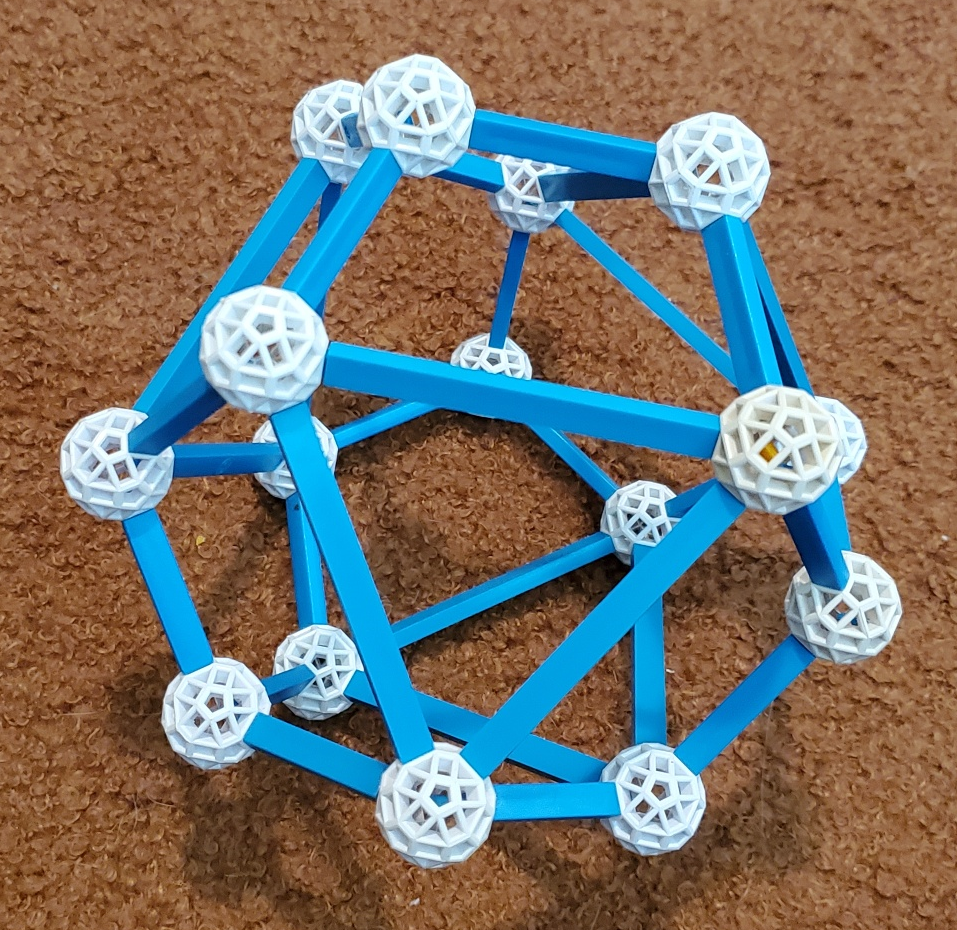
This is the tetrahedrally-diminished dodecahedron, which can be formed from the Platonic dodecahedron by using faceting. In this case, I used Zometools. If you’d like to look into buying some Zome of your own, the website to visit is http://www.zometool.com.

Stellating polyhedra is one of the things Zome was invented for. The images below are two different rotations of a stellated tetrahedrally-diminished dodecahedron.


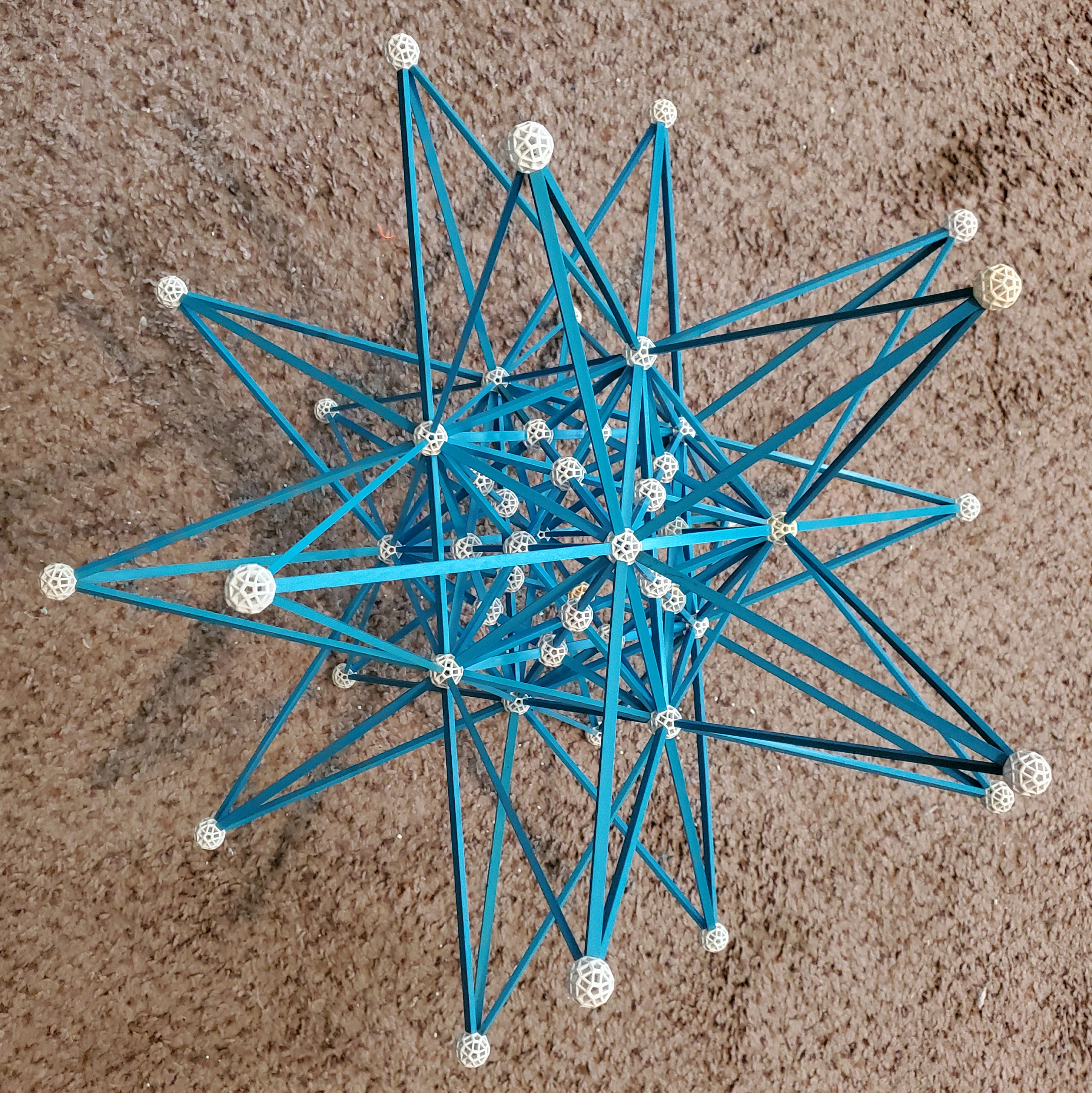
In the center of this figure is a regular dodecahedron, but it’s hard to spot. It is then stellated to form a small stellated dodecahedron. Next, its outer vertices are joined by new edges: those of an icosahedron. This also results in the formation of a great dodecahedron. Finally, the icosahedron is stellated to form the great stellated dodecahedron. To take this further, one could connect the outer vertices with new edges: those of a dodecahedron. The entire process can begin again, then, and this could continue without limit, filling all of space.
Here’s a closer view of the interior:

Zometools may be purchased at http://www.zometool.com.
Just as I was about to take this picture of my latest Zome structure, Bandit the Cat slipped in through the all-blue decagonal hole where his tail is still located. He stayed in it until it had been thoroughly inspected, then slipped back out. He did this without causing the slightest bit of damage to the model.
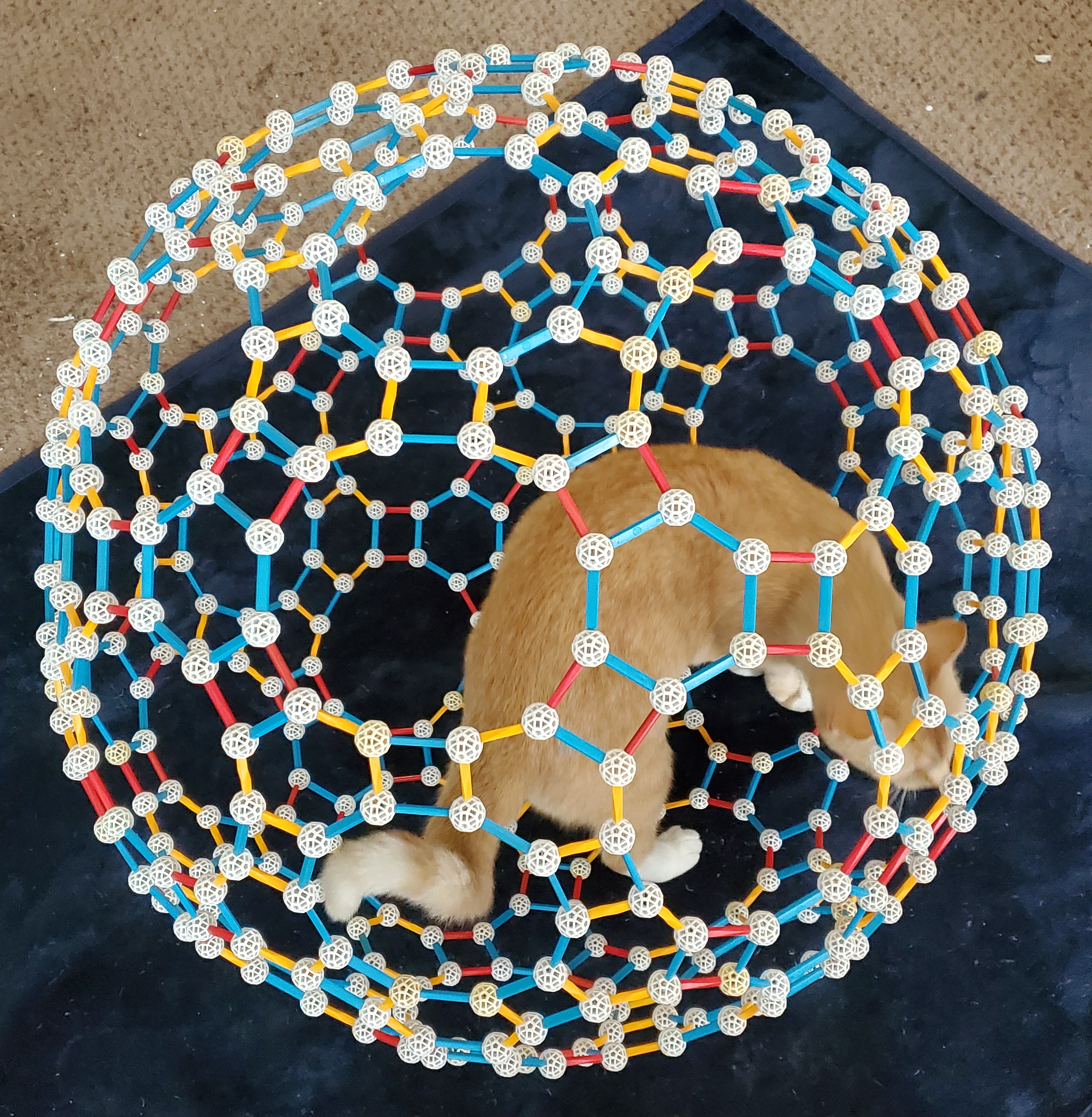
This zonohedron has 242 faces, and is the largest convex polyhedron which can be built with only R0, B0, and Y0 Zome parts. It’s 67 cm tall. If made of all-1 struts, instead of zeroes, it is 1.08 m tall. With all size-2 struts, it is 1.75 m tall. I’ve actually built the “2” version, many times, with students. It requires a lot of support during construction, so that it does not collapse under its own weight. At one point, when teaching at Arkansas Governor’s School, we built one, and got eleven people inside it before it fell. People, unlike cats, generally enter through the multicolored dodecagonal holes.
The Zometool company (http://www.zometool.com) doesn’t make size-3 struts any more, but I still have some left from when they did. This zonohedron made of “3” struts would be 2.84 m tall, which is over nine feet. I may try to built one someday, but not today.
 RobertLovesPi.net