Unknown's avatar

About RobertLovesPi

I go by RobertLovesPi on-line, and am interested in many things, a large portion of which are geometrical. Welcome to my own little slice of the Internet. The viewpoints and opinions expressed on this website are my own. They should not be confused with those of my employer, nor any other organization, nor institution, of any kind.

The Compound of the Dodecahedron and the First Stellation of the Icosahedron

compound of dodeca and ike's first stellation.gif

I made this using Stella 4d, available here.

A Transparent Rhombic Dodecahedron

hollow rd

Created using Stella 4d, a program available at this website: http://www.software3d.com/Stella.php.

A Music Video: Janis Joplin’s “Mercedes Benz”

“A song of great social and political import” from the 1960s, as well as a fun song for which to make a music video — or sing, a capella, in public, loudly and obnoxiously. =D

A Peek Backwards, as Far Back as Possible

peek

Never before have I deliberately tried to recall my earliest memories. This morning, however, simply to see what might happen, I tried it. In my imagination, I returned to further back than I ever had gone before, to a period before I learned to communicate. In this early period, I could visualize things, with the imagery which appeared being geometric in nature. Later, I had to learn English, as a second language, to express the mathematical ideas in my head. My first word, according to my parents, described one of the two shining round things in the sky: “Moon.” I have always preferred moonlight to sunlight, for the intensity of direct sunlight is painful to me.

At least, that’s how I remember these things; I could be wrong about the earliest parts. All I know is that the image above popped into my head, when I tried to recall my oldest accessible memory. I then made the image above, in a short period of time, using Stella 4d, Polyhedron Navigator, available to try for free at this website. (I’ve used the program for over a decade, and find it an indispensable tool for geometrical investigations, such as this recreation of what I found in this morning’s early-memory-search.)

A Deck of Polyhedra

There are 52 rotating polyhedra below. Starting right now, 52 of anything can be called a “deck” of that thing. The derivation of this term is the the number of cards in a standard playing-card deck. The deck is the smaller “cousin” of the mole, or 6.02 x 10²³ of anything, from chemistry, as well as the “big brother” of the dozen, or twelve of anything. All three units are measures of specific quantities, and can be applied to any objects, at least in principle. One never encounters a mole of people because there aren’t that many of us, but a mole of people can still be imagined. The same thing applies to a deck of Earths.

This deck of virtual, rotating polyhedra was created using Stella 4d, a program you may purchase here. If you would like to see a larger image of any one of these polyhedra, simply click on it. 

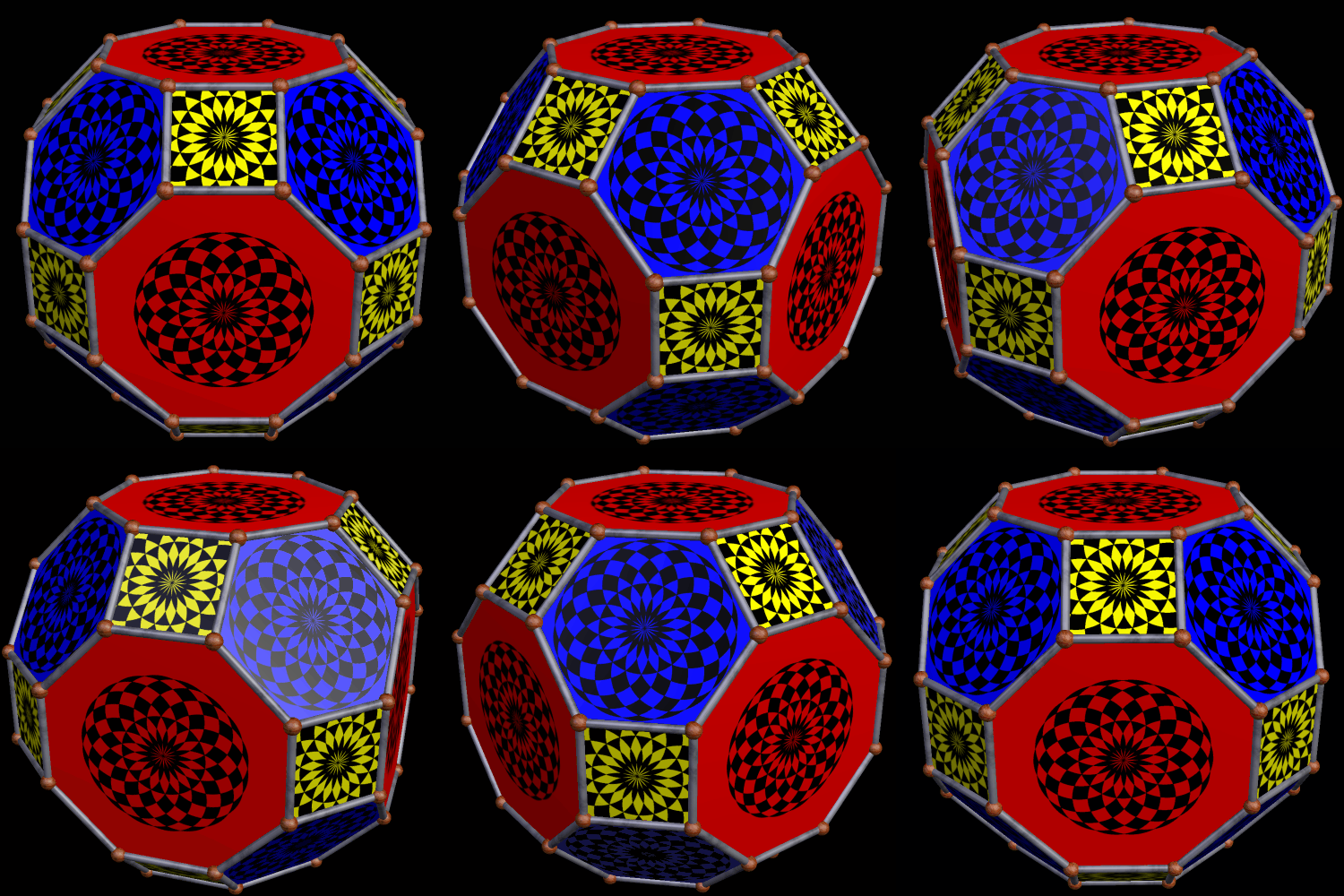
494 Circles, Each, Adorning Two Great Rhombcuboctahedra, with Different (Apparent) Levels of Anxiety


Trunc Cubocta

The design on each face of these great rhombcuboctahedra is made from 19 circles, and was created using both Geometer’s Sketchpad and MS-Paint. I then used a third program, Stella 4d (available here), to project this image on each of a great rhombcuboctahedron’s 26 faces, creating the image above.

If you watch carefully, you should notice an odd “jumping” effect on the red, octagonal faces in the polyhedron above, almost as if this polyhedron is suffering from an anxiety disorder, but trying to conceal it. Since I like that effect, I’m leaving it in the picture above, and then creating a new image, below, with no “jumpiness.” Bragging rights go to the first person who, in a comment to this post, figures out how I eliminated this anxiety-mimicking effect, and what caused it in the first place. 

Trunc Cubocta

Your first hint is that no anti-anxiety medications were used. After all, these polyhedra do not have prescriptions for anything. How does one “calm down” an “anxious” great rhombcuboctahedron, then?

On a related note, it is amazing, to me, that simply writing about anxiety serves the purpose of reducing my own anxiety-levels. It is an effect I’ve noticed before, so I call it “therapeutic writing.” That helped me, as it has helped me before. (It is, of course, no substitute for getting therapy from a licensed therapist, and following that therapist.) However, therapeutic writing can’t explain how this “anxious polyhedron” was helped, for polyhedra can’t write.

For a second hint, see below.

.

.

[Scroll down….]

.

.

Second hint: the second image uses approximately twice as much memory-storage space as the first image used.

Nineteen Circles II

Image

19 circles

One Possible Definition of Physics

Visual definition of physics

With my metaphorical “mathematics of sets” hat on, this is what physics looks like, to me. The further you go in the field, the more challenging the mathematics gets; also, the better (and more expensive) the toys become.

A Music Video for “Ride Into the Sun,” by the Velvet Underground

This music video, for a Velvet Underground classic written by Lou Reed, John Cale, Sterling Morrison and Maureen Tucker, was made today — for a song originally recorded in 1969, the year after I was born. I used Windows Movie Maker to assemble it, and “painted” the preview-pic for the video, using MS-Paint. Other programs I used, for other images in the video, include Geometer’s Sketchpad, MS-Paint (again) and Stella 4d: Polyhedron NavigatorOf all these computer programs, my favorite is Stella 4d, which you may try for free at http://www.software3d.com/Stella.php.

A Scenario I Would Like to See: Friendly Competition, Between Teachers’ Unions and School Administrators, to Help School Libraries Everywhere

school libraries

During the Cold War, the usual way nations compete (direct warfare) was taken off the table by the invention of the hydrogen bomb. With the alternative being mutually-assured destruction, the two sides, led by the USA and the USSR, had to find other ways to compete. Some of those ways were harmful, such as proxy wars, as happened in Vietnam. Others, however, were helpful, such as the space race. The United States put men on the Moon in order to beat the Soviet Union there, as this iconic 1969 photograph makes evident (source: NASA).

planting the flag

We are all still reaping the benefits of the technological and scientific advances made during this period, and for this purpose. The most obvious example of such a benefit is the computer you are using to read this blog-post, for computer technology had to be advanced dramatically, on both sides, in order to escape the tremendously-challenging gravity-well of the Earth.

Wouldn’t it be wonderful if other conflicts in society took beneficial forms, as happened in this historical example?

This could happen in many ways, but the one that gave me the idea for this post is the conflict between teachers’ unions and school districts’ administrators, now taking place in school districts all over the place. I think it would be awesome if this previously-harmful competition changed, to take a helpful form: book drives, to help school libraries.

Please do not misunderstand, though: I’m not talking about taxpayer money, nor union dues. My idea need not, and should not, affect the budget of any school district, nor union budget. All that need happen is for individual people — teachers and administrators  — to go home, look at their own bookshelves, and help students directly, by donating some of their already-paid-for books to school libraries.

While I make no claim to represent any organization, I am a teacher, and a member of the NEA (the National Education Association) in the United States, as well as my state and local NEA affiliates. In an effort to start this new, helpful way to compete, I will give books to the school library where I teach, next week, which is the second week of the new school year. That’s a lot easier than, well, putting men on the Moon. 

This is something we can all do. All of us in the education profession, after all, already agree that we want students reading . . . and this is something we can easily do, to work together towards that goal. School libraries need hardcover books which are student-friendly, meaning that they appeal to a young audience, on a wide variety of subjects. Both fiction and non-fiction books are helpful.

Lastly, in the hope that this idea catches on, I will simply point out one fact: helping turn this idea into a reality is as easy as sharing a link to this blog-post.