Unknown's avatar

About RobertLovesPi

I go by RobertLovesPi on-line, and am interested in many things, a large portion of which are geometrical. Welcome to my own little slice of the Internet. The viewpoints and opinions expressed on this website are my own. They should not be confused with those of my employer, nor any other organization, nor institution, of any kind.

Near-Miss Candidate Update #1

With help from friends on Facebook, I was able to figure out how to make the second of the near-miss candidates in the last post, using Stella 4d: Polyhedron Navigator, a program available here. This is quite helpful, for Stella has a “measurement mode” than lets me determine just how far off from regularity a given polyhedron is. This is what the “unbelted” polyhedron from the last post looks like, with the pentagons regular:

near near miss

In this polyhedron, although the pentagons are regular, the triangles are scalene, with angles measuring ~55.35, ~60.81, and ~63.84 degrees. Of the three edge lengths needed for this, the longest is ~9.1% longer than the shortest, and the triangles are definitely non-regular — by visual inspection alone. It is possible to “tidy up” the triangles a bit, but only at the cost of making the pentagons visibly irregular. This is enough to make the call on the “unbelted” near-miss candidate from the last post — it’s a “near near miss,” not a true “near miss.”

All polyhedra in the last post, as it turns out, are related to another near-miss, the discovery of which I had nothing to do with. It has six pentagonal faces, and four which are quadrilaterals. This near-miss may be found here: http://www.mathcurve.com/polyedres/enneaedre/enneaedre.shtml.

[Note: see the next post, also, for more about these polyhedra.]

Two (New?) “Near-Miss” Candidates

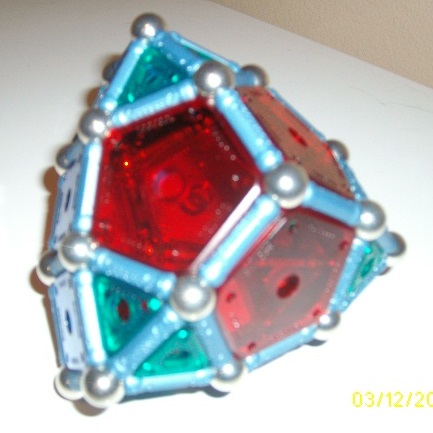
Yesterday, I played for the first time with GeoMag toys, which I recently purchased. I was quite surprised to have what I believe to be a near-miss to the Johnson solids appear before me, one I’ve never seen, within just a few minutes:

SANYO DIGITAL CAMERAHere’s what it looks like, when viewed from two other angles.

The faces of this three-fold dihedral polyedron are six pentagons, twelve triangles, and nine quadrilaterals. The fact that it has been proven that only 92 Johnson solids exist means that all of these faces cannot be regular. However, the irregularity is so small that I could not detect it in this model.

Next, I used Polydrons to build a net of this near-miss candidate.

SANYO DIGITAL CAMERA

What to do next was obvious: remove the “belt” of nine quadrilaterals, creating a net for a second near-miss candidate.

SANYO DIGITAL CAMERA

Having constructed this net, I then returned  GeoMags to build a 3-d model of this second, “unbelted” near-miss candidate.

I then wondered if I could make a third such solid by removal of the triangles, all of which appeared to be the lateral faces of pyramids.

Could I remove them? Yes, and I did so. Did this create a third near-miss candidate? No. The resulting polyhedron, shown immediately above, is non-convex, and therefore cannot be a near-miss. The faces with dihedral angles greater than 180° are the triangle-pairs found where the pyramids were in the previous model.

With the “belted” and “unbelted” polyhedra before this non-convex non-candidate, the next step is to share them with other polyhedra enthusiasts, get their input regarding the question of whether these are genuine near-misses, and see if these polyhedra have already been found, unknown to me, by someone else. 

[Update: please see the next two posts for more on these near-miss candidates.]

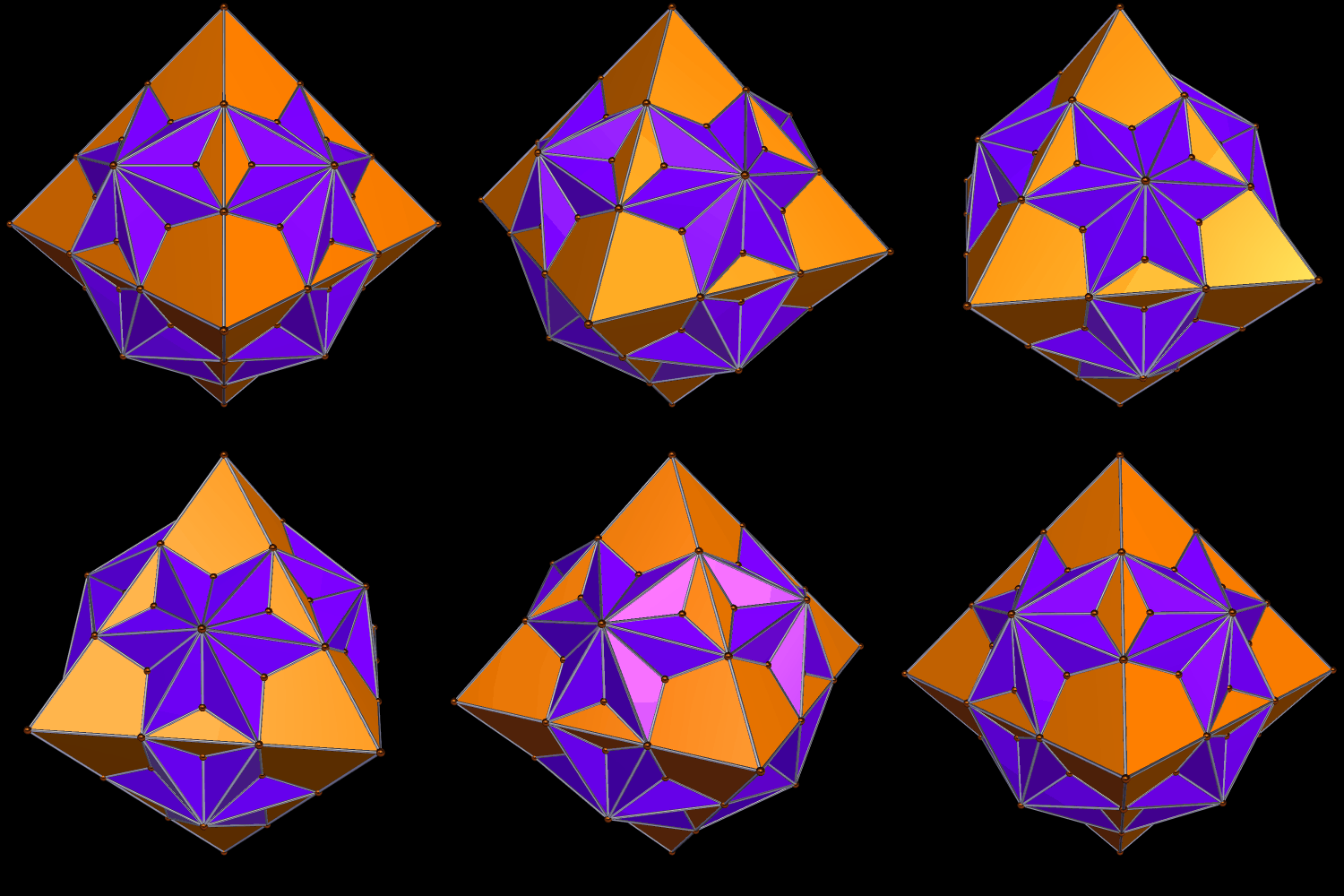
A Gallery of Cuboctahedral Polyhedra, and Polyhedral Compounds, Some of Them Chiral

Any of these images may be enlarged with a click.

They were all created using Stella 4d, available at this website.

“Other Duties as Assigned”

impertinent question

At times, I wonder why I wonder about the things about which I wonder.

On the 2016 American Presidential Election, and the Whole Sorry Lot Running

A self-righteous megalomaniac. Several far-right wingnuts, from a party rapidly making itself irrelevant by trying to live in the past. A big-government advocate with a past history of questionable ethical practices. And, to round out the lot, an actual socialist.

Sigh. I wish we could vote for “none of the above,” and just leave the White House empty for four years.

Next-best option, in my opinion: if we must have a Clinton, bring back Socks the Cat.

Socks_the_Cat_Explores

[Image source:  https://en.wikipedia.org/wiki/Socks_(cat)]

A Thankfully-Brief Annoyance on Facebook

blocked

Does this happen to everyone on Facebook, or is it just me? I believe this person had been my “friend” for less than ten minutes.

For me, geometry for breakfast is not unusual. This morning, though, I’m sprinkling calculus on top before eating it.

It’s important to explain, right up front, that Ronald Reagan was president when I last took calculus. However, I have a new determination to learn the subject. I have a hunch this may go better without the “help” of actually being enrolled in a calculus class, since the way I learn things, and the way most people learn things, aren’t much alike.

My current calculus puzzle started when I noticed that taking the derivative of the volume of a sphere, in terms of the radius, (4/3)πr³, yields the formula for the surface area of a sphere, 4πr². That was both unexpected and exciting, so I tried applying the same idea to another solid: the cube. With edge length e, the volume of a cube is e³, and the derivative of that is 3e² . . . but that’s only half of the surface area of a cube, which is 6e². 

Half? What’s going on here? I mentioned this puzzle on Facebook, where I have many on my friends’-list whose mathematical knowledge exceeds my own. It was pointed out to me that I’d made an important and unhelpful change by going from using the radius, for the sphere, to the edge length, for the cube.

So I’ll try this again, but do it in terms of the radius of the cube, rather than the edge length. For a cube, the radius extends from the center to any of the cube’s eight vertices. Both the light and dark blue segments in the diagram below are cube radii.

cube

This radius is sqrt(3)/2 times the cube’s edge length, as can be verified by applying the Pythagorean Theorem twice, first to triangle ABC (which shows that the green face-diagonal is sqrt(2) times the edge length), and then to triangle BCD (which yields sqrt(3) times the edge length for the interior diagonal DC, half of which is the radius). 

It then follows that, if r = [sqrt(3)/2]e, that e = [2/sqrt(3)]r, which “cleans up” to e = (2/3)sqrt(3)r, when the denominator is rationalized.

If a cube’s volume is e³, and e = (2/3)sqrt(3)r, it then follows that V = [(2/3)sqrt(3)r]³ = (8/27)(3)sqrt(3)r³ = (24/27)sqrt(3)r³ = [8sqrt(3)/9]r³. If I take the derivative of the last expression, I get [8sqrt(3)/3]r² for the derivative of the volume, which I now need to compare to the surface area of a cube, in terms of its radius, rather than edge length.

So here goes . . . SA = 6e² = 6[(2/3)sqrt(3)r]² = [48(3)/9]r² = 16r², which isn’t what I got for the derivative of the volume, above.

Well, I was using, as the radius, the radius of the cube’s circumscribed sphere. Perhaps I should have used the inscribed sphere, instead? The radius of the cube’s inscribed sphere is the “invisible” segment FM in the diagram above, which I’m going to call “a” (for “apothem,” because this looks like the 3-d version of the apothem of a regular polygon). The length of a is exactly one-half that of e, the cube’s edge length, which means that e = 2a. Therefore, V = e³ = (2a)³ = 8a³, the derivative of which is 24a².

Now to check the surface area, in terms of a: SA = 6e² = 6(2a)² = 24a², and that’s what I got when I took the derivative of the volume, in terms of a.

So this trick works for the cube if you use the radius of the inscribed sphere, but not the circumscribed sphere. This leaves me with three questions to address later:

  1. Will this also work for other polyhedra? This is something I intend to explore in future blog-posts, starting with the tetrahedron and the octahedron.
  2. Why did this work at all?
  3. Why was it necessary to use the radius of the cube’s inscribed sphere, rather than its circumscribed sphere?

If any reader of this post knows the answer(s) to #2 and/or #3, sharing your knowledge in a comment would be very much appreciated.

Hexastar Octahedron

hexastar octahedron

I wish I remembered exactly how I made this polyhedron, but I don’t. I found it during a “random walk” polyhedral exploration using Stella 4d: Polyhedron Navigator, software you can buy, or try for free, here.

A Collection of Related Polyhedra Featuring Octagons, Heptagons, Hexagons, and Pentagons

These polyhedra are all part of the same stellation-series, although it appears they were made with truncation, instead. I found them using Stella 4d, a program you may buy, or try for free, right here: http://www.software3d.com/Stella.php. The smaller images may be enlarged with a click.

Spectral 3d6

Image

Spectral 3d6