Unknown's avatar

About RobertLovesPi

I go by RobertLovesPi on-line, and am interested in many things, a large portion of which are geometrical. Welcome to my own little slice of the Internet. The viewpoints and opinions expressed on this website are my own. They should not be confused with those of my employer, nor any other organization, nor institution, of any kind.

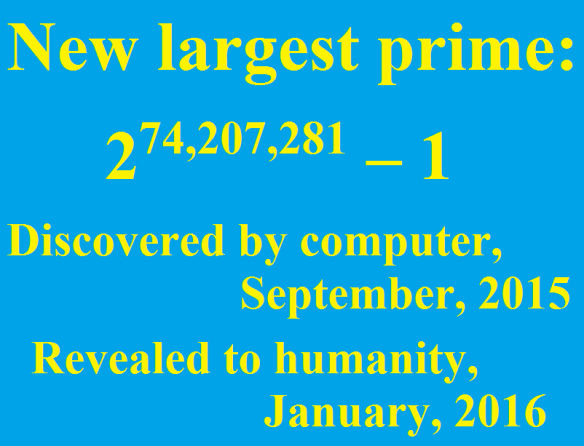
New Largest Known Prime Number Revealed By Computer — After Four-Month Delay

newprime

I find it hilarious that the computer which made this discovery actually kept it a secret for four whole months.

Source: https://www.newscientist.com/article/2073909-prime-number-with-22-million-digits-is-the-biggest-ever-found/

From that article: “[Curtis] Cooper’s computer actually found the prime on 17 September 2015, but a bug meant the software failed to send an email alert reporting the discovery, meaning it went unnoticed until some routine maintenance a few months later.”

47 Polyhedra with Tetrahedral Symmetry, Some of Them Chiral

To enlarge any individual image, simply click on it.

These polyhedral images were created using Stella 4d: Polyhedron Navigator, a program you can find at http://www.software3d.com/Stella.php, with a free trial download available.

Six Non-Convex Polyhedra with Cuboctahedral Symmetry

Each of these polyhedral images (any of which may be enlarged with a click) was created using Stella 4d: Polyhedron Navigator, and this program may be tried for free at http://www.software3d.com/Stella.php.

Also, a question, for regular readers of my blog — you have probably noticed that this post has a different format, but it’s just an experimental thing I’m trying out.

Do you prefer this style of polyhedra-post, or the format I usually use?

Please Join the ACLU, or Renew Your Membership — Because Liberty Can’t Defend Itself

ACLU

http://www.aclu.org

On Polyhedral Augmentation and Excavation

I have made many posts here using polyhedral augmentation, but what I haven’t done — yet — is explain it. I have also neglected the reciprocal function of augmentation, which is called excavation. It is now time to fix both these problems.

Augmentation is the easier of the two to explain, especially with images. The figure below call be seen as a blue icosahedron augmented, on a single face, by a red-and-yellow icosidodecahedron. It can also be viewed, with equal validity, as the larger figure (the icosidodecahedron) augmented, on a single triangular face, with an icosahedron.
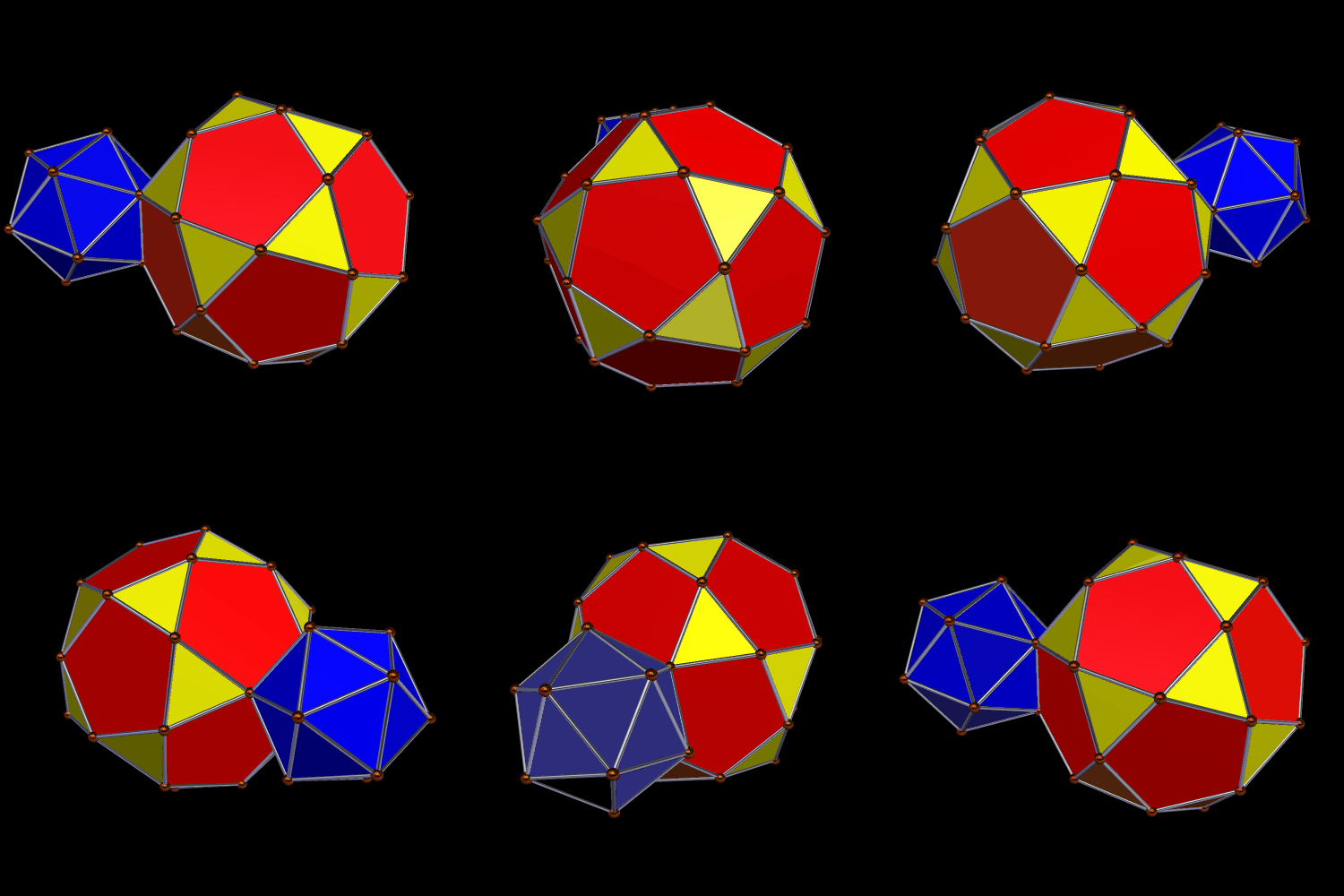
Augmented Icosa Icosidodeca one of each

When augmenting an icosidodecahedron with an icosahedron in this manner, one simply attaches the icosahedron to a triangular face of the icosidodecahedron. The reciprocal process, excavation, involves “digging out” one polyhedral shape from the other. Here is what an icosidodecahedron looks like, after having an icosahedron excavated from it, on a single triangular face.
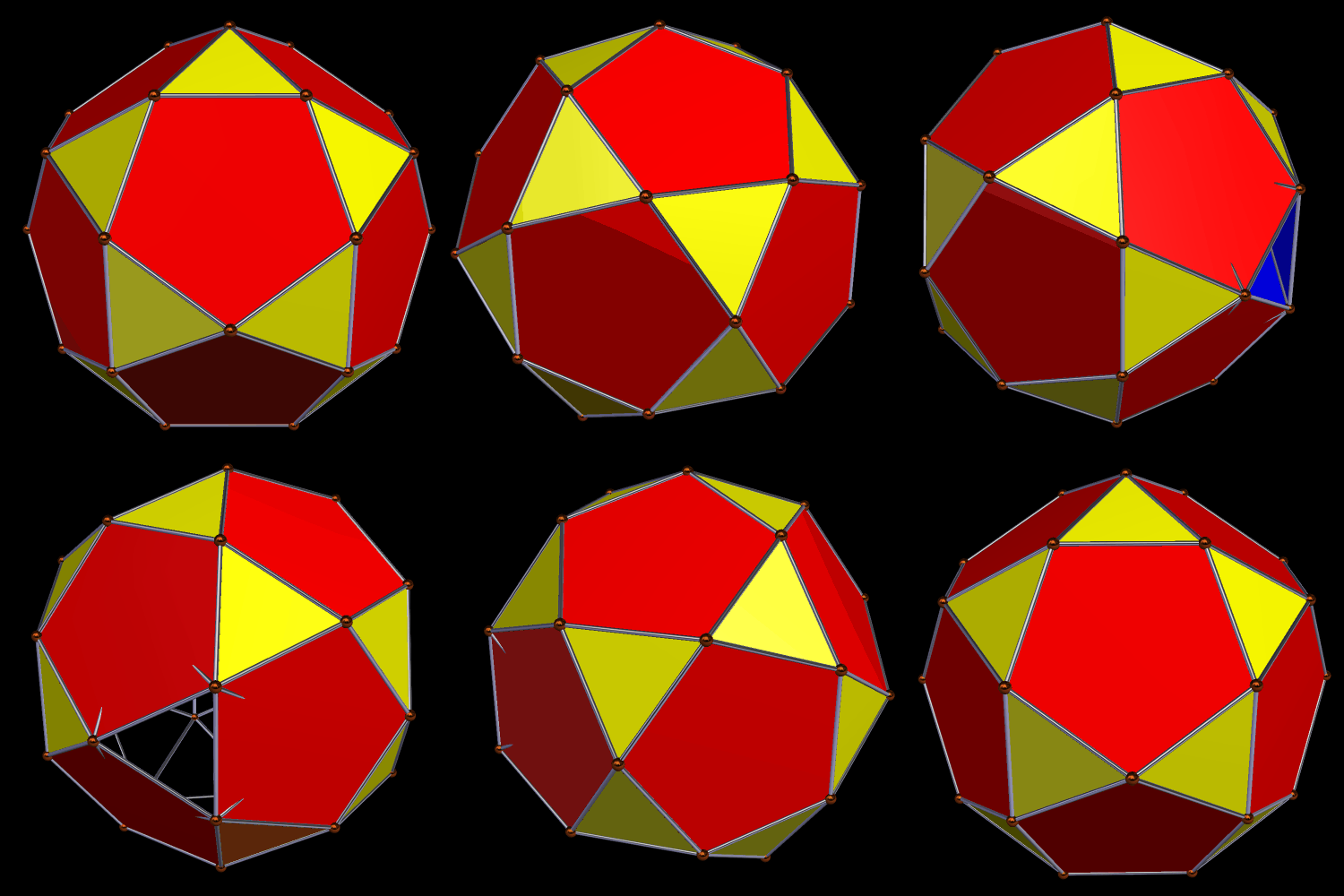
aug Icosidodeca with excavated icosahedron

Excavating the smaller polyhedron from the larger one is easier to picture in advance, just as one can imagine what the Earth would look like, if a Moon-sized sphereoid were excavated from it, with a large, round hole making the excavation visible. (This is mathematics, not science, so we’re ignoring the fact that gravity would instantly cause the collapse of such a compound planetary object, with dire consequences for all inhabitants.) What’s more difficult is picturing what would result if this were turned around, and the Earth was used to excavate the Moon.

This “Earth-excavated Moon” idea is analogous to excavating the larger icosidodecahedron from the smaller icosahedron. If one thinks of subtracting the volume of one solid from that of the other, such a creature should have negative volume — except, of course, that this makes no sense, which is consistent with the fact that it would be impossible to do such a thing with physical objects: there isn’t enough matter in the Moon to remove an Earth’s worth of matter from the Moon. Also, moving back to polyhedra, with excavation only into a single face, it turns out that there is no change in appearance when the excavation-order is reversed:
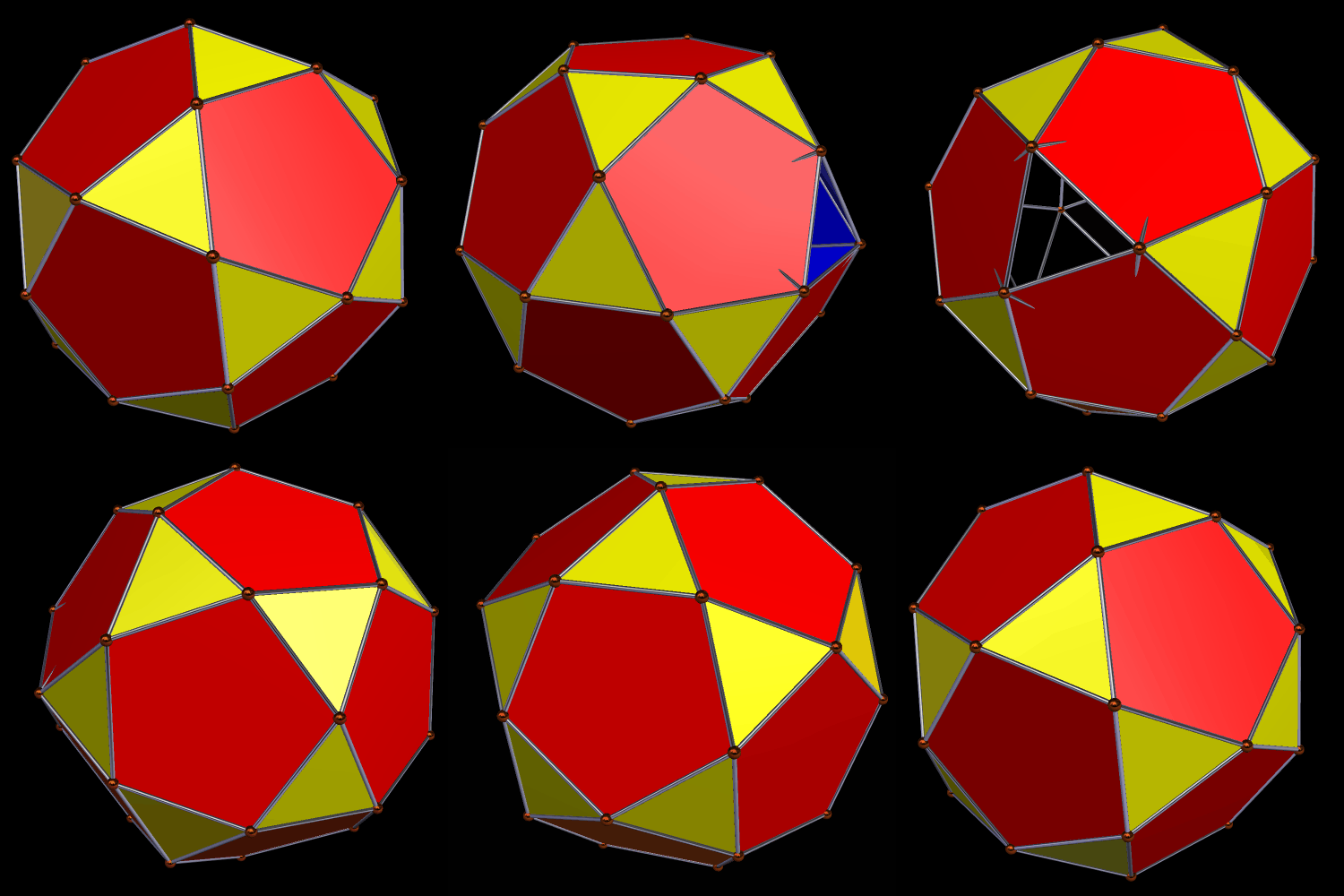
Augmented Icosa with icosidodeca excavated from one face

(Well, OK, there was a small change in appearance between the two images, but that’s only because I changed the viewing angle a bit, to give you a better view of the blue faces.)

Things get different — and the augmentation- and excavation-orders begin to matter a lot more — when these operations are performed on all available faces at once, which, in this case, means on all twenty of each polyhedron’s triangular faces. Here is the easiest case to visualize: an icosidodecahedron, augmented by twenty icosahedra.

Augmented Icosidodec surrounded by icosas

If you use the reciprocal function, excavation, but leave the order of polyhedra the same, you get a central icosidodecahedron, excavated by twenty smaller, intersecting icosahedra:
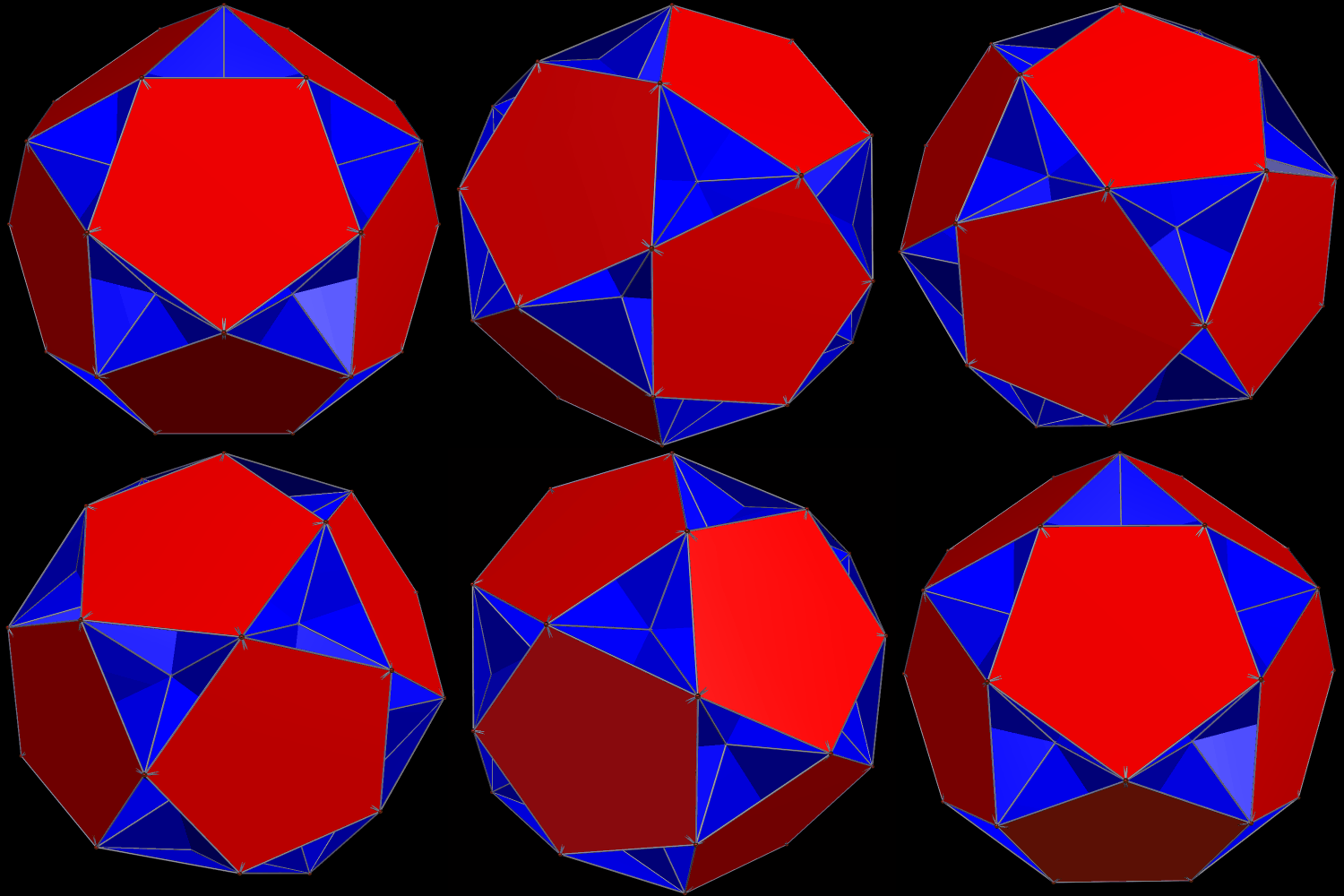
Augmented Icosidodeca excavated by icosas

It is, of course, possible to have other combinations. The ones I find most interesting, using these two polyhedra, are “global” augmentation and excavation of the smaller figure, the icosahedron, by twenty of the larger ones, the icosidodecahedra. Why? Simple: putting the icosidodecahedra on the outside allows for maximum visibility of both pentagons and triangles. On the other hand, the central icosahedron is completely hidden from view, whether augmentation or excavation is used. Here is the augmentation case, or what I have called a “cluster” polyhedron, many varieties of which can be seen elsewhere on this blog (just search for “cluster,” or “cluster polyhedron,” to find them):
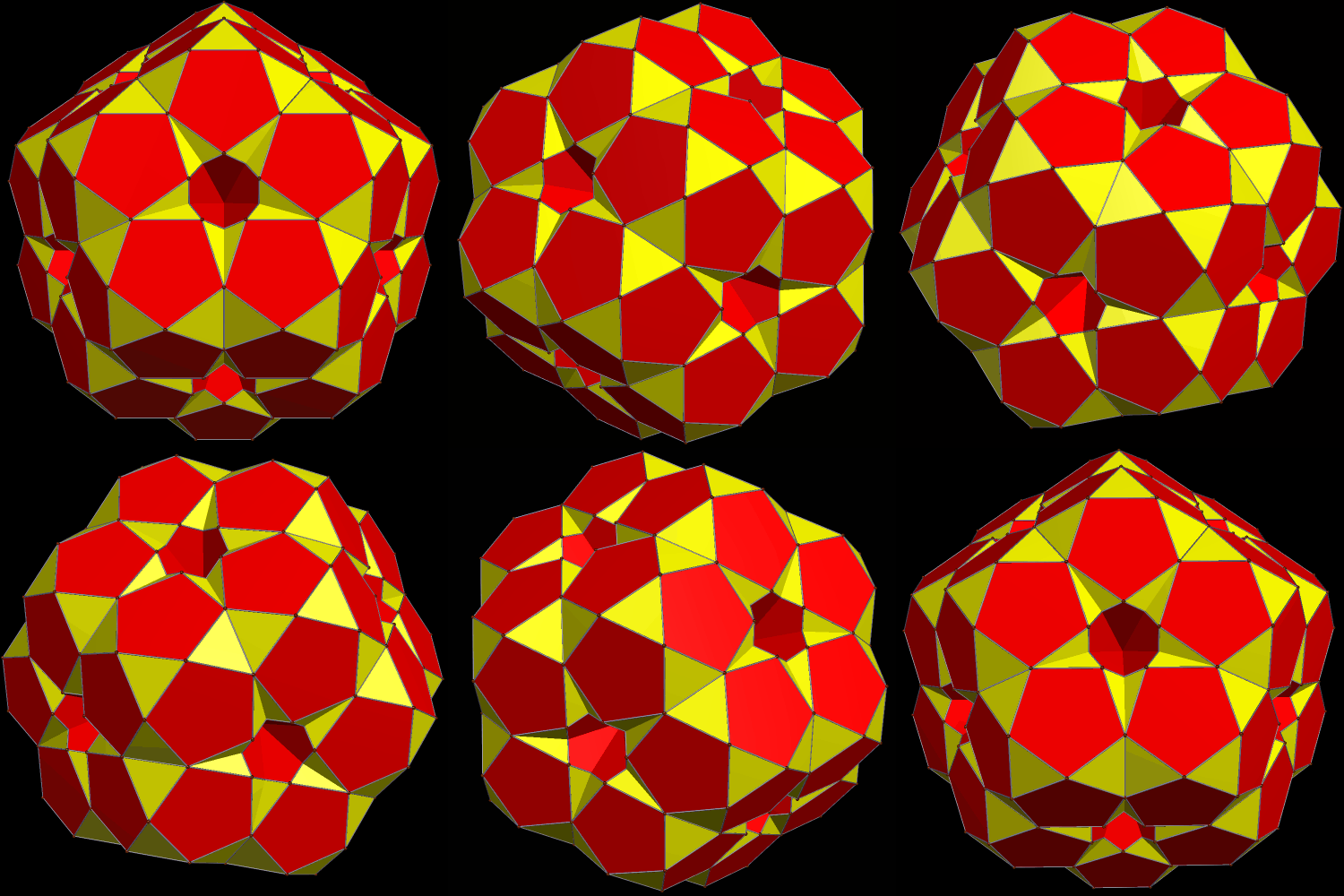
Augmented Icosa

The global-excavation case which has the icosahedron hidden in the middle is similar to the cluster immediately above, in that all that can be seen are twenty intersecting icosidodecahedra. However, it also varies noticeably, because, with excavation, the icosidodecahedra are closer to the center of the entire cluster (the invisible, central icosahedron’s center) than was the case with augmentation. The last image here is of an invisible, central icosahedron, with an icosidodecahedron excavated from all twenty triangular faces. The larger polyhedra “punch through” the smaller one from all sides at once, trapping the central polyhedron — the blue icosahedron — from view. The remaining object looks, to me at least, more like a faceted icosidodecahedron than a cluster-polyhedron. I am of the opinion, but have not verified, that this resemblance to a faceting of the icosidodecahedron is illusory.
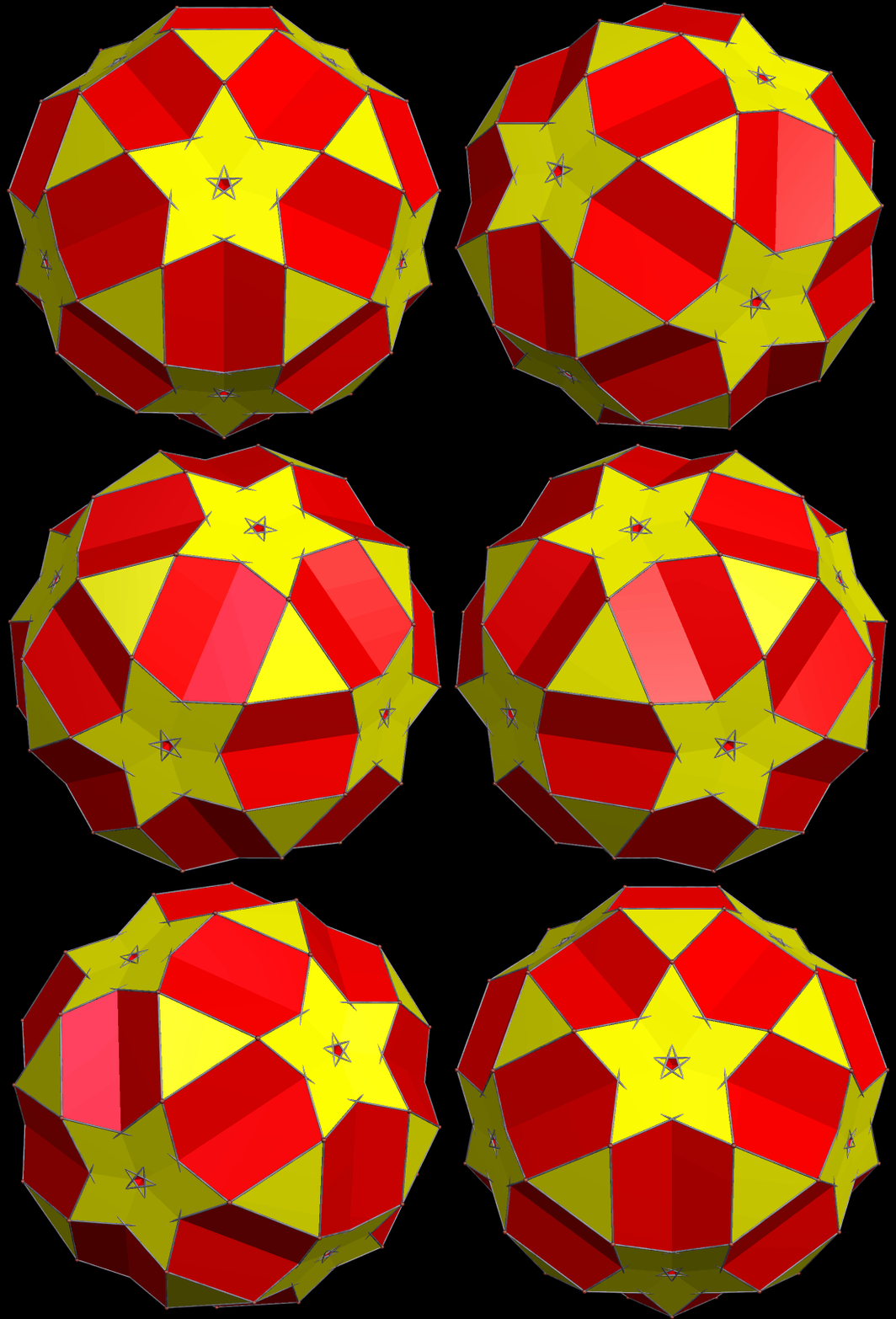
aug tWENTY ICOSIDODECAS EXCAVATED FROM AN ICOSA

[Image credits: all images in this post were made using Stella 4d: Polyhedron Navigator. This program may be purchased, or tried as a free trial download, at http://www.software3d.com/Stella.php.]

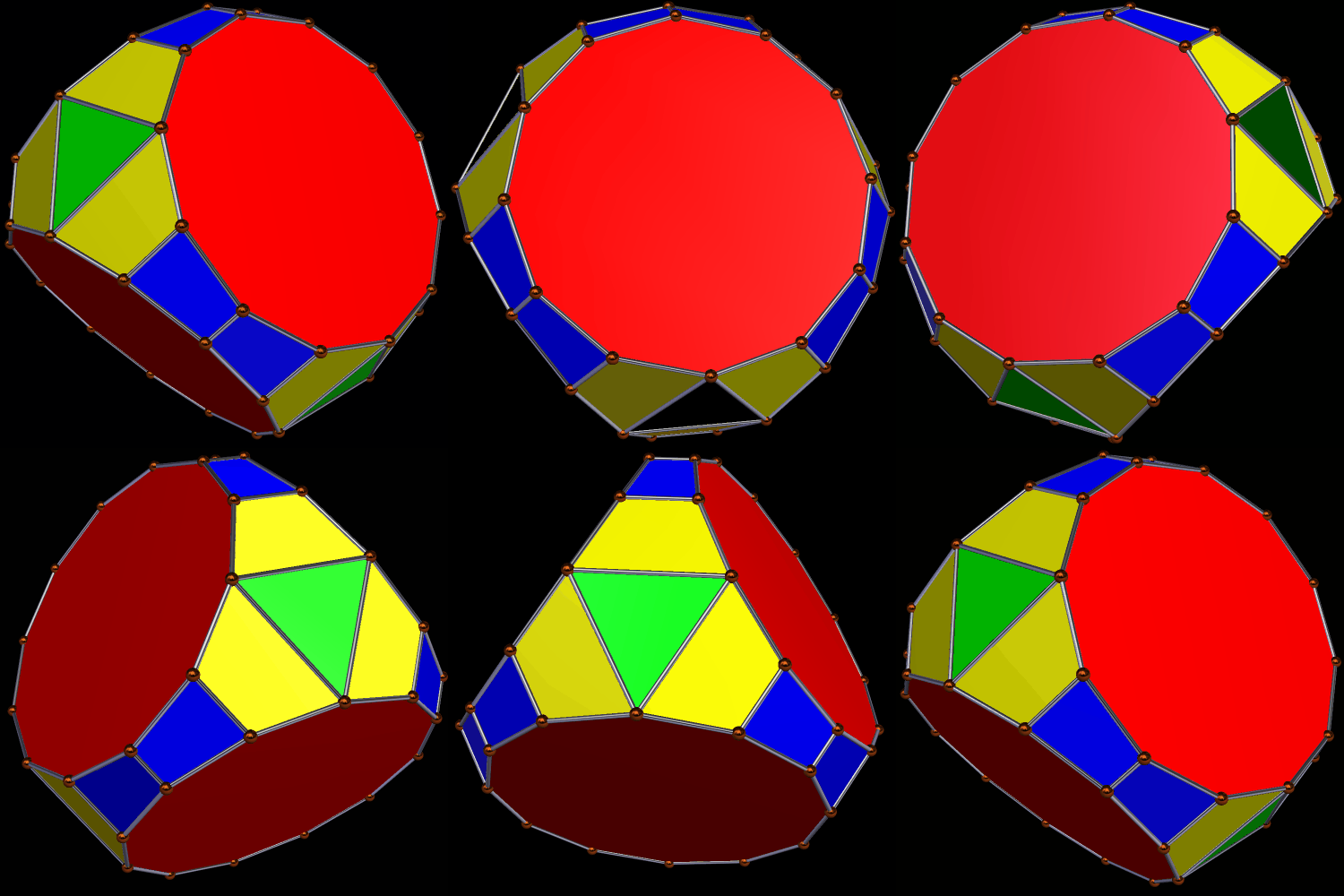
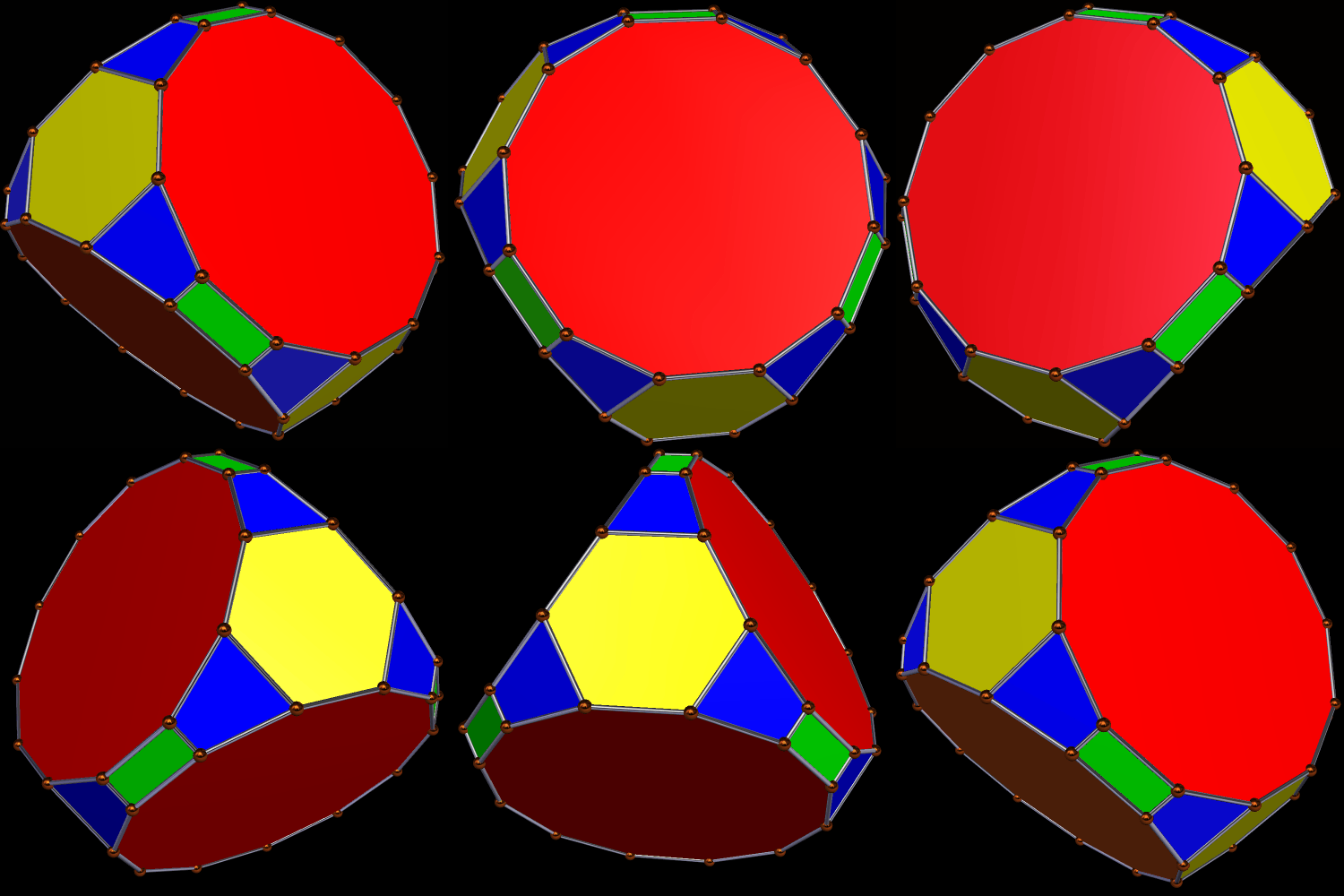
Two Convex Polyhedra with Tetrahedral Symmetry, Each Featuring Four Regular Dodecagons

tet variant featuring reg dodecagons and equits

The polyhedron above is a tetrahedrally-symmetric polyhedron featuring regular dodecagons and triangles, as well as two types of trapezoidal faces.

tet variant using reg dodecagons and hexagons

To make this second polyhedron from the first one, I first augmented each dodecagonal face with an antiprism, took the convex hull of the result, and then used the “try to make faces regular” function of the polyhedron-manipulation software I use, Stella 4d, which can be tried for free right here. The result is a polyhedron which maintains tetrahedral symmetry, and has, as faces, regular dodecagons and hexagons, as well as trapezoids and rectangles.

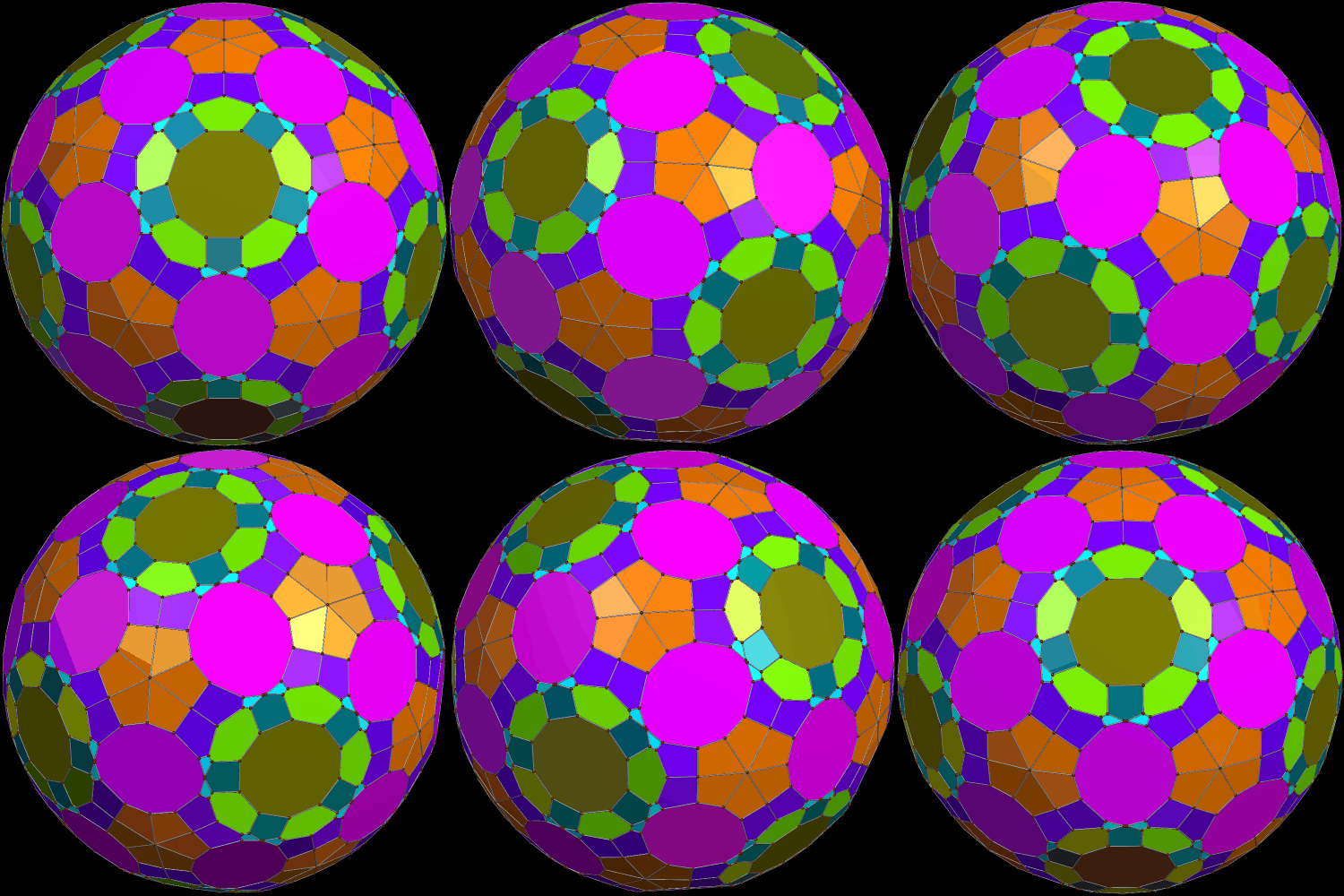
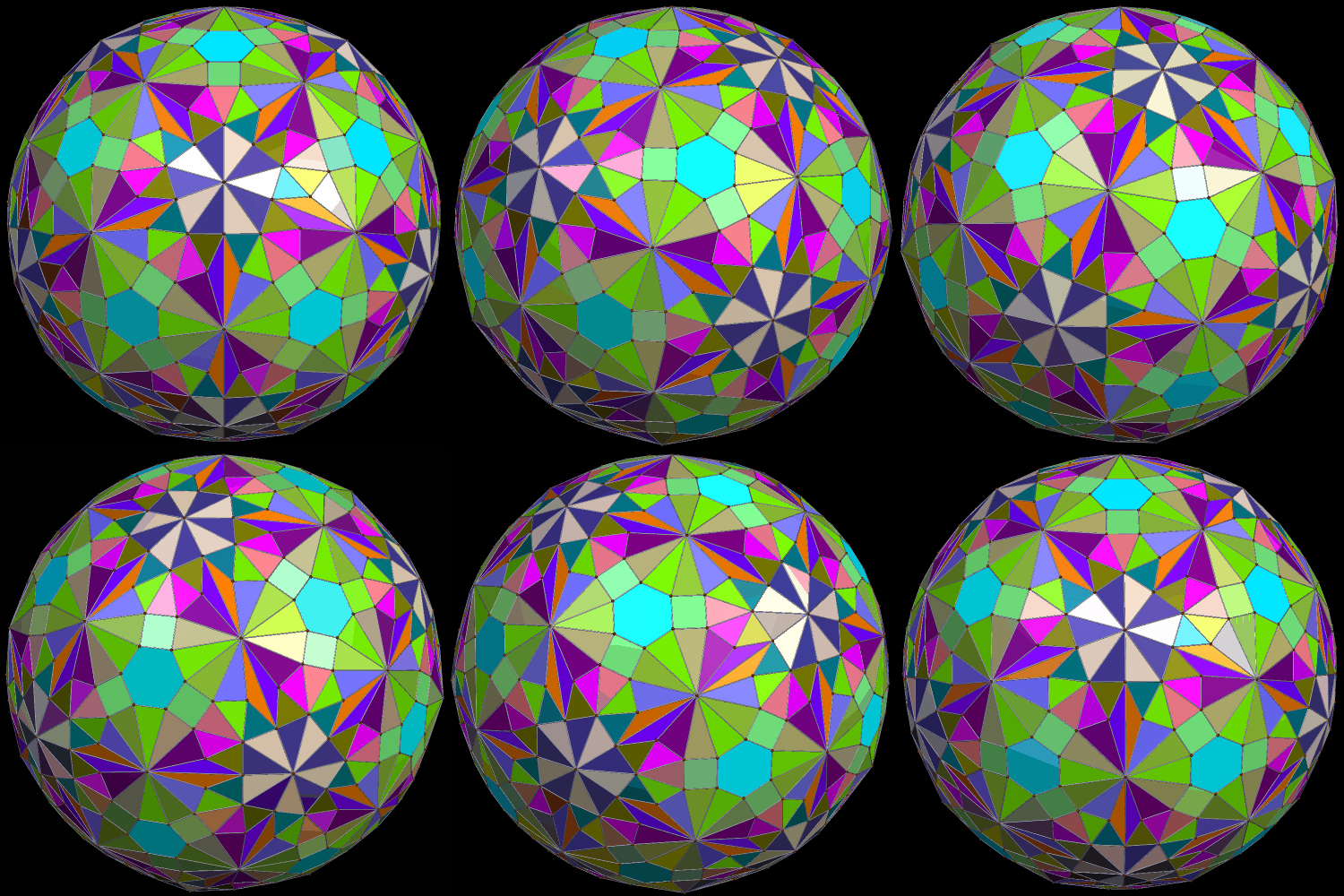
A Zonish Polyhedron with 522 Faces, Together with Its 920-Faced Dual

zonol

The polyhedron above is a 522-faced zonish polyhedron, which resembles, but is not identical to, a zonohedron. True zonohedra are recognizable as that type of polyhedron by their exclusively zonogonal faces. Zonogons are polygons with even numbers of sites, and with opposite sides both congruent and parallel. If you examine the polyhedron above carefully, you’ll find it does not follow these rules. Stella 4d, the polyhedral-manipulation software I use to make these images, allows one to create either a true zonohedron, or a mere “zonish” polyhedron, as the user chooses, starting from another polyhedron (which may, itself, be zonish, a true zonohedron, or neither).

The next polyhedron is the dual of the polyhedron above. This dual has 920 faces. The duals of both zonohedra and zonish polyhedra have a distincive appearance, but, to my knowledge, no one has yet given either set of polyhedra a single-word name. In my opinion, such names are both needed, and deserved.

zono 920 faces dual of the one that had 522 faces

If you would like to try Stella 4d for yourself, there is a free trial download available at http://www.software3d.com/Stella.php.

A Hybrid of the Tetrahedron and the Great Dodecahedron

I made this by stellating a dodecahedron repeatedly, but doing so with Stella 4d, the polyhedral-manipulation software I use (available here), set to use tetrahedral symmetry, rather than the higher-order icosahedral symmetry (which I often call “icosidodecahedral” symmetry) inherent to Platonic dodecahedra.

Hybrid of great Dodeca and the tet

The same polyhedron appears below, but with the coloring-scheme, rotational direction, and rotational speed all set differently.

Tetrahedron meets great dodecahedron

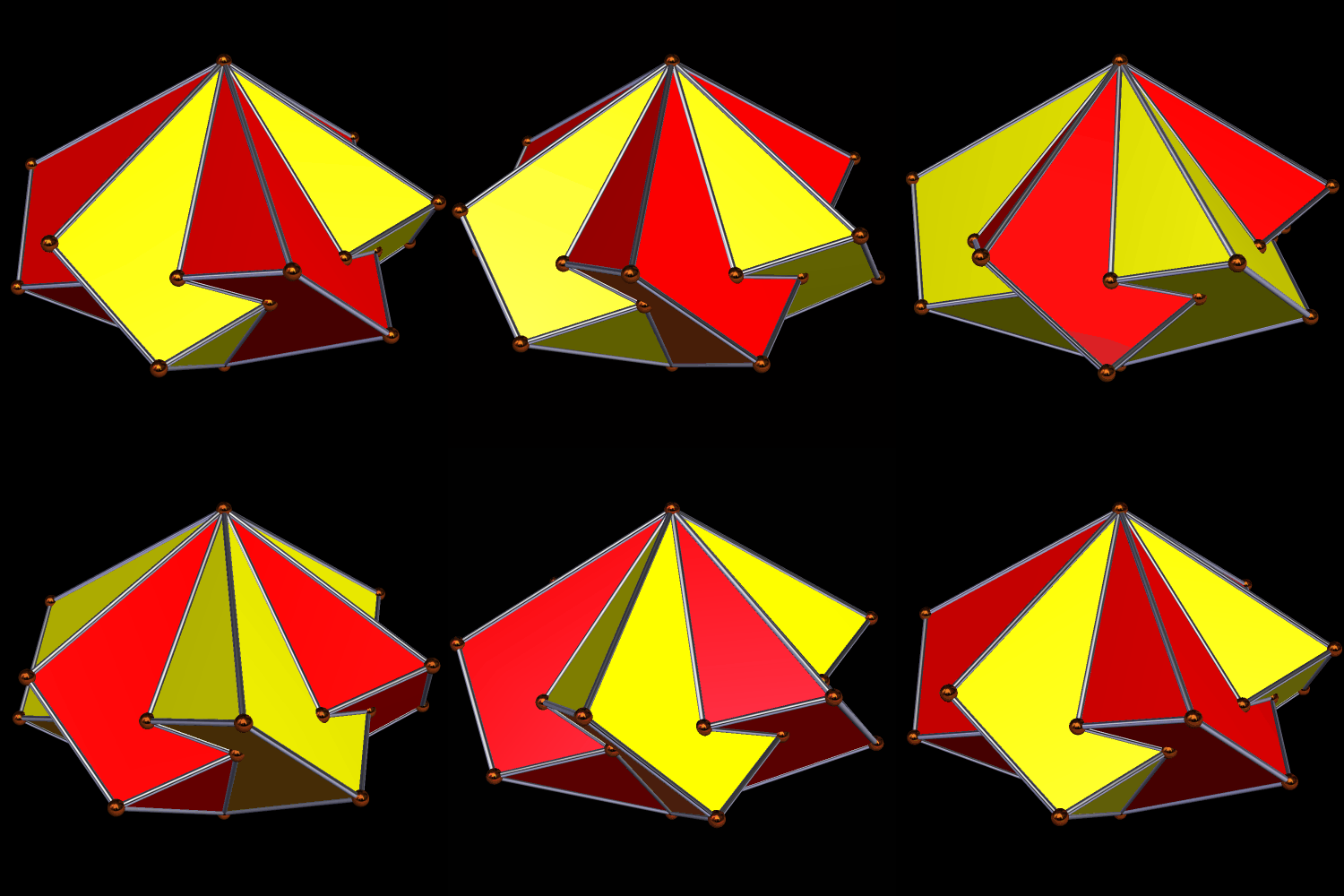
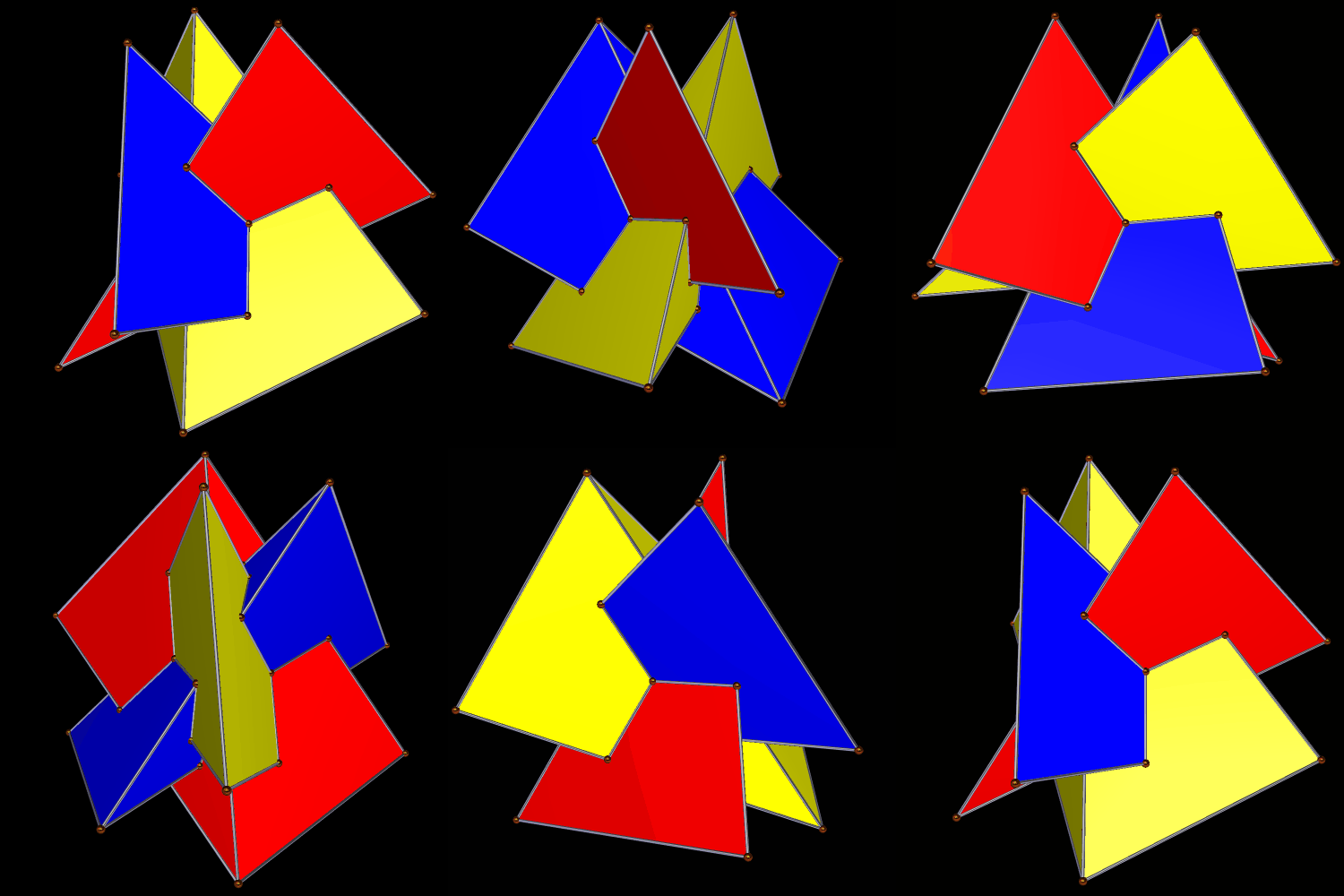
Two Compounds of Skewed Polyhedra, Each with Twelve Total Faces in the Compound

compound with 12 faces total

I found both of these with what one could call “random-walk playing” with polyhedral-manipulation software, Stella 4d, available here, with a free trial-download available. In the figure above, both compound components are skewed cubes, while the image below shows a compound of three skewed tetrahedra. Since (2)(6) = (3)(4) = 12, each of these compounds has the same total number of faces, although, of course, the number of faces per component polyhedron varies from one compound to the other.

compound of three skew tetrahedra

You draw two cards, simultaneously, from a 52-card deck. What is the probability that at least one is an ace?

Image

bigslick

For one card, this is easy: the odds are one in thirteen, for there are four aces in 52 cards, and 4/52 = 1/13.

With a second card drawn at the same time, we must consider the 12/13ths of the time that the first card drawn is not an ace. When this happens, 51 cards remain, with four of them aces, so there is an additional  4/51sts of this 12/13ths that must be added to the 1/13th for the first card drawn.

Therefore, the odds of drawing at least one ace, in two cards drawn from a standard deck, are 1/13 + (4/51)(12/13) = (1/13)(51/51) + (4/51)(12/13) = (51 + 48)/[(51)(13)] = 99/663 = 33/221, or 33 out of 221 attempts, which is as far as the fraction will reduce. In decimal form, as a percentage, this happens ~14.93% of the time.

If I made an error above, please let me know in a comment. I do not claim to be infallible.

[Image credit: I found the image above here.]