Unknown's avatar

About RobertLovesPi

I go by RobertLovesPi on-line, and am interested in many things, a large portion of which are geometrical. Welcome to my own little slice of the Internet. The viewpoints and opinions expressed on this website are my own. They should not be confused with those of my employer, nor any other organization, nor institution, of any kind.

Social Protest, the Easy Way!

Image

socks 2011

A Forgotten Mandala, from 2010

Someone found this, and “liked” it, in my old Facebook pictures. I had forgotten all about it, until this happened. It is a mandala, made of rhombi, with nine-fold symmetry, made in 2010 with Geometer’s Sketchpad — two years before I started this blog.

from 2010

Eight Selections from the Stellation-Series of the Rhombic Enneacontahedron

33rd stellation of the rhombic triacontahedron

The stellation-series of the rhombic enneacontahedron has many polyhedra which are, to be blunt, not much to look at — but there are some attractive “gems” hidden among this long series of polyhedral stellations. The one above, the 33rd stellation, is the first one attractive one I found — using, of course, my own, purely subjective, esthetic criteria.

The next attractive stellation I found in this series is the 80th stellation. Unlike the 33rd, it is chiral.

80th stellation of the rhombic triacontahedron

And, after that, the 129th stellation, which is also chiral:

129th stellation of the rhombic triacontahedron

Next, the 152nd (and non-chiral) stellation:
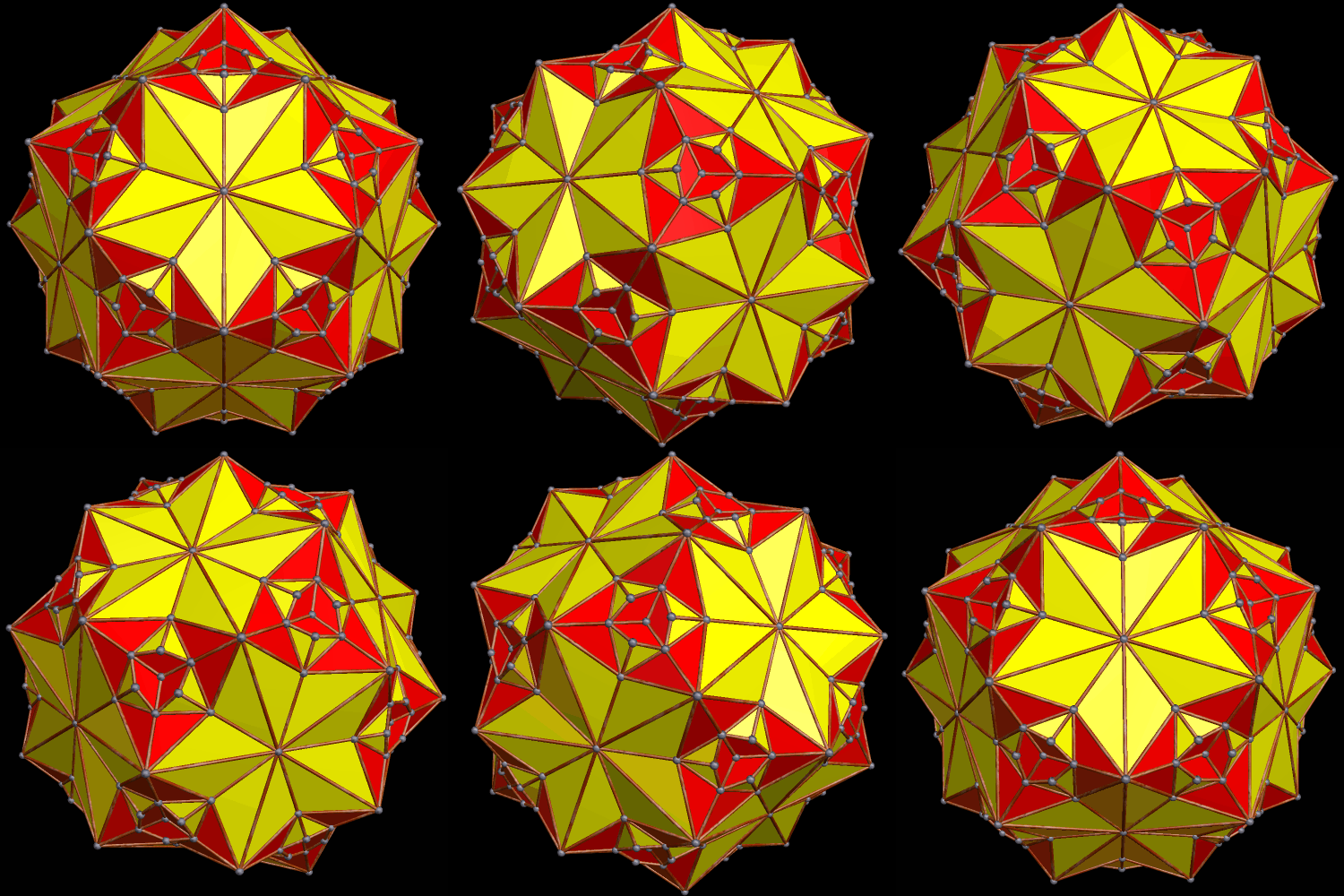
152nd stellation of the rhombic enneacontahedron

I also found the non-chiral 158th stellation worthy of inclusion here:

158th stellation of the rhombic enneacontahedron

After that, the chiral 171st stellation was the next one to attract my attention:

171st stellation of the rhombic enneacontahedron

The next one to attract my notice was the also-chiral 204th stellation:

204th stellation of the rhombic enneacontahedron

Some polyhedral stellation-series are incredibly long, with thousands, or even millions, of stellations possible before one reaches the final stellation, after which stellating the polyehdron one more time causes it to “wrap around” to the original polyhedron. Knowing this, I lost patience, and simply jumped straight to the final stellation of the rhombic triacontahedron — the last image in this post:

final stellation of the rhombic enneacontahedron

All of these images were created using Stella 4d: Polyhedron Navigator, a program available at http://www.software3d.com/Stella.php. For anyone interested in seriously studying polyhedra, I consider this program an indispensable research tool (and, no, I receive no compensation for all this free advertising for Stella which appears on my blog). There’s a free trial version available — why not give it a try?

A Twice-Zonohedrified Dodecahedron, Together with Its Dual

Zonohedrified Dodeca

This polyhedron was created by performing vertex-based zonohedrifications of a dodecahedron — twice. The first zonohedrification produced a rhombic enneacontahedron, various version of which I have blogged many times before, but performing a second zonohedrification of the same type was a new experiment. It has 1230 faces, 1532 vertices, and 2760 edges. All of its edges have equal length. I created the models in this post using Stella 4d, a program you can buy, or try for free, right here.

Here is the dual of this zonohedron, which has 1532 faces, 1230 vertices, and 2760 edges. This “flipping” of the numbers of faces and vertices, with the number of edges staying the same, always happens with dual polyhedra. I do not know of a name for the class of polyhedra made of zonohedron-duals, but, if any reader of this post knows of one, please leave this name in a comment.

Zonohedrified Dodeca dual

A Pyritohedral Coloring-Scheme for the Truncated Icosahedron

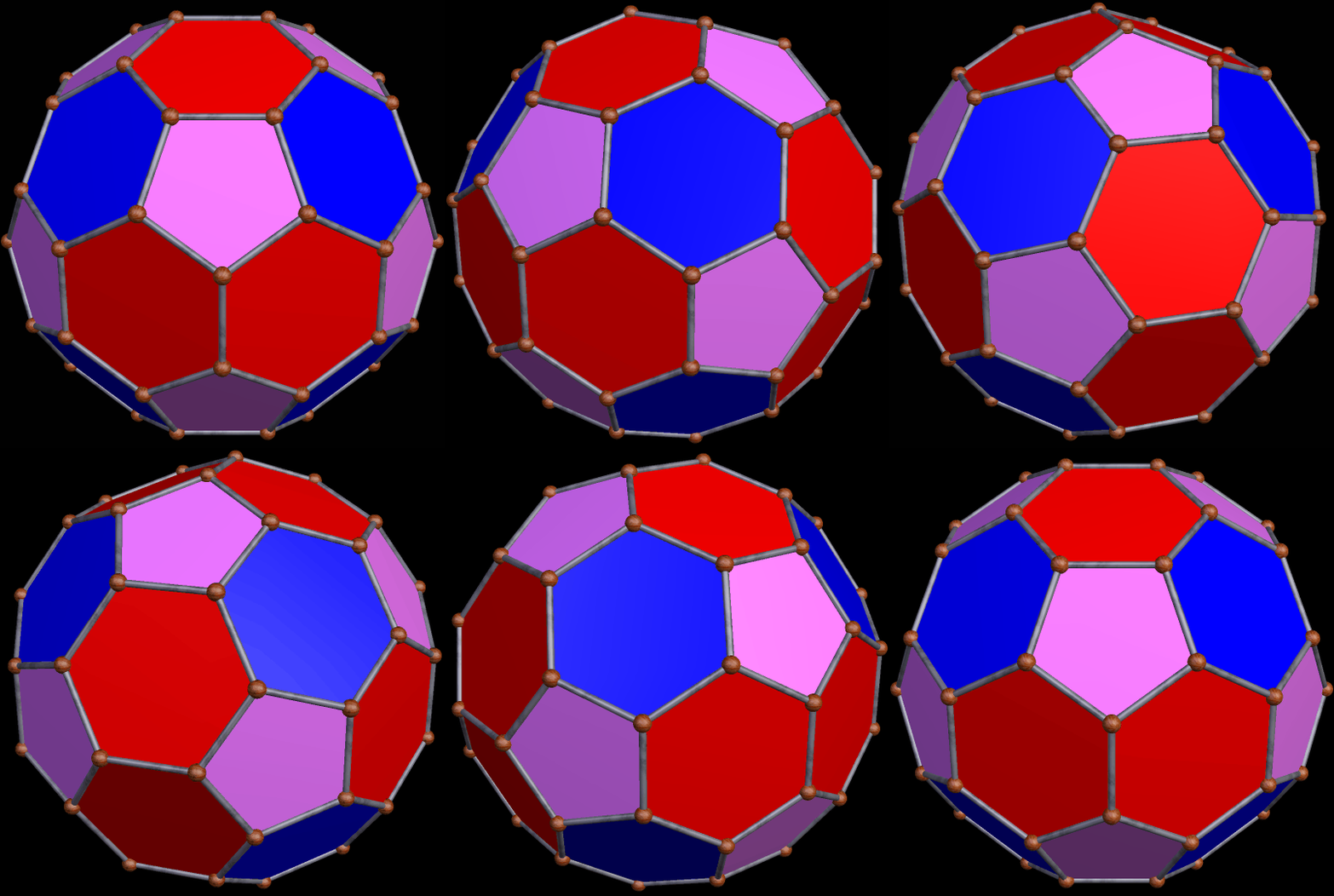
pyritohedral coloring of the truncated icosahedron

While the polyhedron above, informally known as the “soccer ball,” has icosidodecahedral symmetry, its coloring-scheme does not. Instead, I colored the faces in such a way that the coloring-scheme has pyritohedral symmetry — the symmetry of a standard volleyball. This rotating image was made with Stella 4d, a program you can buy, or try for free, right here: http://www.software3d.com/Stella.php.

My Centripetal Force Joke: A True Story

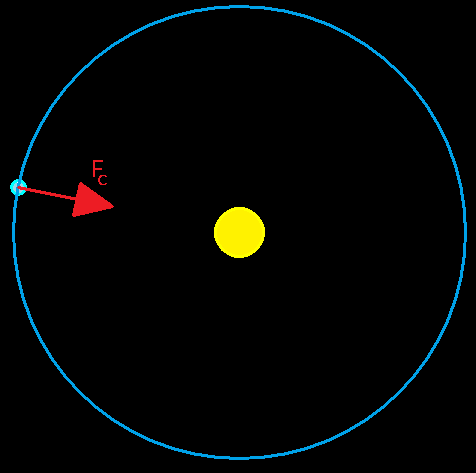
orbit

In the Summer of 2014, with many other science teachers, I took a four-day-long A.P. Physics training session, which was definitely a valuable experience, for me, as a teacher. On the last day of this training, though, in the late afternoon, as the trainer and trainees were winding things up, some of us, including me, started getting a little silly. Physics teachers, of course, have their own version of silly behavior. Here’s what happened.

The trainer: “Let’s see how well you understand the different forces which can serve as centripetal forces, in different situations. When I twirl a ball, on a string, in a horizontal circle, what is the centripetal force?”

The class of trainees, in unison: “Tension!”

Trainer: “In the Bohr model of a hydrogen atom, the force keeping the electron traveling in a circle around the proton is the . . . ?”

Class: “Electromagnetic force!”

Trainer: “What force serves as the centripetal force keeping the Earth in orbit around the Sun?”

Me, loudly, before any of my classmates could answer: “God’s will!”

I was, remember, surrounded by physics teachers. It took the trainer several minutes to restore order, after that.

The Final Stellation of the Rhombic Triacontahedron, Together with Its Dual, a Faceting of the Icosidodecahedron

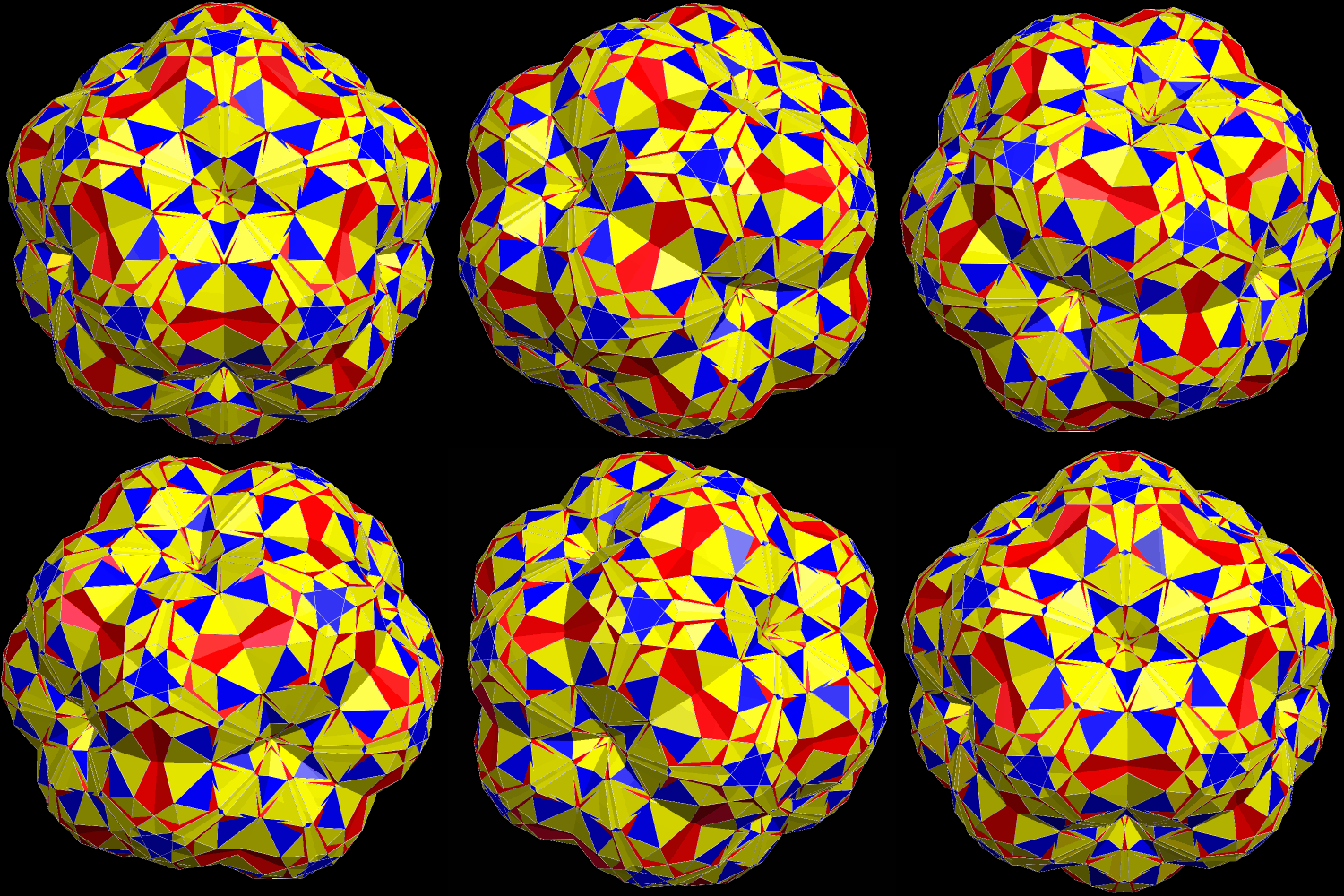
final stellation of the Rhombic Triaconta

Sharp-eyed, regular readers of this blog will notice that this is the same polyhedron shown in the previous post, which was described as the “final stellation of the compound of five cubes,” due to the coloring scheme used in the first image there, which had five colors “inherited” from each of the differently-colored cubes in the five-cube compound. This image, by contrast, is shown in rainbow-color mode.

How can the rhombic triacontahedron and the compound of five cubes have the same final stellation? Simple: the compound of five cubes is, itself, a member of the stellation-series of the rhombic triacontahedron. Because of this, those two solids end up at the same place, after all possible stellations are completed, just as you will reach 1,000, counting by ones, whether you start at one, or start at, say, 170.

I am grateful to Robert Webb for pointing this out to me. He’s the person who wrote Stella 4d, the software I use to make these images of rotating polyhedra. His program may be found at http://www.software3d.com/Stella.php — and there is a free trial version available for download, so you can try Stella before deciding whether or not to purchase the fully-functioning version.

Since faceting is the reciprocal process of stellation, the dual of the polyhedron above is a faceted icosidodecahedron, for the icosidodecahedron is the dual of the rhombic triacontahedron. Here is an image of that particular faceting of the icosidodecahedron, colored, this time, by face-type:

Faceted Icosidodeca dual of final stellation of RTC

The Final Stellation of the Compound of Five Cubes

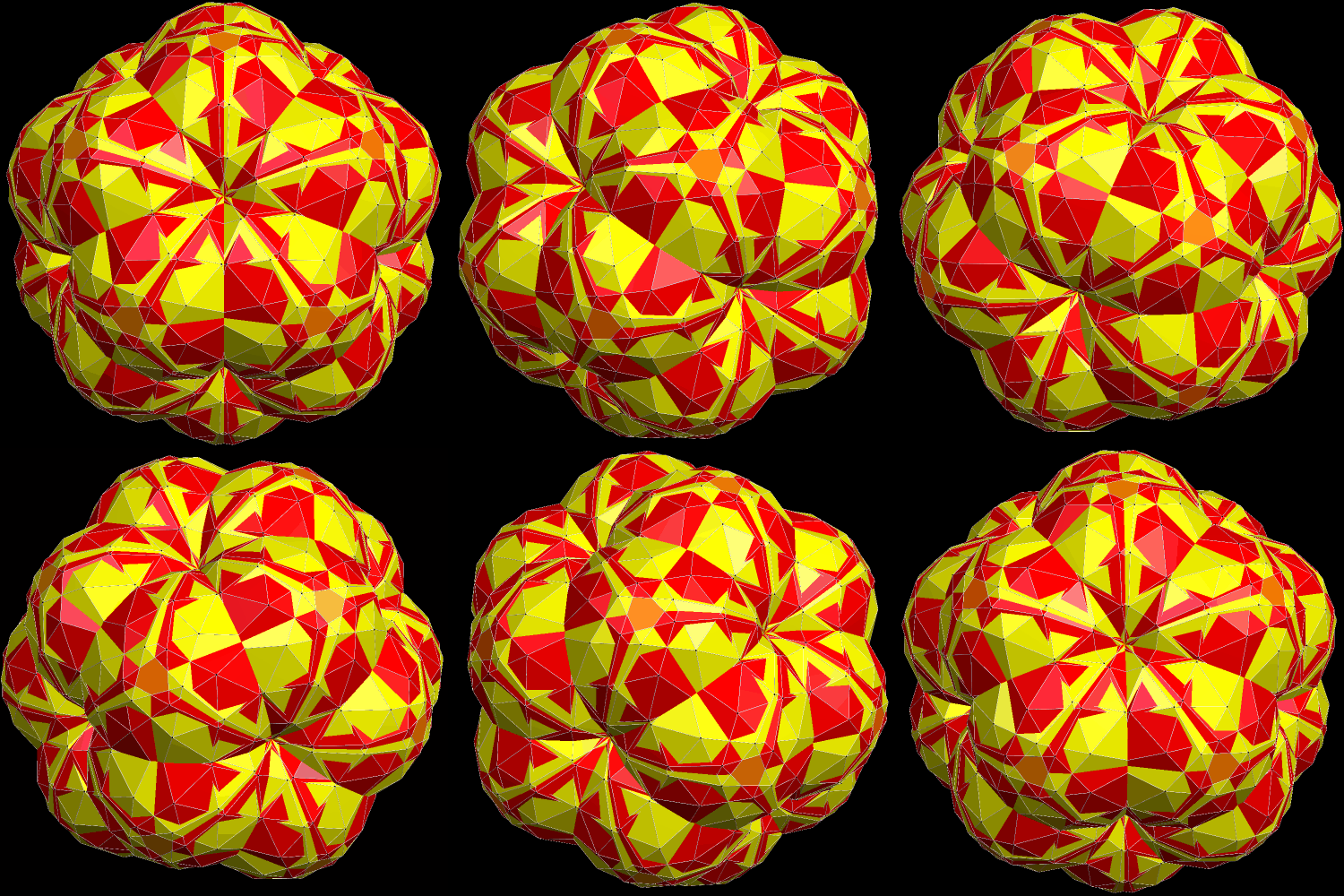
Stellated 5 Cubes final stellation colors derived from compound

The version of the final stellation of the compound of five cubes shown above has its colors derived from the traditional five-color version of the original compound, itself. The one below, by contrast, has its colors selected by face-type, without regard for the original compound.

Stellated 5 Cubes final stellation colored by face type

Both of these virtual models were created with Stella 4d: Polyhedron Navigator, software available at this website. Also, for more about this particular polyhedron, please see the next post.

One of Many Possible Facetings of the Rhombicosidodecahedron

Faceted Rhombicosidodeca

To make a faceted version of the rhombicosidodecahedron, one first (1) starts with a rhombicosidodecahedron, one of the Archimedean solids, then (2) removes the faces and edges of this polyhedron, leaving all the vertices in place, and then (3) connects these vertices in a different way than they were connected in the original polyhedron, forming new edges and faces. Faceting is the reciprocal operation to polyhedral stellation.

This polyhedron was made using Stella 4d, software available here.

An Icosahedron, Augmented by Snub Dodecahedra, Plus Two Versions of a Related Polyhedral Cluster

Icosa augmented by snub dodecahedra

Because the snub dodecahedron is chiral, the polyhedral cluster, above, is also chiral, as only one enantiomer of the snub dodecahedron was used when augmenting the single icosahedron, which is hidden at the center of the cluster.

As is the case with all chiral polyhedra, this cluster can be used to make a compound of itself, and its own enantiomer (or “mirror-image”):

Compound of enantiomorphic pair of snub-dodeca-augemented icosahedra

The image above uses the same coloring-scheme as the first image shown in this post. If, however, the two enantiomorphic components are each given a different overall color, this second cluster looks quite different:

Compound of enantiomorphic pair of snub-dodeca-augemented icosahedra colored by chirality

All three of these virtual models were created using Stella 4d, software available at this website.