Unknown's avatar

About RobertLovesPi

I go by RobertLovesPi on-line, and am interested in many things, a large portion of which are geometrical. Welcome to my own little slice of the Internet. The viewpoints and opinions expressed on this website are my own. They should not be confused with those of my employer, nor any other organization, nor institution, of any kind.

Fort Smith? Pine Bluff? What’s the Difference?

Fort Smith is Pine Bluff

Unless you also live in the American state of Arkansas, you may not have even heard of Fort Smith and Pine Bluff. For those who grew up in this state, though, they’re considered (by our peculiar standards) to be major cities. Fort Smith is on the far West side of the state, on the Oklahoma border, while Pine Bluff is in the Southeastern part of the state, also known as the Mississippi Delta.

I didn’t learn Arkansas geography in school. Instead, when I was a child, my family traveled, mostly within the state — a lot. By the time I was ten years old, I’d been in all 75 counties of Arkansas, and knew quite a bit about where things are here . . . except for these two cities, Fort Smith and Pine Bluff.

If you’re from Arkansas, you know these two cities are nothing alike. What I noticed in childhood, above all else, was the fact that the two cities smelled so different from each other. The reason is simple:  Pine Bluff has a lot of paper mills, and the smell near paper mills is not entirely unlike being locked in a small closet with several dozen rotten eggs. Fort Smith, by contrast, is relatively odorless.

What perplexed my parents, though, is the fact that I would consistently confuse these two cities. I’d refer to the “horrible smell of Fort Smith,” or, if I knew we were going to Pine Bluff, I might ask if we’d be crossing the border into Oklahoma. My parents always corrected these mistakes, but I kept making them, repeatedly, which is not like me at all. When young, I never had more than a 50% chance of correctly identifying either of these cities. Once I figured out what I was doing, though — at around age twelve — this repeated error made perfect sense.

When I try to understand something, I examine it, and consider it, mathematically. Often, I’m not even conscious I’m doing that — it’s simply how I think. Both Fort Smith and Pine Bluff are two-word city names. To make matters even worse, the first word of each city-name has four letters, and the second word in each has five. Once I realized these parallels, though, it all made sense:  no wonder I couldn’t tell these places apart, with names which, examined through the lens of childhood mathematics, looked exactly alike.

To my knowledge, no one else has ever had a long-term problem confusing these two Arkansas cities. However, when those who know me well hear this story, they are never surprised that I would do such a thing.

Sam Harris, on Paying Attention

Sam_Harris_01

Source:  Waking Up: A Guide to Spirituality Without Religion, p. 3.

Four-Part Compound of Thin Parallelopipeds

four-part compound of thin parallelopipeds

I made this using Stella 4d:  Polyhedron Navigator. You may try this program for free at http://www.software3d.com/Stella.php.

Quadrilaterals with Perpendicular Diagonals

I just learned these things are officially called orthodiagonal quadrilaterals. I’ve been calling them Qw⊥Ds (pronounced “quids”) for years, have studied their properties, and have even tested students’ knowledge of Qw⊥D esoterica.

orthodiagonal quadrilateralsObviously, on grounds of symmetry alone, it is easy to determine that Qw⊥Ds include all squares. With congruent triangles, it is also possible to prove that all rhombi, kites, and darts are Qw⊥Ds.

As for other parallelograms, such as the rectangle, they are Qw⊥Ds iff they are also rhombi. No non-rhomboidal parallelograms have perpendicular diagonals.

With no parallel sides, altering darts and kites to make their diagonals off, slightly, from being perpendicular would be easy. In the process, though, the figure would lose its “dartness” or “kiteness.”

With exactly one pair of parallel sides — what most Americans call “trapezoids” (that word has multiple, troublesome definitions) — things get more messy. A non-isosceles trapezoid (lower left) can either have perpendicular diagonals (red) or not (yellow). As can be seen at the lower right, the same is true of isosceles trapezoids.

More Polyhedra, Including Some Compounds, from the Stellation-Series of the Tetrakis Cube

Tetrakishexa stellation

The next one is a compound of eight off-center pyramids. By this point, I had gone so far into the stellation-series (a search I began when preparing the post before this one) that I had lost count.

compound of eight off-center pyramids

This one is a compound of three short square-based dipyramids:

compound of three short square dipyramids

This one, according to Stella 4d, is a compound of three parts, but I can’t quite figure out what the parts are!

more from the stellation series of the tetrakis cube

Here is another “mystery compound,” this one with two parts:

bizarre two-part compound

Stella 4d, which I used to make these, may be tried here.

Two Compounds of Dipyramids from the Stellation-Series of the Tetrakis Cube

The 16th stellation of the tetrakis cube, the dual of the truncated octahedron, is a compound of three elongated octahedra, or square dipyramids:

Tetrakishexa

The 65th stellation of this same polyhedron is of another compound of dipyramids, but these are triangular dipyramids with obtuse faces, and there are four of them:

Tetrakishexa stellation 4

I generated both of these images with Stella 4d:  Polyhedron Navigator, available right here.

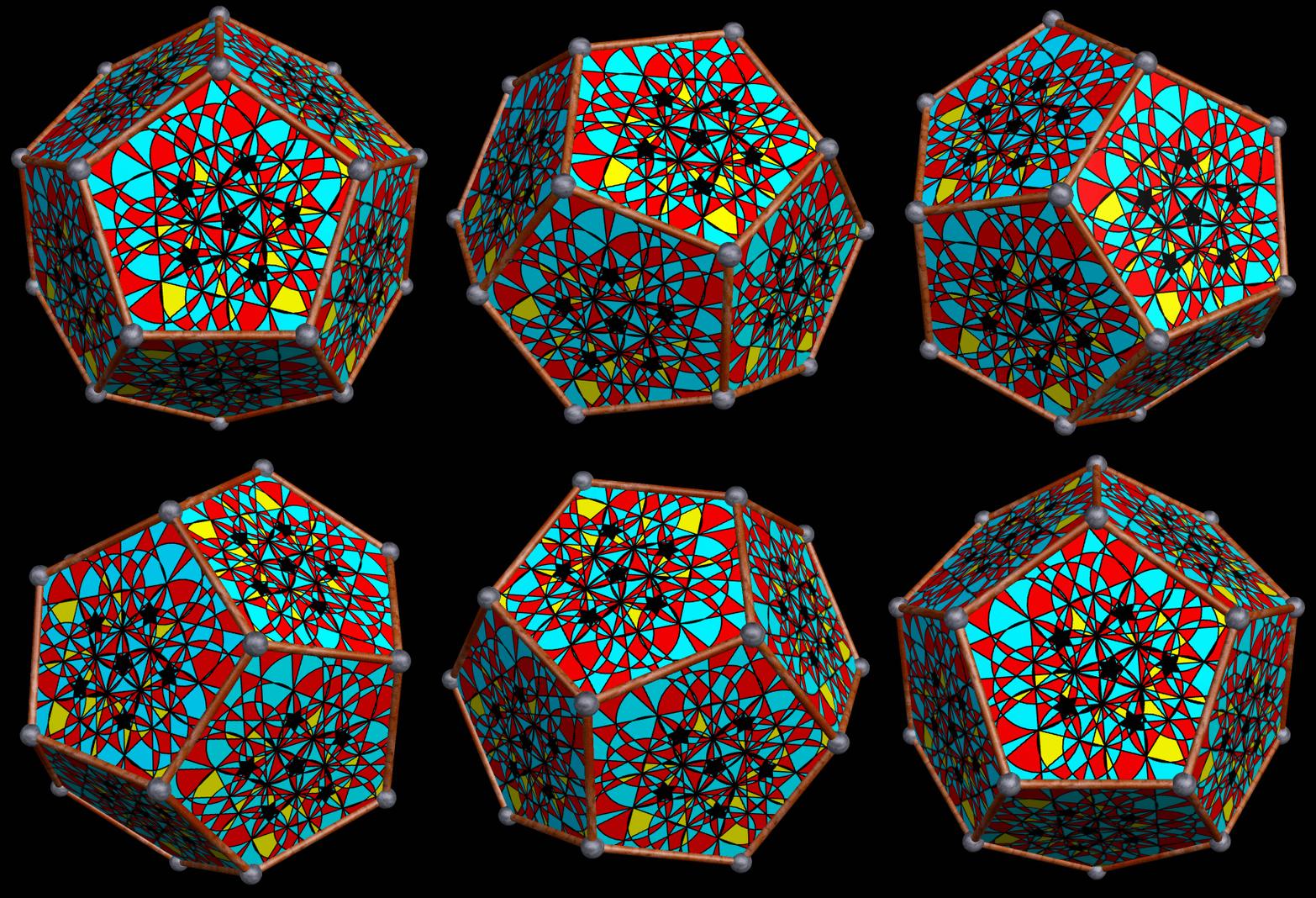
Two Dodecahedra with Varying Rotation-Types of the Same Design Shown On Their Faces

The images shown on the faces of these dodecahedra appeared in the last post, and were made using Geometer’s Sketchpad and MS-Paint.

DodecaAssembling the polyhedral images and creating these rotating .gif files required another program, Stella 4d, which is available at http://www.software3d.com/Stella.php.

Dodeca2

Pentagonal System of Six Vortices

pentagonal system of vortices

A Timeline of the Major Wars of the United States of America, in Our Brief History

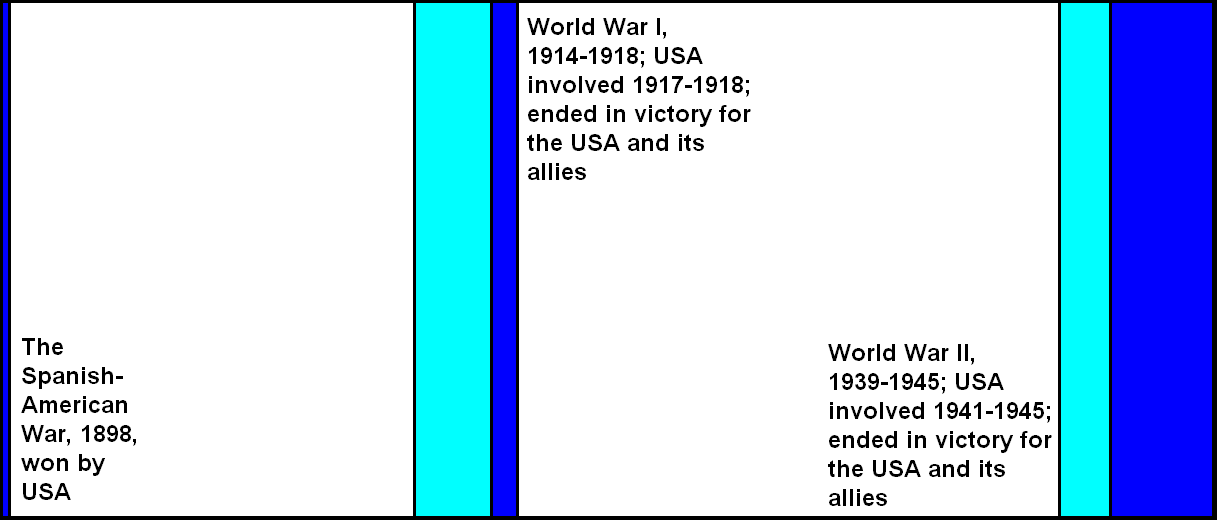
Because it was, in some ways, a precursor to the American Revolutionary War, this timeline begins with the pre-American-independence French and Indian War. American independence was formally declared during the Revolutionary War, in 1776.

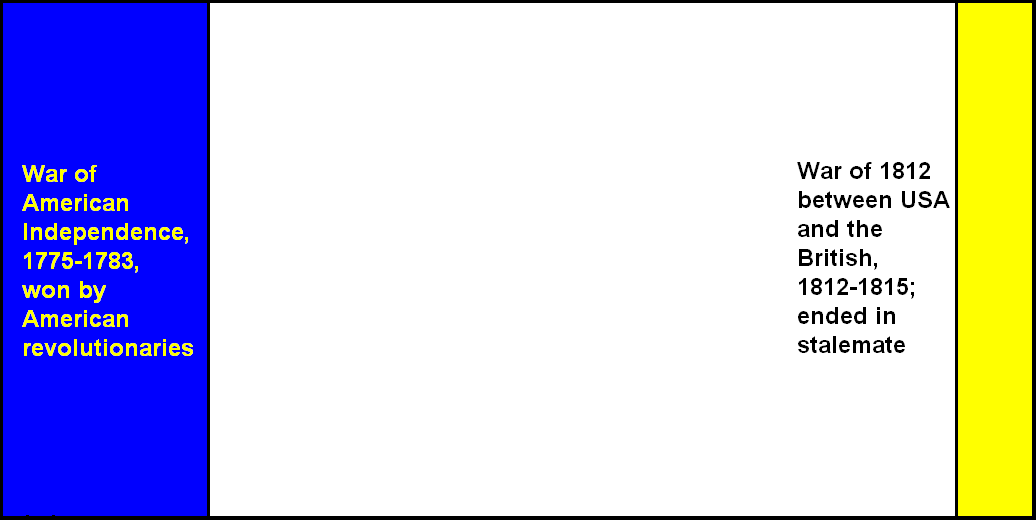
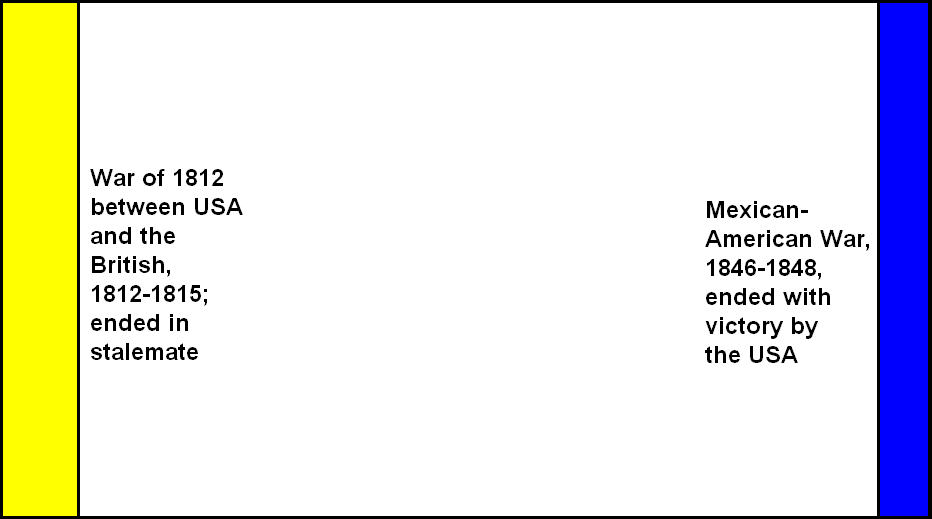
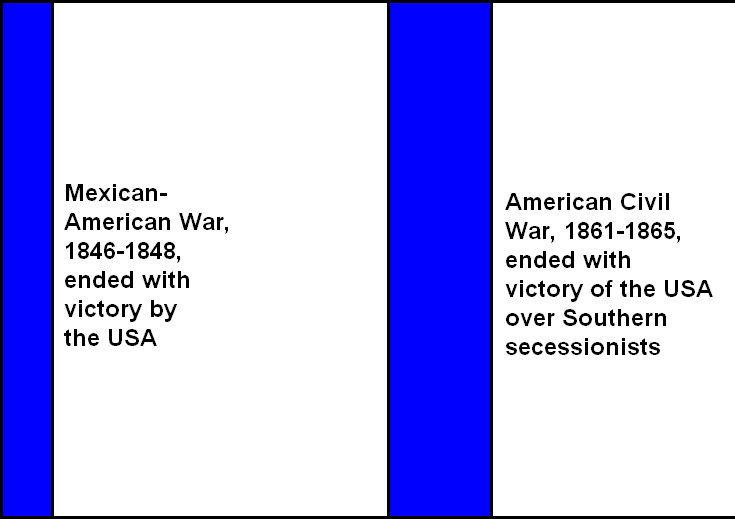
war1Light blue areas are for pre-American involvement in wars which ultimately ended in some form of victory for the USA, with dark blue areas representing American involvement in wars that ended in a victory for the side containing the United States, alone or with allies.

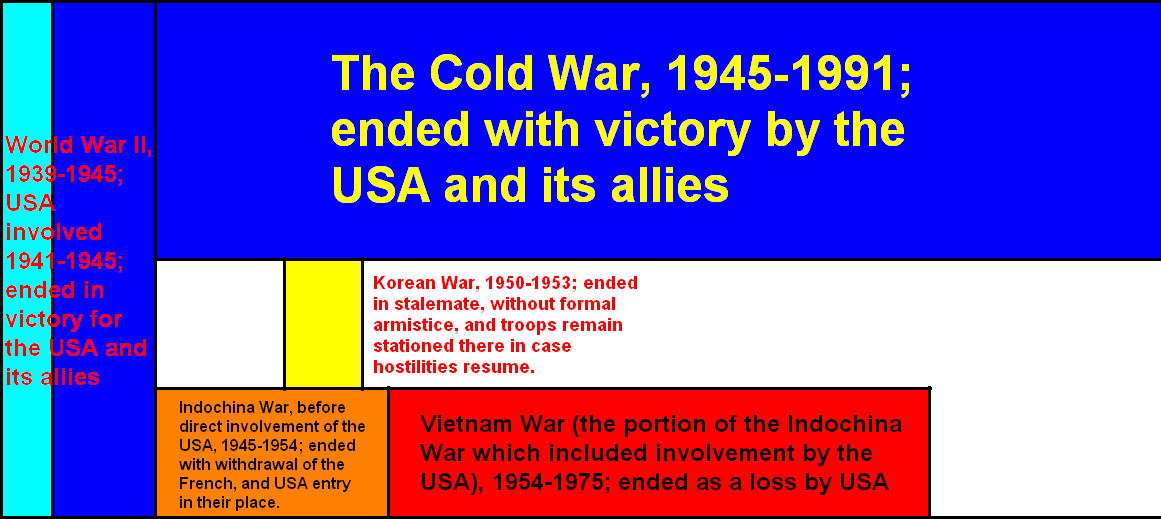
Each new part of this timeline contains the end of the previous one, and all wartimes within a single portion of this timeline are shown to scale. The white areas represent periods of peacetime, and are also shown to scale. Yellow wars are those that ended in stalemates, or conditions that could simply be called a tie.

war2war3war4war5

war6Beginning in 1945, things get complicated, with an ideological war (the Cold War) occasionally turning “hot,” as it did in Korea and Vietnam. A similar “it’s complicated” situation appears later, during the ongoing War on Terror. Also, the Vietnam War makes two new colors needed:  orange, for pre-USA-involvement in wars that ultimately lead to a defeat for the USA, and red, for the period leading up to a loss for the USA which actually involved American personnel.

war7

When the Soviet Union fell in 1991, ending the Cold War, some actually wrote of “the end of history,” as if the world had suddenly became uncomplicated. Subsequent events proved this idea to be premature.

war8

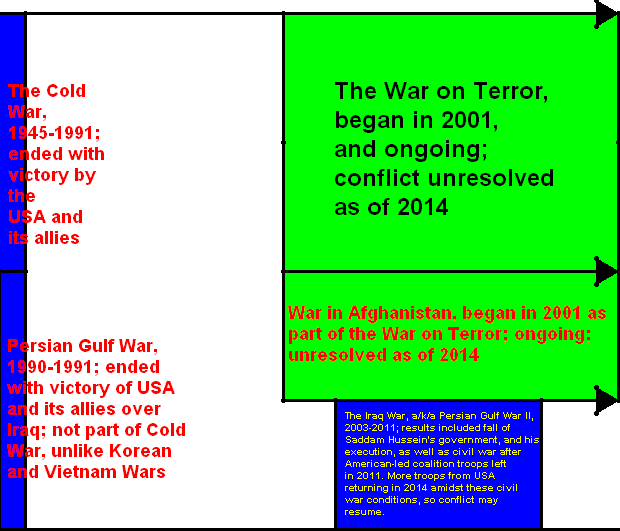
Since the War on Terror, as well as its component in Afghanistan, is unresolved as of now (2014), a new color, green, is used here for ongoing conflicts.

war9

Finally, it should be pointed out that the administration of George W. Bush tried to sell, to the American public and others, the idea that the 2003-2011 Iraq War was part of the War on Terror. Many Americans, however, myself included, do not accept this rationale, for no connection has been established between Iraq, on the one hand, and the 11 September 2001 terrorist attacks against multiple targets in the USA, on the other.

This Space Station for Geometricians Has, as Outer Hulls, Twelve Trapezoids, and Six Parallelograms with One Square Window / Docking Port Each

12 Trapezoids -- and six parallelograms with square windowsl

I can’t think of any good reasons for geometricans not to have their own space station, and I know what we’d do there:  we’d work on geometry (also known informally as “playing with shapes”).

My suggestion for this space station’s design was created with Stella 4d, and you may find that program (to try or guy) here:  http://www.software3d.com/Stella.php.