About RobertLovesPi

I go by RobertLovesPi on-line, and am interested in many things, a large portion of which are geometrical. Welcome to my little slice of the Internet. The viewpoints and opinions expressed on this website are my own. They should not be confused with those of my employer, nor any other organization, nor institution, of any kind.

The Joy of Rediscovery

Even if you are not the first to find something, the thrill of finding it independently is still every bit as real.

So, this morning, as I often do, I’m playing with triangles.  I constructed a triangle’s incircle, using its three angle bisectors. I also constructed the perpendicular bisector of each side, in order to construct the circumcircle.

What I didn’t expect was to find each angle bisector intersecting a perpendicular bisector on the circumcircle. The three such points of intersection (N, O, P) are the  vertices of the yellow triangle below, while the original triangle, ABC, is in bold black.

Image

“Hey, that’s pretty cool,” I thought, using Geometer’s Sketchpad to move A B, and C around, to test what I was seeing. This was certainly no proof, but now I was wondering if it was an original discovery. Google, however, revealed to me that this discovery had already been made:

http://demonstrations.wolfram.com/TheIntersectionOfAnAngleBisectorAndAPerpendicularBisector/

Well, I could be upset that someone else beat me to this discovery, I suppose, but I think I’d rather take comfort in knowing someone else has already written the proof, for I really don’t feel up to that.

At least not today.

And there is joy in rediscovery. As much as in discovery? Well, no, of course not, but life can be such that no joy should be overlooked. When you know something, and no one taught it to you, but you found it out yourself, does that not make you happy? It certainly works for me.

Link

A Gallery of Polyhedra

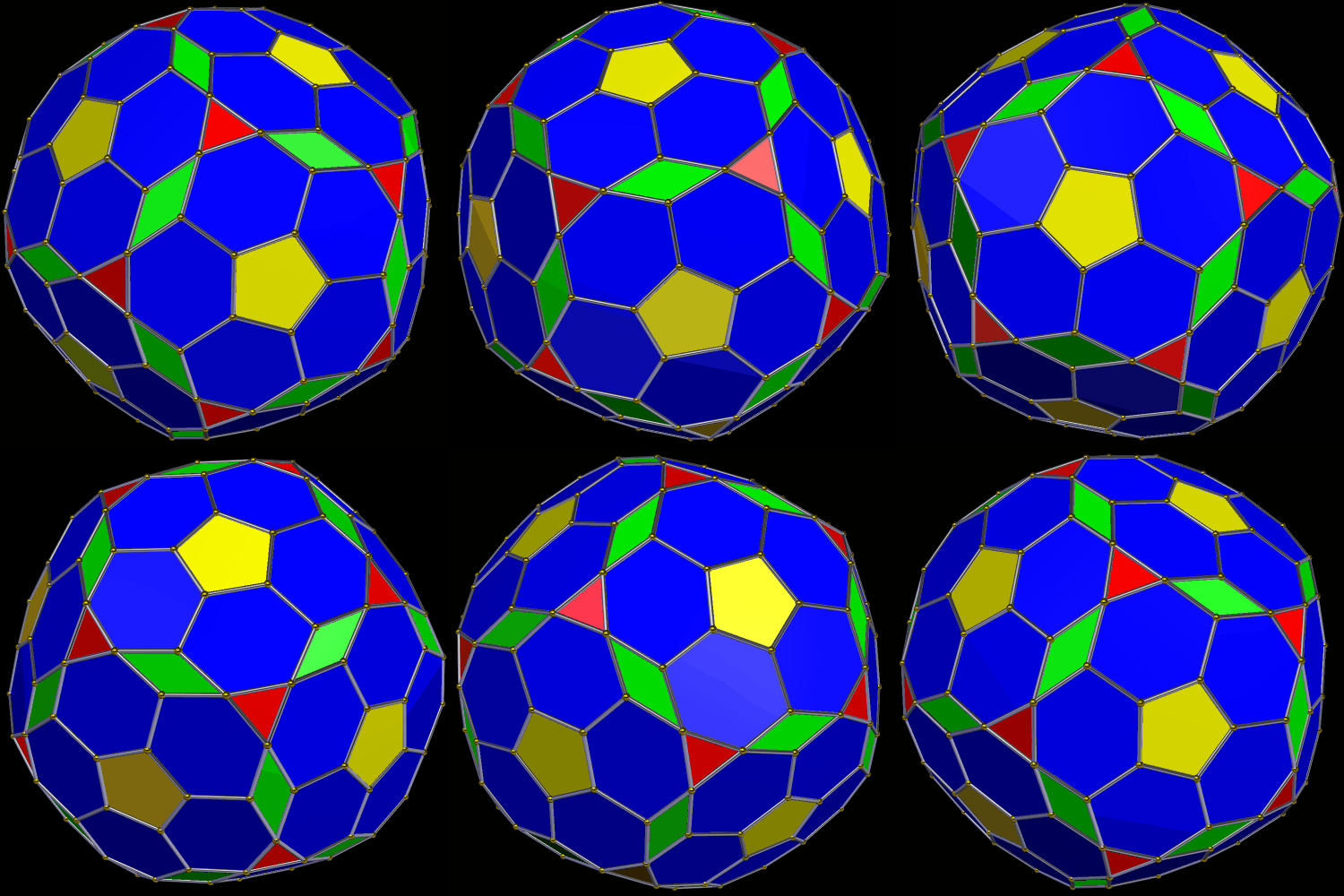
Now that the latest version of Stella 4d allows users to make rotating .gifs, I post those here (see the last post for an example). However, before I started blogging on WordPress, I made a blog on Tumblr with many still images produced using earlier versions of Stella. Here is an example:

Convex hull

The link above is to that blog’s archive — just click on any small pic there to make it larger. Unlike other Tumblr-blogs of mine, this one has no reblogged material — it was the banality of reblogging, you see, that drove me from Tumblr in the first place.

Info on getting/trying Stella 4d for yourself:  www.software3d.com/stella.php

How I Found the Nagel Line While Playing with Triangles

Several days recently swirled down the drain in a depression-spiral. Needing a way out, I spent my Saturday morning playing with triangles, after first getting plenty of sleep. It worked. This technique, however, probably would not transfer to those who are not geometry obsessives. Perhaps any favorite activity would work? I leave that to others to explore.

Here’s what I did that worked for me:

ImageThe original triangle is ABC, and is in bold black. The bold blue line is its Euler Line, and contains the orthocenter (M), circumcenter (G), nine-point center (K), and centroid (point W). It does not, however, contain the incenter (S).

It struck me as odd that the incenter would be different in this way, so I investigated it further. It is the point of concurrence of the three angle bisectors of a triangle. On a lark, I constructed the midsegments of triangle ABC, forming a new, smaller triangle, shown in red. When I then found the incenter of this smaller triangle (Z), it appeared to be collinear with S and W. I checked; it was, and this line is shown in bold yellow. Moreover, the process could be continued with even smaller midsegment-triangle incenters, and they were also on this yellow line.

I wondered if I had discovered something new, and started to check. It didn’t take long to find out that Nagel had beaten me to it. The Nagel line is the official name of this yellow line I stumbled upon, and here is my source:  http://mathworld.wolfram.com/NagelLine.html — but, as far as I know, I did discover that these midsegment-derived points also lie on the Nagel line.

Someone else may have known this before, of coruse. I don’t know, and it doesn’t matter to me, for I had my fun morning playing with triangles, and now feel better than I have in days.

[Side note:  this is my 100th post, and I’d like to thank all my readers and followers, and also thank, especially, those who encouraged me to try WordPress to get a fresh start after Tumblr-burnout. It worked!]


“We Only Come Out at Night”

Video

This is a cover of a Smashing Pumpkins song, performed by Murder By Death. The only thing I did was assemble the video, and create crude (but hopefully funny) visuals to go with the song.

The Two Simplest Polychora

The most familiar polychoron, to those who have heard of any of them, is the hypercube, or tesseract. It is analogous to the cube, but in four dimensions. All polychora are four-dimensional. With numbers of spatial dimensions above four, only the term “polytope” is used. Polyhedra are 3-polytopes, and polychora are 4-polytopes.

This is a three-dimensional projection of a tesseract, as it rotates in hyperspace, casting a “shadow” into our space:

Image

In three dimensions, a cube is not the simplest polyhedron. A tetrahedron (a regular triangle-based pyramid) is simpler.

The simplest polychoron is composed of five tetrahedral cells, and is analogous to the tetrahedron, but in hyperspace. Here is a rotating “hypertetrahedron.”

Image

There are even more names for these two polychora, based on the number of cells (cubes or tetrahedra). The tesseract/hypercube is composed of eight cubes, so it is called the 8-cell, as well as the octachoron. The preferred names for the hypertetrahedron are the 5-cell and the pentachoron, as it is composed of five (tetrahedral) cells.

Just as there are other Platonic solids not mentioned here, there are other regular polychora as well. The others will be subjects of upcoming posts, and one has already appeared here once (the 120-cell, or hyperdodecahedron), just three posts back.

Software note:  these .gifs were made using Stella 4d, which may be purchased, and/or tried for free (on a trial basis), at http://www.software3d.com/Stella.php.